Pan Innovation House Pan Innovation House
INDUSTRY SOFTWARE · YARN SPINNING MILL

Spinning mill software that records every kilogram of yarn, from bale to pallet and from laydown to lot

Pan Enterprise Solutions, the software arm of Pan Innovation House · based in Gaziantep, Türkiye, with a London office

For cotton ring and open-end mills, synthetic filament and textured lines, PP/BCF carpet yarn and twisting plants, we bring bale HVI results, laydown plans, spindle and rotor efficiency, end breaks, quality testing, lot release, pallet labels, kWh/kg energy and cost per kg into one chain of records. Your ERP and your machine suppliers’ systems stay; we build the missing links beside them.

Asking about price? We listen to the scope in a short call and share the budget frame and timeline in writing. The first 30-minute call is free; the scope of an on-site discovery, and its fee if any, is agreed in writing during that call.

We work on site for plants in and around Gaziantep; elsewhere in Türkiye and abroad, discovery starts by video call and a visit is planned if needed. Our London office is at Unit 6 Cranford Way, Hornsey, London N8 9DG.

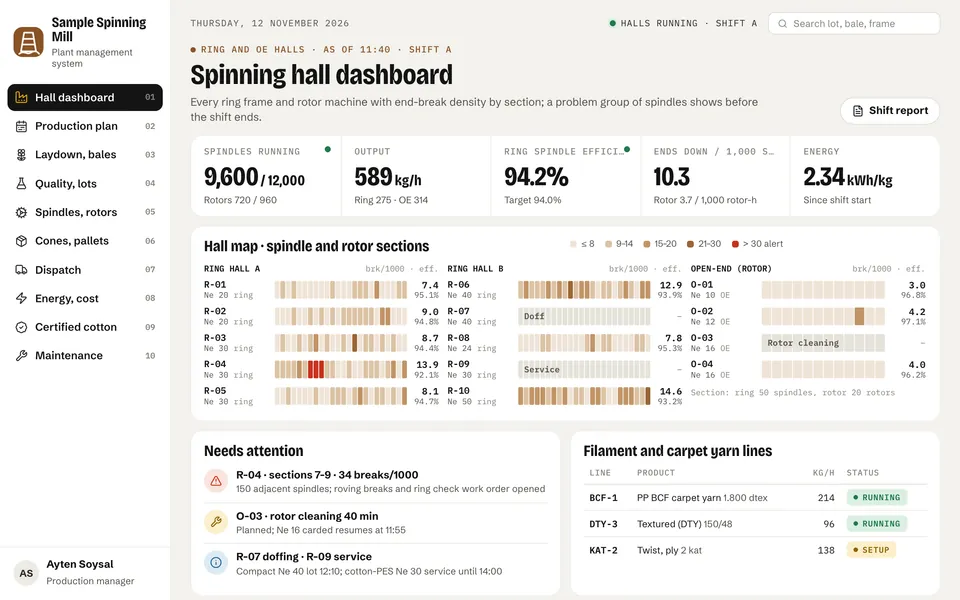
Spinning mill hall dashboard: section-by-section end-break map of ten ring frames and four rotor machines, spindle efficiency, alerts and a table of filament lines
$2.2 billion Yarn exports reached $2.207 billion in 2025, and Türkiye ranks fourth in world yarn exports (İTHİB and İTKİB data). At that volume, lot and quality records are a competitive matter.
5 screens Hall dashboard, laydown and bale HVI, quality and lot release, cone and pallet label with dispatch, and energy and cost can be seen on this page with illustrative data.
Without touching your machines Ring, rotor and filament machines, yarn clearers and laboratory instruments stay as they are; the data route depends on the instrument and version and is settled during discovery.
Scope set in discovery Most mills start with bale, laydown and lot records; the hall dashboard, quality, energy and certificate chain are added later.

This page is a branch of Textile and Apparel Manufacturing software; the wider picture and the other branches are there.

Does this sound familiar?

In a spinning mill, loss disappears in the links from bale to lot and from lot to the customer’s specification.

If the table below describes a ring, open-end, filament or carpet yarn plant, this page was written for you. The numbers come from sourced data; PAN makes no claim about customer counts or success rates.

  • The fibre-related cause of barré is uncontrolled micronaire and colour between laydowns. Yet a bale’s HVI result often stays in a separate list while the laydown is built from experience; how far a laydown drifts from the previous one shows up only in the dyehouse, on the fabric.
  • An HVI result comes with fields that belong to the bale: micronaire, length, strength, uniformity, Rd and +b. In the US CCC schedule micronaire earns a premium at 3.7-4.2 and a discount from 5.0; in HVI strength 26-28 g/tex is average and 31 and above is very strong. That information stays on the bale and does not travel to the laydown sheet or the lot.
  • On a ring frame breaks are not random; repeated breaks often concentrate in a few spindles. Machine suppliers’ systems watch every spindle but only on their own machines; with ring, compact and rotor machines from different makers, the shift supervisor looks at three screens and the report arrives at the end of the shift.
  • Yarn count, twist, composition and lot are written separately for each customer specification. The same Ne 30 combed carries different CVm, neps and hairiness limits for different customers; the limit lives in the order record, the result in the instrument report, and the lot is released without seeing the two side by side.
  • If a lab result is not tied to a release or hold decision, a lot at the limit is palletised and shipped. Neps, thick places or foreign matter (coloured fibre, vegetable matter, polypropylene) turn up later at the customer, and which pallet came from which lot is found in a separate notebook.
  • The certified cotton chain is prone to break in the mill. Better Cotton works by tracking claim units (BCCUs) in mass balance and by declaring a blend percentage in controlled blending; GOTS keeps organic fibre apart so it never mixes with conventional fibre. That distinction is carried by hand to the laydown, lot and pallet claim.
  • Energy is not visible per kilogram. An older Danish Environmental Ministry study gives 2.10 (Ne 16) to 4.51 (Ne 36) kWh/kg for ring yarn and 1.16 to 2.80 kWh/kg for rotor yarn. How many kWh/kg you spend today for which count and which machine comes from meters and production, not from the bill.
  • Türkiye depends on imports for cotton: in 2023/24 it imported 777 thousand tonnes against 777 thousand tonnes of production, with consumption at 1.812 million tonnes. When the cotton price or the exchange rate moves, margin per lot and order is worked out in Excel; quotes and open-order profit are managed by gut feeling.
  • On carpet yarn (BCF) and twisting lines the lot, ply and heat-setting order follow a separate flow. Package dyeing and twisting lots are kept in different records from cotton lots; the link between order, lot and pallet is often just a work order on paper.
  • When a customer asks which bales a lot came from, the answer takes hours. If the chain from the lot number on the pallet label to the laydown, from the laydown to the bales, and from the bales to the HVI result and certificate is not recorded, tracing back means leafing through notebooks.
The software landscape today

Which systems do spinning mills use today, and where do they get stuck?

There are fibre and yarn laboratory instruments, yarn clearers, machine makers’ monitoring systems, textile-specific ERP and general ERP. The link between them, one chain of records from bale to pallet, is missing in most mills.

LayerSoftware in use todayThe gap it leaves
General ERP and accounting (horizontal backbone) Logo (Tiger, GO, Netsis), Mikro, ETA Solid for customers, stock, invoices and e-waybills, and they should stay. Spinning detail such as linking bale HVI to the laydown, the laydown to the lot and the lot to the pallet, spindle-level breaks and kWh/kg usually sits outside these programs, in Excel and notebooks.
Textile-specific ERP and MES Datatex NOW, Enfotek MDS (yarn, weaving, knitting) Datatex offers planning, MES, quality and inventory from fibre to garment; its inventory module tracks lot, batch, container and roll with barcodes, and a yarn producer has chosen NOW and CAMS. Enfotek names a separate MDS product for yarn, weaving and knitting. Spindle and rotor detail on the spinning floor and instrument data still need linking separately.
Fibre and yarn laboratory Uster HVI 1000, Uster Tester 6, Uster Classimat 5, Uster Statistics HVI 1000 measures colour, trash, fineness, length and strength; Tester 6 measures evenness (CVm), imperfections and hairiness; Classimat 5 measures neps, thick and thin places and foreign matter; Uster Statistics is the benchmark. Tying the result to the order specification, lot release and pallet is outside the instrument.
Yarn clearing and ring monitoring Uster Quantum, Uster Sentinel, Loepfe YarnMaster PRISMA, ZENIT+, MillMaster TOP Optical yarn clearers and ring optimisation watch yarn faults and machine performance. Seeing the clearer setting and the cut faults on the same screen as the order, the customer specification and the lot release decision is built separately.
Ring machine maker’s system Rieter ISM premium, ESSENTIALmonitor (Rieter Digital Spinning Suite) ISM premium monitors the running of every spindle; ESSENTIALmonitor analyses end breaks and cops and gives transparency on quality, production and energy data. It covers only that maker’s machines; a combined board with rotor, filament and ERP is built separately.
Rotor machine maker’s system Saurer Senses (Shop Floor, Data Transfer, Maintenance, Workforce, Recipe) Digital service and shop floor tools for Saurer’s rotor machines. Strong inside its own machine family; a mixed machine park, the laydown and lot chain and the customer specification are outside its scope.
Filament and BCF line makers Barmag (BCF S8, BCF S+, eFK, FDY, POY) Barmag’s product menu lists POY/HOY, FDY, DTY (eFK) and BCF lines. Flow after the line, such as twisting, heat setting, package-dyed lots and dispatch to the carpet maker, usually runs in separate records outside the line systems.

Product names are compiled from vendors' public pages (September 2026); PAN is not affiliated with them. The "gap" column summarises situations we commonly meet in discovery and is not a statement about any specific product.

Our approach

A lot layer that closes the gap between machine data, the laboratory and the ERP.

We do not bring your mill a second ERP or machine monitoring system. We build the chain of records from bale to dispatch; your ERP, your machines’ own systems and your laboratory instruments stay as they are, and we fill the missing links between them.

Bales, HVI and laydown plan

Each bale is recorded with its micronaire, length, strength, uniformity, Rd and +b result and its certificate. The laydown plan shows take-off order, group mean and the difference from the previous laydown; the limit is your own laydown rule. Organic (GOTS) bales are kept apart and do not enter the laydown.

Hall dashboard: spindles, rotors, breaks

Ring and rotor machines appear on one map with end-break density by section. Spindle efficiency, kg/h, breaks per 1,000 spindle-hours and downtime reasons are entered at once; a maintenance work order opens for a group of spindles with repeated breaks.

Quality testing and lot release

CVm, thin and thick places, neps, hairiness, tenacity and foreign matter results sit next to the customer’s specification. A lot that fails is put on hold; no pallet label is printed and it waits in the dispatch plan.

Lot chain and traceback

Bale, laydown, frame, lot, pallet and dispatch are tied in one chain. From the lot number on a pallet label you reach the bales and their HVI results, the certificate claim and the customer in seconds.

Cones, pallet label and dispatch

The pallet label prints with cone, carton and pallet counts, net kg, yarn count, twist direction and number, certificate claim and barcode. Packing list, waybill and lot certificate come from pallet records; export paperwork sits in the same record.

Energy, cost and certified cotton

kWh/kg is calculated by department and cost per kg by product; when cotton or power prices change, the margin effect shows. Better Cotton and GOTS claims are tied to the laydown and lot, and document records are kept for the retention period.

Modules we can build

Modules we can build for a spinning mill

You do not need all of them at once. Most mills start with bale, laydown and lot records; the hall dashboard, quality, energy and certificates come later.

LAYDOWN

Laydown plan and barré prevention

Take-off order, laydown mean, micronaire and colour difference from the previous laydown, the mill’s own laydown rule and approval.

BREAKS

Break analysis and maintenance

End-break map by section, spindle groups with repeated breaks, planned cleaning and maintenance work orders.

LOT

Lot chain and traceback

Tracing back and forward from bale to pallet; on a complaint, one query reaches the bale, laydown and frame records of the lot.

CERTIFICATE

Certified cotton chain

BCCUs and chain model for Better Cotton, a separate laydown and transaction certificate for GOTS; lot and pallet claims.

What it looks like on screen

What spinning mill software looks like on screen

These screens come from the demo design we prepared for spinning mills. The figures are sample data; the system is set up around your own machines, yarn counts and customer specifications.

Hall dashboard. Every section of every ring and open-end machine is coloured by end-break density, with spindle efficiency, kg/h and kWh/kg beside it. Filament and carpet yarn lines show on the same board.
Laydown and bale HVI. Each bale’s micronaire, length, strength, uniformity and colour (Rd, +b) are matched before it enters the laydown. The blend is compared with the previous one, and certified cotton groups are tracked separately.
Quality and lot release. Evenness (CVm), thin and thick places, neps, hairiness, tenacity and foreign fibre results sit next to the customer’s specification. A lot that fails is put on hold, and no pallet label is printed.
Cone, pallet and dispatch. The pallet label carries lot, laydown, twist, cone count, net kg and certificate claim. The barcode opens the chain back to the bale, and a pallet from a lot on hold waits in the dispatch plan.
Energy and cost. kWh/kg is tracked by department and shift; cotton, energy, labour and waste become a TL/kg cost per product. When cotton or power prices change, the margin effect shows at once.

Company names, people and figures on these screens are sample data. The system is built around your own processes, document names and rules. We walk you through the demo in a call: request a demo

Integration with your existing ERP

Your ERP, machines and laboratory instruments stay where they are.

Spinning mills usually already have three solid systems: an accounting and e-document program, the machine makers’ own monitoring systems, and laboratory and yarn clearer instruments. PAN does not replace them; it builds the missing links between them, the chain of laydown, lot, pallet and customer specification.

Our integration approach →
  • Customer, stock, order, waybill and invoice exchange with Logo, Mikro, ETA or the ERP you use; double entry disappears. Accounting and official documents stay in your current program.
  • Results from HVI, evenness and strength instruments are taken by file, database or manual entry; the route depends on the instrument and version and is settled in discovery. The result matches bale, laydown, lot and customer specification automatically.
  • Spindle efficiency, break and energy data from the ring, rotor and filament machines’ own monitoring systems; the route is set in discovery according to machine make and version.
  • Cone and pallet barcodes with label printers and handheld terminals; scanning at laydown, opening, winding and store points.
  • You choose the server; the data and the code are yours. The system is built around your machines, yarn counts and customer specifications.
Outcomes

What changes on the hall floor and in dispatch once this layer is in place?

  • Every bale’s HVI result enters the laydown plan; the laydown mean is compared with the previous one, so barré risk shows before the dyehouse does.
  • Breaks on ring and rotor machines show by section; a group of spindles with repeated breaks goes to maintenance without waiting for the end of the shift.
  • The customer specification and the test result sit side by side; a lot that fails goes on hold, and pallet and dispatch do not start.
  • On a complaint, tracing from pallet label back to bales takes minutes instead of hours; the lot, laydown and frame records are known.
  • The certified cotton chain is tied to laydown and lot; the Better Cotton claim and the GOTS separation are on record, and the retention period is tracked.
  • The pallet label prints the same way every time, with cone count, net kg, count, twist and certificate claim; handwritten label errors become candidates for decline.
  • kWh/kg is visible by department and product; the yarn counts and machines that use the most energy stand out.
  • When cotton or power prices change, cost per kg and order margin are worked out at once; quotes are given by the numbers, not by instinct.
  • The packing list, waybill and lot certificate come from pallet records; export paperwork is prepared from the same record.
  • Management sees efficiency, quality and cost by shift, machine and lot on one screen, without merging spreadsheets.
Process

A realistic five-stage path that begins with discovery.

  1. 01

    First conversation and screen tour

    1 week

    We listen to how your mill is set up: ring, rotor, filament or BCF lines, yarn counts, customer sectors, which laboratory instruments and which ERP. We walk through the screens on this page together and talk about which one matches something in your mill.

  2. 02

    Discovery at the mill

    1-2 weeks

    We follow the flow from cotton receipt to dispatch on site. We collect your bale list, laydown sheet, shift report, laboratory printouts, pallet label and dispatch documents, and take your field names exactly as they are.

  3. 03

    Scope, priority and budget

    1 week

    We present the module order starting where it hurts most, the integration routes, the timeline and the budget in writing. The first phase is often bale, laydown and lot records.

  4. 04

    Development and pilot

    6-10 weeks

    We deliver modules in turn and try them in real work with one hall and a few customer specifications. The shift supervisor, the laboratory and the store officer use the screen at every delivery; we take corrections from the floor.

  5. 05

    Rollout and support

    Ongoing

    We extend it to all halls, train your team and stay beside you in the first weeks. Afterwards, growing the system for a new machine, a new customer specification or a certificate continues with the same team.

Why Pan Innovation House?

A team that speaks the mill’s language and builds the lot chain on the floor.

You see the screens first

Not promises but demonstrations: all five screens are on this page. The numbers are illustrative; your system is built with your machines and specifications.

We work in the mill’s terms

Laydown, barré, Ne and dtex, twist, breaks per 1,000 spindle-hours, CVm, neps, lot and pallet appear on screen under the names you use; staff do not learn a new language.

In Gaziantep, close to the floor

Our headquarters is in Gaziantep; in the region where yarn, carpet and textile production is dense we do discovery in the mill and work with you on shift. Our London office makes correspondence and paperwork easier for mills with export customers.

We start with discovery

Machine park, yarn counts and customer mix change from mill to mill, so we give scope and budget in writing after discovery and do not quote a number in advance.

We do not touch your existing systems

Your ERP, your machine suppliers’ systems and your laboratory instruments stay where they are; we build the missing links between them. Accounting and official documents stay in your current program.

The data and the code are yours

You choose the server. The system is written for you; we hand over the data and source code without tying them to another platform.

Frequently asked questions

Yarn Spinning Mill software: common questions

What does spinning mill production tracking software do?

It keeps the chain from cotton receipt to dispatch in one record: bale and HVI result, laydown plan, efficiency and breaks on ring and rotor machines, quality testing, lot release, pallet label and dispatch. The real difference is that every pallet’s lot, laydown and bales stay on record.

What does laydown planning software solve?

It matches each bale’s micronaire, length, strength, uniformity and colour (Rd, +b) results with the laydown plan. The laydown mean is compared with the previous laydown, so micronaire and colour drift shows before it turns into barré. The limits are your own laydown rules; we only make them visible.

How does yarn lot traceability work?

Bale, laydown, frame, lot, pallet and dispatch are tied in one chain. Scan the lot number on the pallet label and you see the laydown, the bales, the HVI and test results and the customer shipped to. On a complaint, which pallets are affected comes out in minutes.

Does it work with Uster and similar instruments?

Your laboratory instruments stay where they are. HVI, evenness and strength results are taken by file, database or manual entry; the route depends on the instrument and version and is settled in discovery. The result matches bale, laydown, lot and customer specification and feeds the lot release.

What if we already have Rieter or Saurer machine systems?

They stay. Machine makers’ systems watch their own machines well; we bring spindle efficiency, break and energy data from a mixed park into one board and into the laydown and lot chain. The data route depends on machine make and version and is set in discovery.

How are breaks per 1,000 spindle-hours tracked?

On a ring frame an end-break map is drawn by section, and a maintenance work order opens for a group of spindles with repeated breaks. The break norm varies with yarn count and fibre quality; we set the target together with your own history by machine and count.

Is certified cotton (Better Cotton, GOTS) tracked?

Yes. For Better Cotton the chain model (mass balance, controlled blending, segregation) and claim quantity are recorded; for GOTS organic fibre is kept in a separate laydown so it never mixes with conventional fibre, and the transaction certificate is tied to the pallet claim.

What does the pallet label carry?

Lot, pallet, laydown, frame, yarn count, composition, twist direction and number, cone and carton counts, net kg, production date, certificate claim, customer, order and barcode.

How are kWh/kg and cost per kg calculated?

Meters and production data give kWh/kg by department; by product, cotton (net of waste income), energy, labour and overheads become a cost per kg. When cotton or power prices change, the margin effect shows at once. The figures on screen are illustrative.

Are filament, carpet yarn (BCF) and twisting lines covered?

Yes. On POY, DTY and PP BCF lines, dtex, lot, ply and twist, heat-setting order and dispatch to the carpet maker are followed in the same system. For the carpet side, see our carpet production software page too.

Our ERP is Logo or Mikro. Do we have to replace it?

No. Accounting, customers, stock and invoices stay. The PAN layer holds the spinning detail (bale, laydown, spindle, lot, pallet) and passes the needed movements to the ERP; double entry disappears.

How long does setup take and what does it cost?

From first conversation to pilot is usually 9-14 weeks; after discovery we give scope, timeline and budget in writing. Because machine park and the number of integrations vary, we do not quote a number in advance.

Where do efficiency and energy data come from?

The machine maker’s monitoring system, meters or manual entry; the route is settled in discovery. Where there is no instrument data we start with end-of-shift entry and move to live data as sensors and meters are added.

Next step

Let’s tour the screens together, then visit your mill

A spinning mill’s system cannot be written remotely. First let’s walk through the screens on this page together; then let’s see your machines, laboratory printouts and pallet label on site. After discovery we give scope, timeline and budget in writing.

Related services

Related areas worth considering

Pan Innovation House

Call us

By phone

+90 543 930 12 72

Our phone line is open every day.

WhatsApp on your phone

Scan with your phone camera. The chat opens with your message ready.

Prefer that we call you? Leave your details