Pan Innovation House Pan Innovation House
INDUSTRY SOFTWARE · APPAREL AND GARMENT MANUFACTURING

Apparel manufacturing software that keeps the count of every piece, from the cutting table to the packing list, on your line and at your subcontractors

Pan Enterprise Solutions, the software arm of Pan Innovation House · based in Gaziantep, Türkiye, with a London office

We bring the style-colour-size order, marker and cutting, the hourly sewing line board, the subcontractor network, AQL final inspection and the packing list into one record chain. Your ERP and accounting system stay where they are, and we do not touch your pattern and marker software; we build the production layer next to them. The screens are on this page; scope is settled in discovery.

Asking about price? We listen to the scope in a short call and share the budget frame and timeline in writing. The first 30-minute call is free; the scope of an on-site discovery, and its fee if any, is agreed in writing during that call.

We work on site for plants in and around Gaziantep; elsewhere in Türkiye and abroad, discovery starts by video call and a visit is planned if needed. Our London office is at Unit 6 Cranford Way, Hornsey, London N8 9DG.

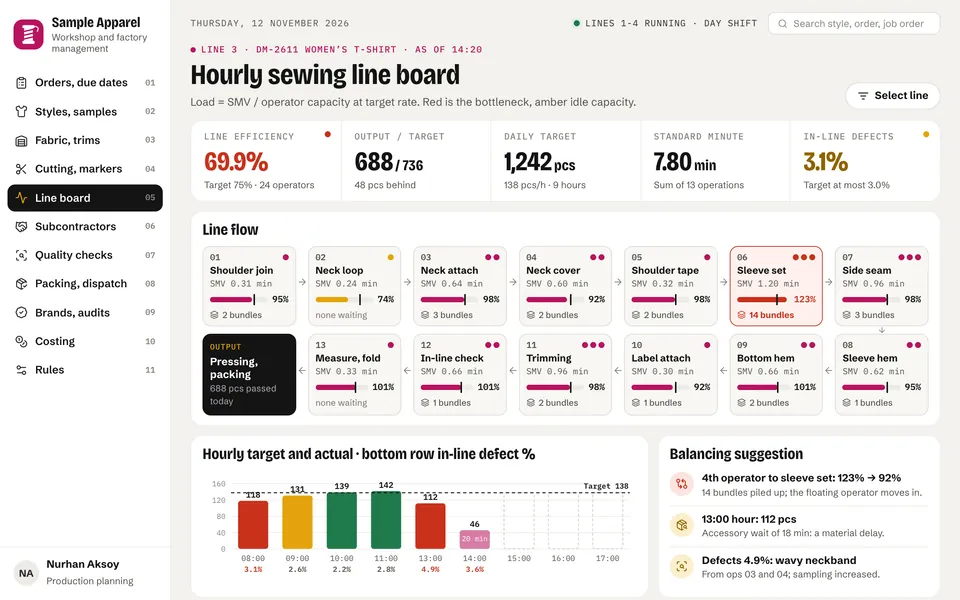
Apparel software hourly line board: 13-operation sewing line flow, station load and waiting bundles, hourly target against actual columns, balancing suggestion
5 screens Hourly line board, cutting and marker plan, order matrix, subcontractor network and final inspection are shown on this page with representative data.
7/10 withholding The Turkish VAT withholding rule for textile and apparel subcontracting is built into reconciliation; the e-dispatch note is prepared before the goods move.
Your ERP untouched Accounts, stock, invoices and e-dispatch notes stay in your current system; the exchange is settled in discovery, by version.
Scope set in discovery Most factories start with the order matrix and subcontractor tracking; cutting and line modules are added later.

This page is a branch of Textile and Apparel Manufacturing software; the wider picture and the other branches are there.

Does this sound familiar?

In apparel, money disappears into fabric and into waiting, and both usually stay out of the ledger.

If the list below describes a garment workshop or an apparel factory you know, this page was written for you. The figures come from academic studies and official documents; they are not PAN customer results.

  • Fabric is about half of the cost of a garment or more: one knitwear study puts it near 50% or above, another study on trousers 50-60%. Even so, marker efficiency and fabric loss are often learned after the job, when the fabric invoice is laid next to the cutting ticket.
  • The same patterns turn into different metres and different second-quality cost when the fabric width changes: in a knitwear study at 145, 165 and 170 cm, unit second-quality cost fell for every style as width rose. The efficiency percentage in the marker program is rarely tied to fabric purchasing, the cutting order and the order's cost.
  • If a roll's label metres, measured metres, usable width and 4-point score are not recorded before cutting, fabric defects surface after cutting, at the most expensive stage. A trouser maker that moved to 4-point checks before cutting cut fabric-related defective garments by 90%.
  • Standard minutes on the sewing line are often estimates: in one T-shirt study a firm's Excel times with a 15% allowance differed by up to 30 seconds from a measured-time system. Measured line efficiencies ran at 57-75% against a 75% target.
  • The bottleneck is found at the end of the shift. Which station has bundles piling up, which operation sits idle, which hour dropped, all of it stays on paper tally sheets or an evening list; by the time it is fixed the day is over.
  • The order is split into a style-colour-size matrix, but cutting, sewing and packing run in separate notebooks. A broken size run shows up on the last day, and the same fabric lot may no longer be available for the extra cut.
  • Cut pieces sent out, pieces returned, second quality, shortages and goods still at the workshop sit in WhatsApp messages, dispatch slips and a notebook. At month-end reconciliation, who received which quantity becomes an argument.
  • VAT withholding on textile and apparel subcontracting is 7/10, and the e-dispatch note must be issued before the goods physically move, cannot be back-dated, and the reply period cannot exceed 7 days. If these are not kept in the same record as the job order, accounting and the subcontracting clerk key the same data twice.
  • A brand can require every facility from yarn to finished garment to be disclosed for each order, and run unannounced traceability audits; social compliance audits and fibre composition labels are also checked before shipment. If this is not checked when a workshop is assigned, the problem surfaces after delivery.
  • In final inspection the sample size, the critical-major-minor defect count and the decision stay on paper. When the packing list and the e-dispatch note are prepared separately for the same lot, carton counts, size totals and the dispatch note do not match.
  • The sector is shrinking: apparel exports fell 6.3% in 2025 to 16.77 billion dollars. In this climate, waste, line efficiency and due-date slippage decide whether an order leaves a profit or a loss.
The software landscape today

Which software do apparel manufacturers use today, and where does it fall short?

There is mature software for patterns, markers and standard minutes, local and foreign ERP products, and brand audit platforms. The gap sits between them: cutting orders, the hourly line, the subcontractor network and final inspection records. Only product names described on their own pages are listed below; we do not assume a feature is missing from a product just because its public page does not describe it.

LayerSoftware in use todayThe gap it leaves
General ERP and accounting (the horizontal backbone) Logo (Tiger, GO, Netsis), Mikro, Nebim V3, ETA, canias ERP Solid for accounts, stock, invoices and e-dispatch notes, and they should stay. The style-colour-size matrix, cutting order, hourly line and subcontractor reconciliation are often kept outside these programs, in Excel and notebooks.
Textile and apparel ERP Login ERP, True ERP, Enfotek EDS; canias ERP partner Trendsoft (apparel ERP offering) Their own pages describe colour-size variant matrices, style-colour-size-ratio and subcontracting processes, subcontracting cost and subcontractor scorecards. Cutting planning, markers and an hourly line board are not separately described on those pages; whether they fit your business is seen in a demo.
Patterns, markers and cutting (CAD/CAM) Lectra (Gerber AccuMark, Vector Fashion), Optitex Marker, Audaces Marker Strong for patterns, size grading and automatic markers, with marker efficiency and fabric consumption reports. The link between measured metres at spreading, plies and end loss and the order's cost remains a separate recording need.
Standard minutes and costing Coats Digital GSDCost Builds standard minute values per operation from 39 motion codes and is used in line balancing and costing. Hourly actuals, bundles waiting at each station and in-line defects are separate data from the floor.
Brand programmes and audit platforms amfori BSCI, Sedex (SMETA), Open Supply Hub, brands' own supplier portals SMETA is Sedex's audit method; independent audit firms carry it out and it gives no pass or fail. amfori BSCI grades from A to E. Audit status and facility disclosure are often not linked to the order and the subcontract assignment.
Excel, paper forms and messaging Excel, paper job orders and dispatch slips, WhatsApp Steps in wherever software stops: cutting tickets, line tallies, the subcontract ledger and reconciliation often live here. Flexible, but nobody checks that quantities and times add up.

Product names are compiled from vendors' public pages (September 2026); PAN is not affiliated with them. The "gap" column summarises situations we commonly meet in discovery and is not a statement about any specific product.

Our approach

A production layer that closes the gap between the pattern program and accounting.

We do not bring a second accounting program or a new pattern program into your workshop. We build the record chain from order to packing list and connect it to your ERP, your marker program and your e-document system. The system does the arithmetic; the line supervisor, the cutter, the subcontracting clerk and management make the decisions.

Style-colour-size matrix and due dates

The order sits in one matrix: style, colour, size ratio and quantity. Each cell shows ordered, cut and sewn pieces; an incomplete size is flagged on cutting day and an extra cut is suggested. Due dates and days left sit beside the order list.

Marker plan and spreading record

Marker options by size ratio, fabric width and plies are put side by side in metres of fabric. At spreading, roll-level label and measured metres, usable width, 4-point score and shade group are tied to the cutting order; end loss and leftover rolls are recorded.

Hourly line board

Operation sequence, standard minute, operators and station load are drawn as one flow. Each hour's target and actual, in-line defects and bundles waiting at each station sit beside it; the bottleneck is visible from the morning and line efficiency is calculated from records.

Subcontractor network and reconciliation

Every subcontract job order tracks pieces sent, returned, second quality, short and still at the workshop. The reconciliation statement comes from unit price, second quality and shortage deductions; facility disclosure and audit status are checked when a workshop is assigned.

Final inspection, packing list and shipping gate

Sample size and acceptance-rejection numbers come from lot size; critical, major and minor defects are counted. Measurements, needle detector, fibre composition label, facility disclosure and audit status are gathered at the shipping gate; the packing list and e-dispatch note come from the same record.

Bridge to your ERP and marker program

Accounts, stock, invoices and e-dispatch notes stay in your ERP; the system passes order, subcontract and shipment data to it. Length, width and efficiency are read from your marker program. The exchange is settled in discovery, by program and version.

Modules we can build

Modules we can build for apparel manufacturing

You do not need all of them at once. Most factories start with the order matrix and subcontractor tracking, and cutting and the line follow. The five screens on this page are representative views of the modules.

ORDERS

Orders, styles and size matrix

Style-colour-size-quantity, size ratio, due date, label and carton instructions; cut and sewn pieces per cell, broken size warnings, customer and due date views.

CUTTING

Marker plan and spreading record

Marker options compared in metres of fabric, plies, end allowance, roll-level measured metres, usable width, 4-point score, shade group and the cutting order.

SAM

Standard minutes and operation bulletin

Operation list and standard minutes per style; transfer from your existing standard minute program, or versioned storage of the firm's own times.

QUALITY

In-line and final inspection (AQL)

Defects recorded on the line, measurement checks, AQL lot and sample calculation, critical-major-minor counts, decision, photo evidence and second-quality tracking.

BRAND

Brand, facility disclosure and audit tracking

Facility list tied to the order, whether a workshop has been disclosed, validity date of its social compliance audit, fibre composition label check.

What it looks like on screen

What apparel manufacturing software looks like on screen

These screens are sample designs we prepared for apparel and garment manufacturers. The figures are representative; the system is set up around your own styles, sewing lines, subcontractor network and customer specifications.

Hourly line board. The sewing line’s operation sequence, each station’s load against its standard minute and the bundles waiting in front of it, in one drawing. Hourly target against actual and in-line defects beside it; the bottleneck is visible from the morning and line efficiency comes from records, not guesses.
Cutting and marker plan. Puts marker options side by side in metres of fabric by size ratio, fabric width and plies; roll-level measured metres, usable width and 4-point scores are tied to the cutting order. Marker efficiency and waste show before cutting, not after the job.
Order matrix. The style’s colour and size split in one matrix; every cell shows ordered, cut and sewn pieces. Incomplete sizes and colours still waiting for fabric are flagged at the cutting stage, with due dates and days left in the order list beside it.
Subcontractor network. The workshop network with pieces sent, returned and still out per job order and size, on one screen. The reconciliation statement is calculated from unit price, second quality and shortage deductions; a warning appears before a job goes to a facility not disclosed to the brand.
Final inspection and packing list. Sample size and acceptance-rejection numbers come from lot size and inspection level, and defects are counted as critical, major and minor. The shipping gate checks measurements, needle detector, label, facility disclosure and audit status; the packing list and e-dispatch note come from the same record.

Company names, people and figures on these screens are sample data. The system is built around your own processes, document names and rules. We walk you through the demo in a call: request a demo

Integration with your existing ERP

Your ERP and your marker program stay where they are.

Apparel manufacturers usually already have three solid systems: accounting and e-document software, a pattern and marker program, and brand portals. What is missing is the flow between them: order matrix, cutting order, line, subcontractor network, final inspection and packing list. We build that layer and set up data exchange with all three. Accounting and official documents stay in your current program; on the floor there is one record, not a second keying.

Our integration approach →
  • Transfer of accounts, stock, orders, subcontract invoices and dispatch notes with Logo, Mikro, Netsis, Nebim V3, ETA, canias or whichever ERP you use; double entry goes away.
  • Reading marker length, width, efficiency and fabric consumption from your pattern and marker program (for example Lectra, Optitex, Audaces); the file format is settled in discovery, by program and version.
  • e-Invoices and e-dispatch notes are issued in your existing e-document integrator; the system prepares the dispatch note draft from the subcontract or shipment job order and reminds you to issue it before the goods move.
  • Bundle and carton barcode scanning, end-of-line quantity entry and in-line inspection records on tablets, handhelds or phones; devices are chosen in discovery.
  • Document storage and validity tracking for social compliance audit reports and brand facility lists; entering data into a brand's portal is done by hand or file, depending on the brand's system.
Outcomes

What changes in the workshop and at the subcontractors once this layer is in place?

  • Marker options are compared in metres of fabric before cutting; the efficiency percentage is tied to fabric purchasing and to the order's cost.
  • A roll's label and measured metres, usable width and 4-point score are tied to the cutting order; metre differences and narrow width show before cutting, not after.
  • The bottleneck is visible without waiting for the end of the shift: which station has bundles piling up, which operation is idle, which hour dropped.
  • Line efficiency is calculated from pieces produced and standard minutes, not estimated; target and actual sit on the same board.
  • Incomplete sizes and colours still waiting for fabric are flagged on cutting day; the extra cut does not wait until the last day.
  • Pieces sent, returned and still out are in one table by job order and size; month-end reconciliation is calculated without paging through notebooks.
  • Facility disclosure and audit status are checked at the moment of subcontract assignment; a brand requirement is caught before delivery, not after.
  • The withholding rule on the subcontract invoice and the e-dispatch note preparation before shipment come out of the job order; accounting does not retype the same data.
  • In final inspection the sample size, defect count and decision are recorded; the packing list and e-dispatch note come from the same carton record, so the numbers match.
  • Management sees the real cost per order, including fabric, subcontracting and waste, while the job is running, not when it ends.
Process

A realistic five-stage path that begins with discovery.

  1. 01

    First conversation and screen walkthrough

    1 week

    We listen to how your business is set up: whether you have your own line or send work out, which customers and audits you have, which ERP and marker program you use. We walk through the screens on this page together and talk about what each one would be in your factory.

  2. 02

    Discovery at the workshop

    1-2 weeks

    We follow the flow from cutting to pressing and packing on site. We collect your order form, cutting ticket, operation bulletin, hourly production sheet, subcontract job orders and reconciliation documents, and take your field names as they are.

  3. 03

    Scope, priority and budget

    1 week

    We present, in writing, the module order starting from where it hurts most, the integration paths, the time and the budget. The first phase is often the order matrix and subcontractor tracking, or the line board.

  4. 04

    Development and pilot

    6-10 weeks

    We deliver the modules in sequence and test them on real work with one line, one style and a few workshops. The line supervisor, the cutter and the subcontracting clerk use the screen at every delivery; we take corrections from the floor.

  5. 05

    Go-live and maintenance

    Ongoing

    After training, data migration and go-live, maintenance and support continue. When a new line, a new customer requirement or a new subcontract workshop arrives, the system grows with you.

Why Pan Innovation House?

A team that speaks the workshop's language and builds the record chain on the floor.

You see the screens first

Show, not tell: the line board, marker plan, order matrix, subcontractor network and final inspection screens are on this page. The figures are representative; your system is built around your styles, lines and rules.

We use the workshop's terms

Marker, size ratio, numbering, bundle, SAM, bottleneck, in-line check, AQL, pressing and packing, packing list and payable appear on screen under the names you use; staff do not learn a new language.

Regulation and specifications become rules

The subcontract withholding rate, e-dispatch steps, AQL tables and the customer's measurement tolerance are entered as rule tables; when a rule changes the table is updated and the software is not rewritten.

Your ERP and marker program stay

We do not rip out working systems; we close the gap between them. That keeps switching risk low and the first benefit early.

Headquartered in Gaziantep, on site when needed

We are based in Gaziantep and have an office in London. We travel to workshops in Gaziantep and manufacturers in other Turkish cities for discovery and run the pilot on site; screens and reports for export customers can be prepared in English when needed.

The data and the code are yours

You choose the server; the data and the code written for you are yours. The system keeps running even after a maintenance contract ends.

Frequently asked questions

Apparel and Garment Manufacturing software: common questions

What does apparel production tracking software do?

It keeps the order's style-colour-size matrix, the cutting order, line production, goods at subcontract workshops, quality control and shipping in one record chain. The real difference is that cut, sewn, at-subcontractor and shipped quantities appear on the same order line, so defects and delays are noticed during the work, not at month-end.

How is marker efficiency calculated, and what should the target be?

Marker efficiency is total pattern area divided by marker area, where marker area is marker width times length. In one academic study the apparel plant examined had a target of 80% and measured 78.3-79.9%. The right target depends on fabric, style, fabric width and size ratio, which is why the board compares options in metres of fabric.

What is a standard minute (SAM or SMV), and how is line efficiency calculated?

A standard minute is the standard time for one garment or one operation. Line efficiency is pieces produced times the standard minute, divided by operators times minutes worked. For example, if 24 operators work 320 minutes and produce 688 pieces of a 7.80-minute style, efficiency is about 69.9%. The target and the working time are your firm's rules; the system calculates from records.

What is line balancing, and how does it show on the board?

Line balancing is allocating sewing operations to operators according to standard minutes; an overloaded station builds a pile of bundles in front of it and an underloaded one sits idle. For each station the board shows the standard minute, operators, load percentage and bundles waiting; a station loaded above target is marked as the bottleneck with an operator-move suggestion beside it.

What does subcontractor tracking software follow?

It follows the subcontract job order, the workshop, the operation, pieces sent, returned first and second quality, short and still at the workshop, the due date and the unit price. From these it calculates loss, the workshop scorecard and the payable. Facility disclosure and audit status are checked when a workshop is assigned, and e-dispatch status shows next to the job order.

How does VAT withholding work on subcontracting in Turkey?

For textile and apparel subcontracting, the VAT withholding rate has been 7/10 since 1 March 2021. The main raw material must come from the party ordering the work; if the subcontractor supplies the dye and chemicals itself, the job may fall outside the scope. The communique mentions transactions above 2,000 TL including VAT. The system ties the rule to the job order; for your accounting decision, consult your accountant.

Is an e-dispatch note required when sending goods to a subcontractor?

If you are an e-dispatch taxpayer, yes. The document is issued before the goods physically move, cannot be back-dated, and the recipient's reply period cannot exceed 7 days. The tax authority's guide describes sample and subcontracting processes separately. The gross sales threshold and the transition date depend on your company; the system only talks to your existing e-document integrator, where the dispatch note is issued.

What is AQL, and how many samples are taken?

AQL is the acceptable quality level; under the ISO 2859-1 sampling tables, lot size and inspection level give the sample size and the acceptance and rejection numbers. At general level II, a lot of 3,201-10,000 pieces has code letter L and a sample of 200; at AQL 2.5 up to 10 major-defect pieces are accepted, and at AQL 4.0 up to 14 minor-defect pieces. Your customer may require a different level and AQL; the system keeps this as a customer rule.

What are the style-colour-size matrix and the size ratio for?

The size ratio is the proportion of sizes in a set (for example XS 1, S 2, M 3, L 2, XL 1). The order matrix multiplies this ratio by the colours and gives the ordered quantity for each cell, with cut and sewn pieces beside it. So a size cut short, a colour whose fabric has not arrived, or a set that does not match at packing shows up early.

How do brand facility disclosure and social compliance audits appear in the software?

A list of facilities disclosed to the brand is kept for the order; when a subcontract job order is opened, the workshop is checked against this list. The validity date of a social compliance audit report (for example SMETA or amfori BSCI) is tracked on the workshop card. Which audit a brand accepts depends on the brand's requirements; the system keeps the requirement as a rule and does not perform the audit.

Do I have to replace my ERP or my marker program?

No. Your accounting, e-invoicing, e-dispatch, pattern and marker programs stay. We build the order, cutting, line, subcontracting and final inspection flow between them; we pass data to your ERP and read length, width and efficiency from your marker program. The exchange is settled in discovery, by program and version.

Is it also suitable for a small workshop or a subcontract manufacturer?

Yes, but scope shrinks. A workshop that only receives subcontract work often needs just the job order, quantities in and out, line efficiency and reconciliation; the cutting, marker and brand audit modules may not be needed. The system is built module by module and the first phase is set in discovery according to your business.

How long does setup take, and how is the budget set?

After discovery we give a written time and budget by module order. Depending on scope, the first phase can reach the floor in a few weeks; the pilot runs with one line, one style and a few workshops. The budget depends on the number of modules, integration paths and devices; we do not quote a figure before discovery.

Next step

Let's walk through the screens, then visit your workshop

A garment manufacturer's system cannot be written remotely. First let's go through the screens on this page together; then we will see your line, your cutting room and your subcontractor network on site and propose the first phase in writing.

Related services

Related areas worth considering

Pan Innovation House

Call us

By phone

+90 543 930 12 72

Our phone line is open every day.

WhatsApp on your phone

Scan with your phone camera. The chat opens with your message ready.

Prefer that we call you? Leave your details