Pan Innovation House Pan Innovation House
INDUSTRY SOFTWARE · HOME TEXTILES

From duvet covers to curtains, home textiles software that records every part of a set and every label of a shipment

Pan Enterprise Solutions, the software arm of Pan Innovation House · based in Gaziantep, Türkiye, with a London office

For duvet cover sets, towel sets, bathrobes, curtains and upholstery we break the order into its parts and bring the set recipe, the cutting layout, towel weight, project fabric and trim needs, and label, barcode and pallet plans into one chain of records. Logo, Mikro, Netsis or whichever ERP you use stays in place; next to it we build the working layer that knows home textile sets, sizes and shipping conditions. We show the screens first as designs, then write them around your product groups, customer specifications and packaging rules.

Asking about price? We listen to the scope in a short call and share the budget frame and timeline in writing. The first 30-minute call is free; the scope of an on-site discovery, and its fee if any, is agreed in writing during that call.

We work on site for plants in and around Gaziantep; elsewhere in Türkiye and abroad, discovery starts by video call and a visit is planned if needed. Our London office is at Unit 6 Cranford Way, Hornsey, London N8 9DG.

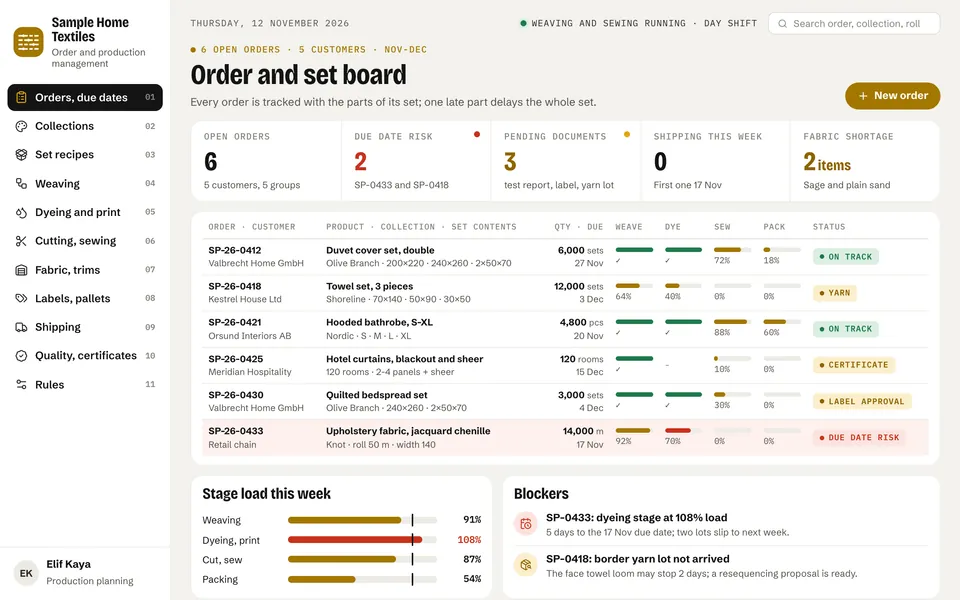
Home textiles software order board: six orders, set contents, four-stage progress bars, stage load and blockers
Set logic A duvet, a sheet and pillow cases are not separate items but parts of one set; orders, fabric and shipping are tracked by part, and the set does not ship until it is complete.
Specification in one record The customer's size, label, packaging and document requirements are attached to the order; labels, cartons and pallets are printed from the same record.
Without touching your ERP Accounts, stock, invoices and e-documents stay in your current program; the transfer is settled in discovery according to its version.
Scope set in discovery Start with the set recipe or the label and pallet plan and grow module by module; not every business needs every module.

This page is a branch of Textile and Apparel Manufacturing software; the wider picture and the other branches are there.

Does this sound familiar?

In home textiles, a set with one missing part is a missing product; the loss usually sits in the smallest part and the last label.

In businesses making duvet covers, towels, curtains and upholstery the picture is largely the same. If even one point sounds familiar, this page was written for you.

  • A duvet cover set consists of a duvet cover, a sheet and two pillow cases, but in many places the order is a single line. The sheet may be sewn while the cases are not yet cut; the set turns out incomplete on shipping day and someone has to be asked where each part is.
  • The same "double" product has different sizes from customer to customer: duvet 200×220 or 200×225, sheet 240×260 or 220×240, case 50×70 or with an extra allowance. Even retail listings show these differences. The size dictionary and the customer specification sit in separate files.
  • Fabric needs are copied from variant to variant in Excel. One collection means several patterns, each pattern several colours and two or three sizes; which colour is short of fabric is discovered when the due date is near.
  • The parts of a set want different fabric widths: the sheet wide, the case narrow. Width and cutting layout are chosen by experience; the waste of the choice is not calculated and the same debate returns with the next order.
  • In towels, weight and pile height are checked against the target, but the measurements remain on the rolls, in a notebook or on a laboratory sheet. That weight is drifting towards the upper limit of the band is not visible until it breaks the band; the piece weight is also calculated by hand.
  • On a terry loom, ground warp and pile warp are on separate beams and the pile warp runs out faster than the fabric metres. When the plan treats them as one beam, a loom whose pile beam is not ready waits.
  • In a hotel or housing curtain project, room type, window width, pleat ratio and seam allowance are turned into fabric metres by personal calculation. Trims such as pleat tape, hooks and weight tape are ordered late and the project waits for a tape.
  • Where the specification asks for a fire class test report, a certificate or a lot trace, the document cannot be found before shipping. Which fabric lot is tied to which test report is scattered over files.
  • Label printing and the customer's label approval slip to the last days of the order. Whether fibre composition, care symbol, origin, batch number and barcode match the customer specification is checked by hand; a wrong label is found when the carton is opened.
  • The carton and pallet plan, the pallet label and the advance shipping notice are prepared by hand. How many cartons, pallets and trucks are needed, and whether the wooden pallet is marked, is settled on loading day.
  • In export orders, having the item code, tariff code, weight and fibre data ready matters more and more; because these are written separately in the order, label and shipping records, they do not match.
The software landscape today

Which software do home textile businesses use today, and where does it stall?

In Turkish searches we found no brand-independent ready product that covers the duvet set recipe, towel weight and pallet label together. Businesses typically run an accounting program, a textile ERP and Excel side by side, and the gap in between is closed with files and notebooks.

LayerSoftware in use todayThe gap it leaves
General ERP and accounting (the horizontal backbone) Logo (Tiger, GO, Netsis), Mikro, ETA, Canias, Uyumsoft, DİA Solid for accounts, stock, invoices, e-dispatch notes and e-ledger, and they should stay in place. Home-textile-specific records such as the set recipe, cutting layout, towel weight, project trim needs and the pallet label do not appear in the standard scope of these programs.
Textile-specific ERP (Türkiye) Login ERP The vendor page lists colour, size and pattern variants, subcontract tracking, production and material requirements planning and store integration for textiles, and mentions the data variety of weaving processes for fabric, towels and carpets. Home textile details such as set contents, cutting layout and pallet labels do not appear as a separate heading on the page; the extent of coverage is settled with the vendor.
International textile ERPs Datatex NOW, TexSavvy (presented for home textile businesses), Kladana The vendor pages describe Datatex NOW as a modular ERP covering textile production from raw material to finished goods, TexSavvy as a package for home textile businesses covering quote to shipment, and Kladana as offering a production route for products such as curtains, bed sheets and cushions that ends in cutting and sewing. Local support, local documents and e-dispatch compliance in Türkiye should be asked about separately.
Loom monitoring platforms Picanol PicConnect, Itema MyWeave They offer live loom status and production charts in the browser and see looms of their own brand. The set recipe, order link, cutting, labels and pallets are outside the scope of these platforms.
Cutting, packaging and labelling side The customer's label template, barcode printer, Excel packing list, pallet label Flexible but detached from the order record; label approval, carton counts and pallet labels are duplicated by hand. Keeping three or four files consistent for the same order is not always possible.
Excel and paper sheets Size table, fabric requirement table, weight measurement sheet, document folder Quick and familiar but tied to one person; it keeps no versions, approvals or history. When a customer asks a question, tracing back which lot went into which set takes time.

Product names are compiled from vendors' public pages (September 2026); PAN is not affiliated with them. The "gap" column summarises situations we commonly meet in discovery and is not a statement about any specific product.

Our approach

A home textiles working layer that closes the gap between accounting and shipping.

We do not bring a second ERP into your business. We build the chain of records from order to pallet that knows the parts of a set and the customer's conditions, and connect it with your existing systems. The system does the calculation; the business makes the decision.

Set recipe and cutting layout

The parts of a set, their finished and cut sizes, trims and the fabric width sit in the recipe. Once the width is chosen, the cutting layout, metres per set and waste are calculated; the same recipe opens into pattern, colour and size variants.

Collection, pattern and size card

Collection, pattern, colour and size combinations are kept together on the product card. The fabric need of each variant is compared against stock; a short colour or size reaches purchasing and weaving before the due date gets close.

Towel weight and two beams

The weight of every roll is tracked against the band of the customer requirement or in-house target, and piece weight is calculated from area. Ground and pile warps are planned as separate beams; which one runs out first is visible.

Project fabric and trim needs

In a curtain or upholstery project the panel size comes from the room type, the fabric length from the pleat ratio, and the tape, hook, weight tape and label needs from the panel. A shortage against stock turns into a purchase proposal.

Specification and document chain

The customer's label, packaging and document requirements are attached to the order. Documents such as a fire class test report or a certificate are tied to the fabric lot; shipment stays locked until the document is closed.

Label, barcode, carton and pallet

The product label, barcode, carton and pallet label are printed from the same order record. Quantities are calculated from set to pallet; the pallet, the advance shipping notice and the shipping gate feed from the same record.

Modules we can build

Modules we can build for a home textiles business

You do not need all of them at once. Most businesses start with the order and set board or the label and pallet plan, and grow with the set recipe and project calculation. The screens can be seen in the gallery on this page.

ORDERS

Order and set board

Duvet cover, towel, bathrobe, curtain and upholstery orders in one table; set contents, quantity, due date and progress from weaving to packing, full stages and blockers.

SET

Set recipe and size dictionary

The parts of a set, their finished and cut sizes, trims, size differences by customer and version history; size families such as double and single come from the same recipe.

CUTTING

Cutting layout and fabric metres

Fabric width, strip layout, metres per set and waste; order fabric by variant compared with the fabric in stock.

VARIANTS

Collection, pattern and colour

Collection, pattern, colour and size matrix; quantity, fabric need and shortage of each variant; customer colour approval and sample status.

TOWELS

Towel weight and beam plan

Weight and pile height by roll, piece weight, after-wash size, run-out times of ground and pile beams.

PROJECT

Curtain and upholstery project needs

Room type, panel size, pleat ratio, fabric and trim needs, comparison with stock and a purchase proposal.

DOCUMENTS

Specification documents and lot trace

Test reports, certificates and customer approvals are tied to the fabric lot; shipment stays locked until the document is closed, and the validity date of each document is visible.

LABELS

Label, barcode and packaging template

Fibre composition, care symbol, origin, batch, manufacturer details and barcode; customer label approval and print record.

PALLETS

Cartons, pallets and shipping gate

Quantities from set to carton and pallet, pallet label, wooden pallet record, advance shipping notice and packing list.

What it looks like on screen

What home textiles software looks like on screen

These screens are sample designs we prepared for duvet cover, towel, bathrobe, curtain and upholstery manufacturers. The figures are representative; the system is set up around your own product groups, set contents, customer specifications and packaging rules.

Order and set board. Duvet cover, towel, bathrobe, curtain and upholstery orders in one table; each row carries the set parts, quantity, due date and progress from weaving to packing. A late part, a missing certificate or a full stage affects the whole set, so it surfaces as a warning at the top.
Set recipe and cutting layout. The parts of a duvet cover set, their finished and cut sizes and the trims sit in the recipe; once the fabric width is chosen, the cutting layout, metres per set and waste are calculated. The same recipe opens into pattern and colour variants, and each variant’s fabric is compared against stock.
Towel weight and two beams. In towels quality starts with weight and pile height: each roll’s g/m² is plotted against the customer’s band and piece weight is calculated from area. Because ground and pile warps run out on separate beams, the loom run-out time is calculated for both.
Curtain project and fabric needs. In a hotel or housing project the panel size comes from the room type, the fabric length from the pleat ratio, and the tape, hook and label needs from the panel. Shortages against stock turn into a purchase proposal; shipment stays locked until specification documents such as the fire class test report are closed.
Label, barcode and pallet plan. In retail-chain and export orders the product label (fibre composition, care, origin, batch, barcode), carton label and pallet label are printed from the same order record. Quantities are calculated from set to pallet; the shipping gate stays closed until labels, batch, pallet mark and shipping notice are complete.

Company names, people and figures on these screens are sample data. The system is built around your own processes, document names and rules. We walk you through the demo in a call: request a demo

Integration with your existing ERP

Both your accounting program and your barcode and label setup stay in place.

Most home textile businesses already have two layers: an accounting and e-document program on one side, and a label printer plus the templates the customer sends on the other. What is missing is the workflow between them: order, set recipe, fabric need, weight check, document chain, labels and pallets. We write that layer and set up data exchange with both sides. The code and data are yours; you choose the server.

Our integration approach →
  • Transfer of accounts, stock, dispatch notes and invoices with Logo, Mikro, Netsis, ETA, Canias or whichever program you use; double entry goes away.
  • If you already have a textile ERP, order and stock transfer with it; which records stay with which system is settled in discovery.
  • Output to barcode and label printers; label templates the customer sends are matched to the order record. Format and printer model are settled in discovery.
  • Reading production data from weaving looms; the export or counter route depends on the make and model of the loom and is settled in discovery.
  • Initial data load from your Excel files (size table, collection list, fabric requirement table); your field names are kept.
Outcomes

What changes in home textiles once this layer is in place?

  • Which part of a set is where becomes visible; a missing part appears as a warning before shipping day.
  • Size and label differences are tied to the customer specification; the size of the same product for different customers is read from one dictionary.
  • Once the fabric width is chosen, metres per set and waste are calculated; the choice of width rests on a number, not on experience.
  • Fabric need by variant is compared with stock; a short colour or size reaches purchasing and weaving before the due date gets close.
  • Towel weight is followed inside the band; a lot drifting towards the upper or lower limit is visible before it leaves the band.
  • Ground and pile beams are planned separately; the hour a loom will wait for a pile beam is seen in advance.
  • In curtain projects, fabric and trim needs are calculated from the room type; small items such as tape and hooks are not left to a late order.
  • Shipment does not go out until the document chain is closed; which fabric lot is tied to which test report sits in one record.
  • Labels, cartons and pallets are printed from the same record; a label that differs from the customer specification is caught before the carton is opened.
Process

A realistic five-stage path that begins with discovery.

  1. 01

    First conversation and screen demonstration

    1 week

    We listen to your product groups (duvet covers, towels, bathrobes, curtains, upholstery), your customer profile, your export and retail chain work and the ERP you use. We go through the screens on this page together and discuss which of them matches your case.

  2. 02

    Discovery on site

    1-2 weeks

    We watch your order flow, your size tables, collection lists, fabric requirement calculation, and label and packing list files on site. We take your field names and customer specifications as they are.

  3. 03

    Written proposal and first phase

    1 week

    We write and propose which module to start with, which data is read from where, the ERP transfer and your server preference, and settle the scope of the first phase together.

  4. 04

    Setup and pilot product group

    4-8 weeks

    We start with one product group or one customer specification: the order board, set recipe and label record go live. Settings are tuned with the users, and code and data are shared with you from the start.

  5. 05

    Rollout and support

    ongoing

    The remaining product groups, towel weight, project needs, document chain and pallet modules are added in turn. Training, tuning and change requests continue with the same team.

Why Pan Innovation House?

A team that thinks in sets and puts the specification on record.

You see the screen beforehand

The order board, set recipe, towel weight, curtain project and label screens can be seen today in the gallery on this page. Your system is built from this core around your products and rules.

We work in home textile terms

Set, duvet, sheet, case, weight, pile, border, pleat, hook, collection and pallet appear on screen under the names you use; staff do not learn a new language.

We record the customer specification

Each customer's size, label, packaging and document requirement is attached to the order; wherever a requirement comes from (the customer or an in-house target), the screen says so, and a limit is never presented as if it were a standard.

We respect your existing systems

Your accounting and ERP program does not change. We write only the home-textile-specific layer and transfer the records to your program.

Data and code are yours

Your data stays on your server or on the cloud you choose; the source code and data are yours. If you want to continue with another team, the system does not lock you in.

Based in Gaziantep, with an office in London

Our headquarters is in Gaziantep; we come to your business and work on the floor. Our London office also covers English documents and screens for producers who export.

Frequently asked questions

Home Textiles software: common questions

What is a duvet cover set recipe and why is it needed?

A set recipe holds which parts a set is made of, the finished and cut size of each part, its quantity and its trims. A double set, for example, can consist of a duvet cover, a flat sheet and two pillow cases; sizes vary from customer to customer. Without a recipe, fabric need, cutting and shipping cannot be followed at set level; with a recipe, variants come from the same source.

How are the cutting layout and waste calculated?

A fabric width is chosen, the parts of the set are arranged in strips and the metres per set are found. Cutting yield is the ratio of the total area of the parts to the fabric area; the rest shows as waste. Wide parts such as the sheet can use the fabric crosswise, and small parts such as cases can sit in the space beside a duvet panel. The system suggests the width, you decide.

How do you handle different sizes for different customers?

The size dictionary and the customer specification are attached to the order. Differences such as one customer asking for a 200×220 duvet and another for 200×225 for the same double set are read from the customer card; the recipe is copied for that customer. Cutting, fabric need and labels then come out in the customer's size.

Which limit do you use for towel weight?

We did not find a single numerical tolerance for towel weight and pile height that binds the whole industry; the limit is set by the customer requirement or an in-house target. We write that band on the order or article card, follow the measurement inside the band, and show a lot that leaves the band or drifts towards its limit. On screens, a limit is shown with its source (customer requirement or in-house target).

How do you calculate piece weight?

Weight (g/m²) is multiplied by product area (m²). A 70×140 cm towel, for example, is 0.98 m²; at 500 g/m² the fabric weighs about 490 grams. Extra weight from borders, edge stitching and trims is added according to the business's own rule.

Why do you plan the two beams of a towel separately?

On a terry loom the ground warp and the pile warp are on separate beams, and the pile warp is used up faster than the fabric metres. The plan follows both beams as separate items; it shows which will run out first and whether the new beam is ready. The ratio between pile warp and fabric is kept on the article card.

How do you calculate fabric in a curtain project?

Curtain width and drop are taken from the room type; the fabric length is the finished width multiplied by the pleat ratio, plus a seam allowance per panel. The pleat ratio is the requirement of the customer or the project. The same calculation is made for pleat tape, hooks and weight tape, and the result is compared with stock.

How do you follow documents such as a fire class report?

If the specification asks for a document, the document is tied to the fabric lot and the order; shipment stays locked until it is closed. For curtains and upholstery, fire behaviour often comes from the customer or project specification; the specification decides which class or standard is requested, and we track the document and its validity.

What must be on a product label?

For sales into the European Union, the fibre composition label is governed by Regulation 1007/2011; fibres are given as percentages in descending order, and the label must be durable, legible and visible. Towels, duvet covers and curtains are not on the exemption list. Türkiye also has a regulation published in the Official Gazette for fibre composition. Care symbol, origin, batch and barcode are added according to the customer specification.

Are manufacturer details and a batch number mandatory?

The EU General Product Safety Regulation has applied since 13 December 2024. The manufacturer's name, postal and electronic address and a type, batch or serial number identifying the product must be on the product or, where that is not possible, on its packaging or an accompanying document. How this applies to each product and market is settled together.

What are a pallet label and an advance shipping notice?

In the GS1 standard each pallet is identified by an 18-digit SSCC; the label carries a GS1-128 barcode, and two identical labels are placed on adjacent sides of the pallet. The same number identifies the pallet's contents in the advance shipping notice. We produce the pallet label and the notice from the same order record; if the customer has a special requirement, it is configured accordingly.

Do you keep a record for wooden pallets?

The international wood packaging standard ISPM 15 requires heat-treated pallets to be marked: the IPPC symbol, a country code, a producer code and a treatment code. At the shipping gate, whether the pallet is marked goes onto the checklist; the mark itself is the business of the firm that supplies the pallet.

Do I have to replace Logo, Mikro or Netsis?

No. Accounts, stock, invoices and e-documents stay in your existing ERP. We write the home-textile-specific layer and transfer the necessary records to your ERP. The transfer route is settled in discovery according to the program's version.

How long does setup take and what does it cost? Do you promise numbers?

After discovery, the written proposal settles scope, duration and price; the first phase usually starts in one product group with the order board, set recipe and label record. We do not promise percentages for waste, yield or time; businesses and product groups differ greatly. What we do is make the state of a part, a document or a label visible through records and make improvement measurable against your own target.

Next step

Let's go through the screens together, then visit your business

A home textile business's system cannot be written remotely. Let's first go through the screens together; then we will see your orders, size tables, and label and packing list files on site and propose the first phase in writing.

Related services

Related areas worth considering

Pan Innovation House

Call us

By phone

+90 543 930 12 72

Our phone line is open every day.

WhatsApp on your phone

Scan with your phone camera. The chat opens with your message ready.

Prefer that we call you? Leave your details