Pan Innovation House Pan Innovation House
INDUSTRY SOFTWARE · TECHNICAL TEXTILES

From the customer’s specification to the roll, from the coating recipe to the test certificate, technical textiles software that proves every technical fabric

Pan Enterprise Solutions, the software arm of Pan Innovation House · based in Gaziantep, Türkiye, with a London office

For plants making coated and laminated fabrics, tarpaulin, tire cord and conveyor fabric, flame-retardant workwear fabric and composite reinforcement fabrics, we bring the customer specification, the coating line recipe and its parameters, every roll’s test result, type test validity and the lot trail into one record chain. Logo, Mikro, Netsis or the ERP you use stays in place; we do not touch your line automation or laboratory instruments, and we build the shop-floor layer beside them. The screens are on this page; the scope is settled in discovery.

Asking about price? We listen to the scope in a short call and share the budget frame and timeline in writing. The first 30-minute call is free; the scope of an on-site discovery, and its fee if any, is agreed in writing during that call.

We work on site for plants in and around Gaziantep; elsewhere in Türkiye and abroad, discovery starts by video call and a visit is planned if needed. Our London office is at Unit 6 Cranford Way, Hornsey, London N8 9DG.

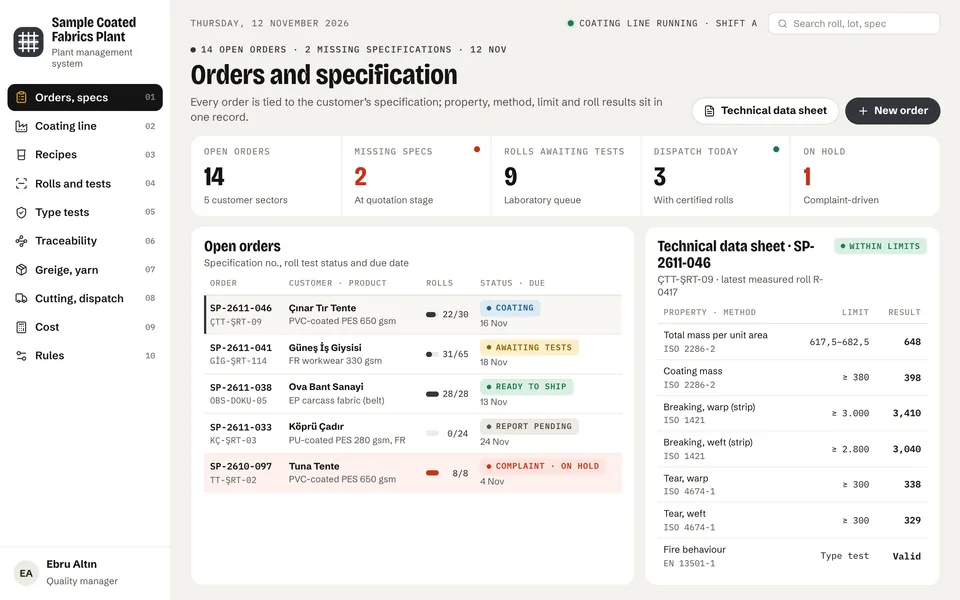
Technical textiles software order and specification screen: five open orders with specification numbers and roll test progress, and a method-coded technical data sheet for the selected order
$2.33 bn According to İTHİB’s 2025 note, technical textile exports were $2,327 million (+2.8%) and the largest product group in textiles. Inside that total, coated, cord and protective fabrics are each made to a separate customer specification.
90-95% About 90-95% of flame-retardant fabric production is exported (Dünya newspaper, March 2025). The buyer’s specification and test certificate are a condition of sale on every batch.
5 screens Orders and specification, coating line, roll test map, type tests and approved products, and traceability can be seen on this page with illustrative data.
Scope in discovery Most plants start with the specification and roll test record; the coating line, type test and traceability modules follow. Without touching your line and instruments.

This page is a branch of Textile and Apparel Manufacturing software; the wider picture and the other branches are there.

Does this sound familiar?

In technical fabric, loss appears where the specification stays on paper, where nobody knows what parameters a roll ran under, and the moment a certificate turns out incomplete.

If the table below describes a coating, lamination, tarpaulin, cord fabric or protective fabric plant, this page was written for you. The figures and standard names come from public sources; they are not PAN’s own customer results.

  • The specification changes by customer and product, but it lives on paper and in e-mail. For protective fabric, one public specification asks for at least 700 N breaking force in warp and weft while another asks for 900 N in the weft; tear is at least 15 N in one item and at least 50 N after washing in another. Which order is bound to which limit often travels by word of mouth from sales to production.
  • Test method and direction are missing from the record. ISO 13934-1 for breaking, ISO 13937-2 for tear, EN ISO 15025 procedure A for flame spread, and ISO 9151 and EN ISO 6942 for heat transfer are written side by side in one specification; coated fabric has its own methods such as ISO 1421, ISO 2286-2 and ISO 4674-1. A result sheet does not always say which method, warp or weft, before or after washing.
  • The coating line’s parameters are in a notebook while the roll’s quality is in the laboratory. Line speed, oven zone temperatures, paste viscosity and coating mass change from one roll to the next, and which roll they belong to is read from the shift notebook. When a roll shows pinholes or low coating mass, finding the cause comes down to guessing.
  • Recipe version and certificate code do not match. A public specification asks that the offered fabric’s product code and technical properties equal those of the certified material. When a recipe or fabric code changes quietly, the report belongs to an older product and nobody notices at dispatch.
  • A roll is not one result. In the same roll one zone can be low in coating mass, another has a splice, another a crease mark; if the test sample happens to come from a good zone, the whole roll looks like a pass. Cutting out the defective length and shipping the rest with its grade is mostly done by hand at the cutting table, unrecorded.
  • Type test validity goes untracked. For protective fabric the EU asks for an EC type-examination certificate under Regulation 2016/425 on personal protective equipment, tests after washing and documents such as OEKO-TEX; each document has an expiry date. A shipment based on an expired report surfaces only when the customer asks.
  • The tender file becomes a pile of documents. A public purchase asks for an EC type-examination certificate, test reports, OEKO-TEX, a REACH compliance statement, a safety data sheet, an ISO 9001:2015 certificate, product liability insurance and a sample; if one is missing the tender is not evaluated. These documents usually sit in different people’s folders.
  • Measure-bound products such as conveyor belts carry stiff penalty rules. One public body’s above-ground belt specification states strength 500 N/mm, 4 plies, top cover 4 mm, bottom cover 2 mm; after ageing a value may deviate by at most ±25%, and if ply adhesion or cover strength falls below the limit there is a price deduction or rejection. For each drum, which sample gave which result has to be on record.
  • When a complaint arrives, tracing back takes days. From which greige fabric, yarn lot, coating batch and paste lot you made a roll sits in separate notebooks, and who holds the other rolls from the same lot is collected by phone. Meanwhile it is unclear whether the rolls in stock are on hold.
  • The market puts the specification first. For flame-retardant fabric there is no domestic rule that makes its use mandatory; almost all production is exported, and the sale depends on the buyer’s specification, test certificate and traceability. Document preparation does not start after the sale but when the order is taken.
The software landscape today

Which software do technical textile plants use today, and where do they get stuck?

There is general ERP, laboratory and MES systems, in-line measurement, roll trim and genealogy software, and coating machine makers. The gap between them sits in the customer specification, the coating recipe, the roll-level test result and type test validity. Below are only product names described on the makers’ own pages; we do not assume a product lacks a feature its pages do not describe.

LayerSoftware in use todayThe gap it leaves
General ERP and accounting (the horizontal backbone) Logo, Mikro, Netsis Solid for customers, stock, invoices and e-waybills; it should stay. Each clause of the specification, the test result tied to a roll, the coating recipe and type test validity, however, are often kept outside these programs, in Excel and folders.
Web-based ERP with production modules Aaro Online ERP Programı Its page describes production tracking and planning, recipe, work order, a quality control module, subcontractor management and e-transformation; it offers a sector-independent structure and does not name textiles or technical textiles as a sector. Specification clauses, roll test maps and type test fields are not described on the page; adaptation to the language of technical fabric needs separate thought.
Laboratory and manufacturing execution systems Centra LIMS and MES (Laboratory Information Management System, Manufacturing Execution System) LIMS covers sample tracking, analysis and result records, electronic approval; MES offers equipment integration and traceability. Its sector page lists pharmaceutical, food, chemical and laboratories; textiles are not named. A test flow tied to the fabric roll, warp and weft direction and the clause of the customer specification still has to be built.
In-line measurement and control Mahlo Qualiscan QMS-12, Textometer RMS Measurement and profile control of basis weight, thickness, density, moisture and coating thickness across the web; residual moisture measurement. These are measuring instruments; orders, customer specifications, certificates and type tests remain outside them.
Roll trim optimisation and genealogy Greycon X-Trim, GreyconMill, opt-Studio Trim optimisation for reel and sheet production; genealogy, traceability and OEE on the MES side; its industry list includes nonwovens and technical textiles. Coating recipes, specification clauses and type test validity are not described on the page; that flow has to be built separately.
Coating and lamination machine makers Coatema (Basecoater, Linecoater, Smartcoater and single units) Offers laboratory, pilot and production machines with application systems, calender, dryer, tenter frame and winder units; textile is in its industry list. A machine maker: customer specifications, roll test results and the certificate flow are not described on its pages, and plants whose lines are not of one make need the same board.
Excel, e-mail, paper labels and messaging Excel, PDF specification, shift notebook, WhatsApp Fills in where software does not reach: the specification PDF, recipe notebook, test result table and dispatch details often live here. Flexible; but nobody checks the link between roll, parameter, test result and document.

Product names are compiled from vendors' public pages (September 2026); PAN is not affiliated with them. The "gap" column summarises situations we commonly meet in discovery and is not a statement about any specific product.

Our approach

A shop-floor layer that closes the gap between specification and line, and between line and certificate.

We do not bring a second ERP or a line control system into your plant. We build the record chain from order to dispatch and connect your existing programs and instruments to it. Most often it starts with the specification and roll test record.

Specification and technical data sheet

The customer specification is entered not as a PDF but as property, method, unit, lower and upper limit and sample direction. Every order is tied to its specification; the technical data sheet comes from this record, and a result outside the limit turns red at once.

Coating line recipe and parameters

A line diagram runs from fabric intake to winder; coating mass at each head, target and actual temperature of oven zones, line speed and paste viscosity are shown with the recipe’s window. A parameter that leaves its window raises an alert before the roll is full.

Roll test map and grading

A measurement grid along the roll’s length and width, splice and defect markers, sample spots such as N1-N2-N3 and each sample’s method-coded result sit on one screen. The defective length is cut out and the rest goes on the certificate with its grade.

Type tests and approved product list

A product family’s accredited-lab type test report, after-wash requirement, validity date and covered lots are on record. If the certified fabric code differs from the shipped fabric code, or the report has expired, dispatch is blocked.

Lot traceability and backward trace

A chain is built from yarn lot to weaving, greige to coating batch, paste lot to roll and dispatch. All rolls from the same lot as the complained roll, who holds them and what is in stock appear on one list; a hold order is issued.

Documents and the tender file

The test certificate is produced tied to the roll. The EC type examination, OEKO-TEX, REACH statement, safety data sheet, ISO 9001 certificate and insurance a public purchase asks for are tracked on one list as ready or missing; a missing document shows today, not on tender day.

Modules we can build

Modules we can build for a technical textile plant

You do not need all of them at once. Most plants start with the specification and roll test record; the coating line, type test, traceability and cost modules follow.

SPEC

Customer specification and technical data sheet

Property, method, unit, lower and upper limit, sample direction and after-wash requirement; a versioned record tied to order and product code.

ORDERS

Orders, planning and due dates

Customer, product, specification no., roll test status and due date; dispatch date by line capacity and test queue.

RECIPE

Recipe and paste lot

Recipe version, approval, lot and mass of each item, mixing batch; which certificate is affected when a version changes.

ROLL

Roll record and test map

Roll no., length, width, kg, splice, defect zone, measurement along length and width, grading and child roll label.

TYPE TEST

Type tests and approved product list

Product family, standard scope, report no., laboratory, validity date, covered lots; dispatch block and alert for an expired report.

TRACE

Lot traceability and backward trace

Chain of yarn, weaving, greige, coating batch, paste lot, roll and dispatch; rolls from the same lot and a hold order.

COST

Roll and square-metre cost

Cost per roll and per square metre from greige, coating mass, waste and grade B length; comparison by recipe version.

What it looks like on screen

What technical textiles software looks like on screen

These screens come from the demo design we prepared for makers of coated, laminated and protective fabrics. The figures are sample data; the system is set up around your own lines, products and customer specifications.

Orders and specification. The specification for tarpaulin, workwear, carcass and PU-coated fabrics is entered at order entry as property, method and limit; roll test status and the technical data sheet appear in the same record.
Coating line. A line diagram from fabric intake to winder: coating mass of each knife, target and actual temperature of every oven zone, and the window the recipe allows, all at a glance. A parameter outside its window raises an alert before the roll is full.
Roll test map. Coating mass along the length and width of a roll, with defect zone and splice; ISO 1421, ISO 4674-1 and ISO 2286-2 results by sample spot beside the limit. The defective length is cut out and the rest goes on the certificate with its grade.
Type tests and approval. Every product family has its accredited-lab type test report, after-wash requirement, validity date and covered lots on record. When a report expires, dispatch of that product stops; the documents a public purchase asks for sit on one list.
Traceability. From a complained roll the trace goes back to the yarn lot, coating batch and paste lot; all rolls from the same lot, who holds them and what is in stock are on one list. A hold order is one click.

Company names, people and figures on these screens are sample data. The system is built around your own processes, document names and rules. We walk you through the demo in a call: request a demo

Integration with your existing ERP

Your ERP and your line system both stay in place.

Technical textile plants usually already have solid systems: an accounting and e-document program, the control panels of lines and measuring instruments, laboratory instruments. We do not replace them; we build the specification, recipe, roll and certificate chain beside them.

Our integration approach →
  • Customers, stock, orders, waybills and invoices exchange with Logo, Mikro, Netsis or the ERP you use; double entry disappears. Accounting and official documents stay in your current program.
  • Speed, temperature and coating mass are taken from the coating line’s control system and the in-line measuring instrument; whether by OPC, file or database depends on the instrument and version and is settled in discovery.
  • Method-coded records from laboratory instruments and hand-entered test results; the result is matched automatically with the roll, the sample spot and the clause of the specification.
  • Roll and child roll barcodes with label printers and handheld terminals; scans at coating, cutting and warehouse points.
  • You choose the server; data and code are yours. The system is built around your lines, products and customer specifications.
Outcomes

What changes on the floor and in dispatch once this layer is in?

  • The customer specification is entered at order entry as property and limit; a result outside the limit and a missing specification show at once, not at the end of the shift.
  • On the coating line a parameter that leaves the recipe window raises an alert before the roll is full; finding the cause goes from guessing to reading a record.
  • Every metre and width of a roll is mapped; the defect zone is cut out and the rest goes on the certificate with its grade and the right kilograms.
  • Because a test result is saved with its method, sample spot and direction, specification disputes are closed with a document.
  • Type test validity and code match are checked on every dispatch; a shipment based on an expired report does not leave unnoticed.
  • The test certificate is produced tied to the roll; hand-typing and copying errors fall.
  • Whether the documents a public or export tender asks for are ready or missing shows on one list; they are completed beforehand, not on tender day.
  • On a complaint, tracing back from the yarn lot to dispatch takes minutes; rolls from the same lot are found on one list and put on hold.
  • Roll and square-metre cost shows by recipe version and grade B length; profit is run by figures, not by feel.
Process

A realistic five-stage path that begins with discovery.

  1. 01

    First meeting and screen tour

    1 week

    We listen to how your plant is set up: which products (coated fabric, tarpaulin, cord, workwear fabric), which customer sectors, which line and measuring system, which ERP. We walk through the screens on this page together and discuss which ones match your plant.

  2. 02

    Discovery at the plant

    1-2 weeks

    We see the coating line, the laboratory, the cutting table and the warehouse on site. We follow one specification, one recipe and one certificate from start to finish; we collect your current tables, instrument outputs and documents.

  3. 03

    Scope, priority and budget

    1 week

    We propose in writing which module to start with, which instruments feed data and which stay manual. A fixed scope and price are settled at this stage.

  4. 04

    Development and pilot

    6-10 weeks

    The first phase runs as a pilot on one line and a few product families. We refine the specification, recipe and test screens with the quality and line teams; it is tried with a real roll.

  5. 05

    Go-live and maintenance

    Ongoing

    Training, cut-over and go-live; afterwards maintenance and development for new products, new specifications and new instruments. Data and code are yours.

Why Pan Innovation House?

A team that speaks the plant’s language and builds the record chain on the floor.

You see the screen beforehand

Not a promise but a demonstration: the order and specification, coating line, roll test map, type test and traceability screens are on this page. The figures are illustrative; your system is built around your lines, products and specifications.

Discovery first, then scope

A technical fabric plant’s system cannot be written remotely. We give neither price nor timeline before we see the line, the laboratory and the cutting table on site.

Your current systems stay

Logo, Mikro, Netsis or the ERP you use and your line automation do not change; the new layer is built beside them and exchanges data with them.

Data and code are yours

You choose the server. The software’s source code and data are yours; if one day you wish to part with us, a working system stays in your hands.

A language backed by sources

The standard names, test methods and specification examples on this page come from public sources; we do not write a figure or a class we could not verify. The customer specification itself is your own document.

Gaziantep headquarters, London office

Our headquarters are in Gaziantep and we have an office in London. We can work with a plant inside the clusters and export markets, on site or remotely.

Frequently asked questions

Technical Textiles Manufacturing (Coated, Laminated and Protective Fabrics) software: common questions

What does technical textiles production tracking software do?

It keeps the customer specification, the coating line recipe and parameters, every roll’s test result, type test validity and the lot trail in one record chain. The real difference is that which specification, recipe and lot each roll is tied to, and its certificate, stay in the record.

Which tests are used on coated fabric?

According to catalogue summaries, ISO 1421 describes breaking strength and elongation of rubber- or plastics-coated fabric (strip and grab methods), ISO 2286-2 total, coating and substrate mass, and ISO 4674-1 tear resistance. The customer’s specification decides which test and which limit apply; the standard texts are paid, and we do not invent limit values.

What does a flame-retardant workwear fabric specification contain?

In the public 2024 and 2025 specifications of Türkiye Taşkömürü Kurumu the fabric must meet EN ISO 11612 codes (for example A1, B1, C1, E1, F1), ISO 11611 class 2 and EN 1149-5; breaking is measured to ISO 13934-1, tear to ISO 13937-2, flame spread to EN ISO 15025 procedure A, and after-wash values are asked after 5 washes in EN ISO 6330 programme 4N. Figures differ from specification to specification; your system uses your customer’s specification.

Why should a type test or EC type-examination certificate be tracked?

For protective workwear fabric an EC type-examination certificate under the EU’s PPE Regulation 2016/425 is requested, and the specification looks for the offered fabric’s product code to equal that of the certified material. If the date and the product code the document covers are not on record, there is a risk of shipping on an expired or differently coded document.

What does a conveyor belt fabric maker need?

A public above-ground conveyor belt specification states TS EN ISO 14890 and TS EN 12882 group 2A, EP carcass type, number of plies, breaking strength (N/mm) and cover thickness; it asks for a mark on the belt every 25 metres with carcass type, number of plies, month and year of manufacture, safety group and brand; there is a deduction and rejection if ply adhesion or cover strength falls below the limit. These data must be on record; a mill making carcass fabric should show how those classes relate to its own fabric.

Why should coating line parameters be recorded?

In coating, the coating material, the method and the substrate fabric decide the final performance; when speed, temperature and viscosity change from roll to roll, so does the result. If parameters are not recorded with the roll, finding the cause of a defective roll comes down to guessing; if they are, a parameter outside the recipe window is visible.

Why is flame-retardant fabric mostly an export matter?

According to Dünya newspaper’s March 2025 report, about 90-95% of flame-retardant fabric production is exported and there is no domestic rule making its use mandatory. The sale depends on the buyer’s specification and test certificate; so document preparation is part of the sale.

We use Logo, Mikro or Netsis; will your software replace it?

No. Accounting, customers, stock, invoices and e-waybills stay in your current program. We build the specification, recipe, roll, test and certificate chain beside it and exchange data with it.

Do you touch our line automation and measuring instruments?

No. Your line control system, in-line measuring instrument and laboratory instruments stay in place. Whether data moves by OPC, file or database depends on the instrument and version and is settled in discovery; if necessary, results are entered by hand.

Is it also suitable for a plant that sends coating or lamination out to subcontractors?

Yes. A plant that sends greige fabric to subcontractors, or buys coated fabric from them, also needs roll, batch and test result records. We cannot watch a subcontractor’s line, but the record, test result and certificate of rolls going out and coming back are kept in the same chain.

How long does the first phase take?

A pilot on one line and a few product families is a development stage of 6-10 weeks in most plants; before it there is one week of first meeting, one to two weeks of discovery and one week of scoping. Timeline and price are given in writing after discovery.

Are the screens and figures on this page real?

The companies, customers, lots, rolls and measurement values on the screens are illustrative. The test method names and specification examples come from public sources; numerical limits for coated fabric methods belong to the customer’s specification and are given as examples on the screens.

Next step

Let us walk through the screens, then visit your plant

A technical textile plant’s system cannot be written remotely. Let us first walk through the screens on this page together; then we see your coating line, your laboratory and your dispatch flow on site and propose the first phase in writing.

Related services

Related areas worth considering

Pan Innovation House

Call us

By phone

+90 543 930 12 72

Our phone line is open every day.

WhatsApp on your phone

Scan with your phone camera. The chat opens with your message ready.

Prefer that we call you? Leave your details