Pan Innovation House Pan Innovation House
INDUSTRY SOFTWARE · DYEHOUSE AND FINISHING

From the recipe in the lab to the load on the machine, dyehouse software that keeps the books on colour and cost

Pan Enterprise Solutions, the software arm of Pan Innovation House · based in Gaziantep, Türkiye, with a London office

We bring the machine and batch schedule, the lab recipe and colour approval, additions and stripping, chemical stock and its documents, water-energy-steam use per kilogram, finishing and print job orders and the dispatch and return of commission customers into one chain of records. Your accounting program, whether Logo, Mikro, Netsis or another, stays where it is; we do not touch your colour measurement equipment or machine automation, we build the dyehouse work layer beside them. You can see what the screens look like in the gallery on this page.

Asking about price? We listen to the scope in a short call and share the budget frame and timeline in writing. The first 30-minute call is free; the scope of an on-site discovery, and its fee if any, is agreed in writing during that call.

We work on site for plants in and around Gaziantep; elsewhere in Türkiye and abroad, discovery starts by video call and a visit is planned if needed. Our London office is at Unit 6 Cranford Way, Hornsey, London N8 9DG.

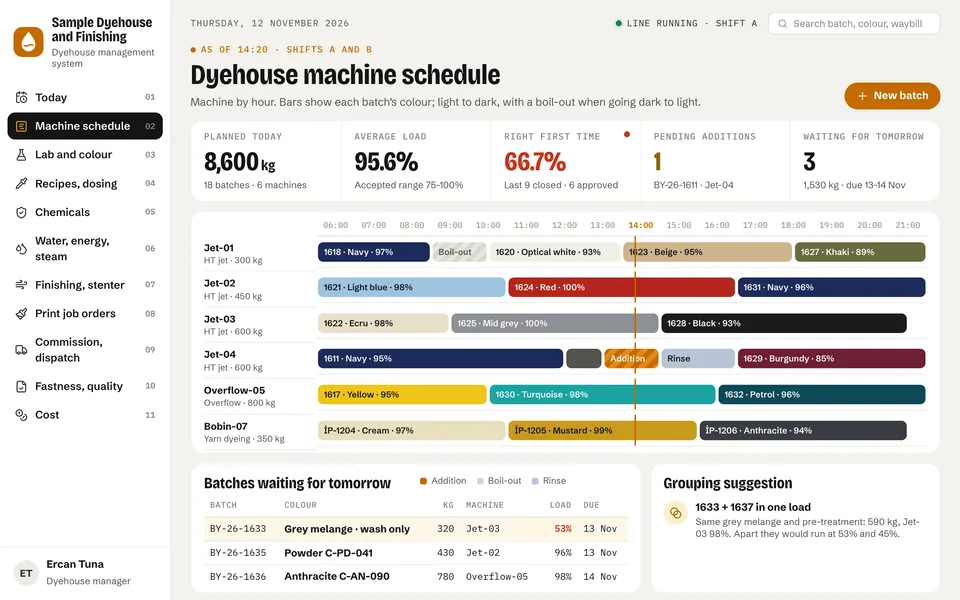
Dyehouse software machine schedule: hourly Gantt for jet, overflow and package machines with batches in their own colours, additions and boil-out cycles, waiting batches
A record of colour Lab recipe, ΔE measurement, light source, addition and stripping are tied to the batch; the right-first-time rate comes straight from the records.
Use per kilogram Water, steam, electricity and gas are visible by machine and by batch; the cost of a half-empty load becomes a number.
Your ERP untouched Accounting, e-invoice and e-waybill stay in your current program; the transfer is settled at discovery, depending on version.
Scope set at discovery Start where it hurts most, such as the machine schedule or commission reconciliation, and grow module by module.

This page is a branch of Textile and Apparel Manufacturing software; the wider picture and the other branches are there.

Does this sound familiar?

In a dyehouse, profit rarely disappears in the price of dye; it disappears in additions, half-empty loads and lost reconciliation.

The picture in dyehouses looks very similar from one site to the next. If even one of these sounds familiar, this page was written for you.

  • The colour that matched in the lab does not match in production. The recipe lives on paper or in a separate colour program and the dyer scales it up by hand; a review published by the Society of Dyers and Colourists reports production dyers cutting the lab recipe by 10-15% and deliberately planning on an addition.
  • The first sample is measured, but the addition decision is verbal: what the ΔE was, under which light, how much was added and who paid for it is not on record. That is why almost nobody has the right-first-time rate as a number.
  • The machine schedule lives on a whiteboard or in Excel. When the same colour family does not run back to back on one machine, boil-out cycles multiply; a half-loaded batch burns the same water and steam as a full one.
  • A colour that matches under one light fails under another. When the customer looks under a different illuminant, the batch’s drift from the approved sample is usually discovered after dispatch.
  • Chemicals and dyestuffs sit in stock as a single line item; ZDHC level, ECO PASSPORT, the date of the safety data sheet and the REACH candidate-list check live in three different folders. A product whose certificate has expired keeps being used in recipes.
  • Water, steam, electricity and gas are read as totals from meters and invoices; consumption per kilogram and per batch is not calculated. The EU’s indicative range for batch fabric dyeing is 10-150 m³ per tonne; a range that wide means a plant that does not measure cannot tell where it stands.
  • Effluent measurements stay in the environmental officer’s notebook; nobody knows which batch or recipe raised the load. The EU BAT conclusions expect effluent to be re-characterised after a recipe change, yet the measurement record is not tied to the batch.
  • In commission dyeing the customer’s fabric comes in and the received-processed-returned weight gap is argued at month end. Who supplied the dye and chemicals decides the VAT withholding, but it is not written separately on the waybill or the invoice.
  • Barré and shade variation inside a batch appear: rolls from yarn of different lots end up in the same load and the dyehouse takes the blame. The yarn lot is not on the batch card.
  • Finishing and print records sit in the operator’s notebook. The stenter recipe (pick-up, temperature, speed, softener) and the print paste recipe are not tied to the batch; leftover paste and cost per design are not calculated.
The software landscape today

Which software do dyehouses use today, and where does it get stuck?

We could not find software in Turkey aimed only at dyehouses that publicly describes its scope and screens. Dyehouses usually run several separate layers side by side; the gaps in between are closed with Excel and notebooks.

LayerSoftware in use todayThe gap it leaves
General ERP and accounting (the horizontal backbone) Logo, Mikro, Netsis Must stay for accounts, stock, invoices and e-waybills. Dyehouse concepts (batch, recipe version, colour approval, addition, liquor ratio) are usually outside these programs; a chemical is held as a single stock item.
Textile ERPs Login ERP, Enfotek EDS, True ERP, Datatex NOW They cover orders, subcontracting and costing; Datatex states on its own site that dyeing recipes are covered natively and that the dyehouse lab, dosing and machine controls can be connected to NOW. The public pages of the others carry no dyehouse detail. Solutions that require replacing the whole system can be heavy for a small or mid-size dyehouse.
Colour lab and recipe software Datacolor Match Textile, X-Rite Color iMatch Strong at recipe calculation, first-time matching and verifying a lab dip against tolerance. Batch scheduling, chemical documents, the cost of additions and commission billing are outside their scope; the hand-over from recipe to production record is often manual.
Dyehouse MES and dosing SedoMaster (Sedo Treepoint) Offers planning from batch start to end, a graphical plan board and passing products to the dosing station. Because it is built around machine, dosing and colour-system brands, orders, commission work, chemical compliance and environmental records stay outside it.
Machine and stenter control software The own interfaces of dyeing, stenter and printing machine makers Right and necessary for managing temperature curves, speed and dosing. There is no single screen for a mixed-brand park; the data a machine produces can only be tied to orders and costs by reading it from there.
Chemical and environmental compliance tools ZDHC Gateway (ChemCheck, InCheck), OEKO-TEX ECO PASSPORT certificates The source for proving a chemical’s conformance level and certificate. On their own they do not say in which recipe or batch the chemical was used; that link has to be built in the dyehouse’s own record.
Public systems and documents GİB e-document systems (e-waybill, e-invoice) Mandatory and unchanging; the dyehouse software’s job is to prepare the right data for them: weight in and out, withholding status, dispatch date.

Product names are compiled from vendors' public pages (September 2026); PAN is not affiliated with them. The "gap" column summarises situations we commonly meet in discovery and is not a statement about any specific product.

Our approach

A work layer that closes the gap between colour measurement, machine automation and accounting.

We do not bring your dyehouse a second colour program, a new dosing system or another accounting package. We build the chain of records from batch card to dispatch and connect it to the systems you already have. The system does the arithmetic; the lab technician and the dyer make the colour decision.

A record that carries the recipe to the batch unchanged

The lab recipe passes to the batch card with its version; the scaled amounts of dyestuff and chemicals, liquor ratio and bath volume are calculated automatically and the actual weigh-in and lot are recorded. Instead of hand-trimming, every change is stored with its reason and the person behind it.

A machine schedule in colour order

The machine-by-hour plan shows each batch in its own colour. The order is built light to dark, a boil-out cycle is suggested when going from dark to light, and loads that fall below your accepted load factor get a grouping suggestion. The plan follows your rules, and you write the rule table.

ΔE, light source and the addition decision

Spectrophotometer readings are recorded as ΔE CMC under illuminants such as D65, TL84 and A; the ΔL, ΔC and ΔH components feed the addition suggestion. The customer’s limit stays on the record and a metamerism warning is visible before approval. The right-first-time rate is calculated from these records.

Chemical, lot and document linkage

Each chemical’s stock, lot, ZDHC level, ECO PASSPORT status, safety data sheet and candidate-list check sit on one line. Every recipe item is linked to a lot and every lot to a document; a product with an expired certificate raises a warning before the batch starts.

Water, energy, steam and cost per kilogram

Totals from meters and invoices are allocated to batch and machine. Consumption per kilogram is read together with load factor; unit cost per batch comes out as dyestuff, chemicals, steam, gas, electricity, water, effluent treatment and labour. Effluent measurements are tied to the batch.

Commission dispatch, return and reconciliation

Fabric received on the customer’s waybill is dyed batch by batch and goes back on an e-waybill. Weight received, processed and dispatched, and the difference, are visible from the record; withholding is calculated according to who supplied the dye and chemicals, and the month-end reconciliation comes out without chasing files.

Modules we can build

Modules we can build for a dyehouse

You do not need all of them at once. Most dyehouses begin with the machine schedule and batch card, or with commission reconciliation, and grow into the lab and chemical side. You can see some of the screens in the gallery on this page.

PLAN

Machine and batch schedule

A machine-by-hour plan board, colour order, boil-out cycles, load factor, liquor ratio and water calculation, grouping suggestions, priority by due date, re-planning after additions and stripping.

RECIPE

Recipes and dosing

Scale-up from lab to production, bath volume and liquor ratio, weigh-in records and lot matching, the job order sent to the dosing station, and a who-when-why record for every change.

CHEMICAL

Chemicals and compliance

Dyestuff and auxiliary stock, minimum stock and order proposals, ZDHC level, ECO PASSPORT, safety data sheet date, candidate-list screening and a recipe compliance check.

FINISH

Finishing and stenter

Stenter and compactor job orders, recipe items such as pick-up, temperature, speed, softener and edge size, width and weight readings, shrinkage results and gas consumption written to the batch.

PRINT

Print job orders

Rotary, flat-screen, digital and transfer print job orders; design file, colour separation, screens, paste recipe and leftover paste, ink use in digital printing and print cost.

ERP

Accounting and ERP integration

Transfer of accounts, stock, waybills, invoices and costs with Logo, Mikro, Netsis and other programs. The connection route is settled at discovery, depending on version and licence.

What it looks like on screen

What dyehouse software looks like on screen

These screens come from a sample build for dyehouses. The figures are sample data; the system is set up around your own machines, recipes, customer requirements and rules.

Dyehouse machine schedule. A machine-by-hour plan: every batch in its real colour, with load factor, additions and boil-out cycles on one board. Half-empty loads and dark-to-light changeovers show up while planning.
Lab and colour approval. The lab recipe reaches the batch without hand-trimming; ΔE shows under three light sources and the addition is calculated from the measurement. The right-first-time rate comes from these records.
Chemicals and compliance. Stock, lot, ZDHC level, ECO PASSPORT and safety data sheet on one line; each recipe item is matched to a lot and a document, and an expired product raises a warning before the batch starts.
Water, energy, steam. Water, steam, electricity and gas are visible per kg and per machine; the cost of a half-full load and the effluent measurements sit on the same screen, next to the EU indicative ranges.
Commission dyeing dispatch. The customer’s fabric from intake to e-waybill dispatch, the received-dyed-sent weight gap, billing and 7/10 withholding in one record; month-end reconciliation comes out without chasing files.

Company names, people and figures on these screens are sample data. The system is built around your own processes, document names and rules. We walk you through the demo in a call: request a demo

Integration with your existing ERP

Your accounting program and your colour and machine systems all stay where they are.

Most dyehouses already have solid systems: an accounting and e-document program on one side, colour measurement and recipe software and machine control on the other. What is missing is the work flow between them: batch, colour decision, addition, chemical documents, consumption, commission dispatch and cost. We write that layer and set up the data exchange with both sides. Accounting and official documents stay in your current program; colour measurements and machine data are read from their source, not typed in.

Our integration approach →
  • Transfer of accounts, stock, waybills, invoices and costs with Logo, Mikro, Netsis or the program you use; double entry goes away.
  • Reading measurement and recipe data from your colour measurement and recipe software (Datacolor, X-Rite or whatever you use); the export format is settled at discovery, depending on instrument and software version.
  • Reading process, consumption and energy data from dyeing, stenter and dosing machines; we do not touch machine control and send no commands.
  • Reading from meters (water, steam, electricity, gas) and from effluent measurements; where a meter is missing, a manual entry screen is built.
  • Preparing document data for e-waybill and e-invoice in commission work; the official document still comes out of your existing e-document program.
Outcomes

What changes in the dyehouse once this layer is running?

  • The lab recipe passes to the batch unchanged; hand-trimming and vague addition records go away and it is clear who changed what and why.
  • The right-first-time rate, the number of additions and strips and the extra cost are calculated from the records; “how are we doing this month” becomes a number, not a guess.
  • Half-empty loads and unnecessary boil-out cycles show up in the schedule; more kilograms are dyed with the same water and steam.
  • Metamerism risk is visible before approval; no surprise when the customer looks under another light.
  • A chemical’s document, level and date are checked together with the recipe; a product with an expired certificate is caught before the batch starts.
  • Water, steam and energy per kilogram are read by machine and batch; which machine costs what stops being a debate.
  • Effluent measurements are tied to batches; the recipes and products that raise the load can be found, and brand and audit records build up by themselves.
  • In commission work the received-processed-returned weight gap and the withholding status are calculated in the record; the month-end reconciliation does not mean collecting files.
  • Finishing and print recipes are tied to the batch; leftover paste, ink and softener use are visible per job order.
Process

A realistic five-stage path that begins with discovery.

  1. 01

    First meeting and screen walkthrough

    1 week

    We listen to how your machines, fabric and yarn types are set up, whether you run your own dyehouse or commission work, and which colour software and accounting program you use. We walk through the screens together and discuss which one matches what you have.

  2. 02

    Discovery in the dyehouse

    1-2 weeks

    We follow the flow from intake to dispatch on site. We collect your batch card, lab forms, recipes, colour order and boil-out rules, chemical documents and commission waybills, and take your field names exactly as they are.

  3. 03

    Scope, priority and budget

    1 week

    We present, in writing, the module order that starts where it hurts most, the integration routes, the timeline and the budget. The first phase is often the machine schedule and batch card, or commission reconciliation.

  4. 04

    Development and pilot

    6-10 weeks

    We deliver the modules one by one and test them with real batches. The lab technician, dyer, planner and commission officer use the screen at every delivery; we take corrections from the floor.

  5. 05

    Go-live and maintenance

    Ongoing

    Training, data migration and go-live are followed by maintenance and support. When a new machine, a new customer requirement or a new regulation version arrives, the rule tables are updated and the system grows with you.

Why Pan Innovation House?

A team that speaks the dyehouse’s language and builds the chain of records on the floor.

We work in the dyehouse’s own terms

Load, liquor ratio, addition, stripping, lab dip, ΔE, stenter, padder, paste and fastness appear on screen under the names you use; staff do not learn a new language.

The colour decision stays with the dyer and the lab technician

The system calculates the measurement, the light source and the addition suggestion; you give the approval and the final decision. Every decision is stored with who made it, when and why.

We put regulations and certificates in as rules

The withholding rule, the e-waybill deadline, ZDHC and REACH tracking and the record fields of the BAT notice go into a rule table; when a regulation or a version changes, the table is updated and the software is not rewritten.

Accounting and ERP stay where they are

We do not replace programs like Logo, Mikro or Netsis; we build a layer beside them. Official documents and accounting stay there, and the dyehouse record is kept with us.

The data and code are yours, and you choose the server

You own the data and the code we write. We set up the server on your own infrastructure or with a provider you choose; if you ever leave us, your records and your code stay with you.

Headquartered in Gaziantep, with an office in London

The team is in Gaziantep and we have an office in London. We come to the dyehouse and run discovery at the machine; if you export, we can discuss the record format your customer expects.

Frequently asked questions

Dyehouse and Finishing software: common questions

What does dyehouse software solve, and how is it different from a colour program?

A colour program (for example Datacolor or X-Rite solutions) calculates the recipe in the lab and compares measurements with tolerance. Dyehouse software ties that recipe to the batch, the machine, chemical stock, consumption, commission work and cost. The two do not replace each other, they complement each other; we read your colour program’s data without replacing it.

Do we have to replace our current accounting program?

No. Accounts, stock, e-invoice and e-waybill stay in your current program. The waybill, cost and billing data produced by the batch and commission records are transferred there; the connection route is settled at discovery, depending on the program’s version and licence.

How does VAT withholding work in commission dyeing?

Under the VAT General Implementation Communiqué, the withholding rate for commission textile work is 7/10. In dyeing, finishing, printing and bleaching, withholding applies where the dye and chemicals are obtained by the party commissioning the work and handed to the processor; it does not apply where the processor obtains and uses them itself. Withholding applies when the VAT-inclusive amount of a transaction exceeds TRY 2,000, and the amount cannot be split to avoid that limit. Confirm the details with your accountant; the software is set up the way you confirm.

Why does the lab recipe not hold in production, and does software fix that?

The causes are mostly differences in weighing, application conditions and dyestuff choice. A review by the Society of Dyers and Colourists reports that production dyers cut the lab recipe by 10-15% and deliberately planned on an addition, and that even well-prepared fabric can show at least 1.2 ΔE CMC of variation along its width and length. Software carries the recipe across unchanged, records the actual weigh-in and lot, and makes the deviation and the addition visible.

What is the right-first-time rate and how is it measured?

It is the share of batches approved on the first sample out of all closed batches. We could not find an independent industry average; vendor pages speak of roughly 65-80% without monitoring, which is a vendor claim. To know your own rate, a batch-linked record of the first-sample ΔE, the decision (approval, addition, strip) and the extra cost is enough; the system calculates it automatically.

What is ΔE CMC and which light sources are used?

ΔE CMC is a colour-difference calculation that reduces two colours to a single number; ISO 105-J03 starts from CIELAB and arrives at that number through the CMC equation, and the preferred illuminant and observer are D65 and 10°. In textiles a 2:1 ratio is usually used. The acceptance limit is set in the contract with the customer; 1.0 or below is common. On screen we show ΔE separately under D65, TL84 and A; a colour that passes under one light and fails under another raises a metamerism warning.

What is the point of tracking ZDHC MRSL, ECO PASSPORT and the REACH candidate list?

Brands and buyers expect the dyehouse to prove that the chemicals it uses are conformant. The ZDHC MRSL is the list of substances banned from intentional use in manufacturing inputs; trade press reported that V4.0 was published on 29 October 2026. OEKO-TEX ECO PASSPORT assesses chemical products through CAS screening and laboratory testing, and the certificate is valid for a year. The REACH candidate list reached 253 substances with its February 2026 update. We keep these documents in the chemical’s record and warn you when a certificate expires or a substance enters the list.

What does the software do for effluent and environmental regulation?

The software does not take on a legal obligation; it collects the record. For textile finishing, the Ministry of Environment, Urbanisation and Climate Change’s Best Available Techniques Communiqué for Other Production Activities entered into force on 1 December 2025 and repealed the 2011 textile communiqué; for textiles it lists BAT conclusions for dyeing, printing and finishing. We tie daily COD, pH, temperature, colour and water-energy records to the batch, enter the limits written in your permit as a table, and warn you when a limit might be exceeded.

Is there a reference for water and energy use per kilogram?

The EU’s Decision 2022/2508 on BAT conclusions gives indicative levels: 10-150 m³ per tonne for batch fabric dyeing, 3-140 for yarn dyeing and 2-16 for continuous dyeing; for thermal treatment, energy of 0.5-4.4 MWh per tonne. These are yearly-average indicative ranges, not targets. What matters is keeping your own series: we record consumption by batch and machine and show your internal target next to the EU range.

Does the machine schedule know our rules, and does it plan automatically?

We write the rule table with you: colour family and order, changeovers that need a boil-out, machine capacity and the load factor you will accept, pre-treatment and dyestuff class, and due-date priority. With those rules the system proposes (for example combining two small batches into one load); the planner approves the plan.

Does it also track finishing, stenter and print job orders?

Yes. For stenters and compactors the job order, speed, temperature and recipe items such as pick-up and softener are recorded, along with width, weight and shrinkage readings. For printing, the design file, colour separation, screens, paste recipe and leftover paste are tracked, and ink use in digital printing.

We already have machine automation and a dosing system, will they clash?

They will not. Automation runs the machine and we send it no commands. If needed, we read process, consumption and energy data from the automation. Our layer holds work processes such as the batch, the colour decision, chemical documents, consumption and commission work. Which machines are read automatically is settled in writing at discovery, depending on the device model and its output.

Who owns our data and code, and who chooses the server?

The data and the code written are yours. You choose the server: it is set up on your own infrastructure or with a provider you prefer.

Next step

Let’s walk through the screens, then come to your dyehouse

It is not possible to write a dyehouse’s system remotely. Let us first go through the screens together; then we will see your machines, your laboratory and your commission flow in person and propose the first phase in writing.

Related services

Related areas worth considering

Pan Innovation House

Call us

By phone

+90 543 930 12 72

Our phone line is open every day.

WhatsApp on your phone

Scan with your phone camera. The chat opens with your message ready.

Prefer that we call you? Leave your details