Pan Innovation House Pan Innovation House
INDUSTRY SOFTWARE · HOSIERY AND UNDERWEAR

From the machine ring to the carton label, hosiery and underwear manufacturing software that keeps a record of every pair

Pan Enterprise Solutions, the software arm of Pan Innovation House · based in Gaziantep, Türkiye, with a London office

We bring the sock machines, the toe closing, boarding and pairing line, packs and assorted cartons, and, for underwear, cutting, elastic, trims and set readiness into one chain of records. Your accounting and ERP, and the program software of your machine makers, stay in place; next to them we build the missing links: machine to model, lot to pairing, pair to carton.

Asking about price? We listen to the scope in a short call and share the budget frame and timeline in writing. The first 30-minute call is free; the scope of an on-site discovery, and its fee if any, is agreed in writing during that call.

We work on site for plants in and around Gaziantep; elsewhere in Türkiye and abroad, discovery starts by video call and a visit is planned if needed. Our London office is at Unit 6 Cranford Way, Hornsey, London N8 9DG.

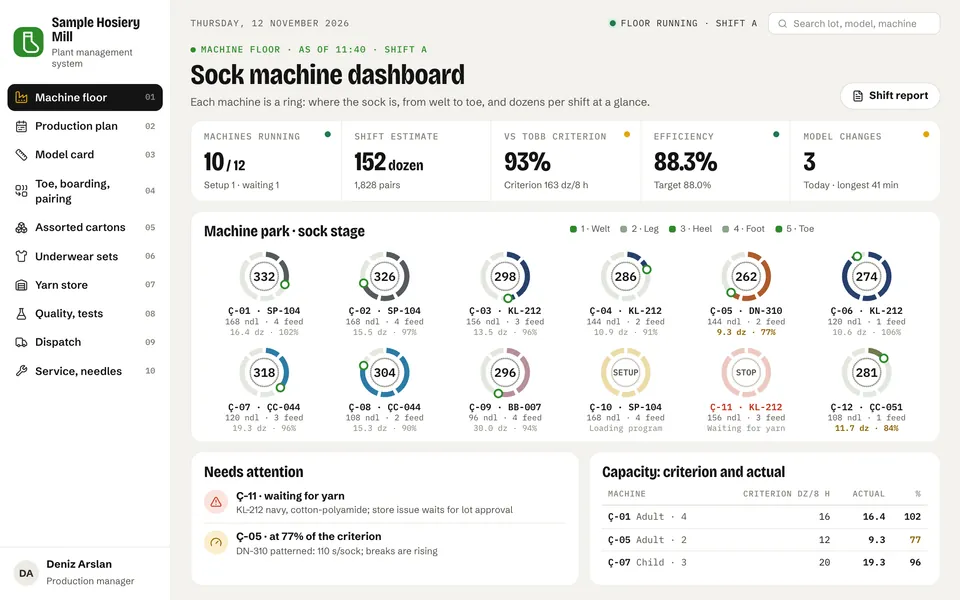
Hosiery mill machine dashboard: twelve sock knitting machines drawn as rings showing the stage from welt to toe, with speed, dozens per shift, TOBB criterion comparison and alerts
$1.16 billion Hosiery exports were $1.156 billion in 2025, down 3.8 percent; in 2024 Turkey was the world's second largest sock exporter after China, with a 7.5 percent share (İHKİB report, Ministry of Trade data). In a shrinking market, pairing waste and missing cartons eat the margin.
$745 million Underwear exports were $744.8 million in 2025, down 2.7 percent, 4.0 percent of apparel exports (İHKİB underwear report, HS 6107, 6108, 6207, 6208, 6212).
5 screens The sock machine dashboard, toe closing, boarding and pairing line, assorted carton plan, model card and underwear set readiness can be seen on this page with illustrative data.
No change to your machines Sock machines and their makers' program software stay in place; the data path is settled in discovery, by machine brand and version, and where there is no data we start with end-of-shift entry.

This page is a branch of Textile and Apparel Manufacturing software; the wider picture and the other branches are there.

Does this sound familiar?

In hosiery and underwear, losses hide in the small links from machine to pairing and from pairing to carton.

If the table below describes a sock or underwear maker, this page was written for you. The figures are sourced data; PAN makes no claim about customer numbers or success rates.

  • TOBB's capacity criterion counts a sock machine in dozens per 8 hours: on an electronic machine, adult socks are 10 dozen on one feeder and 16 on four; children's 14 to 23, babies' 20 to 32. Real output departs from this table with the model, the needle count, the sock length and the efficiency. In most mills, what percentage of the criterion each machine is running at is worked out from the shift book, not seen live.
  • The sock's story does not end at the machine: the circular machine delivers a tube with an open toe, the toe is closed on a separate machine, the sock is turned, put on a form and steam-formed, then paired and packed. The stages are separate machines and separate tables; the dozens waiting in between are often in nobody's record, and the bottleneck is noticed only when the pile has grown.
  • A pair needs the left and right sock to come from the same lot and the same machine group. If two socks from different machines or lots differ in shade, the pair is set aside at pairing; the waste appears at this stage, after the raw sock and all the labour have been spent. Unless the shade difference is caught before pairing, the waste is expensive.
  • A retail chain order means mixed colours and size bands: three colours in a three-pair pack, two size bands in a carton. In socks, how many pairs are in a pack and which colour sits on top is the sales unit itself. Seeing which pack or which pair is missing before the carton is closed is something most mills do not have; the shortage appears on dispatch day.
  • Yarn consumption is kept per dozen: the TOBB criterion gives, per dozen adult socks, 0.625 kg of cotton yarn, 0.5 kg of synthetic yarn, 0.015 kg of covered elastic yarn (gipe) and 0.05 kg of nylon bag. Actual consumption and waste per model, however, often stay at the stores issue rather than on the model's card, and the deviation reaches nobody.
  • The fibre composition label changes with the market and the component. Under EU 1007/2011 the composition is written in descending order; products with the same composition that normally form a single unit may carry one label; in a bra, the outer and inner fabric of the cup and of the back count as separate components. If the label text is not derived from the model, it is written by hand, and by hand it is written wrongly.
  • For baby and children's socks, the General Product Safety Regulation (EU 2023/988, applied since 13 December 2024) asks for the maker's name and postal address and a batch or serial number on the product or packaging; chemical limits for clothing are written in REACH Annex XVII entry 72 (formaldehyde 75 mg/kg; cadmium, chromium VI, arsenic and lead 1 mg/kg). Which lot is tied to which test report is often looked up in a file.
  • In underwear, according to practitioner articles, a bra runs from about ten components to as many as thirty-five depending on style; cut parts are split into sub-bundles such as cup, wing, centre front and strap, and keeping sizes apart is described as the hardest part of the process. A set entering sewing while elastic or hooks are missing is noticed only when the line starts to wait.
  • Production is concentrated largely in Istanbul and in small firms: of the 363 cotton sock producers in the TOBB database, 313 are in Istanbul, with about 40 employees per firm on average (the records belong to 2019-2020 and a single product code). At this scale, records are often kept in a notebook, in the foreman's memory and in messages.
The software landscape today

Which systems do hosiery and underwear makers use today, and where do they get stuck?

There is general ERP, textile-specific ERP, the program software of sock machine makers and design software. The link between them, the single chain of records from machine to pairing and from pairing to carton, has not been built in most places. Product names are taken from the makers' own pages; products whose scope could not be verified are not listed.

LayerSoftware in use todayThe gap it leaves
General ERP and accounting (horizontal backbone) Logo (Tiger, GO, Netsis), Mikro, ETA Solid for accounts, stock, invoices and e-dispatch notes, and they should stay. The machine's model program, shade difference, pairing, pack and carton detail usually sit outside these programs, in Excel and notebooks.
Textile-specific ERP Datatex NOW, Enfotek MDS (knitting, weaving and spinning), Enfotek EDS (textile and apparel) Datatex is a modular ERP for textile and apparel; it describes MQM for machine schedules and MCM for production coordination, and a Chinese sock maker was announced in 2022 as choosing Datatex NOW. Enfotek presents MDS as an industrial ERP running from knitting, weaving and spinning production to finance, and EDS as a textile and apparel ERP. How pairing, shade difference and assorted cartons are handled is settled in discovery.
Sock machine programming ORION (Lonati) Lonati presents ORION as part of the UNLIMITEX suite, programming software that replaces the older Digraph 3+: a visual programming interface, a rule engine and a real-time 3D preview showing the sock before production. Its subject is the machine program and 3D verification; lot, pairing, pack and carton records are outside its scope.
Knitwear design and 3D sampling APEXFiz, SDS-ONE APEX (Shima Seiki) Shima Seiki offers systems covering design, colour work, virtual 3D sampling and machine programming; Lonati's page says a sock-specific version is in development. These are design and program software; the order, lot and production record is kept separately.
Sock and seamless machine makers Lonati and Santoni machines (Lonati Group) Santoni writes that seamless machines make underwear, sportswear and medical garments in addition to its sock machines. The makers' software covers their own machines and programs; the stages outside the machine, such as toe closing, boarding, pairing, pack and carton, are not its subject.
Apparel and underwear cutting and sewing Login ERP, True ERP, Lectra (Gerber AccuMark, Vector Fashion), Optitex Marker, Audaces Marker, Coats Digital GSDCost Strong for the colour-size matrix, markers and standard minutes; their own pages do not describe set component readiness or sub-bundle tracking. In underwear, the readiness of cups, wings, straps, elastic and hooks often sits on a separate list.
Excel, paper forms and messaging Excel, paper pairing lists and carton labels, WhatsApp Steps in wherever software stops: the pairing list, the band, the carton contents and subcontract reconciliation often live here. Flexible, but nobody checks that quantities are consistent.

Product names are compiled from vendors' public pages (September 2026); PAN is not affiliated with them. The "gap" column summarises situations we commonly meet in discovery and is not a statement about any specific product.

Our approach

A pair and dozen layer that closes the gap between machine program, lot and carton.

We do not bring a second ERP or machine monitoring system to your sock mill. We build the chain of records from model to machine, from machine to toe closing, boarding and pairing, and from pairing to carton, leaving your ERP and the makers' program software in place and filling the missing links between them.

Sock machine dashboard

Every machine shows its model program, needle and feeder count, speed, seconds per sock, dozens per shift and efficiency; the ring draws where the sock is from welt to toe. Actual output is compared with the TOBB capacity criterion; a stopped or setting-up machine shows at once.

Toe closing, boarding and pairing line

The dozens waiting at each stage from knitting to pack and the progress of each lot are tracked. The shade difference between left and right sock is caught before pairing; the rule that a pair comes from one lot and machine group works with a threshold you set.

Model card

Size band, cylinder and needles, machine program version, yarn composition, pair weight and consumption per dozen sit on one card. Consumption is compared with the value in the TOBB criterion; the fibre composition label derives from the card.

Pack, band and assorted carton

Mixed colours and size bands are poured into a carton template; which pack is in which cell and which pair is missing shows before the carton closes. Pack and carton barcodes, the carton label and the packing list come from the same record.

Pre-dispatch documents and labels

The fibre composition label, the maker's name and address, the batch number and the test report the customer's specification asks for are tied to the lot; a missing document warns before dispatch. Which lot went with which report stays in the record.

Underwear set readiness

In a bra and brief set the cup, wing, centre, strap, elastic and hook are counted size by size; a missing component shows before the sewing line stops. Label components are split by the cup and back fabrics of the bra.

Modules we can build

Modules we can build for hosiery and underwear manufacturing

You do not need to build all of them at once. Most sock mills start with the model card, lot-to-pairing records and carton output; the machine dashboard, yarn consumption, pre-dispatch documents and underwear set readiness are added later.

LINE

Toe closing, boarding and pairing line

Dozens waiting by stage, lot progress, shade difference alert, pairing waste and the pairing list.

MODEL

Model card and program version

Size band, cylinder and needles, program version and approval, pair weight, yarn composition and label text.

CARTON

Assorted carton plan

Carton template for mixed colours and size bands, pack contents, missing pair alert and order progress.

YARN

Yarn consumption and criterion comparison

Cotton, synthetic, elastane, gipe and bag consumption per dozen; deviation by model and lot; a basis for the capacity report.

SET

Underwear cutting and set readiness

Counts of cup, wing, centre, strap, elastic and hook by size; a shortage list and bra label components.

What it looks like on screen

What hosiery and underwear software looks like on screen

These screens come from the demo design we prepared for hosiery and underwear makers. The figures are sample data; the system is set up around your own machines, models and customer specifications.

Sock machine dashboard. Each sock machine is drawn as a ring showing the stage of the sock from welt to toe. Speed, dozens per shift and the comparison with the TOBB capacity criterion sit beside it, and a stopped or setting-up machine shows at once.
Toe, boarding, pairing. Dozens waiting at toe closing, turning, boarding and pairing, and the progress of each lot, are visible. A shade mismatch is caught before pairing so that a pair comes from one machine and lot.
Assorted carton plan. The mixed colours and size bands of a retail order are poured into a carton template: which pack sits in which cell, and which pair is missing. A missing pair shows during pairing and packing, before the carton closes.
Model card. A model's size band, machine program, yarn composition and consumption per dozen on one card. The fibre composition label derives from the card and consumption is compared with the value in the TOBB capacity criterion.
Underwear set readiness. In a bra and brief set the cup, wing, centre, strap, elastic and hook are counted size by size, so a missing component shows before the sewing line stops. Label components are split by the cup and back fabrics of the bra.

Company names, people and figures on these screens are sample data. The system is built around your own processes, document names and rules. We walk you through the demo in a call: request a demo

Integration with your existing ERP

Your ERP, your machines and your program software stay in place.

Sock mills usually already have two solid systems: an accounting and e-document program and the machine makers' own programming software. PAN does not replace them; it builds the missing links between them, namely the lot, the pairing and the carton output.

Our integration approach →
  • Customer, stock, order, waybill and invoice exchange with Logo, Mikro, ETA or whichever ERP you use; double entry goes away. Accounting and official documents stay in your current program.
  • Taking speed, status and production data from the sock machines' own monitoring systems; the path is set in discovery by machine brand and version. Where there is no data, we start with end-of-shift entry.
  • The program and version of a model prepared in the machine maker's program software are linked to the model card; the file itself stays in that software, and the card shows its version and approval status.
  • Barcoded pack and carton labels; scanning with handheld terminals and label printers at the pairing table and on the pack line. Your customer's carton label and packing list format are taken as they are.
  • The e-dispatch note and the dispatch documents your customer asks for go through your existing ERP; the PAN layer supplies the carton and pallet contents to that document as data.
Outcomes

What changes on the floor, at the pairing table and on the pack line once this layer is in place?

  • What percentage of the TOBB criterion each machine's dozens per shift reach becomes visible; a machine falling below the criterion is noticed without waiting for the end of the shift.
  • Model change and program loading time are recorded; which program version runs on which machine is known.
  • The dozens waiting at toe closing, boarding and pairing are visible live; a bottleneck is noticed before the pile grows.
  • The shade difference between left and right sock is caught before pairing; if a pair is set aside, the machine and lot it came from are known.
  • Mixed colours and size bands are poured into a carton template; a missing pair shows before the carton closes, without waiting for dispatch day.
  • Yarn consumption per dozen is compared with the model card and the criterion value; a deviation is discussed on the model's card.
  • The fibre composition label derives from the model card; when the composition changes, the label is not rewritten by hand.
  • In underwear, a missing component (hook, elastic, cup) is visible by size before the set enters sewing; the line does not wait.
  • Before dispatch, the maker details, batch number and test report are tied to the lot; when a customer asks, the answer is in the record.
Process

A realistic five-stage path that begins with discovery.

  1. 01

    First conversation and screen tour

    1 week

    We listen to how your hosiery or underwear production is built: the number and type of machines, models, customer type (retail, brand, export), pack and carton structure, and which ERP. We tour the screens on this page together and talk about which one corresponds to what you have.

  2. 02

    Discovery at the mill

    1-2 weeks

    We follow the flow from yarn intake to dispatch on site: the knitting floor, toe closing, boarding, the pairing table and the pack line. We collect your machine list, model card, shift report, pairing list and carton label, and take your field names as they are.

  3. 03

    Scope, priority and budget

    1 week

    We present, in writing, the module order starting from where it hurts most, the integration paths, the timeline and the budget. The first phase is often the model card, lot-to-pairing records and carton output.

  4. 04

    Development and pilot

    6-10 weeks

    We deliver modules in order and try them in real work with one floor and a few models. The shift supervisor, the pairing table and the pack supervisor use the screen at every delivery; we take corrections from the floor.

  5. 05

    Go-live and support

    Ongoing

    We roll out to all machines and lines, train your team and stay next to you in the first weeks. Afterwards, growing the system for a new machine, a new model or a new customer requirement continues with the same team.

Why Pan Innovation House?

A team that speaks the hosiery maker's language and builds the machine and carton chain on the floor.

You see the screens first

Not words but a demonstration: the machine dashboard, the toe and pairing line, the assorted carton, the model card and underwear set readiness are on this page. The figures are illustrative; your system is built around your own machines and customer specifications.

We work in the terms of socks

Cylinder, needle, feeder, leg, heel, toe closing, boarding, pairing, dozen, band, carton and assortment appear on screen under the names you use; staff do not learn a new language.

In Gaziantep, close to the floor

Our headquarters is in Gaziantep; we do discovery at the mill and work with you on shift. Our London office makes correspondence and documents easier for firms with export customers.

We start with discovery

The machine park, models and customer mix change from mill to mill; that is why we give the scope and budget in writing after discovery and do not quote figures in advance.

We do not touch your current systems

Your ERP, your machine makers' systems and your program software stay in place; we build the missing links between them. Accounting and official documents stay in your current program.

Data and code are yours

You choose the server. The system is written for you; we hand over the data and source code without tying them to another platform.

Frequently asked questions

Hosiery and Underwear Manufacturing software: common questions

What does sock production tracking software do?

It keeps the chain from model to carton in one record: machine, model program, dozens per shift and efficiency, the dozens waiting at toe closing, boarding and pairing, shade difference, pack and carton contents, and yarn consumption. The key difference is that for every pair the record shows which machine, which lot and which program it came from.

How is sock machine capacity calculated?

The sock section of TOBB's knitted fabric capacity criterion gives dozens per 8 hours: on an electronic machine, adult socks are 10 dozen on one feeder, 12 on two, 14 on three and 16 on four; children's 14, 17, 20 and 23; babies' 20, 24, 28 and 32. A year counts as 300 days. The system shows the machine's actual output next to this criterion and provides a basis for the capacity report.

How many pairs are in a dozen socks?

In TOBB's worked example a dozen is 12 pairs: 17,550 dozen converts to 210,600 pairs a year. The screens show the dozen and the pair together; how many pairs go in a pack comes from the customer's pack instruction and may be 2, 3 or 5 depending on the product and customer.

Why are toe closing (linking) and boarding tracked separately?

A circular knitting machine delivers a tube with the welt and toe open; the toe is closed on a linking machine, the sock is turned, then put on a form and steam-formed (boarding). These are separate machines; if the dozens waiting at each stage are visible separately, the bottleneck and the waste can be discussed together with the stage where they arise.

Why is pairing a separate stage?

A pair needs the left and right sock from the same lot and the same machine group; a shade difference between machines makes the pair waste. The system keeps which machine and lot each sock came from on the pairing list, you set the shade difference threshold, and if it is exceeded the pair is set aside and the waste record keeps its cause.

How is an order with mixed colours and size bands tracked?

The order's pack type (for example a three-pair, three-colour pack), size band and carton instruction are poured into a carton template. Which pack is in which cell, which pair is missing and what percentage of the order is complete shows before the carton closes; the carton label and packing list come from the same record.

How is fibre composition written on a sock label?

Under EU Regulation 1007/2011 the composition is written with the name and weight percentage of every fibre in descending order; up to 5 percent of a single fibre or 15 percent in total may, under conditions, be called "other fibres". Products with the same composition that normally form a single unit may carry one label; along the supply chain, commercial documents may replace the label. We derive the label text from the model card.

How are label components split on a bra?

Annex IV of EU 1007/2011 asks that for a bra the composition be stated for the whole product or for the outer and inner fabric of the cups and the back; for corsets and girdles the front, rear and side panels, and for corselets the cups, front and rear stiffening panels and side panels. The system keeps the components apart and shows them in the label preview.

Which rules matter for baby and children's socks?

In the EU the General Product Safety Regulation (2023/988, applied since 13 December 2024) asks for the maker's name and postal address and a batch or serial number on the product or packaging. Chemical limits for clothing are in REACH Annex XVII entry 72; class one of OEKO-TEX STANDARD 100 is for baby articles up to three years. The system ties the batch number and the test report.

In which provinces are sock and underwear makers concentrated?

The TOBB industry database lists 363 registered cotton sock producers, 313 of them in Istanbul; Istanbul's registered capacity is about 906 million pairs a year against about 1.2 billion for the country. After Istanbul, employment is highest in Çankırı, Tekirdağ, Giresun, Düzce and Edirne; Denizli, Ankara, Kırklareli, Gaziantep and Bursa also have registered producers (the records cover 2019-2020 and a single product code). The provincial split for underwear could not be verified.

My ERP is Logo or Mikro. Do I have to replace it?

No. Accounting, customers, stock and invoices stay. The PAN layer keeps the detail of socks and underwear (machine, model, lot, pairing, carton, set) and passes the needed movements to the ERP; double entry goes away.

How long does it take to set up, and what does it cost?

From the first conversation to a pilot it usually takes 9-14 weeks; after discovery we give the scope, timeline and budget in writing. Because the number of machines, models, customer specifications and integrations changes, we do not quote figures in advance.

Next step

Let's tour the screens together, then visit your sock mill

It is not possible to write the system of a sock or underwear mill from a distance. Let's first tour the screens on this page together; then we will see your machines, your model cards and your carton label on site. After discovery we give the scope, timeline and budget in writing.

Related services

Related areas worth considering

Pan Innovation House

Call us

By phone

+90 543 930 12 72

Our phone line is open every day.

WhatsApp on your phone

Scan with your phone camera. The chat opens with your message ready.

Prefer that we call you? Leave your details