Pan Innovation House Pan Innovation House
INDUSTRY SOFTWARE · WEAVING MILL

Weaving mill software that records the path of every beam and every loom stop, from warp to loom

Pan Enterprise Solutions, the software arm of Pan Innovation House · based in Gaziantep, Türkiye, with a London office

We bring the plan between warping, indigo dyeing, sizing, drawing-in and tying-in and the looms, plus the article card, loom stops, yarn requirement and greige rolls, into one chain of records. Your ERP (Logo, Mikro, Netsis or another) stays where it is; we do not touch the loom maker's monitoring screen, we build the business layer beside it, including weaving preparation. We show the screens as designs first, then build them around your own looms.

Asking about price? We listen to the scope in a short call and share the budget frame and timeline in writing. The first 30-minute call is free; the scope of an on-site discovery, and its fee if any, is agreed in writing during that call.

We work on site for plants in and around Gaziantep; elsewhere in Türkiye and abroad, discovery starts by video call and a visit is planned if needed. Our London office is at Unit 6 Cranford Way, Hornsey, London N8 9DG.

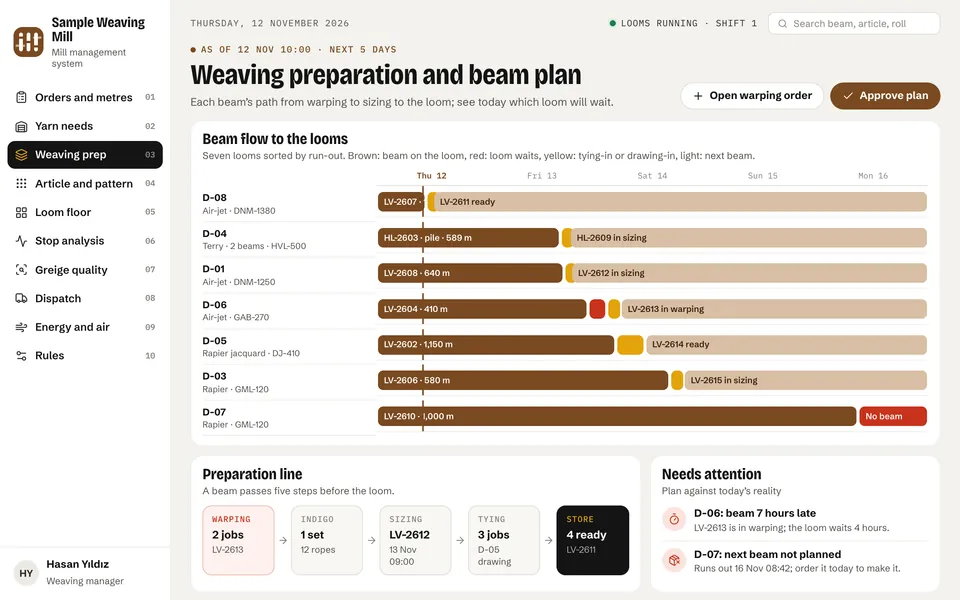
Weaving software preparation screen: five-day beam plan for seven looms, the beam on the loom, tying-in and drawing-in gaps, the next beam status, preparation line steps and alerts
Beam plan When each beam runs out, whether the next one is in warping, sizing or the store, and how long the loom will wait, on a five-day plan.
Consistent with TOBB Loom output, preparation capacity and yarn kilos follow the same logic as the formulas in the Turkish TOBB weaving capacity criterion.
Your ERP untouched Accounts, stock, invoices and e-documents stay in your current system; the exchange is confirmed in discovery, by version.
Scope set in discovery Start with the beam plan or with stop recording and grow module by module; not every mill needs every module.

This page is a branch of Textile and Apparel Manufacturing software; the wider picture and the other branches are there.

Does this sound familiar?

In weaving, margin is lost not when a loom stops turning but when a beam does not reach it on time.

The picture in weaving mills is largely the same. If even one line sounds familiar, this page was written for you.

  • When a beam is about to run out, whether the next one is in warping, in sizing or in the store often lives in the head of the preparation foreman; the loom stops for "no beam" or "drawing-in" before anyone notices. In a 16-week study at an upholstery mill, manual warp tying took 62,095 minutes in 334 stops.
  • The warping, sizing and drawing-in plan runs on spreadsheets or a whiteboard; a loom's run-out time rests on a guess at the machine. The real run-out time from remaining metres, speed, weft density and efficiency is not calculated.
  • In denim, indigo warp dyeing, re-beaming and sizing run in sequence; when the dyeing set is not traced, shade differences appear between beams of the same order and nobody can find the cause.
  • Article data (warp and weft density, total ends, sizing recipe, jacquard file) sits separately with the warping foreman, the loom fitter and purchasing; when a version changes, one of them keeps the old value.
  • Loom stops are entered from paper at the end of the shift; because nobody knows whether a break came from the yarn, preparation or the loom setting, the same problem repeats for weeks. Stop reason codes vary from person to person.
  • Recurring break causes such as selvedge ends, low-twist weft yarn, thick-thin places and extra ends are not tied to the lot, the beam or the supplier; a yarn complaint and a preparation complaint both stay without proof.
  • In a park of looms from different makers, each maker has its own monitoring screen; there is no single efficiency definition, no single stop dictionary and no single shift report. On air-jet looms, compressed air use does not show next to efficiency.
  • When an order in metres is turned into yarn kilos, the loom width, weight and yarn utilisation calculation depends on one person; warp and weft yarn are not ordered separately, so the shortage appears when the due date is close.
  • On two-beam products such as terry, the pile warp runs out before the ground warp but the plan is made as if there were one beam; if the pile beam is not ready, the loom waits.
  • On greige rolls the length on the loom counter and on the inspection machine do not match; because the gap is recorded nowhere, length reconciliation with the customer turns into an argument.
The software landscape today

Which software do weaving mills use today, and where does it fall short?

In our searches we did not find a maker-independent, ready product that treats weaving preparation, the beam plan and loom stops together. Mills usually run three or four layers side by side; spreadsheets and notebooks fill the gap in between.

LayerSoftware in use todayThe gap it leaves
General ERP and accounting (the horizontal backbone) Logo (Tiger, GO, Netsis), Mikro, ETA, Canias, Uyumsoft, DİA Solid and should stay for accounts, stock, invoices, e-waybills and ledgers. Weaving-specific records such as beams, the warp plan, loom stops and greige rolls do not appear in their standard scope.
Loom makers' monitoring platforms Picanol PicConnect, Itema MyWeave They give live loom status, production and history charts; PicConnect also covers energy and air monitoring, alerts, a style library and export. They see their own brand of looms; a single screen for a mixed park, the preparation line and the link to orders are outside their scope.
Weaving preparation machines Karl Mayer (warping machines, sizing and assembling machines, indigo dyeing units, creels and sample warpers) A broad machine family, very strong on the machine side. Orders, the article card, the beam plan and the link to the looms belong to the mill's own business layer, not to the machine maker.
Textile-specific ERP and MES Datatex NOW (including machine queue scheduling), BMSvision WeaveMaster, Enfotek EDS and MDS, Login ERP The vendors' pages list planning, production monitoring and textile processes. They are end to end and strong, but the installation is large; fit for a small or mid-sized weaver who wants to keep the current ERP and add only preparation and loom layers is settled in discovery.
Jacquard and pattern software NedGraphics Jacquard CAD/CAM, Stäubli and Bonas jacquard machines They carry the design file from the designer to the jacquard machine. Which file version is tied to which article, loom and order stays a production-record question.
Spreadsheets and paper notebooks Beam notebook, sizing sheet, stop sheet, roll inspection sheet, yarn requirement table Flexible but tied to one person; no versions, approvals or history. Tracing back from a customer complaint to the beam, yarn lot, sizing recipe and loom takes days.

Product names are compiled from vendors' public pages (September 2026); PAN is not affiliated with them. The "gap" column summarises situations we commonly meet in discovery and is not a statement about any specific product.

Our approach

A weaving business layer that closes the gap between loom monitoring and accounting.

We do not bring a second ERP or a monitoring system that competes with the loom maker's screen. We build the chain of records from the order to the greige roll, weaving preparation included, and connect it with your existing systems. The system does the arithmetic; the mill makes the decisions.

Beam and warp plan

The beam on each loom, remaining metres and the real run-out time are calculated from speed, weft density and efficiency. The next beam shows as in warping, in sizing or in the store; tying-in and drawing-in time enter the plan, and the hours a loom will wait turn red in advance.

Article and pattern card

Warp and weft density, loom width, total ends, yarns, weave, loom type, target efficiency, sizing recipe and the jacquard file sit on one card. The same card goes to warp preparation, the loom and the yarn calculation; when the version changes everyone sees the same value.

The root of a loom stop

Stops are recorded with codes: warp, weft, setting, maintenance, cleaning, beam, drawing-in. Each stop is split by origin into yarn, preparation or weaving; frequency per 100,000 picks is compared by loom and article, and a recurring cause is tied to the beam and the yarn lot.

Yarn requirement and order metres

Order metres are turned into kilos through loom width, weight and a yarn utilisation rate; warp and weft yarn are calculated separately and compared with stock and open purchase orders. In terry, ground and pile are separate lines.

Loom and ERP connection

Loom data is read by whatever the machine offers: the maker platform's export, the loom controller's output or a counter. Accounting and stock records are exchanged with your current ERP; the same information is never typed twice.

Greige roll quality and dispatch

As a beam's fabric is cut into rolls, fault positions, inspected length and the loom counter gap are recorded. The class follows the customer's rule; suitable rolls go into the dispatch order, the waybill and the customer's metres.

Modules we can build

Modules we can build for a weaving mill

You do not need all of them at once. Most mills start with the beam plan or stop recording and grow with the article card and the yarn calculation. The screens can be seen in the gallery on this page.

PREPARATION

Weaving preparation and beam plan

Warping order, number of sections, ends and warp length, sizing sequence, drawing-in and tying-in crew, beam store; the flow of beams to the looms on a five-day plan, with the risk of a loom waiting.

INDIGO

Denim indigo warp chain

Ball warping, number of ropes, dye boxes, re-beaming and the dyeing set record; sequential dyeing is tied to the beam and the order, so a shade difference can be traced back.

ARTICLE

Article and pattern card

Warp and weft density, total ends, loom width, weight, weave, sizing recipe and add-on target, loom type and version history; for jacquard, the design file and its approval status.

STOPS

Loom stop analysis

Stop causes, stops per 100,000 picks, origin split, long-stop durations, shift and loom comparison.

FLOOR

Loom floor and shift report

Live loom status, shift metres, efficiency and beam run-out; looms of different makes on one screen with one stop dictionary. The maker platform's data is read where available.

YARN

Yarn requirement and order metres

Metres to kilos, warp and weft split, pile and ground in terry, stock and open purchase orders, the open shortfall and the purchase request.

QUALITY

Greige roll quality and dispatch

Roll cutting, fault positions and types, inspected length against the loom counter, class, roll label, dispatch order and waybill.

ENERGY

Compressed air and energy

Air and energy use on air-jet looms beside metres and efficiency; a leak and nozzle check order for a loom that drifts from its own average.

SERVICE

Loom maintenance plan

Periodic maintenance, setting and part replacement plans tied to the loom's running hours; the service record is read together with the stop analysis.

What it looks like on screen

What weaving mill software looks like on screen

These screens are sample designs we prepared for weaving mills. The figures are representative; the system is set up around your own looms, articles, preparation line and rules.

Weaving preparation and beam plan. When each beam runs out, whether the next one is in warping, sizing or the store, and how long the loom will wait, all on a five-day plan. The red bar shows up before the beam does.
Article and pattern card. Warp and weft density, total ends, weave, indigo warp chain, sizing recipe and jacquard file live on the article card. The same card goes to preparation, the loom and the yarn calculation.
Loom stop analysis. Stops are ranked by cause, origin (yarn, preparation, weaving) and frequency per 100,000 picks. Long stops such as manual warp tying and drawing-in show separately; problems trace back to the beam and the yarn lot.
Yarn requirement and order metres. Order metres are turned into kilos through loom width and weight; warp and weft yarn are compared separately with stock and open purchase orders. A shortfall shows before the due date arrives.
Greige roll quality and dispatch. As a beam’s fabric is cut into rolls, each roll’s faults, inspected length and loom counter gap are recorded. The class follows the rule, and suitable rolls go into the dispatch order.

Company names, people and figures on these screens are sample data. The system is built around your own processes, document names and rules. We walk you through the demo in a call: request a demo

Integration with your existing ERP

Your accounting program and your loom monitoring screens both stay in place.

Most weaving mills already have two layers: an accounting and e-document program on one side, and the loom maker's monitoring screen or loom controller on the other. What is missing is the workflow between them: the order, yarn requirement, warp preparation, beam plan, stop root cause, roll quality and dispatch. We build that layer and set up data exchange with both sides. The code and the data are yours; you choose the server.

Our integration approach →
  • Exchange of accounts, stock, waybill and invoice data with Logo, Mikro, Netsis, ETA, Canias or whichever program you use; double entry goes away.
  • Loom data: the export offered by maker platforms such as Picanol PicConnect or Itema MyWeave, the loom controller's output or a counter. Which one is used is settled in discovery by the make and model of the loom.
  • Tying jacquard design files to the article card; the file format and transfer path are confirmed by the jacquard controller's model.
  • Reading counters and production data from warping, indigo and sizing machines, confirmed in discovery by the machine's output.
  • First data load from your spreadsheets (beam notebook, article list, yarn table); your own field names are kept.
Outcomes

What changes in weaving once this layer is in place?

  • You know where the next beam is before one runs out; the hours a loom will wait for "no beam" or "drawing-in" show at the planning stage.
  • A loom's run-out time is calculated from remaining metres and real metres per hour, not guessed; arguments at shift handover shrink.
  • The total time of long stops such as manual warp tying and drawing-in is visible on its own; moving to a tying-in machine or bringing a warping order forward is discussed with numbers.
  • Stops are split into yarn, preparation and weaving origin; the problem goes to the team where it lives, and the record speaks instead of blame.
  • The same break cause is tied to the beam and the yarn lot; when you talk to a supplier or to preparation you hold a date, a lot and a frequency.
  • The article card lives in one place; when a version changes, warping, sizing and the loom see the same value.
  • Order metres are turned into kilos; because warp and weft yarn are calculated separately, a shortage shows before the due date draws near.
  • The gap between the loom counter and inspected length is recorded per roll; reconciliation with the customer is done with a document.
  • Compressed air use on air-jet looms is followed together with efficiency; a loom that drifts from its own average is caught early.
Process

A realistic five-stage path that begins with discovery.

  1. 01

    First conversation and screen walk-through

    1 week

    We listen to the number and makes of your looms, your product groups (denim, terry, shirting, upholstery, jacquard), your preparation line and the ERP you use. We walk through the screens on this page together and talk about which one matches yours.

  2. 02

    Discovery at the mill

    1-2 weeks

    We watch the warping, dyeing, sizing, drawing-in and tying-in flow on site, along with your beam notebook, article cards, stop record and roll inspection sheet. We take your own field names and stop codes as they are.

  3. 03

    Written proposal and first phase

    1 week

    We write down which module to start with, which data is read from which loom and how, the ERP exchange and your server preference, and settle the scope of the first phase together.

  4. 04

    Build and pilot hall

    4-8 weeks

    We start in one hall or one product group: the beam plan, the article card and stop recording go live. Settings are tuned with your users, and code and data are shared with you from the start.

  5. 05

    Rollout and support

    ongoing

    The remaining halls and the yarn calculation, roll quality and energy modules are added in turn. We keep working with the same team on training, tuning and change requests.

Why Pan Innovation House?

A team that speaks the weaver's language and builds the chain of records at the mill.

You see the screens first

You can see the beam plan, article card, stop analysis, yarn requirement and roll quality screens in the gallery on this page today. Your system is built from that core with your looms and your rules.

We work in weaving terms

Beam, warp, weft, sizing, drawing-in, tying-in, article, dobby, jacquard, pile warp and efficiency appear on screen under the names you use; your staff learn no new language.

We do not depend on your loom brand

Air-jet, rapier and projectile looms may come from different makers. A single stop dictionary and a single efficiency definition can pull them onto one screen; how the data is read is settled in discovery.

Arithmetic consistent with TOBB

Loom output, preparation capacity and yarn kilos are calculated with the same logic as the formulas in the capacity report, so the figure on screen and the figure in the report agree.

Your data and your code

Your data lives on your server or the cloud you choose; the source code and the data are yours. If you want to continue with another team, the system does not hold you hostage.

Headquartered in Gaziantep, with a London office

Our headquarters are in Gaziantep, close to the field; we come to your mill and work beside the looms. Our London office also covers English documents and screens for weavers who export.

Frequently asked questions

Weaving Mill software: common questions

What is a beam and what does a beam plan do?

A beam is the large spool onto which the warp yarns are wound before they are mounted on the loom. When a loom's beam runs out, the loom stops until a new one is tied in. A beam plan calculates each loom's remaining metres and run-out time and shows whether the next beam is in warping, in sizing or in the store, so when and for how long a loom will wait is visible in advance.

How do you calculate a loom's run-out time?

Loom output follows the logic of the TOBB weaving capacity criterion: speed times 60 times efficiency divided by weft density times 100. The remaining metres are divided by this rate. Efficiency is not a fixed number; it is read from the latest data of the loom and the article, and the mill sets the rule.

If the loom maker has a monitoring platform, why do I need your software?

Maker platforms are strong at seeing their own brand of looms. Warp preparation, the beam plan, the article card, yarn requirement and greige rolls can fall outside their scope, and a mixed-brand park may need a single screen. We leave the maker platform in place, read its data by export or API and build the business layer beside it. What can be read depends on the loom's model and version and is settled in discovery.

Why do you split stops into yarn, preparation and weaving?

In weaving literature, roughly 20-30% of stops are reported to come from yarn faults, 30-40% from preparation and 30-40% from the weaving process. Comparing your own mill with that split shows which team has the problem. If there is a deviation, the cause is traced to the beam, the yarn lot or the loom setting.

Why does stops per 100,000 picks matter?

Looms run at different speeds and for different times, so comparing raw stop counts misleads. Relating stops to the number of picks compares looms, articles and shifts fairly. The literature notes that 10 stops per 100,000 picks was once standard and that under five is tolerated today; the mill sets the target for its own article.

How do you track the indigo warp chain in denim?

In ball warping the number of ends and ropes, the dyeing range, dye boxes and dips, re-beaming, sizing and size add-on are tied to the beam record. If a shade difference shows up between beams of one order, you can see which dyeing set and which sequence it came from. You can also define your own sequential dyeing rule.

How is planning done for two-beam products such as terry?

In terry the ground and pile warps are on separate beams and the pile warp is used up faster than the fabric metres. The plan follows both beams as separate lines, shows which runs out first and whether the new beam is ready. The pile take-up ratio is kept on the article card.

Do you also manage jacquard design files?

We tie the file version, its approval status and the loom it runs on to the article card. Sending the file to the jacquard controller depends on the connection between your design software and the controller; we record which version was used on which order.

How do you calculate the yarn requirement?

Order metres are multiplied by loom width and average weight, then divided by the yarn utilisation rate. The TOBB criterion gives this rate as 92-95%. Warp and weft yarn are separate lines; the result is compared with stock and open orders and the shortfall becomes a purchase request. Sizing materials can be counted by the same logic.

Why track compressed air use?

One loom maker states that about two thirds of an air-jet loom's energy use relates to compressed air; that is a manufacturer's claim. When air and energy data show beside the loom's metres and efficiency, a loom that drifts from its own average is caught early. Whether the data can be read depends on the loom's model and platform.

Do I have to replace Logo, Mikro or Netsis?

No. Accounting, accounts, stock, invoices and e-documents stay in your current ERP. We write the weaving-specific layer and send the needed records to your ERP. The exchange path is confirmed in discovery by the program's version.

Which weaving products do you cover?

We prepared screens for mills producing denim, shirting poplin, gabardine, terry towels, upholstery and jacquard fabric. Every mill's article structure is different; the screens are built around your articles and your rules.

How long does installation take and what does it cost?

After discovery, the written proposal fixes scope, time and price. The first phase usually starts in one hall or one product group with the beam plan, the article card and stop recording. Scope varies with the number of looms and the ways data can be read.

Do you promise numbers on efficiency and waste?

No. We do not promise a percentage for efficiency gains or fewer stops; mills, articles and loom parks differ too much. What we do is make the cause of a stop or a waiting loom visible in the record and make improvement measurable against your own target.

Next step

Let's walk through the screens together, then come to your mill

A weaving mill's system cannot be written remotely. Let us first go through the screens together; then we will see your looms, your preparation line and your beam notebook on site and propose the first phase in writing.

Related services

Related areas worth considering

Pan Innovation House

Call us

By phone

+90 543 930 12 72

Our phone line is open every day.

WhatsApp on your phone

Scan with your phone camera. The chat opens with your message ready.

Prefer that we call you? Leave your details