Pan Innovation House Pan Innovation House
INDUSTRY SOFTWARE · NONWOVENS

Nonwoven software that records every metre of the line, from resin to jumbo roll and from slitting to the customer’s roll

Pan Enterprise Solutions, the software arm of Pan Innovation House · based in Gaziantep, Türkiye, with a London office

We bring line speed, width and basis weight for spunbond, meltblown, spunlace, needle-punched felt and thermobond lines, the PP resin lot, the jumbo roll and slitting plan, laboratory results and the customer’s specification into one chain of records. Your ERP stays where it is; we do not touch your line automation or measuring instruments, we build the shop-floor layer next to them. The screens are on this page; scope is settled in discovery.

Asking about price? We listen to the scope in a short call and share the budget frame and timeline in writing. The first 30-minute call is free; the scope of an on-site discovery, and its fee if any, is agreed in writing during that call.

We work on site for plants in and around Gaziantep; elsewhere in Türkiye and abroad, discovery starts by video call and a visit is planned if needed. Our London office is at Unit 6 Cranford Way, Hornsey, London N8 9DG.

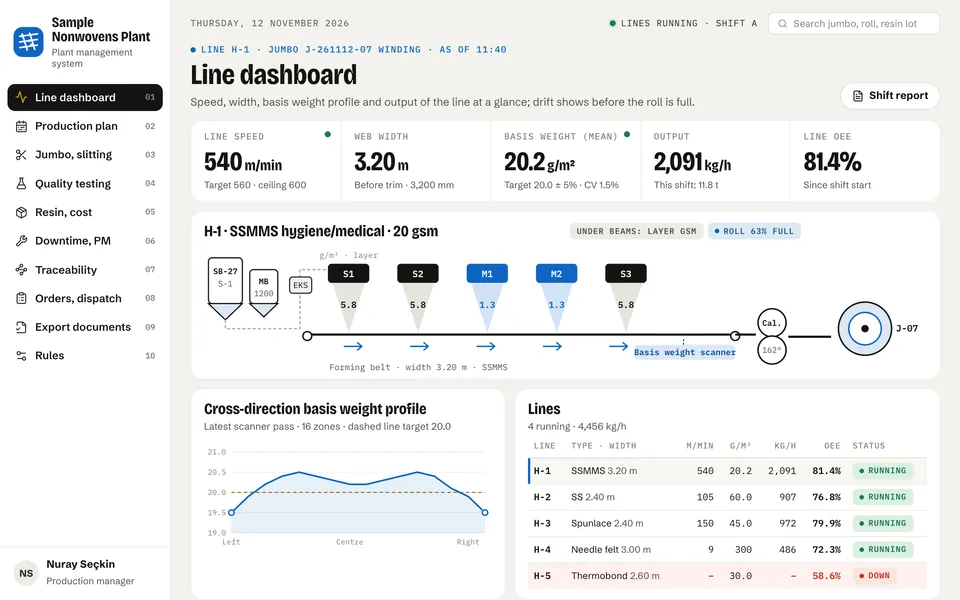
Nonwoven software line dashboard: SSMMS line layout, speed, width, basis weight, output and OEE, cross-direction profile and a status table for five lines
81% Gaziantep produces about 81% of Turkey’s nonwovens, with 40 companies registered with the chamber of industry (GSO data as reported in 2022). We build software close to the floor.
5 screens Line dashboard, jumbo roll to slitting traceability, quality and specification, raw material and cost, and orders and dispatch are on this page with sample data.
Without touching your lines Line control, scanners and laboratory instruments stay as they are, and so do customers, stock and invoices in your ERP. Data transfer is settled in discovery by instrument and version.
Scope in discovery Most plants start with the line dashboard and the jumbo and slitting record; quality, raw material and export modules follow.

This page is a branch of Textile and Apparel Manufacturing software; the wider picture and the other branches are there.

Does this sound familiar?

On a continuous line, losses disappear between the jumbo roll and the customer’s roll, and between the lab result and the specification.

If the table below describes a spunbond, meltblown, spunlace or felt plant, this page was written for you. The figures come from published sources; they are not PAN’s own customer results.

  • Lines are fast and heavy: on a Reicofil spunbond line the belt can reach 1,200 metres a minute, the line width 5.2 metres, and beam output 155-270 kilograms an hour per metre. At that speed half an hour of drift means tonnes of product, yet hourly output is calculated on a paper form collected at the end of the shift.
  • Basis weight is not the same across the width. Even where a scanner exists, the profile is not tied to that jumbo roll’s label or the order specification; the drift at the left and right edges often turns up in the lab or at the customer. Which jumbo went to which customer, and how many metres, is written in a separate book.
  • The link between resin lot and product is weak. Spunbond uses melt flow classes such as MFR 27 and 37, meltblown from 800 up to 1,800; the value on the supplier’s certificate, the silo on the line, the masterbatch lot and the jumbo roll are often matched by hand in a silo book. When a customer asks for the lot, the answer takes hours.
  • Going from jumbo roll to customer roll is a separate optimisation problem. Order widths from 340 mm to 1,200 mm are cut from the jumbo width, and edge trim and knife setup time often depend on a cut layout chosen by hand. The waste of alternative plans is not seen side by side.
  • After slitting, the link between slit roll, jumbo and resin lot breaks. The slit roll label shows customer and order but not which line, which hour and which lot it came from; when a complaint arrives, tracing back is paperwork and guesswork.
  • Test method and sample position are not in the record. The EDANA/INDA method list has separate method numbers for basis weight, breaking force and elongation, air permeability, hydrostatic pressure, strike-through time, linting and bacterial filtration efficiency; but the result sheet does not always say which method, machine or cross direction, and which strip of left, centre or right was measured.
  • The specification changes with the customer’s sector. Medical middle layers meet mask standards such as EN 14683 and gown standards such as EN 13795; filtration asks for an ISO 16890 class; geotextiles need CE marking; wet wipes need plastic content marking. If one line serves all of them, the specification is remembered when the product is loaded, not when the order is opened.
  • Whether trim may be fed back depends on the specification. One customer may allow edge trim to return to the same line while a medical or hygiene specification may not allow regrind at all. If the regrind bin, the jumbo it came from and where it goes are not tracked, mix-ups become possible.
  • Resin prices are volatile and raw material is the largest cost. Unless the cost change per 1,000 square metres and per jumbo roll is calculated when the price moves, quotes and open orders are managed by feel. If the resin is imported, the inward processing permit and export commitment are tracked by hand as well.
  • The sector is large and concentrated in one province: Gaziantep counts 40 nonwoven lines, 18 meltblown and spunbond lines, 5 spunlace, 2 thermobond and 22 felt lines, serving hygiene, medical, automotive, construction and filtration. With that many lines side by side, efficient, traceable and documented production is a competitive field beyond price.
The software landscape today

Which software do nonwoven plants use today, and where does it fall short?

There are the line makers’ own systems, in-line measuring instruments, slitting optimisation and MES for roll production, plus general ERP. The gap sits in order specifications, the jumbo-to-slit-roll record, the resin lot and export documents. The list below names only products described on their own pages; we do not assume a product lacks a feature its pages do not describe.

LayerSoftware in use todayThe gap it leaves
General ERP and accounting (horizontal backbone) Logo (Tiger, GO, Netsis), Mikro, ETA Solid for customers, stock, invoices and e-waybills, and they should stay. The jumbo-to-slit-roll genealogy, the basis weight profile per line, the resin lot and the slitting plan are usually outside these programs, in Excel and notebooks.
Line maker systems Reifenhäuser Reicofil (HMI, CMS, dashboards, data analyser, digital assistant options) The technical data sheet lists line control, monitoring dashboards and data analysis options. Customer specification, slitting, lab results and export papers are not described there; a plant with lines of other makes also needs one board across them.
In-line measurement and control Thermo Scientific 21PlusHD Measures basis weight or thickness, binder, SAP and moisture for nonwovens; covers spunbond, spunlace, airlaid, meltblown and carded lines; shares data over OPC and offers roll quality reports with full lot traceability. Orders, customer specifications and the slitting plan stay outside the measuring system.
Slitting optimisation and roll genealogy Greycon X-Trim, GreyconMill Optimises cut layouts for roll and sheet production and aims to reduce trim waste and knife changes; described as providing parent-to-child roll genealogy and integrating with SAP and other ERP. Line data, lab results and customer documents remain a flow to be built separately.
MES for roll and web production COAGO MES (GRASS), Plex (Rockwell) COAGO offers batch traceability for film, paper, nonwoven and packaging; Plex appears in a nonwoven maker's case study. They are designed for large integrated plants; a local line park and Turkish-language shop-floor screens need separate thought.
Excel, paper labels and messaging Excel, shift forms, paper labels, WhatsApp They step in where software does not reach: the shift record, silo book, slitting list and dispatch plan often live here. Flexible, but nobody checks the link between jumbo, slit roll and lot.

Product names are compiled from vendors' public pages (September 2026); PAN is not affiliated with them. The "gap" column summarises situations we commonly meet in discovery and is not a statement about any specific product.

Our approach

A shop-floor layer that closes the gap between line automation and accounting.

We do not bring a second ERP or a line control system to your plant. We build the chain of records from order to dispatch and connect it with your ERP, the line measuring systems and your laboratory instruments. The system does the arithmetic; the shift supervisor, the laboratory and management make the decisions.

Line dashboard and OEE

Per line, speed, width, gsm, kg/h and OEE sit on one screen. The line layout shows beams, layer weights, calender and winder; the cross-direction profile comes from the scanner’s latest pass, so drift shows before the roll is full. Downtime reasons are entered as they happen, not at the end of the shift.

Jumbo roll, slitting plan and slit roll

Every jumbo roll is recorded with width, length, kg, line, time, mean basis weight and resin lots. The slitting plan shows knife positions, customer roll widths and edge trim; alternative plans are compared on waste. Every slit roll links to its jumbo, line time and lot.

Quality testing and specification

Basis weight, breaking force and elongation, air permeability, hydrostatic pressure and bacterial filtration results are recorded with a method code and set against the customer’s specification. A jumbo that fails is put on hold; slitting and dispatch do not start for that jumbo.

Raw material, resin lot and cost

Silo, resin lot, the MFR value on the supplier’s certificate, masterbatch and regrind records are kept with the line. When resin prices move, the cost change per 1,000 square metres and per jumbo is calculated; whether trim may go back in comes from the specification.

Orders, planning and dispatch

Orders from six customer sectors are tied to specification, line, slitting and due date. The packing list comes from roll records; e-waybills and export papers are prepared from the same record. When a line stops, the affected orders are flagged.

Inward processing and export papers

Imported resin, export commitment, time left and the export share of open orders are visible per permit. The rules and waste ratios are set with your own accountant and customs broker; the system keeps the records and the balance.

Modules we can build

Modules we can build for a nonwoven plant

You do not need all of them at once. Most plants start with the line dashboard and the jumbo and slitting record; quality, raw material and export come later. The five screens on this page are sample views of the modules.

PROFILE

Basis weight profile and in-line measurement

A cross-direction profile of 16 or more zones from the scanner, mean, coefficient of variation and out-of-limit zone alerts; whether data comes by OPC or by file is settled in discovery.

JUMBO

Jumbo roll record

Jumbo number, line, start and end time, width, length, kg, mean gsm, resin lots and quality status; follow-up from winder to warehouse with labels and barcodes.

SLITTING

Slitting plan and edge trim

Knife positions for open orders, edge trim of alternative plans, number of knife setups, slit roll labels and the trim bin.

MATERIAL

Resin, masterbatch and regrind

Silo and lot book, MFR certificate, consumption and time left, masterbatch and additive dosing, the regrind bin and a specification-based regrind rule.

COST

Jumbo and square-metre cost

Jumbo and 1,000 square metre cost from blended PP price, waste, energy and labour; a resin price scenario and its effect on open orders.

ORDERS

Orders, planning and due dates

Customer, sector, product, specification, quantity, line and due date; flagging orders affected when a line stops.

DISPATCH

Packing list and dispatch

Packing list from roll records, pallet and vehicle plan, and e-waybill and test certificate prepared together with the shipment.

What it looks like on screen

What nonwoven software looks like on screen

These screens come from the demo design we prepared for nonwoven manufacturers. The figures are sample data; the system is set up around your own lines, products and customer specifications.

Line dashboard. A line layout from resin to jumbo roll, with live speed, width, gsm and kg/h and the cross-direction profile from the scanner’s last pass. Every line, whatever its process, appears on one board.
Jumbo and slitting. As a jumbo roll is split across orders, knife positions and edge trim are visible, and alternative plans are compared on waste. Every slit roll links back to its jumbo, line time and resin lot.
Quality and specification. Basis weight, breaking force, air permeability, hydrostatic pressure and bacterial filtration results, with the EDANA/INDA method code, against the customer’s specification. A jumbo that fails is put on hold; slitting and dispatch do not start.
Raw material and cost. Resin lot, the certificate MFR and silo level appear alongside the line. When resin prices move, the cost change per 1,000 m² and per jumbo roll is calculated at once; trim regrind follows each specification’s rule.
Orders and dispatch. Medical, hygiene, filtration, agriculture, automotive and furniture orders are tied to specification, line and slitter. The packing list comes from roll records, and the inward processing permit shows imported resin and export commitment remaining day by day.

Company names, people and figures on these screens are sample data. The system is built around your own processes, document names and rules. We walk you through the demo in a call: request a demo

Integration with your existing ERP

Your ERP and your line systems stay in place.

Nonwoven plants usually have three solid systems already: an accounting and e-document program, the lines’ own control and measuring system, and laboratory instruments. What is missing is the flow between them: the jumbo and slit roll genealogy, the quality decision against the specification, the resin lot and the slitting plan. We build that layer and exchange data with all three.

Our integration approach →
  • Customers, stock, orders, waybills and invoices exchange with Logo, Mikro, ETA or the ERP you use; double entry disappears. Accounting and official documents stay in your current program.
  • Speed, width, output and profile are taken from the line control system and the basis weight scanner; whether by OPC, file or database depends on the instrument and version and is settled in discovery.
  • Method-coded records from laboratory instruments and hand-entered test results; the result is matched automatically with the jumbo, line time and resin lot.
  • Jumbo and slit roll barcodes with label printers and handheld terminals; scans at the winder, slitter and warehouse.
  • You choose the server; data and code are yours. The system is built around your lines, products and customer specifications.
Outcomes

What changes on the line and in dispatch once this layer is in place?

  • Speed, width, basis weight and kg/h per line are visible live; drift is noticed before the roll is full, not at the end of the shift.
  • The cross-direction basis weight profile is tied to the jumbo record and the customer’s limit; edge drift is seen on the line, not in the lab.
  • Every slit roll links to its jumbo, line time and resin lot; tracing back after a complaint takes minutes, not hours.
  • In the slitting plan, alternative cut layouts are compared on waste; edge trim and knife setups become candidates for reduction.
  • Test results sit next to method code, sample position and customer limit; a jumbo that fails is put on hold.
  • Resin lot, MFR certificate and silo book go digital; when a customer asks for the lot, the answer is ready.
  • When resin prices move, the cost change per jumbo and per 1,000 square metres is calculated at once; quotes and open orders are managed by numbers, not by feel.
  • Whether trim may be fed back comes from the specification; the risk of mix-ups falls.
  • The packing list comes from roll records; waybill, test certificate and export papers are prepared from the same record.
  • Imported resin and export commitment balance on the inward processing permit stay current; time to closing holds no surprises.
Process

A realistic five-stage path that begins with discovery.

  1. 01

    First meeting and screen tour

    1 week

    We listen to how your plant is built: which lines, which products and customer sectors, which measuring system and which ERP. We walk through the screens on this page together and discuss which one matches what you have.

  2. 02

    Discovery at the plant

    1-2 weeks

    We follow the flow from the resin silo to dispatch on site. We collect your shift form, silo book, jumbo and slit roll labels, laboratory report, slitting list and dispatch documents, and keep your field names as they are.

  3. 03

    Scope, priority and budget

    1 week

    We present in writing the module order starting where it hurts most, the integration routes, the timeline and the budget. The first phase is most often the line dashboard together with the jumbo and slitting record.

  4. 04

    Development and pilot

    6-10 weeks

    We deliver modules in turn and try them in real work with one line and a few customer specifications. The shift supervisor, the laboratory and the dispatch officer use the screen at every delivery; we take corrections from the floor.

  5. 05

    Go-live and maintenance

    Ongoing

    After training, data migration and go-live, maintenance and support continue. When a new line, a new customer requirement or a new product arrives, the system grows with you.

Why Pan Innovation House?

A team that speaks the plant’s language and builds the chain of records on the floor.

You see the screen first

Not a promise but a demonstration: the line dashboard, slitting plan, quality and specification, raw material and cost, and orders and dispatch screens are on this page. The figures are sample data; your system is built around your lines, products and specifications.

We use the plant’s own terms

Jumbo, slit roll, slitting, beam, forming belt, calender, basis weight profile, MFR, regrind, inward processing permit and packing list appear on screen under the names you use; staff do not learn a new language.

In Gaziantep, close to the floor

Our headquarters is in Gaziantep, in the province where nonwoven production is concentrated; we do discovery at the plant and work with you on the shift. Our London office makes correspondence and documents easier for plants with export customers.

We begin with discovery

Lines, products and customer structure vary from plant to plant, so we give scope and budget in writing after discovery and do not quote a number beforehand.

We do not touch your existing systems

Your ERP, line control system and measuring instruments stay where they are; we write the layer that closes the gap between them.

Data and code are yours

You choose the server. The source code and the database stay with you; if you ever want to continue with another team, the door is not locked.

Frequently asked questions

Nonwoven Fabric Manufacturing software: common questions

What does nonwoven production tracking software do?

It keeps the chain from order to dispatch in one record: speed, width, basis weight and output per line; the jumbo roll and slitting plan; the resin lot; laboratory results and the customer’s specification; dispatch and export papers. Its main difference is that every customer roll can be traced to the jumbo it came from, the line hour and the resin lot.

What data is tracked for a spunbond and meltblown line?

Line speed, width, layer weights, total gsm, kg/h, OEE, downtime reason, beam and calender status, the jumbo on the winder and the cross-direction basis weight profile. Data from the line maker and the measuring instruments is taken by the route settled in discovery; a screen is provided for hand-entered data.

How is kilograms per hour calculated?

Speed (m/min), width (m) and basis weight (g/m²) are multiplied, then multiplied by 60 and divided by 1,000. For example, 540 m/min, 3.2 m and 20.2 gsm give about 2,094 kg/h. How that output splits across beams and layers is shown separately for the line’s configuration.

Why are the jumbo roll and slitting plan a separate screen?

Because when a jumbo is split into customer widths, edge trim and knife setup time are two costs that vary. Alternative cut layouts for open orders are compared on waste; the chosen plan is written to the slit roll labels and the traceability record.

Why should the resin lot and MFR be in the record?

Spunbond and meltblown use different MFR classes; if the value on the supplier’s certificate cannot be tied to the lot on the line, the jumbo and a customer complaint, finding the cause gets harder. The system records lot and certificate value and warns on the line when a lot falls outside the grade range.

Which test methods are used in quality testing?

Methods from the EDANA/INDA list such as basis weight, breaking force and elongation (strip method), air permeability, hydrostatic pressure, strike-through time, linting and bacterial filtration efficiency are recorded with the method code. Which method applies to which customer is chosen in the specification; the method list and version are set with your laboratory.

What can be done for medical products?

The medical face mask standard EN 14683 separates masks into Type I and Type II by bacterial filtration efficiency, and splash-resistant masks as Type IIR; its tests include bacterial filtration, differential pressure, microbial cleanliness and splash resistance. We keep the middle layer’s test record, lot traceability and certificate; whether the product conforms to the standard is decided by the laboratory and the notified body.

Is it different for sectors such as filtration and geotextiles?

Yes, the specification definition changes. Filtration looks for support and meltblown layers for ISO 16890 classes; geotextiles need factory production control records and test results for CE marking. The system picks the test plan and document by sector; the current text of the standard is determined by your laboratory and notified body.

How are trim and regrind tracked?

Edge trim comes from the jumbo and slitting record and is written to the regrind bin; if the specification allows feed-back, the line and ratio it went into are recorded, and if not, the bin stays separate. The rule is defined in the customer specification.

Can inward processing be tracked?

Per permit, imported resin, export commitment, time left and the export share of open orders are visible. The regime’s rules and waste ratios are set with your customs broker; the system keeps the balance and the documents. See our export and inward processing tracking page for detail.

We also have spunlace, needle-punched felt and thermobond lines; are they all on one board?

Yes. Each line appears on the same board with its own type (speed, width, gsm, kg/h); needle felt and spunlace lines have speed and weight ranges different from spunbond, and the board takes this from the line definition. Upstream units such as fibre opening and feeding are defined separately.

Will our current ERP and line system stay?

Yes. Customers, stock, invoices and e-waybills stay in your ERP; we do not touch line control or measuring systems. Transfer routes (file, database, OPC) are settled in discovery by version.

How long does setup take and how is the budget set?

After discovery we give a written timeline and budget by module order. The first phase can reach the floor in a few weeks, depending on scope, and is piloted with one line and a few customer specifications. Budget varies with the number of modules, integration routes and devices; we do not give a figure before discovery.

Next step

Let us walk through the screens, then visit your plant

A nonwoven plant’s system cannot be written remotely. Let us first walk through the screens on this page together; then we see your lines, your laboratory and your dispatch flow on site and propose the first phase in writing.

Related services

Related areas worth considering

Pan Innovation House

Call us

By phone

+90 543 930 12 72

Our phone line is open every day.

WhatsApp on your phone

Scan with your phone camera. The chat opens with your message ready.

Prefer that we call you? Leave your details