Pan Innovation House Pan Innovation House
INDUSTRY SOFTWARE · KNITTING MILL

From yarn lot to roll label, from machine setting to dye lot, knitting mill software that keeps the record of every roll

Pan Enterprise Solutions, the software arm of Pan Innovation House · based in Gaziantep, Türkiye, with a London office

We bring the machine, article, yarn lot, stitch length, elastane feed, roll weight, greige fault and panel records of a circular knitting floor, warp knitting machines and a flat knitting knitwear line into one chain. Your accounting and ERP and the machine makers' own systems stay where they are; we build the missing links beside them: lot to machine, article to fabric weight, roll to dye lot.

Asking about price? We listen to the scope in a short call and share the budget frame and timeline in writing. The first 30-minute call is free; the scope of an on-site discovery, and its fee if any, is agreed in writing during that call.

We work on site for plants in and around Gaziantep; elsewhere in Türkiye and abroad, discovery starts by video call and a visit is planned if needed. Our London office is at Unit 6 Cranford Way, Hornsey, London N8 9DG.

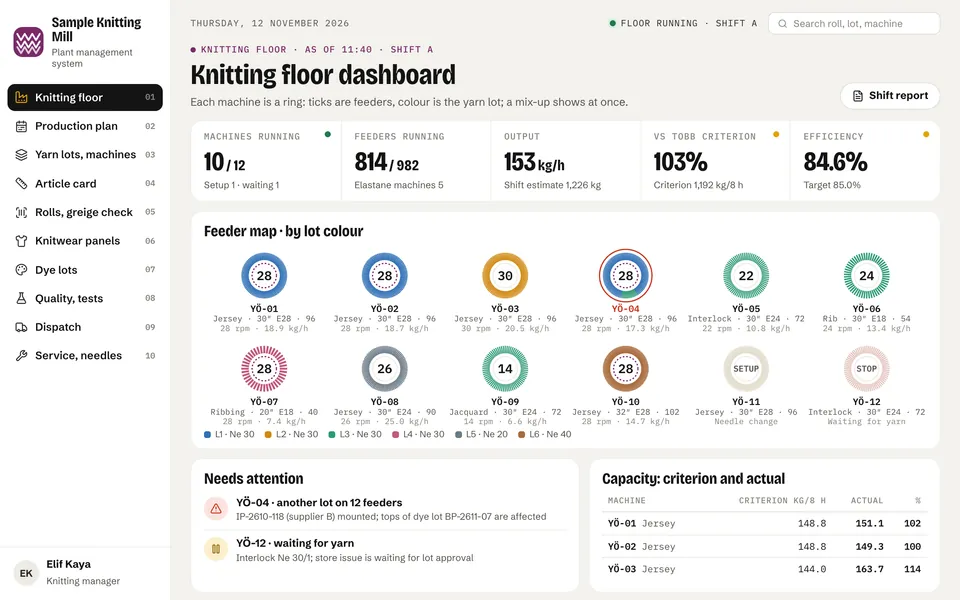
Knitting mill floor dashboard: twelve circular knitting machines drawn as feeder rings coloured by yarn lot, with speed, kg/h, capacity criterion comparison and alerts
$1.6 billion Knitted fabric exports were $1.631 billion in 2025, down 9.1 percent; knitwear garment exports were $2.899 billion (Ministry of Trade and İTHİB data). In a shrinking market, waste and barré eat the margin.
5 screens The knitting floor, yarn lot and machine matching, article card, roll barcode and greige inspection, and knitwear panel plan can be seen on this page with illustrative data.
No change to your machines Circular, warp and flat knitting machines and their makers' monitoring systems stay in place; the data path is settled in discovery, by machine and software version.
Scope set in discovery Most knitting mills start with yarn lot, roll label and article records; the floor dashboard, greige inspection and knitwear plan are added later.

This page is a branch of Textile and Apparel Manufacturing software; the wider picture and the other branches are there.

Does this sound familiar?

In knitting, loss disappears in the links from yarn lot to machine and from machine to dye lot.

If the table below describes a circular knitting, warp knitting or knitwear mill, this page was written for you. The figures come from sources; PAN makes no claim about customer numbers or success rates.

  • The causes of barré are summed up in one word in Cotton Incorporated's technical bulletin: inconsistency. On the yarn side it lists mixing different counts, spinning systems, blend levels, suppliers, twist levels and directions, hairiness and wax content. Yet the lot on the machine is unrecorded in most mills; the mix-up shows only in the dye house, in the fabric.
  • Which yarn lot the rolls for a dye lot were knitted from is looked up by hand while the dye lot is prepared. If a wrong lot is mounted during a cone change, one machine's roll carries two lots and nobody sees it. Labelling stock yarn and first in, first out are written in the bulletin as prevention, but recording them is a separate job.
  • Capacity is a guess. TOBB's knitted fabric capacity criterion (decision 62, revision 31.07.2024) gives 1.5 kg per feeder per 8 hours for circular knitting, 0.8 kg for jacquard and 3 kg for welsoft, terry and mattress fabric; each feeder carrying elastomer yarn adds 0.1 kg (0.06 for jacquard). Actual output depends on diameter, gauge, feeders, speed, stitch length and count, and nobody sees the criterion and the actual side by side.
  • Article knowledge sits in the master's head. The stitch length of a jersey, the yarn feed of a rib, the take-up of an interlock, the draft and tension of elastane are set by hand from machine to machine. The same article gives different weight and width on two machines, and there is no single record of which setting is approved.
  • Greige faults are discovered after dyeing. Practitioner sources list needle lines, holes, dropped stitches, missing elastane and oil stains as typical knitting faults; barré, sinker marks and slight elastane differences are hard to see in greige and become obvious after dyeing. A single needle line can downgrade a whole roll.
  • Roll weight, fabric weight and width live on paper. The roll is taken off, weighed, and the label is handwritten or printed from a separate program; machine, shift, yarn lot and elastane lot are often missing from the label. When a customer asks which machine a roll came from, the answer is searched for in a notebook.
  • Knitwear is produced panel by panel: front, back, sleeves and collar are knitted separately and go to linking. Even the TOBB criterion for electronic flat knitting is calculated from working needles, panel width and panel count. Panel balance (one front, one back, two sleeves per sweater) and which version of a machine file runs on which machine are kept in separate records; a panel knitted on an old version drifts in size.
  • Monitoring is tied to the machine brand. Makers of circular, flat and warp knitting machines each have their own digital system, and each sees only its own machines. On a mixed floor the shift supervisor looks at three screens; yarn lot, article and dye lot are the subject of none of them.
  • The market is shrinking. With knitted fabric exports down 9.1 percent in 2025, waste, second-quality fabric and re-dyeing because of barré eat directly into margin. Most of the loss happens during production, in places that are not recorded.
The software landscape today

Which systems do knitting mills use today, and where do they stall?

There is general ERP, textile-specific ERP, the machine makers' digital systems and design and programming software. The link between them, one record chain from yarn lot to roll label to dye lot, has not been built in most mills. Product names are taken from the makers' own pages; products whose scope could not be verified are not listed.

LayerSoftware in use todayThe gap it leaves
General ERP and accounting (horizontal backbone) Logo (Tiger, GO, Netsis), Mikro, ETA Solid for customers, stock, invoices and e-waybills, and they should stay. Knitting detail such as the yarn lot on the machine, article setting, roll weight and fault by roll, and barré risk usually sits outside these programs, in Excel and notebooks.
Textile-specific ERP Datatex NOW, Enfotek MDS (knitting, weaving and spinning), Enfotek EDS (textile and apparel) Datatex NOW is described as a modular ERP for textile and apparel from raw material to finished goods, with planning, production, quality, inventory and logistics modules, and an industry publication mentions a customer making seamless knitted garments. Enfotek presents MDS as an industrial ERP running from knitting, weaving and spinning production to finance, and EDS as a textile and apparel ERP with the KeyPad quality control device. How the yarn lot, stitch length and elastane detail on the machine are handled is settled in discovery.
Circular knitting machine maker's digital platform Mayer & Cie knitlink Mayer & Cie has a page for a digital platform called knitlink on its own site; its scope is not described there in detail. As a machine maker's platform it looks first at the maker's own machines; on a mixed circular floor, the link between yarn lot, article and dye lot still has to be built separately.
Flat knitting (knitwear) production management SHIMA KnitManager (Shima Seiki) Shima Seiki offers flat knitting factories real-time operating rate and progress by order, KPI management and critical path analysis, an API for ERP links and flat knitting machines connected by IoT; SPP planning, SPR3 data collection and SPC data transfer belong to the same family. It covers only Shima flat knitting machines; circular knitting, yarn lots and greige inspection are not its subject.
Flat knitting design and machine programming SDS-ONE APEX4 (Shima Seiki), M1plus (Stoll) The APEX series covers planning, design, fabric simulation, 3D virtual sampling and machine programming. Stoll's M1plus is the workstation for drawing patterns and producing Sintral knitting programs, and it supports the knit and wear pattern type. Both are design and program software; panel balance, which machine file version runs on which machine, and the production record still need to be tracked separately.
Warp knitting machine control KAMCOS (KARL MAYER) KARL MAYER has built the control structure of its group's machines on the KAMCOS command system since 2003; the current interface is KAMCOS 2. It is a machine control platform covering KARL MAYER machines; the yarn and beam record of a raschel or tricot roll still needs to be linked separately.

Product names are compiled from vendors' public pages (September 2026); PAN is not affiliated with them. The "gap" column summarises situations we commonly meet in discovery and is not a statement about any specific product.

Our approach

A roll and lot layer that closes the gap between machine data, articles and ERP.

We do not bring your knitting mill a second ERP or machine monitoring system. We build the record chain from yarn lot to machine, machine to roll and roll to dye lot; your ERP, your machine makers' own systems and your design software stay in place, and we fill the missing links between them.

Knitting floor: feeder map

Every circular knitting machine appears with diameter, gauge, feeders, speed, article, yarn lot and kg/h. Which lot is mounted on each feeder is drawn on a map, and a machine with two lots raises a warning. Efficiency and shift kg are compared with the TOBB capacity criterion.

Yarn lot and barré prevention

Machine and yarn lot are matched; for rolls going into one dye lot, lot compatibility, supplier, spinning system, twist and laydown differences are shown side by side. A different-lot warning suggests splitting the dye lot; you set the rules, we only make them visible.

Article card

For single jersey, rib, interlock, ribbing, two-thread, three-thread or jacquard articles, the card holds diameter, gauge, feeders, needle count, speed, stitch length, LFA, elastane draft and tension, and the weight and width target. Fabric weight and tube width come from the stitch count and sit beside the measured value.

Roll barcode and greige inspection

The roll is weighed as it leaves the machine and gets a barcoded label: machine, shift, yarn and elastane lot, kg, weight, tube width. In greige inspection holes, needle lines, dropped stitches, missing elastane and oil stains are marked metre by metre, and the roll is split or graded before dyeing.

Preparing the dye lot

Rolls enter the dye lot card with lot, machine, kg and quality status. A roll with mixed lots is kept apart; the dye lot card comes from the same record to your dye house software or to paper. When barré is suspected, which machine and lot a roll came from is found in minutes.

Knitwear: panel and machine file plan

A panel-based plan for flat knitting machines: front, back, sleeve and collar counts are tracked separately and the lagging panel shows. The version of each machine file is compared with the one running on the machine, and a panel knitted on an old version raises a warning. Linking and apparel plans draw on panel balance.

Modules we can build

Modules we can build for a knitting mill

You do not need all of them at once. Most knitting mills start with yarn lot, roll label and article records; the floor dashboard, greige inspection, dye lot, knitwear plan and cost are added later. The five screens on this page are the main faces of the modules.

LOT

Yarn lot and machine matching

Lot on the machine, lot compatibility for the dye lot, supplier, laydown and twist differences, barré warning and split suggestion.

ARTICLE

Article card

Diameter, gauge, feeders, speed, stitch length, LFA, elastane draft, weight and width target, approved setting version.

DYE LOT

Dye lot preparation

Dye lot card, roll list, lot compatibility and dispatch to the dye house; data exchange with dye house software.

WARP

Warp knitting and beams

Beam and yarn records for raschel and tricot machines, piece length, capacity by machine gauge.

COST

Cost and efficiency

TL/kg cost by fabric: yarn, elastane, labour, energy, waste and second quality; comparison of criterion and actual.

What it looks like on screen

What knitting mill software looks like on screen

These screens come from the demo design we prepared for knitting mills. The figures are sample data; the system is set up around your own machines, articles and customer specifications.

Knitting floor. Each circular knitting machine is drawn as a ring; ticks are feeders and the colour is the yarn lot. Speed, kg/h and the comparison with the TOBB capacity criterion sit beside it, and a lot mix-up on a machine shows at once.
Lot to machine matching. A machine by yarn lot matrix shows lot compatibility for rolls going into one dye lot. A different supplier, laydown, twist or spinning system raises a barré warning and suggests splitting the lot.
Article card. For single jersey, rib, interlock or ribbing, diameter, gauge, feeders, stitch length, LFA and elastane draft live on the article card. Weight and tube width come from the stitch count and sit beside the measured value.
Roll and greige inspection. A roll gets a barcoded label as it leaves the machine: machine, shift, yarn and elastane lot, kg, weight and tube width. In greige inspection holes, needle lines, missing elastane and oil stains are marked metre by metre, and the roll is split or graded before dyeing.
Knitwear panel plan. A panel-based plan for flat knitting machines: front, back, sleeve and collar counts are tracked separately, so the lagging panel shows. The version of each machine file is compared with the one running on the machine, and a panel knitted on an old version raises a warning.

Company names, people and figures on these screens are sample data. The system is built around your own processes, document names and rules. We walk you through the demo in a call: request a demo

Integration with your existing ERP

Your ERP, machines and design software stay where they are.

Knitting mills usually already have three solid systems: an accounting and e-document program, the machine makers' own digital systems and, in flat knitting, design and programming software. PAN does not replace them; it builds the missing links between them: the chain of yarn lot, article, roll and dye lot.

Our integration approach →
  • Customer, stock, order, waybill and invoice exchange with Logo, Mikro, ETA or whichever ERP you use; double entry goes away. Accounting and official documents stay in your current program.
  • Taking speed, status and production data from the machine makers' own monitoring systems on circular, warp and flat knitting machines; the path is set in discovery by machine brand and version. Where there is no data, we start with end-of-shift entry.
  • Barcoded roll labels with a roll scale, label printer and handheld terminals; scanning at the knitting machine, in greige inspection and at dye house intake.
  • Passing the roll list with lot, machine, kg and quality status to your dye house software or dye lot card; roll and panel information to the apparel and subcontracting side.
  • You choose the server; the data and code are yours. The system is built around your machines, articles and customer specifications.
Outcomes

What changes on the floor and at dye house intake once this layer is in?

  • Which yarn lot is mounted on each machine is visible; if a machine carries two lots a warning arrives without waiting for the end of the shift.
  • Lot compatibility for rolls going into one dye lot shows while the dye lot is prepared; barré risk is noticed before the dye house.
  • Capacity is calculation, not guesswork: kg/h comes from feeders, speed, stitch length and count, and the TOBB criterion and the actual sit side by side.
  • Article setting no longer depends on a person; the approved stitch length, elastane draft and weight target sit on a versioned card and are written to the machine.
  • Every roll is labelled with weight, machine, shift, yarn and elastane lot; when a customer asks, the answer comes from the record, not the notebook.
  • Greige faults are marked metre by metre; the roll is split or graded before dyeing, so faulty metres do not consume dye and labour.
  • In knitwear, panel balance is visible; a lagging panel is noticed before linking starts, and an old machine file version is caught before sizes drift.
  • On barré or a complaint, tracing a roll back from machine to yarn lot and setting record takes minutes instead of hours.
  • Management sees efficiency, quality and cost by machine, shift, article and lot on one screen, without merging Excel files.
Process

A realistic five-stage path that begins with discovery.

  1. 01

    First conversation and screen tour

    1 week

    We listen to how your knitting mill is set up: circular, warp or flat knitting, number of machines, articles, which yarn, which dye house, which ERP. We walk through the screens on this page together and talk about which one matches something in your mill.

  2. 02

    Discovery at the mill

    1-2 weeks

    We follow the flow from yarn intake to dispatch on site. We collect your machine list, work orders, shift report, roll label, greige inspection form and dye lot card, and take your field names as they are.

  3. 03

    Scope, priority and budget

    1 week

    We present the module order starting where it hurts most, the integration paths, the timeline and the budget in writing. The first phase is often yarn lot, roll label and article records.

  4. 04

    Development and pilot

    6-10 weeks

    We deliver modules one by one and try them in real work with one floor and a few articles. The shift supervisor, greige inspector and planner use the screen at every delivery; we take corrections from the floor.

  5. 05

    Go-live and support

    Ongoing

    We roll out to all machines, train your team and stay beside you in the first weeks. Afterwards, growing the system for a new machine, a new article or a new customer specification continues with the same team.

Why Pan Innovation House?

A team that speaks the knitter's language and builds the roll and lot chain on the floor.

You see the screens first

Not promises but a demonstration: the knitting floor, lot and machine matching, article card, roll barcode and greige inspection, and knitwear panel plan are on this page. The figures are illustrative; your system is built around your machines and specifications.

We work in knitting's own terms

Diameter, gauge, feeders, stitch length, LFA, jersey, rib, interlock, barré, roll and panel appear on screen under the names you use; your staff learn no new language.

In Gaziantep, close to the floor

Our headquarters is in Gaziantep; we do discovery on site in a region dense with textile production and work with you during shifts. Our London office eases correspondence and documents for mills with export customers.

We start with discovery

Machine parks, articles and customer structures differ from mill to mill, so we give scope and budget in writing after discovery and do not quote figures in advance.

We do not touch your existing systems

Your ERP, your machine makers' systems and your design software stay where they are; we build the missing links between them. Accounting and official documents stay in your current program.

The data and code are yours

You choose the server. The system is written for you; we hand over the data and source code without tying you to another platform.

Frequently asked questions

Knitting Mill (Circular, Warp and Knitwear) software: common questions

What does knitting production tracking software do?

It keeps the chain from yarn intake to dye lot in one record: machine, article, yarn lot, stitch length and elastane setting, kg/h and efficiency, roll weight and label, greige faults and dye lot preparation. The key difference is that for every roll the record shows which machine, which lot and which setting it came from.

How is circular knitting tracked?

Each machine is recorded with diameter, gauge, feeders, speed, article and yarn lot. A lot map by feeder, kg/h and efficiency are tracked; machine status, stop reasons and shift output are entered. Where there is no machine data we start with end-of-shift entry and move to live data as sensors are added.

What is barré, and how does software prevent it?

Barré is an unintentional, repeating pattern of bars and stripes in the yarn direction. Cotton Incorporated's bulletin sums up the cause as inconsistency: different count, spinning system, blend, supplier, twist, hairiness and wax content. The software records the lot differences of rolls going into one dye lot at the machine and shows them as the dye lot is prepared; you set the rules.

How is the yarn lot tied to the machine?

At yarn issue the lot number is matched with machine and shift; if a second lot is mounted at a cone change and scanned, a warning is raised. The roll label carries the lot and the elastane lot, so lot compatibility for rolls entering a dye lot is visible.

What does the article card contain?

Article name and version, diameter, gauge, feeders, needle count, speed, stitch length, LFA, elastane dtex, draft and tension, take-up setting, weight and width target, and the shrinkage requirement. Fabric weight and tube width are calculated from the stitch count and compared with the measured value. Fields are set up under the names you use.

How is capacity calculated, and what does the TOBB criterion say?

Actual output is calculated from speed, feeders, needle count, stitch length and yarn count. TOBB's knitted fabric capacity criterion gives 1.5 kg per feeder per 8 hours for circular knitting, 0.8 kg for jacquard and 3 kg for welsoft, terry and mattress fabric, with extra yarn for feeders carrying elastane. The system shows the criterion and actual side by side and supports your capacity report.

How do the roll barcode and greige inspection work?

The roll is weighed as it leaves the machine and a barcoded label is printed: roll number, machine, shift, yarn and elastane lot, kg, weight, tube width. In greige inspection holes, needle lines, dropped stitches, missing elastane and oil stains are marked by metre, and the decision (send to dyeing, split, second quality) is recorded.

Is warp knitting (raschel, tricot) covered?

Yes. Beam and yarn records on raschel and tricot machines, capacity by machine gauge, piece length and greige inspection are tracked in the same system. Taking data from the machine maker's control platform is settled in discovery by machine and software version.

What do you offer for knitwear (flat knitting)?

A panel-based plan: front, back, sleeve and collar counts are tracked separately, and panel balance and the lagging panel show. The version of a machine file is compared with the one running on the machine; an old version raises a warning. Linking and apparel plans draw on panel balance. Your design and programming software stays in place.

What if we already use maker systems such as Shima Seiki, Stoll or Mayer & Cie?

They stay. Maker systems do their own machines and the design or programming work well; on a mixed floor we build the chain of yarn lot, article, roll and dye lot and the panel balance, taking machine data from them where possible. The transfer path is settled in discovery by machine brand and version.

Our ERP is Logo or Mikro. Do we need to replace it?

No. Accounting, customers, stock and invoices stay where they are. The PAN layer holds the knitting detail (machine, article, lot, roll, panel) and passes the needed movements to the ERP; double entry goes away.

How long does setup take, and what does it cost?

Usually 9-14 weeks from first conversation to pilot; after discovery we give scope, timeline and budget in writing. Because machine parks, article counts and integrations differ, we do not quote figures in advance.

Next step

Let us walk through the screens together, then come to your knitting mill

A knitting mill's system cannot be written remotely. First let us walk through the screens on this page together; then let us see your machines, article cards and roll label on site. After discovery we give scope, timeline and budget in writing.

Related services

Related areas worth considering

Pan Innovation House

Call us

By phone

+90 543 930 12 72

Our phone line is open every day.

WhatsApp on your phone

Scan with your phone camera. The chat opens with your message ready.

Prefer that we call you? Leave your details