Pan Innovation House Pan Innovation House
INDUSTRY SOFTWARE · WOVEN PP SACKS AND BIG BAGS

From resin to bale, from denier to test certificate, production software that keeps every record of the sack and the big bag

Pan Enterprise Solutions, the software arm of Pan Innovation House · based in Gaziantep, Türkiye, with a London office

We bring the denier and kg/h of the raffia tape line, the breaks and metres of the circular looms, the size, weight, mesh, colours and lamination on the order card, the safe working load and test result of the big bag, the unit cost that follows the resin price and the bales in the container into one chain of records. Logo, Mikro or whichever ERP you use stays in place; we build a shop-floor layer next to your line data and your test reports. The five screens are shown on this page; scope is settled at discovery.

Asking about price? We listen to the scope in a short call and share the budget frame and timeline in writing. The first 30-minute call is free; the scope of an on-site discovery, and its fee if any, is agreed in writing during that call.

We work on site for plants in and around Gaziantep; elsewhere in Türkiye and abroad, discovery starts by video call and a visit is planned if needed. Our London office is at Unit 6 Cranford Way, Hornsey, London N8 9DG.

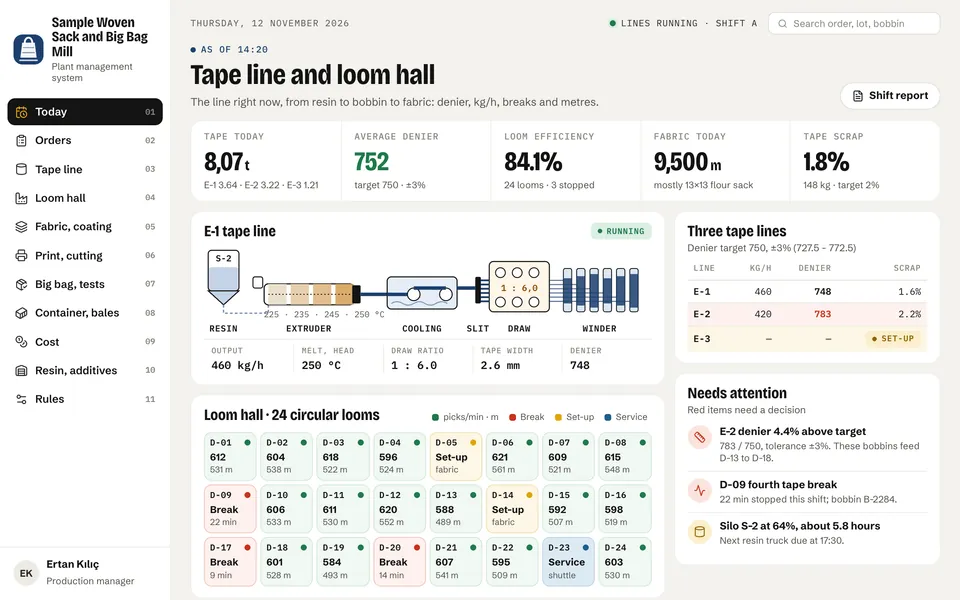
Woven sack mill software home screen: tape line diagram, denier of three lines, 24-loom hall map and items needing attention
$356.7 million Türkiye's 2025 exports under HS 6305, sacks and bags of a kind used for packing goods (Ministry of Trade packaging report, TurkStat data). The line covers sacks of every material; no separate figure for PP is published.
Based in Gaziantep PAN is headquartered in Gaziantep; several PP sack and big bag makers appear on their own pages in the Gaziantep industrial zones, with others in Adana and Gebze. We build software close to the floor.
5 screens Tape line and loom hall, order-size-print card, big bag test and certificate record, resin cost, container and bales can be seen on this page with representative data.
Scope at discovery Start with the tape line or the order card and grow module by module; no mill needs every module.

This page is a branch of Textile and Apparel Manufacturing software; the wider picture and the other branches are there.

Does this sound familiar?

In a sack and big bag mill, margin disappears between denier, fabric weight and paperwork.

If the table below describes a woven PP sack or big bag mill, this page was written for you. The basis is official texts and manufacturer pages; none of it is a PAN customer result.

  • On the tape line a denier target of 750 with a three percent tolerance means a limit of 727.5 to 772.5, yet the real denier of every bobin the line makes is collected on paper at the end of the shift. A bobbin outside target shifts the fabric weight once it reaches a loom, and the difference shows only at weighing or at the customer.
  • Fabric weight is a formula: (warp ends per inch + weft picks per inch) × denier / 228.6. When denier or mesh moves a little, the weight and strength of the fabric change. In many places this calculation lives in the foreman's head; it is not tied to the order card or to the price.
  • Flour sacks have a legal threshold: under the Wheat Flour Communiqué art. 10, a polypropylene pack needs a weave density of 5 per cm and a weight of at least 80 g/m². A 12×12 per inch fabric gives only 4.7 per cm; 13×13 gives 5.1. Fabric below the threshold must not be linked to a flour order, but the rule is rarely written on the job order.
  • On a circular loom a tape break counts as a stop. Which bobbin and which loom break most is scattered across notebooks; without seeing the cause, the same break repeats.
  • Food-contact and non-food orders run on the same line. Under the Regulation on Food Contact Materials and Articles art. 21, recycled plastic may not be used; the only exception is production offcuts and edge trim that never leave the plant. If the share of regrind in each recipe is unrecorded, a wrong recipe goes unnoticed.
  • For big bags the safe working load, safety factor, type test, marking and lot certificate sit in different places. For a UN-marked flexible IBC the tests that ADR/RID 6.5 lists (top lift, stacking, drop, tear, topple, righting) cannot be found at dispatch if they are not recorded against the lot.
  • The electrostatic type is a critical detail. On a Type C big bag the resistance from fabric to earthing point is expected to be at most 1 × 10^8 Ω; if one sample exceeds the limit the lot must not be linked to a shipment. The measurement usually sits on a separate form with no link to the lot.
  • The order card is scattered: size, seam allowance, weight, mesh, print colours, lamination and customer approval live in separate documents. The fabric kilos for 1,000 sacks and what lamination adds are not calculated at quotation, and appear later as scrap.
  • Resin prices are volatile: the CIF price of imported PP raffia can change markedly within a few months. The unit cost of a sack and a big bag follows that price directly; if the quote validity and cost are not recalculated, the margin melts with the resin price.
  • The container and bale plan is made by hand. Bale count, bale weight, the weight and volume fill of the container and the loading documents (packing list, declaration of conformity, origin) are not visible in one place before loading.
The software landscape today

Which software do PP sack and big bag mills use today, and where does it get stuck?

There is general ERP, the vendors' own monitoring systems, line and loom controllers, laboratory reports and Excel. The gap sits in the order card, the weight and legal threshold check, the big bag test record and cost. We did not find a local system built for sack and big bag makers with its screens and scope clearly presented; not finding one does not mean none exists. Below are only products named on their own pages.

LayerSoftware in use todayThe gap it leaves
General ERP and accounting (horizontal backbone) Logo (Tiger, GO, Netsis), Mikro, ETA Solid for accounts, stock, invoices and e-waybills, and should stay. Raffia tape denier, fabric weight, loom breaks, big bag test lots and the container-bale plan, however, often sit outside these programs, in Excel and notebooks.
Line vendor monitoring system Starlinger GRAFiT On its conversion line page Starlinger names an interface for production monitoring systems such as GRAFiT, and a press release describes central monitoring of a whole machine park. These sources do not describe the legal threshold of an order, big bag testing or cost; in a mixed-brand park a single screen has to be built separately.
Winder counter and bobbin monitoring Starlinger filTRONIC (winder option) According to the maker's page it gives a metre counter and a bobbin-change signal for each winding head. Which loom, fabric and order a bobbin goes to is not described on that page.
Line and loom controllers Line PLC and HMI screens, loom counters (vary by brand) They run the machine and some show production values. Order requirements, lots, documents and cost are not their job; part of the data can be taken out and part cannot, which is settled at discovery.
Test laboratory reports Accredited and in-house laboratory reports (PDF, paper) UN type test and electrostatic type reports mostly arrive as PDF and sit in a folder. If the lot behind each report, its expiry and the marking print are not recorded, they are hunted for at dispatch.
Excel and paper (cutting, print, cost, bales) Excel, spreadsheets, shift forms The order card, fabric kilos, flexo print colours, resin price and bale plan are often here. It is flexible, but versions get lost and nobody recalculates when the price changes.

Product names are compiled from vendors' public pages (September 2026); PAN is not affiliated with them. The "gap" column summarises situations we commonly meet in discovery and is not a statement about any specific product.

Our approach

A shop-floor layer that closes the gap between line, loom and laboratory on one side and accounting on the other.

We do not bring a second ERP or a new line control system to your mill. We build the chain of records from resin to bale and connect it to your existing ERP, line monitoring system and test reports. The system does the arithmetic; the shift lead, the quality manager and management decide.

Tape line and loom hall

On a line diagram showing the extruder, water bath, slitter, drawing oven and winder, denier, kg/h, draw ratio and scrap stay live; when denier leaves tolerance, the looms the bobbins feed are flagged too. The hall map shows each circular loom's picks per minute and metres today, with breaks and stop minutes.

Order, size and print card

Size, seam allowance, fabric, weight, mesh, colours and lamination are gathered on one card. Weight is calculated by formula; for flour sacks the 5 per cm and 80 g/m² threshold is checked when the recipe is chosen. The fabric kilos for 1,000 sacks, with and without lamination, are ready at quotation.

Big bag test and certificate record

For each lot the safe working load, safety factor, electrostatic type, UN code and the rule and measured value of each type test are recorded. The UN marking sequence is produced from the record; if a Type C earthing measurement exceeds the limit, the lot cannot be linked to a dispatch document.

Unit cost from resin

From PP raffia CIF price, duty, freight and exchange rate the blend cost per kg and the unit cost of a sack and a big bag are calculated. Price points are shown with their source; when resin moves from the January level to the June level you see in advance where the quote goes.

Food-contact order rules

On a food-contact order regrind can be chosen only from in-house unprinted scrap; external recycled PP cannot be selected. The declaration of conformity and the business registration number are added to the document list; traceability from production to distribution is built with lot and bale numbers.

Container and bale plan

Bale count, weight and volume of the orders are placed against the container; weight and volume fill, free space and document status are visible before loading. The packing list comes from the record, and a missing document holds the loading approval.

Modules we can build

Modules we can build for a PP sack and big bag mill

You do not need all of them at once. Most mills begin with the tape line and loom record or with the order card; big bag testing, cost and bales are added later. The five screens on this page are representative views of the modules.

BOBBIN

Bobbin and tape lot

Each bobbin is tied to the line, the hour, the denier and the resin lot; which loom turns a bobbin into fabric and which bobbin is behind a break can be seen from the record.

ORDER

Order, size and print card

Size, weight, mesh, denier, colours, lamination, seam allowance and customer approval; fabric kilos and sack weight; legal threshold check for flour sacks.

FABRIC

Fabric, coating and print

Fabric roll, metres, weight weighing, lamination and coating g/m², flexo print colours and set-up scrap; piece count and offcuts in cutting and sewing.

COST

Resin and unit cost

PP raffia CIF price, duty, freight, exchange rate, filler and UV additive share, scrap allowance; unit cost and price scenarios for the sack and the big bag.

RAW MATERIAL

Resin and additive receipt

Resin lot, melt flow rate, supplier document, UV and filler masterbatch stock; silo level and the time until the next delivery runs out.

What it looks like on screen

What woven sack and big bag mill software looks like on screen

These screens come from the demo design we prepared for woven PP sack and big bag makers. The figures are sample data; the system is set up around your own lines, looms and customer specifications.

Tape and loom hall. Denier, kg/h and draw ratio of the tape line with picks/min and metres of 24 circular looms on one screen; off-target denier and repeated breaks show up before the shift ends.
Order and print card. Sack size, fabric weight, mesh, print colours and lamination on one card; for flour sacks the weave density and 80 g/m² minimum are checked when the recipe is chosen, and the fabric kg per 1,000 sacks is calculated.
Big bag test and certificate. Safe working load, UN type tests, marking order and Type C earthing measurement of each big bag lot in one record; a lot over the limit cannot be linked to a shipment.
Cost from resin price. Cost per kg and per unit of a sack and a big bag from PP raffia CIF price, duty, freight and exchange rate; you see in advance where the quote lands when the price rises.
Container and bales. Bale count, weight and volume of the orders are placed in a 40 ft container; fill, packing list and declaration of conformity are visible before loading.

Company names, people and figures on these screens are sample data. The system is built around your own processes, document names and rules. We walk you through the demo in a call: request a demo

Integration with your existing ERP

Neither your ERP nor your line monitoring system goes away.

Sack and big bag mills usually already have three solid things: an accounting and e-document program, line and loom controllers or the line vendor's monitoring system, and laboratory reports. What is missing is the flow between them: the record that runs from tape denier to fabric weight, from order requirement to test lot and to the bales in the container. We write that layer and set up data exchange with each side.

Our integration approach →
  • Transfer of accounts, stock, orders, waybills and invoices with Logo, Mikro, ETA or whichever ERP you use; double entry ends. Accounting and official documents stay in your existing program.
  • Taking production values from the line monitoring system, loom counters and the metre counter on the winder; OPC, file or database path depends on the device and version and is settled at discovery, and a manual entry screen is opened for data that cannot be taken.
  • Linking laboratory and test reports to the lot record; the report is uploaded as PDF, result values are entered in the record and the lot is tied to its dispatch document.
  • Barcode and label output: labels and marking prints for bobbins, fabric rolls, bales and big bag lots; the lot on the label is tied to the record in the system.
  • Data and code are yours. You choose the server: it runs on your own server, in the cloud or in a data centre in Türkiye.
Outcomes

What changes in the mill once this layer is running?

  • Denier, kg/h and draw ratio on the tape line are visible live; off-target denier is noticed before the bobbin reaches a loom.
  • Loom breaks and stops are recorded with their cause; repeated breaks on the same bobbin or loom show before the shift ends.
  • Fabric weight is calculated by formula; on a flour sack order the weave density and 80 g/m² threshold are checked when the recipe is chosen, and fabric below it is not linked to the order.
  • The fabric kilos for 1,000 sacks, with and without lamination, are calculated at quotation; surprises that later appear as scrap shrink.
  • On a food-contact order regrind is chosen only from in-house unprinted scrap; external recycled PP cannot slip into the recipe by mistake.
  • The load, type tests, marking and earthing measurement of a big bag lot sit in one record; a lot over the limit cannot be linked to a shipment.
  • When the resin price changes, the unit cost of the sack and the big bag is recalculated at once; quote validity is chosen deliberately.
  • The weight and volume fill of the container, the bale count and document status are visible before loading; a missing document holds the loading.
Process

A realistic five-stage path that begins with discovery.

  1. 01

    First conversation and screen tour

    1 week

    We listen to how your mill is built: how many tape lines and looms, which products (flour sacks, fertiliser sacks, big bags), which line monitoring system and which ERP. We walk through the screens on this page together and discuss which of them matches something in your mill.

  2. 02

    Discovery on site

    1-2 weeks

    We follow the flow from the resin silo to the bale on site. We collect your shift form, bobbin label, loom counter records, order card, test reports and dispatch documents, and take your field names as they are.

  3. 03

    First phase proposal

    1 week

    We propose a written first phase: usually it starts with the order card or the tape and loom record. Scope, time and responsibilities are written down.

  4. 04

    Development and floor trial

    Depends on phase

    We build the first phase and trial it on a shift with real data. The tape and loom record or the order card goes live first; screens and rules take shape with feedback.

  5. 05

    Extension and support

    Ongoing

    Big bag test record, cost, quality documents and the container-bale plan are added in turn. Data and code are yours; maintenance and development continue together.

Why Pan Innovation House?

A team that speaks the mill's language and builds the chain of records on the floor.

You see the screens first

Not promises but a demonstration: tape and loom, order card, big bag test, cost and container screens are on this page. The numbers are representative; the system is built around your lines and specifications.

We work in the mill's own terms

Denier, mesh, picks per minute, break, tubular fabric, seam allowance, SWL, safety factor, Type C, UN marking and bale appear on screen under the names you use; staff do not learn a new language.

With legal and standard sources

The flour sack threshold, the food-contact regrind rule, the UN tests and the Type C limit rest on the Official Gazette, ADR/RID and standards body texts; we do not write what we cannot verify.

We do not touch your ERP

Accounting and ERP stay in place and we build a layer next to them. Double entry ends and your existing investment is not wasted.

Based in Gaziantep, office in London

Our headquarters is in Gaziantep, so visiting the mill and standing next to the loom on a shift is possible. We also have an office in London.

Data and code are yours

The system runs on your server or the cloud you choose; you own the data and the code.

Frequently asked questions

Woven Polypropylene Sack and Big Bag (FIBC) Manufacturing software: common questions

What does PP sack production tracking software do?

It keeps the chain from resin and additives through the tape line, the circular loom, coating and print, cutting and sewing to the bale in one record: denier, kg/h, breaks, metres, fabric weight, order requirements, test results, cost and dispatch. The real difference is that the bobbin, loom and resin lot behind each sack stay in the record.

What is denier and how is fabric weight calculated?

Denier is the weight in grams of 9,000 metres of tape; the thinner the tape, the lower the denier. Fabric weight is found approximately as (warp ends per inch + weft picks per inch) × denier / 228.6. For example 13×13 per inch and 750 denier gives 85.3 g/m². Crimp is not included; the real weight is confirmed by weighing.

What is the legal requirement for a flour sack?

Under art. 10 of the Turkish Food Codex Wheat Flour Communiqué (Official Gazette 02.04.2013, no. 28606), if the packaging is polypropylene its weave density must be 5 per cm and its weight at least 80 g/m²; the packaging must also be made of materials that comply with the food-contact regulation. The system checks the recipe against this threshold.

Can recycled PP be used in a food-contact sack?

Under art. 21 of the Turkish Food Codex Regulation on Food Contact Materials and Articles (Official Gazette 05.04.2018, no. 30382), recycled plastics cannot be used in making food-contact materials and articles. The exception is production offcuts and edge trim used as part of production without leaving the plant and under good manufacturing practice. The system blocks external recycled PP on a food-contact order; consult your legal adviser for interpretation.

Which standard applies to big bags?

For non-dangerous solids, ISO 21898 applies; the 2024 edition (BS EN ISO 21898:2024, 30.09.2024) covers materials, construction, design, type tests and marking plus guidance on selection and safe use. For big bags carrying dangerous goods, ADR/RID Chapter 6.5 governs; woven plastic flexible IBCs are coded 13H1 to 13H5. The detailed numeric values of the standard are in the paid text; the system records the value in your specification.

What are the UN tests for big bags?

In ADR/RID 6.5 the design type tests for flexible IBCs are top lift, stacking, drop, tear, topple and righting. In the top lift test the IBC is loaded to six times its maximum permissible gross mass and lifted for five minutes; in stacking, 1.8 times the superimposed load is applied for at least 24 hours; drop height is 1.8, 1.2 or 0.8 metres depending on the packing group. Testing is subject to acceptance by the competent authority; the system ties the result and the report to the lot.

What do safe working load and safety factor mean?

Safe working load (SWL) is the highest load a big bag is intended to carry. The safety factor shows how many times that load is applied in the lifting test; manufacturer and industry sources give 5:1 for single-trip and 6:1 for multi-trip bags. These ratios come from secondary sources; the exact value is in the standard and your customer specification.

What is the difference between Type A, B, C and D big bags?

Electrostatic classification rests on IEC 61340-4-4. Type C is woven with conductive thread and is earthed during filling and discharge; the resistance from fabric to earthing point is expected to be at most 1 × 10^8 Ω. Type D is made of a special material that does not need earthing. Which type is allowed in which atmosphere depends on the minimum ignition energy of the dust, which NFPA 77 tabulates. The system ties type and measurement to the lot.

We have Logo, Mikro or another ERP, do we have to replace it?

No. Accounting, accounts, stock, invoices and e-documents stay in your existing program. We build the tape, loom, order card, test record, cost and bale layer next to it and set up data transfer for orders, stock, waybills and invoices.

Resin prices swing a lot, how do we follow cost?

We build a model that calculates blend cost per kg and the unit cost of a sack and a big bag from PP raffia CIF price, duty, freight and exchange rate. The price points on the screen are illustrative; the quote price is recalculated scenario by scenario from the current price and rate you enter. You provide the rate and price inputs.

How long does it take and what does it cost?

Time and cost depend on scope: a narrow first phase such as the tape line and loom record or the order card can be built in weeks, while scope that extends to big bag testing, cost and bales takes longer. Exact time and cost are given in writing after discovery.

Are the numbers on the screens real customer data?

No. Company names, lots, measurements and costs on the screens are representative. The legal thresholds (flour sack weave density and weight, the recycled plastic ban), the UN test values and the Type C resistance limit come from the relevant official texts and standard notes; resin price points are illustrative.

Next step

Let's walk through the screens together, then come to your mill

It is not possible to write a sack and big bag mill's system remotely. First let's walk through the screens on this page together; then we will see your tape line, loom hall and test flow on site and propose the first phase in writing.

Related services

Related areas worth considering

Pan Innovation House

Call us

By phone

+90 543 930 12 72

Our phone line is open every day.

WhatsApp on your phone

Scan with your phone camera. The chat opens with your message ready.

Prefer that we call you? Leave your details