Pan Innovation House Pan Innovation House
INDUSTRY SOFTWARE · BULGUR AND PULSES PROCESSING

Bulgur and pulses processing software that accounts for every tonne, from the wheat and lentils on the weighbridge to the pack on the shelf

Pan Enterprise Solutions, the software arm of Pan Innovation House · based in Gaziantep, Türkiye, with a London office

We bring durum wheat and whole lentil intake, the cooking, drying, dehulling, cracking and sieving line, size grading, yield, by-products, packed lots and dispatch into one chain of records. Your accounting system, whether Logo, Mikro, Netsis or another, stays where it is, and we leave your line automation untouched; we build the operations layer that sits next to them. We define scope together during discovery: not every plant needs every module.

Asking about price? We listen to the scope in a short call and share the budget frame and timeline in writing. The first 30-minute call is free; the scope of an on-site discovery, and its fee if any, is agreed in writing during that call.

We work on site for plants in and around Gaziantep; elsewhere in Türkiye and abroad, discovery starts by video call and a visit is planned if needed. Our London office is at Unit 6 Cranford Way, Hornsey, London N8 9DG.

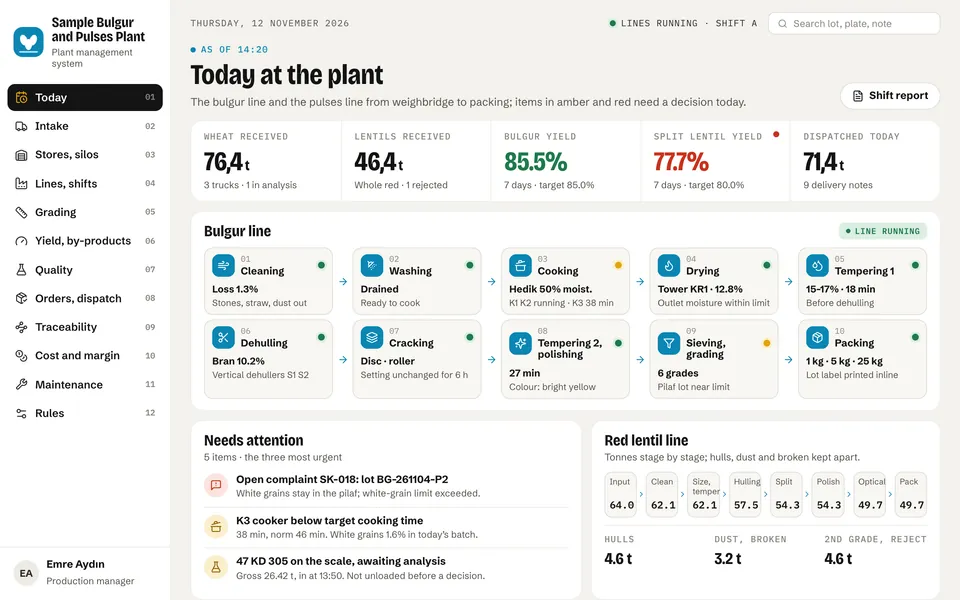
Bulgur and pulses processing software home screen: daily intake, yield indicators, ten-stage bulgur line diagram, items needing attention and the red lentil line
Sieve table becomes a rule The six grades and sieve limits in Annex-2 of the Bulgur Communiqué are entered as rules; the sieve analysis tells which grade each lot fits.
Every stage on record Cleaning, washing, cooking, drying, tempering, dehulling, cracking, polishing, sieving and packing; moisture, time and output of each stage are tied to the lot.
Your ERP untouched Accounting, e-invoice and e-waybill stay in your current program; the transfer route is settled during discovery, depending on version.
Scope set in discovery We start with intake and the weighbridge and grow into line, yield, quality and imported raw material modules as needed.

This page is a branch of Food and Beverage Manufacturing software; the wider picture and the other branches are there.

Does this sound familiar?

In bulgur and pulses processing, margin is lost not in the raw material price but in yield and in the line.

The picture follows from how the industry works: raw material is expensive, product grades depend on sieve and rule tables, and losses tend to sit between stages. If any of the points below sounds familiar, this page was written for you.

  • When a truck reaches the weighbridge, net weight goes into one program, the sample result into the lab notebook and the price deduction into the buyer's notes; the three meet only at month end.
  • Protein and foreign matter in durum wheat for bulgur vary by supplier, but which supplier's wheat went into which line batch, and what yield it gave, is not linked on record.
  • Cooking time, steam pressure, hedik moisture and dryer outlet moisture live in the notebook at the line or in the operator's memory; when white grains show up, finding the cause takes days.
  • The sieve analysis is not tied to the lot; whether a lot will be sold as pilaf, fine pilaf or köfte grade is written by hand, and a lot that breaks the communiqué's sieve limit is found only when the customer objects.
  • Yield is estimated roughly at the end of the shift; because bran, dust and fine broken, and for lentils hulls, broken and second-grade split lentils, are not separate items, nobody can tell where the loss happened.
  • Water is added in tempering and polishing and removed in drying, so moisture changes from stage to stage; without a moisture correction the mass balance never closes.
  • In whole red lentils, chalky grains, weed seeds, insect damage and heated grain set the price and the dehulling yield, but the deduction rule is on paper and its application depends on a person.
  • In a plant working with imported raw material, the inward processing permit balance, yield ratio and expiry counter sit in a separate file, often tracked by one person.
  • When a customer complains that white grains stay in the pilaf, going from the packed lot to the line batch, the cooker, the store and the truck takes a day; the list of customers who received the same batch is built separately.
  • In the accounting program wheat and lentils are one stock item, and bulgur and split lentils show one average cost; which grade and which line actually earn money is not known.
The software landscape today

Which software do bulgur and pulses plants use today, and where does it fall short?

We found no business software built for bulgur or pulses processing on any public vendor page. Plants usually run separate layers side by side, and the gaps are filled with spreadsheets and notebooks.

LayerSoftware in use todayThe gap it leaves
General ERP and accounting (horizontal backbone) Logo, Mikro, Netsis, ETA, Canias, Uyumsoft, DİA; web production and stock software, for example Aaro Solid for ledgers, stock, invoices and e-documents, and should stay. Aaro's page lists production tracking, recipes, serial and lot tracking and quality control modules; it does not mention grain, pulses or bulgur. Line details such as cooking time, sieve grade and mass balance still have to be defined per plant in programs of this kind.
Line automation and machine makers' software Tanış (SCADA, MES, recipe and blending software; its home page lists mills, seed cleaning and feed mill machinery), machine makers in Gaziantep that build bulgur and red lentil lines Strong at running the machinery and the process. Their public pages do not list commercial processes such as bulgur and pulses intake pricing, supplier scorecards, customer specs or inward processing.
Optical sorting machines Bühler SORTEX range (B MultiVision, A ColorVision, H SpectraVision) The manufacturer's pages say the sorters handle lentils, chickpeas, beans and dry peas, and some models send data to a cloud monitoring dashboard. This is machine software; how much each batch rejected and its effect on yield still has to be tied to the plant record.
Laboratory information management (LIMS) Centra LIMS and similar Centra's page lists sample, analysis and method, equipment and reporting modules; its target sectors are pharma, food, chemicals and R&D labs, and grain and pulses are not mentioned. Sector-specific rules, such as tying a sieve analysis to a bulgur grade, are defined separately.
Weighbridge and silo programs Weighbridge ticket and silo stock programs (e.g. Divizyon), indicator makers' software They hold weights and stock; with no link to analysis, intake rules, line batches or cost, the data is carried to the next step by hand.
Spreadsheets and paper notebooks Cooking log, sieve table, yield table, store ledger, dispatch ledger Flexible but tied to one person; no versions, approvals or history. Tracing backwards after a complaint or an audit takes days.

Product names are compiled from vendors' public pages (September 2026); PAN is not affiliated with them. The "gap" column summarises situations we commonly meet in discovery and is not a statement about any specific product.

Our approach

An operations layer that closes the gap between line automation and accounting.

We do not bring a second accounting program or a new automation system into your plant. We build the record chain from the weighbridge to dispatch and connect it to your existing systems. The system does the calculation; the master, the quality lead and management make the decision.

A record that starts at the weighbridge and the analysis

A record opens the moment a truck reaches the weighbridge: plate, supplier, gross and tare, sample, moisture, protein, foreign matter, defective and insect-damaged grain, acceptance, conditional acceptance or rejection under your own intake rule, deduction and a suggested store. Durum wheat and lentils are judged by separate rule tables, and the supplier scorecard builds itself from these records.

Line batch and stage records

Cooking, drying, tempering, dehulling, cracking, polishing and sieving are tied to a line batch: which cooker, which dryer, which dehuller, how long, at what moisture. For pulses, cleaning, sizing, temper, dehulling, splitting, polishing and optical sorting are held the same way. When something deviates, the batch is flagged.

Size grade and yield

The sieve analysis is entered against the lot and compared with the sieve limits in Annex-2 of the Bulgur Communiqué, and the lot is assigned the grade it fits. The mass balance holds input, cleaning loss, bran, dust and broken, second-grade product and rejects in one equation; yield is calculated the same way every shift.

Quality, labelling and traceability

For bulgur, the lot analysis is checked against Annex-1 limits (moisture, ash, protein, white and red grains, water-soluble matter, foreign matter), and the variety name, grain size name and wheat type on the label match the product card. After a complaint, the chain from packed lot to truck opens in seconds.

Dispatch and transfer to accounting

Orders, stock cover by size grade, loading order, weighbridge ticket and delivery note on one screen. Delivery notes and intake documents are passed to your accounting program; the same data is not typed twice.

Cost, by-products and imported raw material

Real raw material cost, energy, labour and packaging, less bran, hull and broken income, give the cost per tonne of each grade. In a plant working with imported raw material, the balance, expiry and yield calculation of the inward processing permit are followed from the same record.

Modules we can build

Modules we can build for a bulgur and pulses plant

You do not need all of them at once. Most plants start with intake, the weighbridge and the store ledger, and grow into line records and yield.

INTAKE

Intake, weighbridge and raw material analysis

Weights from the weighbridge indicator, moisture, protein and foreign matter results, separate rule tables for durum wheat and whole lentils, accept, conditional and reject decisions, deductions, store suggestion and supplier scorecard.

STORE

Stores, silos and licensed warehouse receipts

Batches inside silos and stores, transfers, count differences, insect and moisture tracking. For goods held in a licensed warehouse, the receipt, type, grade, origin, harvest period and term sit in the same record as stock.

GRADE

Sieve analysis and product grade

Sieve analysis, comparison with communiqué limits, grade assignment to the lot, re-sieve decisions and daily size shares; comparison of ordered grades with produced grades.

YIELD

Yield, mass balance and by-products

Stage-by-stage mass balance, moisture correction, shift comparison, bran, hull, dust and broken items, and the by-product sales record.

TRACE

Traceability and recall

From a packed lot, delivery note or plate back to the truck and forward to the customer; the list of customers who received the same batch and the complaint closure record.

COST

Cost and margin by grade

Cost per tonne, by-product credit, raw material price scenarios and price list suggestions.

What it looks like on screen

What bulgur and pulses processing software looks like on screen

The screens below are a sample design prepared for plants that process bulgur and pulses. Companies, people and figures are fictional; the system is set up around your own lines, product grades and rules.

Today at the plant. The ten stages of the bulgur line and the pulses line tonnage on one screen: which cooker fell short on time, which yield is under target and which truck is waiting for analysis.
Intake and weighbridge. Durum wheat and red lentils arrive at the same weighbridge and are judged by separate rule tables: moisture, protein, foreign matter, defective and insect-damaged grain, the decision, deductions and the store on one line, while the supplier scorecard builds itself.
Grading and size class. Each lot’s sieve analysis is compared with the Annex-2 limits of the Bulgur Communiqué and the grade it fits (whole-grain, coarse pilaf, pilaf, fine pilaf, köfte, fine köfte) comes out by itself; the sieve that breaks a limit shows in red.
Yield and by-products. Mass balance from received tonnage to packed product: cleaning loss, dehulling bran, dust and broken, second-grade product and rejects each appear separately. Yield is read together with the shift comparison and the maintenance log.
Traceability. From a customer complaint to the packed lot, the cooker, the store and the truck that brought the wheat, on one screen; the lot analysis is checked against the Annex-1 limits of the Bulgur Communiqué and customers who received the same batch become a ready list.

Company names, people and figures on these screens are sample data. The system is built around your own processes, document names and rules. We walk you through the demo in a call: request a demo

Integration with your existing ERP

Your accounting program and your line automation both stay where they are.

Most plants already have two sound systems: an accounting and e-document program on one side, and automation or operator panels running the machinery on the other. What is missing is the workflow between them: the intake decision, the line batch, the sieve grade, quality, yield, dispatch and cost. We write that layer and set up data exchange with both sides. Accounting and official documents stay in your current program; process data is read from automation where possible, not typed.

Our integration approach →
  • Transfer of ledger accounts, stock, intake documents, delivery notes and invoices with Logo, Mikro, Netsis, ETA, Canias or whatever you use; double entry disappears.
  • Reading data from the weighbridge indicator, moisture and protein meters and lab instruments; settled in discovery by model and output, with a quick manual entry screen for any instrument that cannot be read.
  • Where line automation or operator panels exist, reading cooker time, dryer outlet moisture and weights; machine control is never touched.
  • The reject quantity and monitoring data from an optical sorter are tied to the line batch where the machine allows it; we do not replace the machine's own software.
  • A daily summary for management that reads on a phone: raw material received, processed, yield, dispatched and decisions pending.
Outcomes

What changes in the plant once this layer is live?

  • Every truck's analysis, decision, deduction and store sit in one record; month-end reconciliation does not mean collecting files.
  • Cooking time, moisture and machine data are tied to the line batch; when white grains appear, the cause is found in minutes.
  • The sieve analysis assigns the grade; a lot that breaks the communiqué limit goes back to re-sieving before dispatch.
  • Yield is visible stage by stage; whether the loss came in cleaning, dehulling or sieving stops being a matter of argument.
  • Bran, hulls, dust and broken become separate lots and separate income lines; by-products are linked to yield and cost.
  • For lentils the intake rule and deduction sit in a table; the same impurity gets the same deduction on every truck.
  • After a complaint the chain opens in minutes; customers who received the same batch are already on a list.
  • Raw material commitments, store stock and open orders are compared by size grade; tomorrow's cracking and sieve setting is planned from them.
  • The real cost and margin per tonne of each product grade is known; for imported raw material, the permit balance and expiry are no longer a surprise.
Process

A realistic five-stage path that begins with discovery.

  1. 01

    First conversation

    1 week

    We listen to how your lines, product grades, capacity, weighbridge and lab are set up and which accounting program you use. Together we map your problem to the screen that answers it.

  2. 02

    Discovery at the plant

    1-2 weeks

    We follow the flow from the weighbridge to packing on site. We collect your intake rule, cooking and sieve forms, lab records, dispatch documents and, if you have one, your inward processing file, and we take your field names as they are.

  3. 03

    Scope, priority and budget

    1 week

    We present, in writing, the module order that starts where it hurts most, the integration routes, the timeline and the budget. The first phase is often intake, the weighbridge and the store ledger.

  4. 04

    Development and pilot

    6-10 weeks

    We deliver modules one by one and test them with real trucks and real line batches. The weighbridge operator, lab technician, shift lead and master use the screen at every delivery; we take corrections from the floor.

  5. 05

    Go-live and maintenance

    Ongoing

    After training, data migration and go-live, maintenance and support continue. When a new product grade, a new line or a new customer rule arrives, the system grows with you.

Why Pan Innovation House?

A team that learns the language of your line and builds the record chain on site.

Your rules come first

The intake table, deduction rule, sieve limit and label declaration come from your own product card; the screen shows the field and stage names you use.

Regulation as rules

The sieve and quality limits of the Bulgur Communiqué, lentil quality criteria and licensed warehouse receipt data go into the system as rule tables; when the regulation changes, the table is updated, not the software rewritten.

We ask line questions

In discovery we map, one by one, the order of cooking, drying, tempering, dehulling, cracking, splitting, polishing and sorting in your plant and where each measurement is taken.

Accounting and automation stay put

We do not rip out working systems; we close the gap between them. That keeps the switch risk low and brings the first benefit early.

Based in Gaziantep, we come to you

We are headquartered in Gaziantep with an office in London. We travel to plants anywhere in Türkiye for discovery and run the pilot on site.

Your data and code

You choose the server; your data and the code written for you belong to you. The system keeps running even if the maintenance contract ends.

Frequently asked questions

Bulgur and Pulses Processing software: common questions

What stages does bulgur go through, and how does the software follow them?

The Antep Bulguru geographical indication document gives the production order as cleaning, washing, cooking, drying, tempering, dehulling, cracking, a second tempering and polishing, grading and packing. Each plant may arrange this a little differently. In discovery we map your own order and tie every stage to a line batch, recording time, moisture and machine.

How is the grade of bulgur determined?

Under the Bulgur Communiqué, pilaf bulgur is split into four groups (whole-grain, coarse pilaf, pilaf, fine pilaf) and köfte bulgur into two (köfte, fine köfte) by grain size, and Annex-2 gives the limits as the share passing round-hole sieves. For pilaf bulgur, for example, the share passing a 3.00 mm sieve must be at least 80%, under 1.60 mm at most 10% and under 0.50 mm at most 0.5%. The system compares the sieve analysis with this table and shows which grade the lot fits.

Are the physical and chemical limits for bulgur checked in the system?

Yes. Under Annex-1 of the communiqué, moisture is at most 13%, total ash at most 2.0% of dry matter (2.5 for flavoured bulgur), protein at least 11% of dry matter (10 for brown bulgur), white and red grains at most 1%, stones and sand at most 0.1%, and water-soluble matter in pilaf bulgur at most 10% of dry matter. For protein, the Ministry may lower the value in low-protein years provided it does not fall below 10.5; the system updates this from the rule table.

What is a white grain and how does it relate to line records?

A white grain is a bulgur kernel whose inside stayed white because it was not cooked enough; under the communiqué it counts as a defective grain, with a limit of 1%. It can rise when cooking time, steam pressure or cooker load drops. With time and cooker recorded against the line batch, you immediately see which cooker a problem batch came from and which other batches passed through it.

What does the Antep Bulguru label require, and can software help?

Antep Bulguru is a geographical indication of origin registered for the Gaziantep Chamber of Commerce (No 289, registered 25.12.2017; boundary: Gaziantep province). According to the document, Triticum durum wheat is used, the whole conversion from wheat to bulgur takes place in Gaziantep, tempering lasts at most 30 minutes at 15-17% moisture, cracking is done in disc, hammer or roller mills and dehulling in vertical dehullers. Keeping these conditions in the line record keeps the data ready for the inspection body. Which products may carry the indication depends on the conditions in the document and the inspection body's decision.

Which measurements are tracked for whole red lentils?

Lentil quality criteria are defined through items such as moisture, total foreign matter, inorganic matter, defective grain, insect-damaged grain, heated and sprouted grain, and broken and dehulled grain. For split red lentils, unhulled grain is also tested. Because a revision of the Lentil Communiqué has been in preparation, current limits are taken from the text in force during discovery and entered into the rule table.

How does red lentil processing run?

The general flow is described as cleaning, washing, drying, tempering, size grading, dehulling, polishing and splitting; depending on the plant, steps such as a brief water soak, resting in temper and returning whole grains to the dehuller are added. The system is set up around your plant's own order, and hulls, dust, broken and second-grade split lentils are tracked as separate items.

How is yield calculated, and why is moisture correction needed?

Yield is the share of packed product against the raw material entering the line; which weight is the basis (raw material at the weighbridge or cleaned raw material) varies by plant, so the definition is fixed to your own rule. In bulgur, water is added in cooking and tempering and removed in drying, so moisture shifts between stages; without a moisture correction the total does not close. The system holds input, loss, bran, dust, broken, second-grade product and rejects together.

Do we have to replace our current accounting program?

No. Accounting, ledger accounts, e-invoice and e-waybill stay in your current program. Intake documents, delivery notes and stock movements are passed to it; the connection route is settled in discovery, depending on the program's version and licence.

We have an optical sorter. Will they clash?

No. The sorter separates grains; we send no commands to the machine. If the machine can export reject and monitoring data, we tie it to the line batch; if not, the reject quantity is recorded on a quick manual entry screen.

We process imported red lentils or wheat. Can inward processing be tracked?

Yes. With the Ministry of Trade's circular change of 24.10.2025, chickpeas and lentils were added to the list of yield and secondary-processed product ratios in the inward processing regime, and red lentil exports were placed on the registered goods list in 2025. The system tracks imports, exports, balance and expiry per permit; numerical ratios and permit conditions are entered into the rule table from the current annex of the circular. Whether a separate provision exists for bulgur should be settled for your case with your customs broker.

How do licensed warehouse receipts appear in the system?

Under the licensed warehouse communiqué for cereals, pulses and oilseeds, lentils, chickpeas and beans are in scope; a receipt carries type, grade, origin and harvest period, is issued for each 1,000 kg, and goods may be held for at most 24 months from the harvest period. This data is kept in the same record as warehouse stock, with a warning before the term runs out.

We are a small plant. Would this be too heavy for us?

The system is built module by module. A single-line plant can start with intake, the weighbridge and the store ledger alone; line records, sieving and yield are added as needed. Screens you will not use are not built.

How long does it take, and how is the budget set?

After discovery we give you a written timeline and budget by module order. In most plants the first phase is in the field within a few weeks; the full scope with the pilot usually takes two to three months. The budget varies with the number of modules, integration routes and instrument connections.

Next step

Let us talk through your line and your rules, then visit your plant

A plant's system cannot be written from a distance. Let us first listen to your line, your product grades and the programs you use; then we will see your weighbridge, lab and line on site and propose the first phase in writing.

Related services

Related areas worth considering

Pan Innovation House

Call us

By phone

+90 543 930 12 72

Our phone line is open every day.

WhatsApp on your phone

Scan with your phone camera. The chat opens with your message ready.

Prefer that we call you? Leave your details