Pan Innovation House Pan Innovation House
INDUSTRY SOFTWARE · PASTA AND SEMOLINA PRODUCTION

From durum wheat to the container, production software that keeps the pasta record chain

Pan Enterprise Solutions, the software arm of Pan Innovation House · based in Gaziantep, Türkiye, with a London office

We bring durum wheat intake, the semolina lot, dough and press records, the drying curve, die life, packs, pallets and the export permit into one chain. Logo, Mikro, Netsis or whichever accounting program you use stays where it is; we do not touch your line automation or dryer supervision system, we build the business layer next to them. Scope is set in discovery.

Asking about price? We listen to the scope in a short call and share the budget frame and timeline in writing. The first 30-minute call is free; the scope of an on-site discovery, and its fee if any, is agreed in writing during that call.

We work on site for plants in and around Gaziantep; elsewhere in Türkiye and abroad, discovery starts by video call and a visit is planned if needed. Our London office is at Unit 6 Cranford Way, Hornsey, London N8 9DG.

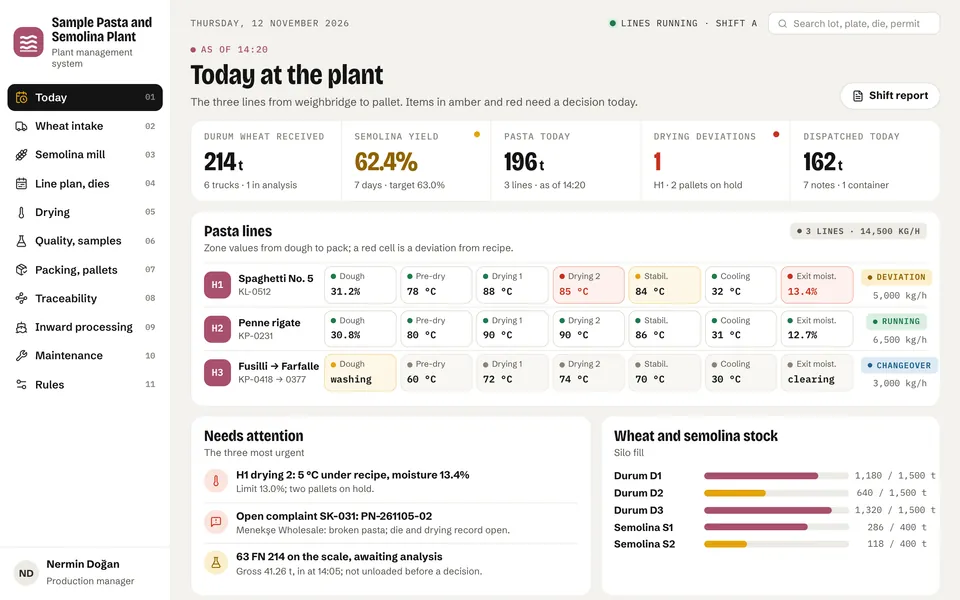
Pasta and semolina plant software home screen: daily intake, semolina yield, zone-by-zone temperature and moisture view of three lines, items needing attention and silo fill
One record chain From the wheat truck to the semolina lot, the die, the drying cycle, the pallet and the export permit in one chain.
Regulation as rules Limits of the pasta and semolina communiqués, the TMO durum scale and the inward processing circular are entered as rule tables.
Your ERP untouched Accounting, e-invoice and e-waybill stay in your current program; the transfer is confirmed in discovery by version.
Your lines untouched Dryer and press supervision systems keep running the machines; we read the data and tie it to records and quality decisions.

This page is a branch of Food and Beverage Manufacturing software; the wider picture and the other branches are there.

Does this sound familiar?

In pasta, margin and reputation get lost in drying, in dies and in paperwork.

These are headings we see often on pasta and semolina floors. If even one sounds familiar, this page was written for you.

  • On a durum wheat truck, protein, test weight, mealy kernels, sunn pest damage and sprouted kernels are each graded separately; which element pulled the truck down stays on the analysis sheet and reaches the supplier scorecard by hand at month end.
  • The mycotoxin result, the date the wheat entered the silo, the semolina lot and the pasta lot do not sit in one record; when a rejection or a customer complaint arrives, finding the root cause takes days.
  • Semolina yield is written by estimate at the end of the shift; because pasta semolina, under-semolina flour and bran output are not kept at separate weighing points, nobody can say where the loss occurred.
  • Sieve analysis, moisture, protein, ash and acidity of the semolina sit in the lab notebook; which semolina lot went onto which line sits in the press operator's note.
  • The drying curve lives in the line automation; when temperature or humidity drifts from the recipe, even if exit moisture crosses the limit, the affected pallets are carried to the quality record by hand.
  • Die change, washing and first-piece approval do not enter the plan as time; die life lives in the foreman's memory, and a die past its life causes an unplanned stop.
  • When a complaint arrives, finding which line, die, drying cycle and semolina lot the broken pasta came from means going through separate notebooks and files.
  • If the same plant makes pasta from durum and, for some export markets, from common wheat, lot separation and the wheat ratio on the pack are kept by hand.
  • On inward processing permits, commitment, exports, equivalent wheat imports and deadline sit in a separate table, often with one person; for the common wheat option there is no ready data for the pack ratio and the certified public accountant report.
  • With many shapes, pack weights and markets, label, carton and pallet records are scattered; which lot went to which customer and which container is learned only by joining delivery notes.
The software landscape today

Which software do pasta and semolina plants use today, and where does it fall short?

We found no end-to-end business software in Turkey specifically for pasta and semolina with clearly published screens and scope. Plants usually run several layers side by side, and the gaps are covered by Excel and notebooks.

LayerSoftware in use todayThe gap it leaves
General ERP and accounting (the horizontal backbone) Logo, Mikro, Netsis and similar general ERP and accounting programs They should stay: accounts, stock, invoices and e-documents. Pasta- and semolina-specific intake rules, drying records, die life and permit balances are not their natural job; those topics usually run outside the program.
Machine makers' line and drying software Bühler (WinCos, PastaSense, PastaPro), Fava Storci (ATS Supervisor) Their pages describe recipes, parameter change logs, die life and motor hour tracking, in-line measurement through drying, batch traceability and data to MES. The same pages do not list commercial processes such as wheat purchase pricing, inward processing and export permits, accounts or customer complaints.
General-purpose manufacturing execution systems GEA (Codex Recipe Advanced, Codex Scheduler) A general MES family offering recipe management, production records, change history and scheduling; pasta does not appear on the product page. It does not know pasta terms such as drying curve, die and semolina lot on its own; these are defined during setup.
Semolina mill automation Tanış (SCADA, MES, blending and lot traceability) Strong at managing intake, silo, tempering, milling and packing data. Its published page does not list a pasta line, inward processing permits or commercial records such as customer complaints.
Laboratory and in-line measurement NIR protein and moisture instruments, sieve and colour measurements, in-line moisture and colour sensors Measurement is accurate but the result stays on the instrument screen or printout; it does not tie automatically to the truck, the semolina lot, the line and the pallet.
Excel and paper notebooks Intake notebook, semolina lot table, die list, permit tracking table Flexible but dependent on one person; no versions, approvals or history. Tracing backwards in a complaint or an audit takes days.
Public systems and documents TMO purchase documents, Ministry of Trade inward processing procedures, e-document systems Mandatory and fixed; the software's job is to prepare correct data from records for them: from which wheat, to which market, how much exported and how much imported.

Product names are compiled from vendors' public pages (September 2026); PAN is not affiliated with them. The "gap" column summarises situations we commonly meet in discovery and is not a statement about any specific product.

Our approach

A business layer that closes the gap between line automation and accounting.

We do not bring a second accounting program or a new dryer supervision system to your plant. We build the record chain from wheat intake to the export permit and connect it with the systems you already run. The system does the arithmetic; the foreman, quality manager and management make the decisions.

Durum wheat intake and mycotoxin record

A record opens when the truck enters the scale: plate, supplier, gross and tare, sample, moisture, test weight, protein, mealy kernels, sunn pest damage, sprouted kernels, common wheat admixture and the DON or OTA result. The TMO durum scale runs from a rule table; how the weakest element affects the truck is written as the grounds for the decision.

Semolina lot and yield

Tempered wheat input, pasta semolina, under-semolina flour, bran and loss are held in one equation. Every semolina lot is recorded with sieve range, moisture, protein, ash and acidity and checked against the communiqué limits; which lot went onto which line is known.

Dough, press and die record

Recipe, dough moisture, line speed and die number are written to the cycle record. How many hours a die has run, how much life is left, and the changeover time including washing and first-piece approval feed back into planning.

Drying curve and exit moisture

Temperature, relative humidity and time of the pre-drying, drying, stabilisation, humidification and cooling zones are watched next to the recipe. Deviations are written to the cycle and the lot; if exit moisture nears the limit in the pasta communiqué, the relevant pallets are held.

Packing, pallets and dispatch

Pack lot by shape, weight and market, carton and pallet records, label checks, delivery note and container. A pallet is tied to its drying cycle and semolina lot; every carton sent to a customer can be traced backwards.

Traceability and inward processing tracking

In a complaint or an audit, the chain from carton to wheat truck opens in seconds. On inward processing permits, commitment, exports, equivalent wheat imports and deadline are tracked; for the common wheat option, the pack ratio and the data needed for the certified public accountant report are prepared from records.

Modules we can build

Modules we can build for a pasta and semolina plant

You do not need all of them at once. Most plants start with intake and the semolina lot and grow into drying, dies and traceability. The screens in the gallery are example views of these modules.

INTAKE

Durum wheat intake and weighbridge

Scale weights, samples and analysis results, element grades on the TMO durum scale, your internal limits, accept, conditional accept and reject decisions, silo suggestion and supplier scorecard.

SEMOLINA

Semolina mill and lot quality

Mass balance, semolina yield, under-semolina flour and bran output, sieve analysis of the semolina lot, moisture, protein, ash and acidity checks, silo and line assignment.

LINE

Line plan and die management

Product sequence per line, die change, washing and first-piece approval times, die inventory, run hours and life counter, sharpening and renewal plan.

DRYING

Drying curve and deviation management

Zone-by-zone temperature, relative humidity and time, recipe comparison, exit moisture, deviations written to the lot, holding affected pallets and the release decision.

PALLET

Packing, pallets and dispatch

Pack lot by shape and weight, carton and pallet labels, order and loading plan, delivery note, container fill and transfer to accounting.

TRACE

Traceability and recall

By lot, pallet or delivery note, the full chain back to the wheat truck and forward to the customer and container; the list of customers who received the same lot and the complaint closing record.

ERP

Accounting and ERP integration

Purchase documents, delivery notes, invoices, stock and accounts passed to Logo, Mikro, Netsis and other programs. The integration path depends on version and licence and is confirmed during discovery.

What it looks like on screen

What pasta and semolina software looks like on screen

These screens come from the demo we prepared for pasta and semolina producers. The figures are sample data; the system is set up around your own lines, dies and permits.

Today at the plant. The zone-by-zone state of three pasta lines from dough to pack, semolina yield and the decisions waiting today on one screen: which dryer drifted, which die is being changed, which truck is in analysis.
Wheat intake and semolina. Durum wheat is accepted on the TMO scale, mealy kernels, common wheat admixture and DON; the semolina lot is checked against sieve range, moisture, protein, ash and acidity limits.
Drying curve. In every zone of the drying tunnel, recipe and actual temperature and product moisture overlaid: deviations are written to the lot and pallets above the 13% moisture limit are held.
Line plan and dies. In the six-day plan of three lines, die changes and washing take their place as time; die life is counted by the hour so a worn die is renewed before it causes an unplanned stop.
Traceability and inward processing. The chain from the complained carton to the wheat truck opens in seconds; the same record shows which wheat type and pack ratio each export permit is tied to, and how much time is left.

Company names, people and figures on these screens are sample data. The system is built around your own processes, document names and rules. We walk you through the demo in a call: request a demo

Integration with your existing ERP

Your accounting program and your line automation both stay where they are.

Pasta and semolina plants already have two solid systems: accounting and e-document software on one side, and the automation running the press and dryer on the other. What is missing is the workflow between them: intake decision, semolina lot, die plan, quality decision, lot chain and export permit. We write that layer and set up data exchange with both sides. Accounting and official documents stay in your current program; process data is read from automation, not typed in.

Our integration approach →
  • Accounts, stock, purchase documents, delivery notes and invoices passed to Logo, Mikro, Netsis or the program you use; double entry disappears.
  • Reading data from the weighbridge indicator and laboratory instruments; confirmed in discovery by instrument model and output.
  • Reading temperature, humidity, speed and stop data from press and dryer automation; machine control is not touched.
  • Matching inward processing permit information and export and import records with actual production and dispatch data.
  • A daily summary readable on a phone for management: wheat received, semolina yield, pasta produced, pallets on hold and open complaints.
Outcomes

What changes on the floor once this layer is in place?

  • The grade, mycotoxin result, decision and silo of every truck sit in one record; month-end reconciliation is no longer about collecting files.
  • Semolina yield, under-semolina flour and bran output are calculated from weighing points; loss stops being a shift estimate.
  • Every semolina lot is checked against the communiqué limits for sieve, moisture, protein, ash and acidity; a lot beyond the limit is seen before it reaches a line.
  • Drying deviations are recorded in the cycle and the lot; pallets whose exit moisture is near the limit are held before dispatch.
  • Die life is counted hour by hour; a die at the end of its life enters the plan before it causes an unplanned stop.
  • Die change, washing and first-piece approval show as time; the product sequence is planned to reduce changeover loss.
  • In a complaint the chain opens within minutes; customers who received the same lot are on a ready list.
  • Which pallet was made from durum and which from common wheat, and the ratio on the pack, are clear from the record.
  • The commitment, balance and remaining time of an inward processing permit sit on one screen; no surprises at closing time.
  • Management reads yesterday's production, the decisions waiting and the riskiest permit from the phone every morning.
Process

A realistic five-stage path that begins with discovery.

  1. 01

    First conversation and screen walk-through

    1 week

    We listen to the number of lines, long-cut and short-cut products, whether you have a semolina mill, your drying and press automation and the accounting program you use. We walk through the gallery screens together and discuss which one matches what you have.

  2. 02

    Discovery at the plant

    1-2 weeks

    We watch the flow from weighbridge to palletising on site. We collect your intake rules, semolina and pasta specifications, drying recipes, die list, permit tracking file and label records, and take your field names as they are.

  3. 03

    Scope, priority and budget

    1 week

    We present in writing the module order starting from where it hurts most, the integration paths, the timeline and the budget. The first phase is usually intake, semolina lot and traceability.

  4. 04

    Development and pilot

    6-10 weeks

    We deliver modules one by one and test with real trucks, real semolina lots and real cycles. The lab technician, drying operator and quality manager use the screen at every delivery; corrections come from the floor.

  5. 05

    Go-live and maintenance

    Ongoing

    After training, data transfer and go-live, maintenance and support continue. When a new shape, a new die, a new market or a new regulatory rule arrives, the system grows with you.

Why Pan Innovation House?

A team that speaks the pasta maker's language and builds the record chain on site.

You see the screens first

Not promises but screens: intake, drying curve, line plan and dies, traceability and inward processing sit in the gallery on this page. Your system is built from this core around your rules.

We work in pasta terms

Semolina, mealy kernels, undersize, dough moisture, pre-drying, stabilisation, die and long or short cut appear on screen under the names you use; staff do not learn a new language.

Regulation goes in as rules

Limits of the pasta and semolina communiqués, the TMO durum scale and the inward processing circular are entered as rule tables; when regulation changes, the table is updated and the software is not rewritten.

Accounting and automation stay in place

We do not rip out working systems; we close the gap between them. That keeps switching risk low and brings the first benefit early.

Our base is Gaziantep, we come to you

We are based in Gaziantep and have an office in London. By the industry association's own statement about half of the country's pasta capacity is in Gaziantep; we go to plants anywhere in Turkey for discovery and run the pilot on site.

Data and code are yours

You choose the server; your data and the code written for you are yours. The system keeps running even if the maintenance contract ends.

Frequently asked questions

Pasta and Semolina Production software: common questions

Which wheat is pasta made from, and what does regulation say?

The Turkish Food Codex Pasta Communiqué (2002/20) defines pasta as made from semolina produced from Triticum durum wheat. The Ministry's 2022 draft proposed a limit of at most 3 percent for incidental common wheat in pasta and semolina; we confirm the text in force together during discovery and enter it into the rule table.

Are the limits of the semolina communiqué checked in the system?

Yes. Under the Semolina Communiqué (2002/21), semolina for pasta is the product lying between 125 and 530 micron sieves; the undersize is at most 10 percent and the oversize at most 1 percent. Semolina moisture is at most 14.5 percent, protein at least 10.5 percent of dry matter, ash at most 1 percent and acidity at most 0.05 percent. Net semolina weight is calculated on a 14.5 percent moisture basis. These limits are entered as rules and every semolina lot is checked against them.

Which quality limits for pasta are entered as rules?

Under the Pasta Communiqué, pasta moisture is at most 13 percent. For plain pasta, ash is at most 1 percent of dry matter, protein at least 10.5 percent, matter passing into cooking water at most 10 percent, and no salt is added to plain pasta. For whole wheat pasta, protein is at least 11 percent and ash at most 2 percent. Outgoing analysis is judged against these limits.

How is the TMO durum scale used?

Test weight, protein, mealy kernels, sunn pest damage, sprouted kernels and the other elements of the 2026 TMO durum wheat scale are entered as a rule table. For example, protein of 13.5 and above reads as group one, 12.5-13.4 as group two and 11.5-12.4 as group three. Your own internal limits and premium rules are defined separately; both calculations are shown side by side on every truck.

Will the software decide the drying curve?

No. The foreman and the quality manager set the recipe and curve, and your existing automation keeps running the machine. We read zone temperature, relative humidity and time, compare them with the recipe, write deviations to the cycle and the lot, and suggest holding pallets whose exit moisture nears the limit. The decision stays with the quality manager.

We have line automation or the equipment maker's own software; will that clash?

No. Line makers' software is strong on the machine side, such as recipes, parameter logs and drying supervision. We do not send commands to machines; where useful we read data from them. Our layer holds business processes such as the intake decision, semolina lot, quality, pallets, complaints, export permits and cost.

Which inward processing rules are tracked?

Under the 24.10.2025 text of the Inward Processing Circular for Agricultural Products, permit requests for pasta, semolina and vermicelli exports are evaluated on durum wheat, and an equivalent quantity of wheat is imported after export. For exports to African countries, Iraq, Syria, Lebanon, Jordan, Central and South America there is a common wheat option; the ratios of durum and common wheat are stated on the pack, common wheat is processed at a yield of at least 74 percent, and a certified public accountant report is requested at permit closing. Conditions such as permit period, by-product unit price and the import window are tracked as rules.

How are mycotoxin results tracked?

The DON and OTA result at intake is tied to the truck record and from there to the silo, the semolina lot and the pasta lot. For exports to the EU, the values of Regulation (EU) 2023/915 can be used as the limit: for example, for DON 1,750 micrograms/kg in unprocessed durum wheat and 750 in dry pasta. Current Turkish limits are confirmed from the Contaminants Regulation; your company can also define its own internal limit.

What is die life and die change tracking for?

It records which die ran on which line, on which product, for how many hours; a die approaching its life limit enters the line plan. Die change, washing and first-piece approval are written into the plan as time. That reduces unplanned stops from a worn die and shows which die was worn when a complaint comes.

Do we have to replace our accounting program?

No. Accounts, e-invoice and e-waybill stay in your current program. Purchase documents, delivery notes and stock movements are passed to it; the integration path is confirmed in discovery by program version and licence.

We are a small plant; will this be too heavy for us?

The system is built module by module. A single-line plant can start with intake, semolina lot and traceability only; drying, dies and inward processing are added as needed. A screen you will not use is not built.

How long does it take and how is the budget set?

After discovery we give a written timeline and budget by module order. The first phase usually reaches the floor in a few weeks at most plants; full scope with the pilot generally takes two to three months. The budget depends on the number of modules, integration paths and device connections.

Where will our data live?

The system runs on the server or cloud account you choose; your data and the code written for you are yours. Access roles are set separately for weighbridge staff, lab technicians, drying operators, quality and management; price and cost screens open only to authorised people.

Next step

Let's walk through the screens together, then visit your plant

A pasta or semolina plant's system cannot be written remotely. First we walk through the gallery screens together; then we see your weighbridge, semolina mill, drying line and paperwork on site and propose the first phase in writing.

Related services

Related areas worth considering

Pan Innovation House

Call us

By phone

+90 543 930 12 72

Our phone line is open every day.

WhatsApp on your phone

Scan with your phone camera. The chat opens with your message ready.

Prefer that we call you? Leave your details