Pan Innovation House Pan Innovation House
INDUSTRY SOFTWARE · FEED MILLS AND COMPOUND FEED

From the maize on the truck to the feed on the farm: feed mill software that keeps the ration's books

Pan Enterprise Solutions, the software arm of Pan Innovation House · based in Gaziantep, Türkiye, with a London office

We put raw material intake and aflatoxin results, least-cost rations, line and mixer planning, medicated feed e-prescriptions, labels and the recall list into one chain of records. Logo, Mikro, Netsis or whatever accounting package you run stays in place; we do not touch your dosing and pellet automation, we build the business software next to it. You can see the screens, from ration to label, in the gallery in the middle of this page.

Asking about price? We listen to the scope in a short call and share the budget frame and timeline in writing. The first 30-minute call is free; the scope of an on-site discovery, and its fee if any, is agreed in writing during that call.

We work on site for plants in and around Gaziantep; elsewhere in Türkiye and abroad, discovery starts by video call and a visit is planned if needed. Our London office is at Unit 6 Cranford Way, Hornsey, London N8 9DG.

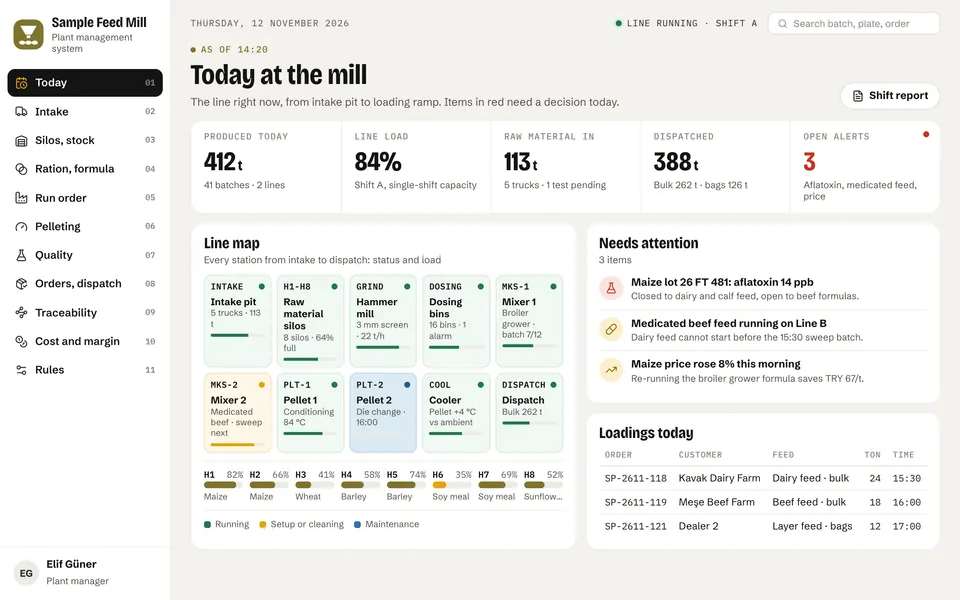
Feed mill software home screen: daily output, line load, line map from intake pit to dispatch, aflatoxin and medicated feed alerts and today’s loadings
One chain of records From raw material lot to formula, feed batch, label and farm in a single record chain; if a recall is needed, the list is ready.
Limits as rules The aflatoxin limits in the Undesirable Substances in Feed Communiqué arrive as a rule table by animal type and are checked at intake and in the formula together.
Without touching your ERP Accounting, e-invoice and e-waybill stay in your current package; the transfer is settled in discovery, depending on version.
Without touching your line Dosing, mixer and pellet automation keep running the machines; we read the data and tie it to the record and the decision.

This page is a branch of Food and Beverage Manufacturing software; the wider picture and the other branches are there.

Does this sound familiar?

In a feed mill, profit is lost inside the ration and the intake, not in the selling price.

The picture in feed mills is often alike: the calculation in one place, the machine in another, the analysis in a third. If even one of these sounds familiar, this page was written for you.

  • Maize or soy price changes in the morning and the formula is still running at the old price in the evening. Which formula must be recalculated, and what the tonne cost difference is, stays in a spreadsheet that is carried around by hand.
  • The truck's moisture and protein go into the weighbridge book and the aflatoxin result onto a lab sheet. Which animal types the lot may be fed to depends on the memory of the foreman or the quality manager.
  • The aflatoxin limit differs by animal type. The limit for dairy cattle and calf complete feed is far lower than for a feed material; a lot below the feed material limit can still push the mix over the limit once it enters a dairy formula.
  • What happens to the next batch after medicated feed has run on a line? If the sweep batch and cleaning record are run by hand, they can be skipped, and nothing in the system notices.
  • The line plan lives on a board or in a table. Die changes, mixer cleaning, a medicated batch and layer or broiler feed all land in the same sequence, and half a day later the plan is off.
  • Labels are prepared by hand for each feed. If the feed type, approval number, batch number, additive list, moisture, minimum shelf life and ingredient order are not kept with the formula version, the risk of printing a wrong label appears.
  • When a farm reports a milk yield or growth complaint, finding which raw material lots made up the batch takes hours. Calling the other farms that got the same batch is a separate job.
  • The accounting package keeps purchases and sales solid but sees maize only as a stock item. Silo, formula, batch and yield either do not exist or live in a side table typed by hand.
  • Bulk and bagged dispatch are tracked in two separate books. Which truck took how much feed from which batch is looked for at month end when a stock difference appears.
  • Management learns what each feed earns only at month end. By the time you know which formula turned loss-making when ingredient prices moved, the order price has long been given.
The software landscape today

Which software do feed mills use today, and where does it fall short?

Looking at public product pages, we see two separate worlds: automation that runs the machines and programs that calculate rations. The intake decision, medicated feed, labels and recalls in between are closed with spreadsheets and books in many places. The products below are named only with features we read on the vendors' own pages.

LayerSoftware in use todayThe gap it leaves
General ERP and accounting (the horizontal backbone) Logo (Tiger, Netsis), Mikro, ETA, Canias, Uyumsoft, DİA Solid for accounts, stock, invoices and e-documents, and should stay in place. Concepts specific to a feed mill do not appear in their standard scope: maize is often one stock item, while formulas, batches, aflatoxin results and label fields are kept outside these programs.
Feed mill automation and SCADA (Türkiye) Softek (PlantManager), Yemmak (Yemmak SCADA, Yemmak IQ), Alapala (automation) The vendors' pages describe production orders, dosing recipes, flow monitoring, integrated stock control, stock and recipe access on mobile, ERP integration and a traceability infrastructure. The same pages do not list an aflatoxin decision at intake, ration optimisation, medicated feed e-prescriptions, labels or a customer-level recall list.
Formulation and ration programs Bestmix, MixitWin (Agricultural Software Consultants) The vendors' pages describe least-cost rations, re-formulation when prices change, bringing in quality and lab data, and stock and label helpers for feed mills. Setting up Turkish regulatory limits, the approval number and the medicated feed flow locally falls outside the scope described on those pages.
Manufacturing execution systems (MES) Bühler (Mercury MES) The page describes traceability from raw material intake to outtake, yield tracking and ERP and quality data in one database; feed is mentioned only as an application area. The cost and set-up load of a platform designed for large plants is often hard to carry for small and mid-sized mills.
Laboratory and quality Instrument vendor software, rapid test strips, paper forms Moisture, protein and aflatoxin are measured correctly; the problem is tying the result to the record, the lot, and the silo and formula decision. When the result stays on paper, what the lot goes into is decided from the foreman's memory.
Excel, e-mail and WhatsApp Ration sheets, line plan files, e-prescription and dispatch notes Cheap and flexible, so every mill has them. When one file is wrong the difference shows up at month end; formula versions, approval trails and who changed what are often not recorded.

Product names are compiled from vendors' public pages (September 2026); PAN is not affiliated with them. The "gap" column summarises situations we commonly meet in discovery and is not a statement about any specific product.

Our approach

Business software for the gap between automation and accounting.

We do not bring a second accounting package or a new SCADA to your mill. We build the chain of records from intake to dispatch and connect it to your existing systems. The system does the calculation; the quality manager and plant manager make the decision.

Intake and aflatoxin record

A record opens as the truck rolls onto the weighbridge: plate, supplier, gross and tare, sample, moisture, crude protein, aflatoxin and other mycotoxin results. Under your intake rule the lot is accepted, conditionally accepted or rejected. With a conditional acceptance, the lot goes into the silo together with the animal types whose formulas it stays closed to.

Ration and least-cost formula

The ingredient matrix, prices and stock are kept together; the cheapest mix is calculated under limits such as crude protein, energy, crude fibre, calcium, phosphorus and lysine. When prices move you see which formula changed and what the per-tonne difference is. Banned and restricted materials do not enter a formula.

Line plan and medicated feed flow

Mixer, pellet mill and die planning sit on one calendar. A medicated batch opens together with its e-prescription; afterwards no non-target feed can be scheduled without a sweep batch and a cleaning record. No production order is issued for a form or quantity other than the one on the prescription.

Label, dispatch and recall

Mandatory label fields are generated from the formula version and batch record. For bulk feed the details are printed on the delivery document. If a batch becomes a problem, the farms that received it, the truck plates and the quantities are ready as a list.

Cost and margin

Ingredient cost, energy, labour, packaging and loss are calculated per tonne for each feed type. When ingredient prices move while the price list does not, you see in advance which feed leaves its margin band.

Link to accounting and automation

Accounts, stock, delivery notes and invoices stay in your current accounting package; the transfer is two-way. Dosing and mixer data is read from the automation and tied to the record and the batch. How each item is read is settled in discovery, depending on device and version.

Modules we can build

Modules we can build for a feed mill

You do not need all of them at once. Most mills start with intake and silos and grow into rations and medicated feed. The screens in the gallery show most of these modules.

INTAKE

Raw material intake and analysis

Weighbridge weight, moisture, crude protein, aflatoxin and mycotoxin results, supplier scorecard, accept, conditional accept and reject decision, silo or bin suggestion, and which formulas the lot is open to.

STOCK

Silos, bins and store

A lot book by silo and bin, stock count difference, batch and minimum shelf life tracking in the additive and premix store, material age and consumption rate.

RATION

Ration and formulation

Ingredient matrix, nutrient limits by animal type and production stage, least-cost formula, formula version and approval, price scenarios, banned and restricted material check.

RUN

Line plan and batch record

Mixer and pellet mill plan, die changes, cleaning and sweep batches, actual weighing and deviation by batch, shift report.

MEDICATED

Medicated feed and e-prescription

Prescription number, animal owner, veterinarian, medicated premix weighing, production approval, return of unused medicine, the carry-over rule for the feeds that follow and the cleaning record.

PELLET

Pellet and conditioning

Conditioning temperature by pellet mill, die life and change record, energy use, cooler output and pellet quality measurements.

LABEL

Label and dispatch

Mandatory label fields, bulk and bagged dispatch, order and truck plan, delivery note and dispatch document, bag and pallet count, delivery record by customer.

TRACE

Traceability and recall

From a batch number back to the raw material lot and supplier, forward to the farm; a notification list for customers who got the same batch; complaint and corrective action record.

COST

Cost and margin

Tonne cost by feed type, ingredient price scenarios, energy and labour share, loss, contribution by order and customer.

MAINT

Maintenance and calibration book

Maintenance plan for the hammer mill, mixer, pellet mill and weighing equipment, scale calibration, mixer homogeneity test records and fault history.

What it looks like on screen

What feed mill software looks like on screen

These screens come from the demo we built for feed mills. Figures and prices are sample data; the system is set up around your own lines, formulas and rules.

Today at the mill. Every station from intake pit to dispatch on one map: which feed is in which mixer, whether a pellet mill is down, and which raw material lot is closed to which formula. Decisions due today sit on top.
Raw material intake. A record opens as the truck rolls onto the weighbridge. Moisture, protein and aflatoxin results, the mill’s own acceptance rule and the formulas the lot is open to sit on one line, and the supplier scorecard builds itself.
Ration and formula. The cheapest mix that meets crude protein, energy, fibre, calcium, phosphorus and lysine limits is calculated. When maize or soy prices move, you see which formula changes and the saving per tonne on the same screen.
Run order and medicated feed. Which line a medicated batch runs on, under which e-prescription, and what may follow: the sweep batch, the cleaning record and blocked sequences show in the plan. Nothing beyond the prescribed form and quantity is produced.
Traceability and label. From a farm complaint to the feed batch, the formula, the raw material lot and the supplier on one screen; farms that received the same batch are a ready list. Mandatory label fields come from the same record.

Company names, people and figures on these screens are sample data. The system is built around your own processes, document names and rules. We walk you through the demo in a call: request a demo

Integration with your existing ERP

Your accounting program and your dosing automation both stay where they are.

Most feed mills already have two solid systems: accounting and e-document software on one side, and automation running the dosing, mixer and pellet line on the other. What is missing is the workflow in between: the intake decision, ration, line plan, medicated feed, label, dispatch and cost. We write that layer and set up data exchange with both sides. Accounting and official documents stay in your current program; line data is read from the automation and tied to the record and the batch. Data and code belong to the customer; you choose the server.

Our integration approach →
  • Accounts, stock, purchase documents, delivery notes and invoices passed to Logo, Mikro, Netsis, ETA, Canias or whatever you use; double entry disappears.
  • Batch and weighing data is read from the dosing and mixer automation; the method is settled in discovery, depending on device and version.
  • Weight is taken from the weighbridge indicator, and moisture, protein and aflatoxin values from rapid tests and lab results; results typed by hand are recorded too.
  • Your existing ration files and ingredient matrix are brought in; formulas are built with your limits and your names.
  • Data and code belong to the customer; on your own server, in the cloud or in your own data centre, you choose the server.
Outcomes

What changes in the mill once this layer is in?

  • Each truck's analysis, decision and silo sit in one record; month-end reconciliation is no longer a hunt for files.
  • The aflatoxin result is tied to the formula; because the limit is calculated by animal type, the wrong lot does not enter the wrong feed.
  • When maize or soy price moves, you see in the morning which formula to recalculate and what the tonne difference is.
  • The cheapest mix that meets the nutrient limits is calculated every day under the same rules; formula versions and approval trails are recorded.
  • After a medicated batch, the sweep and cleaning step is written into the plan; skipping it becomes visible in the system.
  • The line plan is updated with the real situation; die changes and cleaning times are part of the calculation.
  • The label is generated from the formula version; the risk of missing or outdated mandatory fields falls.
  • When a complaint comes in, the batch, formula, raw material lot and supplier are found in minutes; farms that received the same batch become a ready list.
  • Tonne cost and margin by feed type are visible without waiting for month end.
  • Your accounting and automation systems are not touched; installation risk stays small and going back is easy.
Process

A realistic five-stage path that begins with discovery.

  1. 01

    First conversation and screen walk-through

    1 week

    We listen to the mill's capacity, the number of lines and mixers, the feed types, and the accounting and automation systems you use. We walk through the gallery screens together and talk about which has a counterpart at your mill.

  2. 02

    On-site discovery

    1-2 weeks

    We follow the flow from the intake pit to dispatch on site. We collect your intake rule, ingredient matrix, formulas, line plan, medicated feed practice and label records, and take your field names as they are.

  3. 03

    Phase one: intake and silos

    4-8 weeks

    The weighbridge, analysis, decision and silo record go live. The supplier scorecard starts to build. Purchase and delivery note transfer to the existing accounting program is set up.

  4. 04

    Phase two: ration, line and medicated feed

    6-10 weeks

    Formulas are brought in, price scenarios and the approval flow are set up; the line plan and medicated feed flow are added. Batch data starts to be read from the dosing automation.

  5. 05

    Label, traceability and what follows

    ongoing

    Label, dispatch and recall list go live; the cost and margin screen is added. Later, new feed types, extra lines and new reports grow as needed.

Why Pan Innovation House?

A team that speaks the feed miller's language and builds the record chain on site.

Discovery first, then a proposal

The system of a feed mill cannot be written remotely. We see your intake pit, mixers, formulas and medicated feed practice on site and propose the first phase in writing.

We work in the mill's own terms

Ration, formula, premix, sweep batch, crude protein, ME, complete feed, complementary feed and pellet conditioning appear on screen under the names you use; staff do not learn a new language.

We build regulation as rules

Aflatoxin limits, banned and restricted materials, label fields and e-prescription steps are entered as a rule table; those sourced from official texts are shown with their source on screen. When the regulation changes, the table is updated.

We do not touch your line or your ERP

Dosing and mixer automation keep running the plant, and the accounting program keeps the books. The layer is built next to them; data and code belong to the customer.

Based in Gaziantep, with an office in London

The team is in Gaziantep and our office is in London. We can visit your mill for discovery on site and then work together remotely and on site.

It grows phase by phase

You start with intake and silos and go on with rations and medicated feed. Each phase delivers value on its own; you do not have to move to the next one.

Frequently asked questions

Feed Mills and Compound Feed software: common questions

What is a ration, and what is formulation?

A ration is the feed mix that meets an animal's daily nutrient needs. In the mill the same job is called formulation: setting the ingredient proportions that meet limits such as crude protein, energy, crude fibre, calcium, phosphorus and amino acids. Least-cost formulation picks the cheapest among the mixes that satisfy those limits; the usual method is linear programming. The software calculates it together with ingredient prices and stock, and the feed manager makes the decision.

What are the aflatoxin limits?

Under Annex 1 of the Communiqué on Undesirable Substances in Feed, the aflatoxin B1 limit is 0.02 mg/kg in feed materials and 0.01 mg/kg in complementary and complete feeds. For compound feeds for dairy cattle and calves, dairy sheep and lambs, dairy goats and kids, piglets and young poultry the limit is 0.005 mg/kg; for compound feeds for other cattle, sheep, goats, pigs and poultry it is 0.02 mg/kg. Values refer to feed at 12 percent moisture. Because limits can change, the system keeps them as a rule table shown with their source.

Can we dilute a lot that is over the limit by blending it with other feed?

No. Under Article 7 of the Communiqué, feed containing undesirable substances above the maximum level cannot be blended with the same or other feed for dilution. The software does not let an over-limit lot into a formula. On the other hand, a lot below the feed material limit can still push a complete feed over its limit because of its share in the formula, so the calculation is made at intake and in the formula together.

How do registration and approval of a feed business work?

Under the Feed Hygiene Regulation, businesses that make compound feed for the market using additives or premixes containing them, and those making such compound feed for their own animals, obtain approval before starting. Other compound feed makers, retail storage and sales points and importers are subject to registration. Registration and approval of compound feed is handled by the Ministry's provincial directorates. The software keeps the approval and registration number on the label and batch record; it does not make the application on your behalf.

What does the software do in medicated feed production?

Under the Veterinary E-Prescription Instruction, a medicated feed plant is registered in the e-prescription system, produces the feed in the form and quantity on the prescription and dispatches it to the livestock holding, gives production approval in the system when production ends, and returns unused medicine to the animal owner with a record. The software ties these steps to the production order and batch record. Carry-over measures such as the sweep batch, cleaning record and the type of the next feed are your own rules; the regulation gives no figures for them, and we set up your rule in the system.

Which label details are mandatory?

Under the Regulation on Placing Feed on the Market and Use, a compound feed label states the feed type, the business name and address, the approval number for approved businesses, the batch or serial number, the quantity, the list of additives and moisture where above the threshold. It also needs the animal species or category, the purpose of use, the minimum shelf life and the composition, meaning the ingredient names ranked from largest to smallest. For bulk feed the details appear on the accompanying document. The December 2025 amendment introduced single-value declaration of analytical components and renewed some annexes; the system is set up to the current text.

How are label tolerances calculated?

The regulation contains tolerance values for the gap between the analytical component on the label and the laboratory result. The annex that holds these values was renewed by the amendment in the Official Gazette of 20 December 2025. For that reason we do not write the tolerances into page text; at set-up we take them from the annex in force and enter them in the rule table. The value calculated from the formula, the label value and the sample result appear in the same record.

How do banned and restricted materials reflect in a formula?

Under Annex 2 of the regulation, hormones and hormone-like substances, antibiotics other than coccidiostats and histomonostats, waste fats and restaurant and canteen waste (other than for fur animals) are banned. Animal proteins such as meat and bone meal, fish meal, blood meal, poultry meal and hydrolysed protein, and DCP and TCP of animal origin, cannot be used in ruminants. These rules are flagged in the ingredient matrix by animal type; a banned material does not enter that species' formula.

How is a formula recalculated when prices move?

When ingredient prices are updated, the system shows the new cost of the current formula next to a re-optimised proposal with the same nutrient limits. In our demo broiler grower formula, for example, when maize rises 8 percent the wheat share goes up and the tonne cost difference becomes visible; when soybean meal rises, the formula does not change because no substitute is left. The figures are demo data; for your mill the calculation uses your own ingredient matrix and limits.

How does it talk to our dosing automation?

The automation that runs the dosing, mixer and pellet line keeps running the machines. We read batch and weighing data and tie it to the record and the batch; the formula and production order side is passed to the automation or prepared in a form it can read. The method is settled in discovery, depending on the automation's brand, version and output interface. The line itself is not touched.

We run Logo, Mikro or Netsis; do we have to change?

No. Accounts, stock, invoices, e-invoice and e-waybill stay in your current program. The new layer carries the intake, ration, line, medicated feed, label and cost workflow, and passes purchase document, delivery note and invoice information to the accounting program. The transfer method is determined in discovery, depending on the program version.

We are a small mill; is this for us?

Most compound feed mills in Türkiye are small and mid-sized; according to the Ministry's sector document, about 80 percent of mills in 2020 had capacity below 10 tonnes an hour. That is why the build goes module by module: intake and silos first, then rations, line planning and medicated feed as needed. We decide together in discovery which module creates value for you.

Who keeps our data, and who chooses the server?

Data and code belong to the customer. You choose the server: your own server, the cloud or a data centre. After delivery the system can be moved to another provider, and your right to export your data is always kept.

Are the numbers in the demo real?

The prices, compositions and person and company names on the screens are illustrative. Regulatory limits, such as the aflatoxin limits, are taken from official texts; at your site the system runs with your ingredients, formulas and rules.

Next step

Let's walk through the screens together, then visit your mill

A feed mill's system cannot be written remotely. Let's first walk through the screens together; then we see your intake pit, mixers and formulas on site and propose the first phase in writing.

Related services

Related areas worth considering

Pan Innovation House

Call us

By phone

+90 543 930 12 72

Our phone line is open every day.

WhatsApp on your phone

Scan with your phone camera. The chat opens with your message ready.

Prefer that we call you? Leave your details