Pan Innovation House Pan Innovation House
INDUSTRY SOFTWARE · BAKERY AND BAKED GOODS PRODUCTION

From the evening cut-off to the morning route, production software that runs the bakery's night

Pan Enterprise Solutions, the software arm of Pan Innovation House · based in Gaziantep, Türkiye, with a London office

We bring dealer and branch orders, the night production schedule, dough and proofing, the oven line, weight and moisture records, the morning delivery route, returns and the frozen goods cold chain into one record. Logo, Mikro, Netsis or whichever accounting program you use stays where it is; we do not touch your oven and line automation, we build the business layer next to it. Scope is set through discovery.

Asking about price? We listen to the scope in a short call and share the budget frame and timeline in writing. The first 30-minute call is free; the scope of an on-site discovery, and its fee if any, is agreed in writing during that call.

We work on site for plants in and around Gaziantep; elsewhere in Türkiye and abroad, discovery starts by video call and a visit is planned if needed. Our London office is at Unit 6 Cranford Way, Hornsey, London N8 9DG.

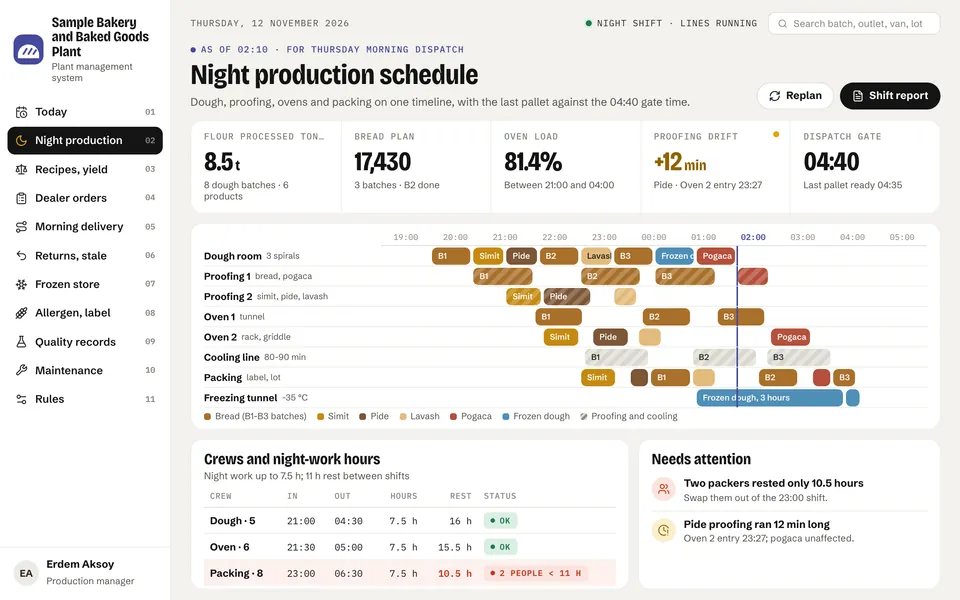
Bakery night production schedule: 19:00-06:00 timeline for the dough room, proofing, two ovens, cooling, packing and freezing tunnel, with crew working hours
The night on one schedule Dough, proofing, two ovens, cooling, packing and the freezing tunnel on one timeline; you see in advance whether the pallet makes the gate time.
Weight on record Oven exit time, sampling time, mean weight, moisture and salt result in one record, so you can explain an inspection hour by hour.
Without touching your ERP Accounts, stock, e-invoice and e-waybill stay in your current program; the transfer is settled in discovery according to its version.
Without touching your line Oven, dough and freezing line automation keeps running the machines; we read the data and tie it to quality and dispatch records.

This page is a branch of Food and Beverage Manufacturing software; the wider picture and the other branches are there.

Does this sound familiar?

In a bakery, profit is lost in the night's slippage, in unit weight and in returns.

In bakeries and baked goods plants that produce at night and deliver in the morning, these topics come up often. If even one sounds familiar, this page was written for you.

  • Evening orders change by phone, message and spreadsheet until the cut-off; the production order is rewritten by hand at the last minute, and what was promised to which dealer becomes an argument the next morning.
  • Dough, proofing and ovens are planned on one board for the same night; when proofing runs long on one batch, the next oven entry, cooling and packing slide, and the effect on the dispatch gate is noticed only towards dawn.
  • The recipe lives in the master baker's notebook or a spreadsheet; because dough yield and bake loss are estimated at the end of the shift, nobody knows whether flour was lost in the dough, in baking or in trimming.
  • For unpackaged bread, the weight inspection looks at the mean weight of the samples; if oven exit time, sampling time and moisture were not recorded, the reason for a failing weighing cannot be explained.
  • Bread moisture is capped at 38% and salt at 1.5% on a dry basis; when a recipe changes, how close the new salt level sits to the limit is learned only when the lab result arrives.
  • The 7.5-hour night limit and the 11-hour rest at shift change are left to the memory of whoever writes the roster; crew lists are built to fill the lines, and the rule is checked afterwards.
  • Morning vans leave through the same gate and the route depends on the driver's habit; when a van is late, which stop will miss its delivery window is understood only after the dealer calls.
  • Returns are not collected per dealer; inflated orders, crate counts and returned product sit on separate sheets, and which point is over its return target shows up at month end.
  • Returned bread leaving as breadcrumbs, crumb or feed is not recorded against a lot; reworking stale product becomes a blind spot in traceability.
  • When the door of a frozen dough or finished goods store stays open the temperature rises; product should be at -18 °C or below at every point, yet which pallet a drifting room affected and how long the drift lasted often goes unrecorded.
The software landscape today

Which software do bakeries and baked goods plants use today, and where does it fall short?

In this research we did not find an end-to-end Turkish business application for industrial bakery and baked goods production with openly presented screens and scope. Plants usually run several layers side by side; gaps such as the night plan, weight records and dealer routes are closed with notebooks and spreadsheets.

LayerSoftware in use todayThe gap it leaves
General ERP and accounting (the horizontal backbone) Logo, Mikro, Netsis and similar general ERP and accounting programs Solid for accounts, stock, invoices and e-documents, and should stay where it is. The night dough and oven schedule, proofing drift, weight records tied to oven exit time and returns per dealer are not the natural job of these programs, and are often handled outside them.
Foreign bakery and baked goods software Cybake, Supply'd ERP, BatchMaster ERP for Bakery The vendors' own pages describe order and production planning, recipes and costing, yield and waste, lot traceability, allergens and labels, and delivery routes, plus returns monitoring on the Cybake page. The same pages do not mention the moisture and salt limits of the Turkish Food Codex bread communiqué, weight inspection tied to oven exit time for unpackaged bread, or the night-work rules of Law no. 4857.
Recipe and manufacturing execution systems GEA Codex Recipe Advanced The product page describes recipe management, change tracking, double-check, PLC interaction, RFID material identification and planning with Codex Scheduler; bakery or bread is not mentioned on the page. Bakery-specific terms such as proofing, the cooling line and packing are defined at setup.
Oven, dough and freezing line automation Control panels from makers of ovens, dough mixers, cooling lines and blast freezing tunnels Good at running the machine and its line parameters. The data stays in a separate panel on each line and does not connect automatically to orders, dealers, lots and dispatch.
Spreadsheets and paper notebooks Order list, production board, recipe notebook, weight and returns sheet Flexible and quick, but tied to one person; they keep no version, approval or history. Tracing back during an inspection or a complaint takes time.
Public systems and documents The Ministry's food business registration and approval procedures, the chamber and Ministry of Trade price tariff process, e-document systems Mandatory and fixed; the software's job is to prepare the right data from the record: which product, which lot, which weight and which temperature record it was dispatched with.

Product names are compiled from vendors' public pages (September 2026); PAN is not affiliated with them. The "gap" column summarises situations we commonly meet in discovery and is not a statement about any specific product.

Our approach

A business layer that closes the gap between the oven line and accounting.

We do not bring a second accounting program or a new line automation to your plant. We build the record chain that runs from the evening cut-off to morning delivery and returns, and connect it with your existing systems. The system does the maths; the head baker, the quality manager and management make the decisions.

Evening cut-off and production order

Branch, dealer, chain and institution orders gather in one table until the cut-off. The system compares each order with recent returns and flags outliers; at cut-off, output per product, dough batches and flour need are produced. Changes after the cut-off are logged.

Night production schedule

The dough room, proofing, ovens, cooling, packing and freezing tunnel sit on one timeline. When proofing runs long, the next dough and oven entry slide with it and the effect on the dispatch gate shows immediately. Crew hours are checked against the night-work and rest rules.

Recipe, dough yield and weight

A percentage recipe on flour turns into batch kilos. Dough yield and bake loss are logged for every batch; oven exit time, sampling time, mean weight, moisture and salt results are kept in the same record. The limits of the communiqué run from a rule table.

Morning delivery route

Pallet, crate, van and stop form one record. Departure time, stop order and delivery window are followed live; a delay shows together with the stops it affects, and you decide before the dealer calls.

Returns, stale bread and rework

Returns show as a rate per point; a dealer over target is also flagged on the order screen. Returned product is never resold; it moves to a breadcrumb, crumb or feed record under a new lot.

Frozen goods cold chain

Temperatures of the freezing tunnel, frozen dough and finished goods rooms are recorded with date and time. A room that drifts off the -18 °C line is listed with its pallets and how long it has been off; records are kept for at least one year.

Modules we can build

Modules we can build for a bakery and baked goods plant

You do not need all of them at once. In most plants we start with the order cut-off and the night schedule and grow into weight, routes and returns. When you ask, we walk through screen examples of these modules together in a meeting.

RETURNS

Returns, stale bread and rework

Return rate per point with target and trend, return reason, and the move of returned product to a breadcrumb, crumb, feed or disposal record under a new lot.

CREW

Shifts and working hours

Crew in and out times, night-work hours, rest checks at shift change, and a warning before a roster that breaks the rule is written.

What it looks like on screen

What bakery and baked goods software looks like on screen

These screens come from the demo we prepared for bakery and baked goods producers. The figures are sample data; the system is set up around your own lines, recipes and dealer network.

Night production schedule. Eight lines, from the dough room to the freezing tunnel, on one timeline. When proofing runs long the next dough and oven entry slide with it, and night-work hours and the 11-hour rest rule are checked on the same screen.
Recipe and weight. The percentage recipe turns into batch kilos, and dough yield and bake loss are logged for every batch. Oven exit time, sampling time, weight and moisture are checked against the decree’s inspection rules, and the allergen matrix is built from recipes.
Evening cut-off. Dealer, branch and institution orders gather in one table until cut-off. The system compares each order with the last 7 days of returns and flags outliers; at cut-off, output per product, dough batches and flour need are ready.
Morning delivery. From the packed pallet through the gate, onto the van and from stop to stop, delivery is tracked in one record. A late van shows together with the stops likely to miss their delivery window, so you decide before the dealer calls.
Returns and cold chain. Return rates show point by point, and a dealer over target is also flagged on the order screen. A frozen store that drifts off the -18 °C line is listed with its pallets and how long it has been off.

Company names, people and figures on these screens are sample data. The system is built around your own processes, document names and rules. We walk you through the demo in a call: request a demo

Integration with your existing ERP

Your accounting program and your oven automation both stay where they are.

Most bakeries already have two solid systems: an accounting and e-document program on one side, and the automation that runs the dough, ovens and belts on the other. What is missing is the record chain between them, from the evening order to the morning route. We build that.

Our integration approach →
  • Transfer of accounts, stock, delivery notes and invoices with Logo, Mikro, Netsis or whichever program you use; double entry goes away.
  • Reading temperature, time and stoppage data from dough, oven, cooling and blast freezing line automation; machine control is not touched.
  • Taking data from devices such as scales and label printers; settled in discovery by device model and output.
  • Dealer and branch orders entered through a portal or phone app; mobile delivery confirmation for the van and driver side.
  • A daily summary readable on a phone for management: flour processed tonight, loaves made, late vans, return rate and open quality alerts.
Outcomes

What changes in the bakery once this layer is in place?

  • Evening orders gather in one table; the production order is not rewritten by hand, and surprises after the cut-off shrink.
  • When proofing runs long, the effect on the dispatch gate is visible at once; the decision is made at midnight instead of a surprise towards dawn.
  • Dough yield and bake loss are logged for every batch; flour loss stops being a guess.
  • Weight and moisture records are kept with oven exit time; in an inspection or an objection you can show what was measured at which hour.
  • Salt level is calculated against the limit while the recipe is being changed, and corrected before the lab result arrives.
  • Night-work hours and the rest rule are checked before the roster is written; a breach is caught beforehand, not afterwards.
  • Morning vans are followed with route and delivery window; a delay is seen before the dealer calls.
  • Returns are visible per point; order inflation and a dealer over target are caught early.
  • Returned product moves to a breadcrumb, feed or disposal record under a new lot; stale bread stops being a blind spot in traceability.
  • Frozen store temperature is recorded with date and time; the drifting room and its pallets are found before dispatch.
Process

A realistic five-stage path that begins with discovery.

  1. 01

    First conversation and screen walkthrough

    1 week

    We listen to your line count, your products (bread, simit, pide, lavash, pogaca, frozen dough), your night shift pattern, your dealer and branch network and the accounting program you use. We walk through the gallery screens together and talk about which has a counterpart in your plant.

  2. 02

    Discovery and scope

    1-2 weeks

    We follow the night on site: from the dough room to the dispatch gate, from morning delivery to returns. We review recipes, weight and moisture records, returns and stale processes and the cold store, and propose a first phase in writing.

  3. 03

    First phase build

    Depends on scope

    We usually start with the evening cut-off, the night schedule and weight records. Screens are built around your products, recipes and rule tables; the accounting transfer is connected in this phase.

  4. 04

    Parallel running

    Depends on scope

    We run the new record next to the old board for a few nights. The head baker, the quality manager and the dispatch team give feedback while using it, and adjustments are made.

  5. 05

    Expansion and support

    Ongoing

    Route, returns, cold chain and allergen modules are added in turn. Data and code are yours; you choose the server. When regulation changes, the rule tables are updated.

Why Pan Innovation House?

A team that speaks the baker's language and builds the record chain on site.

You see the screens first

Not promises but a walkthrough: the night schedule, recipe and weight, evening cut-off, morning route and returns screens are in the gallery on this page. Your system is built from this core with your own rules; when you ask, we walk through the screens together in a meeting.

Regulation as rules

The moisture and salt limits of the bread communiqué, the weight and sampling rule, the quick-frozen food temperature and the night-work limits enter the system as rule tables; when the rules change, the tables are updated.

Accounting and line stay put

Logo, Mikro, Netsis and your line automation do not change. We build the business layer in between; double entry and rewriting disappear.

We start with discovery

A bakery's night cannot be written remotely. We first follow the flow on site, then propose a written first phase. Scope and duration are settled together at the end of discovery.

Your data and code

The database, source code and documents are yours. You choose the server; leaving us does not mean being locked in.

Headquarters in Gaziantep, office in London

Our team is based in Gaziantep and we have an office in London. We work close to the plant, and think through document and language needs of customers who ship abroad together with the London office.

Frequently asked questions

Bakery and Baked Goods Production software: common questions

How is bread weight inspected?

Unpackaged bread is offered from 200 grams in 10-gram steps and produced with a minus 2 percent weight tolerance. In an official inspection, the mean weight of at least six loaves is used. Samples are not taken in the first two hours after the oven and must reach the laboratory within six hours; the oven exit time is written into the sampling record. The software keeps these times and the measurement in one record. For the current text, check the Ministry of Agriculture and Forestry legislation.

What are the moisture and salt limits for bread?

Under the Bread Communiqué, moisture is at most 38 percent for bread, 42 percent for wholewheat bread and wholewheat flour bread, and 43 percent for rye, bran and oat bread; salt is at most 1.5 percent on a dry basis for every type. The system shows the salt level calculated from the recipe against this limit before production; the lab result is added to the record.

How does amendment 2026/6 affect recipes?

Under the communiqué amendment, roasted malt flour, roasted chickpea flour, dark malt extract and similar ingredients cannot be added to give a dark brown or black colour or aroma, and no ingredient may be roasted or baked at high temperature to make the inside of the product darker than its natural colour. Food business operators must comply by 31 December 2026. The system flags these items as rules in recipes.

Are simit, pide, lavash and yufka covered by the Bread Communiqué?

The Bread Communiqué excludes dried bread, yufka, bazlama, pide and simit. We still keep dough, oven and dispatch records for these products, but we do not apply the written moisture, salt and weight limits for bread to them. Your own internal quality targets go into the rule table.

Is frozen dough covered by the Bread Communiqué?

Under the 2017 amendment, products made with frozen dough technology or other methods that are unbaked, part-baked or chilled must meet the communiqué once the final baking is done. For quick-frozen foods, every point of the product is expected to be at minus 18 degrees or below and temperature records are kept for at least one year. We suggest clarifying with the Ministry which framework your product falls under.

What are the legal limits for night shifts?

Under Labour Law no. 4857, night is the period starting at 20.00 at the earliest and ending at 06.00 at the latest, lasting at most 11 hours. Night work cannot exceed 7.5 hours, and a worker changing shift cannot be put on the other shift without at least 11 uninterrupted hours of rest. The system checks these hours before a crew assignment is written.

What is needed before opening a bakery?

Under the regulation on registration and approval of food businesses, businesses producing bread, bread varieties and plain pide are subject to an on-site official control before a registration certificate is issued. This process is not the software's job; however, the system keeps hygiene, recipe, temperature and weight records ready for inspection.

Who sets bread prices and weights?

The weight rule is in the Bread Communiqué. The bread and simit price tariff is set through the chamber, union and commission under the regulation on price tariffs for goods and services produced by tradesmen and craftsmen; the opinions of the Turkish Bakers Federation and the Ministry of Trade are taken, and the tariff applies only to members of the chamber that signed the commission decision. As an industrial producer, you keep your contract prices in the system.

Will our accounting program change?

No. Logo, Mikro, Netsis or whichever program you use stays in place for accounts, stock, e-invoice and e-waybill. We build the order, production, weight, route, returns and cold chain layer and make the transfer with your existing program; the transfer method is settled in discovery according to its version.

Will you touch our oven and line automation?

No. The dough, oven, cooling and freezing lines keep running on their own control systems. We read temperature, time and stoppage data and tie it to quality and dispatch records. What can be read is settled in discovery by device model and output.

How do dealers and branches place orders?

Through a portal, a phone app or the channel your firm is used to. Orders gather until the cut-off, unusual orders are flagged, and at cut-off they become the production order. The channel and user count are set in discovery.

How are allergens and labels managed?

The allergen matrix is built from recipes; when a recipe changes, the label version reopens approval. The allergen emphasis and date rules of the Labelling Regulation enter the label template as rules. The 31 December 2026 deadline for compliance with the regulation amendment is also flagged when scanning stock that is already labelled.

Next step

Let's walk through the screens together, then visit your plant

A bakery's night cannot be written remotely. First let's walk through the gallery screens together; then we see your dough room, ovens, dispatch gate and paperwork on site and propose the first phase in writing.

Related services

Related areas worth considering

Pan Innovation House

Call us

By phone

+90 543 930 12 72

Our phone line is open every day.

WhatsApp on your phone

Scan with your phone camera. The chat opens with your message ready.

Prefer that we call you? Leave your details