Pan Innovation House Pan Innovation House
INDUSTRY SOFTWARE · CONFECTIONERY, CHOCOLATE AND TURKISH DELIGHT

From the cocoa intake to the festive shipment, confectionery software that keeps a recipe's name, a batch's temper and the season's stock in one place

Pan Enterprise Solutions, the software arm of Pan Innovation House · based in Gaziantep, Türkiye, with a London office

We tie the tempering curve of the chocolate, the cocoa and milk share of the recipe, the cooking and resting records of the delight, the label version of the pack and the production calendar of the festive season to one batch. Your accounting and ERP programme stays where it is, and so do the machines' own panels. We write the workflow between them.

Asking about price? We listen to the scope in a short call and share the budget frame and timeline in writing. The first 30-minute call is free; the scope of an on-site discovery, and its fee if any, is agreed in writing during that call.

We work on site for plants in and around Gaziantep; elsewhere in Türkiye and abroad, discovery starts by video call and a visit is planned if needed. Our London office is at Unit 6 Cranford Way, Hornsey, London N8 9DG.

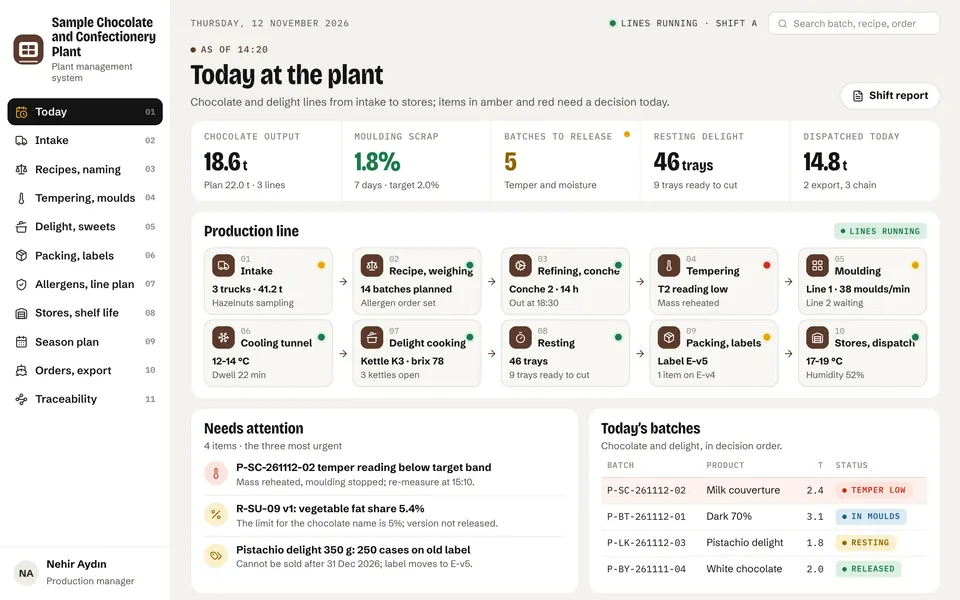
Chocolate and Turkish delight plant home screen: daily output, moulding scrap, ten-stage production line diagram, items needing attention and today’s batches
The name comes from the recipe Milk or extra milk, and whether the product may be called chocolate: a recipe version's cocoa dry matter, milk and vegetable fat shares are compared with the Turkish Food Codex thresholds, and what the label must say follows from the record.
Temper lives on the batch The tempering curve and the temper reading are tied to the batch number; mass that falls under its band stops before moulding and cannot be opened without a reheat record.
A separate rule set for delight Moisture, total sugar, flavouring share and the geographical indication specification are checked on the recipe and batch line; an input outside the specification, such as glucose, is caught early.
The season is planned with the stock Production and dispatch windows of festive and gifting seasons are seen against line load, remaining shelf life and the label date.

This page is a branch of Food and Beverage Manufacturing software; the wider picture and the other branches are there.

Does this sound familiar?

In chocolate and delight, profit slips away in a recipe's name, a batch's temper record and a season stock's shelf life.

The picture from the sector itself: Türkiye's sugar confectionery exports reached USD 4.5 billion in 2025, and the cocoa-containing item is growing fast at USD 1.41 billion; because production capacity exceeds domestic demand, most medium and large firms export (Ministry of Trade, TurkStat data). As volume grows, keeping recipe, name, label, temper and season records by hand gets expensive.

  • The name "chocolate" depends on figures in the communiqué: chocolate needs at least 35% total cocoa dry matter and 18% cocoa butter, milk chocolate at least 25% total cocoa dry matter, 14% milk dry matter, 3.5% milk fat and 25% total fat (Turkish Food Codex Cocoa and Chocolate Products Communiqué, 2017/29). When a recipe version changes, whether the name still holds is often checked by hand, from memory.
  • Vegetable fat other than cocoa butter may be at most 5%, and where present the label must carry the statement that the product contains vegetable fat in addition to cocoa butter. Under cost pressure a small shift in the recipe quietly changes the product's name and the label text.
  • Tempering does not show until the mould: mass whose crystals did not set loses gloss and snap and can bloom. The machine's curve stays on the machine's screen, and which batch was processed on which curve cannot be explained afterwards.
  • The official criteria for Turkish delight are numeric: total sugar (cream and fruit separated, on dry matter) at least 75%, moisture at most 16%, at least 12% flavouring in flavoured delight, at least 18% in rolled (sucuk-type), and at least 10% Afyon clotted cream in cream delight (Delight Communiqué, 2013/55). These values sit in the lab report, while the recipe sits in another file.
  • For delight with a geographical indication, the specification locks the recipe. The Afyon Lokumu specification asks for white sugar, native corn starch and citric salt, states that glucose and cane-sugar derivatives are never used, and describes resting as 12 to 24 hours. A wrong input or a short rest takes the product outside the specification.
  • Festive and gifting demand moves in lumps, and season products are made months ahead. Because line load, remaining shelf life, store temperature and label version are tracked in separate sheets, it is hard to say with confidence mid-season which stock covers which order.
  • The deadline for the changes to food labelling is 31 December 2026: after that date, food on a label that does not meet the 2024 amendment cannot be on the market. If season stock is still in stores and on shelves then, the question of which old-label batch is sold in which order, how many cases, on what date, becomes urgent.
  • Hazelnuts, pistachios, milk, gluten and sesame are processed in the same plant. The "may contain" decision and the cleaning check when moving from the chocolate line to the delight line, or from nut to nut-free products, are run on paper records; the EU's 2025 report names labelling (allergen emphasis, date wording, font size) as the most frequent fault in confectionery.
  • Buyers of firms shipping cocoa-containing products to the EU may ask for the origin and plot data of the cocoa input because of the deforestation regulation (EUDR). The application date is 30 December 2026 for medium and large operators and 30 June 2027 for micro and small ones. Today that information sits scattered in supplier e-mails at most plants.
The software landscape today

What software do confectionery and chocolate plants run today, and where does it jam?

On their public pages we found no operational layer that compares a chocolate recipe with the Turkish Food Codex thresholds and gives a name decision, checks delight against the communiqué and the geographical indication specification, and ties temper records to the batch. The products below are described only as far as we read them on the vendors' own pages.

LayerSoftware in use todayThe gap it leaves
Accounting and ERP (the horizontal backbone) The plant's own accounting and ERP programme; Aaro as an example among web-based production and stock software Sound for ledger, stock, invoices and e-documents, and it should stay in place. Aaro's page lists recipe and work order, production tracking and cost analysis, serial and lot tracking, a warehouse terminal and e-document modules; quality control and toll management appear in the menu but their content is not described; the page does not mention chocolate or confectionery. Confectionery-specific records such as the cocoa dry matter calculation, the name decision, the tempering curve and the season calendar wait to be defined per plant in this kind of programme.
Foreign food ERPs for confectionery Aptean Confectionery ERP, BatchMaster ERP (confectionery and candy page), Datacor (candy and confectionery page) All three have a section on their pages devoted to confectionery. Aptean's page lists a Microsoft Dynamics 365 Business Central base, seasonal recipe management and versioning, allergen control, lot-level traceability, batch costing and demand forecasting for seasonal lines. BatchMaster's page mentions recipe, two-way lot traceability, recall, allergen management, shelf-life determination and nutritional labelling. Datacor's page lists ERP, MES, warehouse, formulation versioning and nutrition labels with allergen tracking. These pages do not describe the Turkish Food Codex chocolate and delight communiqués, a Turkish interface or Turkish e-document systems; those have to be added per plant.
Laboratory management (LIMS) Centra LIMS Built to manage sample, analysis, equipment and reporting on the laboratory side; its page names pharmaceuticals, food, chemicals and laboratories as target sectors, and does not mention confectionery. The laboratory result stays there; which moisture or total sugar result belongs to which delight batch and which shipment waits to be built in the operational layer.
Line automation and machine makers' software Tanış (SCADA, MES, recipe and blending software; its home page shows mill, seed cleaning and feed machines) Strong on running the machine and the process. Tanış's page does not mention a chocolate or confectionery line; the control panels of tempering, moulding and depositing machines also tend to stay on the machine and process side. Business records such as which batch a temper reading belongs to, which recipe version the mass was made with and which shipment it went to sit outside that layer.
Excel, notebooks, e-mail and telephone Recipe sheets, the temper logbook, the delight resting list, the label approval form, the season plan file In every plant these are the sheets one person holds and no one else can read once that person is on leave. Rebuilding a batch's chain after a buyer complaint or an audit takes days. These sheets move into the system as the record of a workflow.

Product names are compiled from vendors' public pages (September 2026); PAN is not affiliated with them. The "gap" column summarises situations we commonly meet in discovery and is not a statement about any specific product.

Our approach

An operational layer that closes the gap between machine and accounting, with the batch at the centre.

We do not bring your plant a second accounting programme or new line automation. We write the layer that ties the workflow from cocoa intake to shipment, meaning a recipe's name, a batch's temper record, the cooking and resting trail of delight, the label version and the season's stock, to a single batch.

A lot record that starts at intake

At the intake of cocoa mass, cocoa butter, cocoa powder, sugar, milk powder, hazelnuts, pistachios and starch, supplier, internal lot, origin, analysis result and allergen profile are recorded. Aflatoxin in hazelnut and pistachio and ochratoxin A in cocoa powder are defined as acceptance rules; if a result is over its limit the lot closes to use. For products going to the EU, the origin and plot data of the cocoa input is kept in the same record.

A name and a label calculated from the recipe

For every recipe version, total cocoa dry matter, cocoa butter, fat-free cocoa dry matter, milk dry matter, milk fat and vegetable fat share are calculated and compared with the Turkish Food Codex thresholds. The system shows whether a version fits the name milk chocolate, extra milk, white or couverture, whether the vegetable fat statement is needed and what minimum cocoa dry matter the label must state. A version that breaks a threshold is not released to production.

A tempering record tied to the batch

The tempering machine's time-temperature curve and temper reading are written to the batch number together with the target band of the mass type. A batch under its band stops at the moulding line; reheating, reworking or rejection is decided on record. When a bloom or a buyer complaint comes up later, the curve the batch was processed on can be read from the screen.

Communiqué and specification checks for delight

The cooking kettle's temperature and brix record, tray resting hours, moisture, total sugar, flavouring and cream share are read against the Delight Communiqué criteria on the same line. For products with a geographical indication, the specification's input list is written into the recipe as a rule; a forbidden input (glucose, for example) or a short rest is caught when the production order is issued.

Season plan, stock and label version

Production and dispatch windows for New Year, Valentine's Day and the two Eids are planned together with line load. The season stock's remaining shelf life, store temperature and humidity record, label version and the 31 December 2026 deadline are counted on the same screen; which stock must be used up or relabelled is visible in advance.

Retail and export orders

Retail chain, distributor and export orders are followed with product, quantity, dispatch date and document set. On an order going to the EU you can see on which line the cocoa origin data is still missing; the data comes from the lot record and is not collected by hand. Accounting and e-document work stays in your existing programme.

Modules we can build

The modules we can set up for a confectionery and chocolate plant

You do not need all of them at once. Most plants start with intake and the recipe and name check; tempering, delight, label and season modules are added as needed.

INTAKE

Intake and cocoa origin record

Intake of cocoa, fat, sugar, milk powder, hazelnuts, pistachios and starch, analysis result and acceptance decision, internal lot, supplier scorecard, origin and plot data for EU orders.

RECIPE

Recipe, version and name check

Calculation of cocoa dry matter, cocoa butter, milk and vegetable fat shares, thresholds for milk, extra milk, white, couverture and gianduja chocolate, version history, cost effect.

TEMPER

Tempering and moulding

Time-temperature curve, temper reading, target band by mass type, moulding line lock, reheat and rework record, scrap, deposit weight.

DELIGHT

Delight and sweets cooking

Kettle temperature and brix, tray resting map, moisture, total sugar, flavouring and cream checks, geographical indication specification check.

LABEL

Packing and label approval

Product name, flavour name, vegetable fat statement, minimum cocoa dry matter, allergen emphasis, date wording, label version and an old-label stock counter.

ALLERGEN

Allergen matrix and line plan

Allergens per product, cross-contact from products run on the same line, the "may contain" decision, cleaning and verification records at line changeovers.

SEASON

Season product plan

Production and dispatch window for New Year, Valentine's Day and Eid boxes, line load, season stock, shelf life and store temperature tracking.

ORDERS

Retail and export orders

Chain and distributor orders, document set by country, cocoa origin data on EU orders, dispatch and delivery note link.

TRACE

Traceability and recall

Forward and backward tracing from input lot to batch and batch to shipment, retention sample, recall drill, product card and batch record.

What it looks like on screen

What confectionery, chocolate and delight production software looks like on screen

The screens below are a sample design prepared for plants that make chocolate, Turkish delight and sweets. Companies, people and figures are fictional; the system is set up around your own lines, recipes and product rules.

Today at the plant. The ten-stage chocolate and delight line from intake to stores, batches awaiting release and the label counter on one screen: which tempering machine is under its band, which recipe version is losing its name, which stock is left on the old label.
Tempering and moulding. The tempering machine’s time-temperature curve is drawn over its target; a batch whose temper reading falls under the band stops before moulding and cannot be opened without a reheat record.
Recipe and name check. A recipe version’s cocoa dry matter, cocoa butter, milk and vegetable fat shares are calculated; whether it is milk or extra milk chocolate, whether the product can be called chocolate and which wording the label needs is visible on screen.
Delight and confectionery cooking. Kettle temperature and brix, tray resting hours, moisture, total sugar and flavouring share are read against the regulation’s criteria; an input that breaks a geographical indication specification (glucose, for example) is caught in the recipe.
Season plan and orders. The production and dispatch windows of New Year, Valentine’s Day and the two Eids are seen against line load, remaining shelf life and the 31 December 2026 label date; so is the order line where cocoa origin data is still missing on an EU order.

Company names, people and figures on these screens are sample data. The system is built around your own processes, document names and rules. We walk you through the demo in a call: request a demo

Integration with your existing ERP

Your accounting programme and your line automation both stay where they are.

Plants usually already have two systems: on one side the accounting and e-document programme, on the other the control panels of the tempering, moulding and packing machines. What is missing is the workflow between them: a recipe's name, a batch's temper record, the resting trail of the delight, the label version, the season stock and the shipment. We write that layer and set up the data exchange with both sides. Accounting and official documents stay in your existing programme; machine data is read from the device wherever possible instead of typed.

Our integration approach →
  • Transfer of accounts, stock, purchase documents, delivery notes and invoices with Logo, Mikro, Netsis or whichever accounting and ERP programme you use; double entry goes away.
  • Reading temperature and curve data from tempering machines, moulding lines and cooking kettles; it is settled in discovery by device model and output, and a quick manual entry screen is set up for any device that cannot be read.
  • Tying moisture, total sugar, aflatoxin and ochratoxin results to the batch through your laboratory information system or laboratory forms.
  • Tying the label version to the product card and batch through your label design and printing process; recording the label approval on the packing line.
  • Receiving orders from the order channels of retail chains and distributors; exchanging data with your e-document and customs programme for export documents.
Outcomes

What changes in the plant once this layer is in place?

  • When a recipe version changes, whether the product's name still holds shows before the production order; a label error is caught on paper, not at dispatch.
  • Vegetable fat share, milk dry matter and cocoa share are calculated in the recipe; the effect of small cost-driven shifts on the product's name is known.
  • Every batch's temper curve and reading stays on record; mass under its band stops before moulding, and the cause of a scrap or bloom complaint can be explained later.
  • Delight moisture, total sugar and flavouring results sit on the same line as the communiqué's criteria; for products with a geographical indication, an input outside the specification is caught when the production order is issued.
  • Resting trays and cooking kettles are on one map; which tray is ready to cut and which batch has not finished resting is visible without walking the hall.
  • Season stock is counted with its remaining shelf life and label version; as dates like 31 December 2026 approach, which case will be used up and which relabelled is known in advance.
  • The allergen matrix and line plan are fed from the product card; when moving from nut to nut-free products the cleaning check is recorded, and the "may contain" decision stands with its reason.
  • On EU orders, cocoa origin and plot data is collected from the lot record; a buyer's data request does not turn into an e-mail hunt.
  • After a buyer complaint or in an audit, a batch's chain from input lot to shipment comes up in minutes; the recall drill rests on records.
Process

A realistic five-stage path that begins with discovery.

  1. 01

    First conversation

    1 week

    We listen to the plant's product families (chocolate, delight, sweets), its lines, season peaks, export share, the accounting and ERP programme you use and your laboratory set-up. Together we work out which screen answers which problem of yours.

  2. 02

    Discovery at the plant

    1-2 weeks

    We follow the flow from intake to stores on site. We see your recipe sheets, temper records, delight resting list, label approval form, season plan file and the output of your machine panels; we settle which data can be read from devices and which will be entered by hand.

  3. 03

    Written proposal and scope

    1 week

    We present the module list based on discovery, the integration points, the first phase, server options and the timetable in writing. You choose the server; data and code become yours.

  4. 04

    First-phase set-up

    6-10 weeks

    At most plants we start with intake and the recipe and name check. Your recipe sheets and rule thresholds are loaded into the system; the first weeks run in parallel and deviations are corrected together.

  5. 05

    Expansion and hand-over

    Ongoing

    Tempering, delight, label, season and export modules are added as needed. Your team is trained to use the system; changes in the rule tables are entered with dates.

Why Pan Innovation House?

A team that learns the language of recipe, temper and season, and builds the record chain in the plant.

Your rules first

Your recipe codes, product names, temper curves, resting times and label versions are taken from your own product card; the screen shows the field and stage names you use.

Regulation as a rule table

The thresholds of the Cocoa and Chocolate Products Communiqué and the Delight Communiqué, and the input rules of geographical indication specifications, enter the system as dated rule tables; when a communiqué changes the table is updated, while legal interpretation is for you or your adviser.

We start with discovery

A plant's system cannot be written remotely. We first listen to your line, your product families and the programmes you use, and then see them at your plant.

Your accounting stays

We do not replace Logo, Mikro, Netsis or similar programmes; we build a layer beside them and let data flow both ways.

Data and code are yours

Records and the code we develop belong to the customer. You choose the server; the system does not leave you tied to us.

Headquarters Gaziantep, office London

We are based in Gaziantep; our London office makes it easier to talk to plants working for the European market. Site visits and meetings can be held in either direction.

Frequently asked questions

Confectionery, Chocolate and Turkish Delight software: common questions

How does chocolate software decide a product's name from its recipe?

The Turkish Food Codex Cocoa and Chocolate Products Communiqué (2017/29) asks for at least 35% total cocoa dry matter, 18% cocoa butter and 14% fat-free cocoa dry matter in chocolate; at least 25% total cocoa dry matter, 14% milk dry matter, 2.5% fat-free cocoa dry matter, 3.5% milk fat and 25% total fat in milk chocolate; and at least 20% cocoa butter, 14% milk dry matter and 3.5% milk fat in white chocolate. The software calculates these shares from the recipe's mass balance and compares them with the thresholds. For the dry-matter compositions in Annex 2 and any later amendments, the current text must be verified by you or your adviser; the system keeps the thresholds as a dated rule table.

How does the vegetable fat share affect the product's name?

Under the communiqué, vegetable fat other than cocoa butter may be at most 5% of the final product and must not reduce the minimum cocoa butter and total cocoa dry matter. Where vegetable fat is present, the label must carry the statement that the product contains vegetable fat in addition to cocoa butter, in bold, near the ingredient list and in a font no smaller than the product name. The software calculates the share in the recipe, warns about a version over the limit and checks at label approval that the statement is present.

Why should tempering be recorded separately?

Tempering is the melt, cool and reheat that sets the cocoa butter crystals; makers advise different temperature bands by mass type (separate curves for dark, milk and white chocolate, for example). These values are maker advice, not a communiqué; the system uses the target curve on your own mass card. The point of the record is to be able to explain afterwards which curve a batch was processed on, what the temper reading was and what was done with mass under its band.

Which official criteria for Turkish delight are brought onto the screen?

According to the annexes of the Delight Communiqué (2013/55), total sugar (cream and fruit part separated, on dry matter as sucrose) at least 75%, moisture at most 16%, saponin at most 0.1% in sultan delight; dried, nut or candied fruit at least 12% in flavoured delight and at least 18% in rolled (sucuk-type) delight; in cream delight, Afyon clotted cream at least 10% and cream at least 8%. On the label, the name of flavoured delight is given together with the flavour. The software shows these values on the same line as batch results; the results come from your laboratory or your own measurements.

We make delight with a geographical indication; how does the software follow the specification?

The specification in the TÜRKPATENT register describes input and process rules. The Afyon Lokumu specification, for example, describes the use of white sugar, native corn starch and citric salt, no glucose or cane-sugar derivatives, bench work done on marble and a 12-24 hour rest on a single tray; the Safranbolu Lokumu specification asks for experienced staff with at least five years in production. We write your specification's input and time rules into the recipe and production order as rules. The right to use the indication and the reading of the specification are for you and the relevant body.

How is the production plan for the festive season made in the software?

In Türkiye confectionery is a common gift at festivals, weddings and celebrations (Ministry of Trade sector note), so demand piles into a few weeks. In the software, each season product's production and dispatch window, line load and order quantity are planned together, and the season stock's remaining shelf life and store condition are followed. Which window pushes the line over capacity is visible in advance; the decision belongs to your planning team.

How does the 31 December 2026 label date concern us?

It is stated that food on a label that does not comply with the 2024 amendment to food labelling cannot be on the market after 31 December 2026. In confectionery, season stock may be in stores or on shelves on that date. The software counts, on one screen, the label version per product, the stock made with that version, its remaining shelf life and the open orders; which stock to use up and which to relabel becomes visible. Checking the correctness of label content is the responsibility of you and your adviser.

We ship chocolate and cocoa products to the EU; how does the deforestation regulation (EUDR) affect us?

The EUDR covers cocoa; Annex I lists cocoa beans, shells, paste, butter, powder and "chocolate and other food preparations containing cocoa" (CN 1806). Regulation 2025/2650 postponed application to 30 December 2026 for medium and large operators and 30 June 2027 for micro and small operators; the Commission's May 2026 simplification review did not reopen those dates. The obligation sits with the operator that first places the product on the EU market or exports it; for a producer in Türkiye it arises not directly but through the EU buyer's request. The software keeps the origin and plot data of the cocoa input in the lot record and ties it to the order; the scope and compliance decision is for you and your buyer's legal advisers.

Can the software read data from our machines?

Whether data can be read from the tempering machine, moulding line and cooking kettles, and what output they give, depends on the device model; we check this in discovery. On devices that can be read, curve and temperature come in automatically; for those that cannot, a quick manual entry screen is set up. We do not change the machine's own control software.

How long does set-up take, and who keeps the data and code?

The first phase takes 6-10 weeks at most plants; scope is settled in writing after discovery. Set-up is on a server you choose; data and code belong to you. Price depends on scope and is given after discovery.

Next step

Let's talk through your recipes and lines, then we will come to your plant

A plant's system cannot be written remotely. Let us first listen to your product families, lines, season peaks and the programmes you use; then we will see your line on site and propose the first phase in writing.

Related services

Related areas worth considering

Pan Innovation House

Call us

By phone

+90 543 930 12 72

Our phone line is open every day.

WhatsApp on your phone

Scan with your phone camera. The chat opens with your message ready.

Prefer that we call you? Leave your details