Pan Innovation House Pan Innovation House
INDUSTRY SOFTWARE · NUT AND PISTACHIO PROCESSING

From the truck at the gate to the shipment at the border, nut processing software that keeps every lot's aflatoxin and paperwork in order

Pan Enterprise Solutions, the software arm of Pan Innovation House · based in Gaziantep, Türkiye, with a London office

We bring pistachio intake from growers, traders and toll customers, the hulling, drying, grading, optical sorting, roasting and kernel lines, aflatoxin sampling and lot release, licensed warehouse receipts and the export certificate chain into one record. Hazelnuts, almonds and walnuts run on the same frame as product cards. Your accounting and ERP program stays; we do not touch your machine automation, we build the operations layer next to them.

Asking about price? We listen to the scope in a short call and share the budget frame and timeline in writing. The first 30-minute call is free; the scope of an on-site discovery, and its fee if any, is agreed in writing during that call.

We work on site for plants in and around Gaziantep; elsewhere in Türkiye and abroad, discovery starts by video call and a visit is planned if needed. Our London office is at Unit 6 Cranford Way, Hornsey, London N8 9DG.

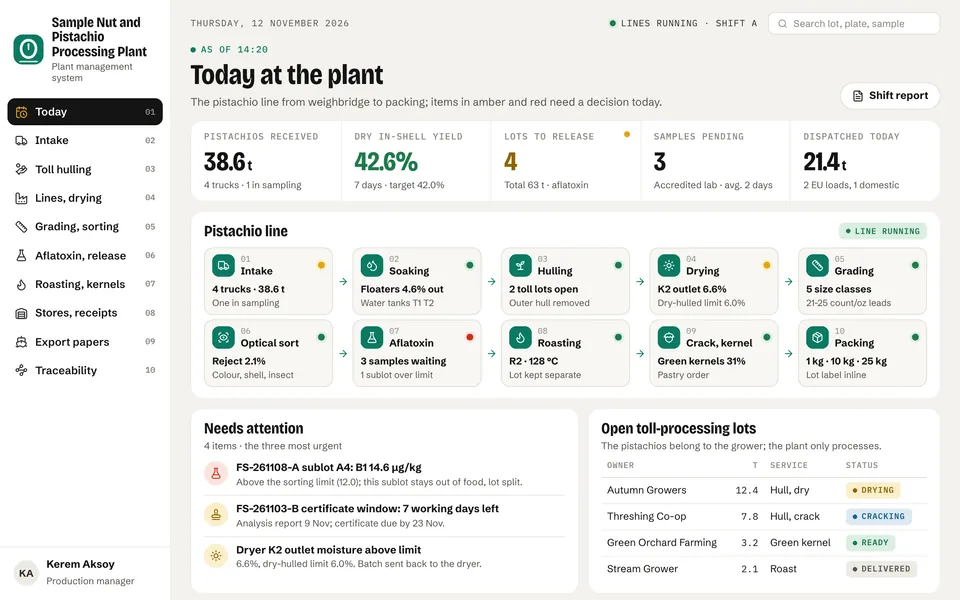
Pistachio processing software home screen: daily intake, dry in-shell yield, ten-stage pistachio line diagram, items needing attention and open toll-processing lots
Lots split into sublots Sublots of 25 tonnes by lot size, each with its own sample and result; one rejected sublot does not quietly change the whole lot, it shows on screen.
Market lock per lot An aflatoxin result is judged separately for the domestic, EU and other markets; the system says which lot may go into which shipment.
Export deadlines count themselves At most 10 working days from report to certificate, the certificate's 4-month validity and the EU control rate are visible in the shipment file.
Scope set in discovery Starts at intake and the weighbridge; grows with toll, grading, aflatoxin and export modules as the need arises.

This page is a branch of Food and Beverage Manufacturing software; the wider picture and the other branches are there.

Does this sound familiar?

In pistachio processing, profit is not lost in the price per kilo but in the lot's record, result and paperwork.

This is the picture that comes out of how the sector works: the crop is 176 thousand tonnes one year and 383 thousand the next, the nuts may belong to the grower, a trader or a toll customer, and each market's aflatoxin condition changes lot by lot. If any of the following sounds familiar, this page was written for you.

  • The harvest swings widely: according to TÜİK, Türkiye produced 176 thousand tonnes of pistachios in 2023 and 383 thousand in 2024.
  • When a truck enters the weighbridge, the net weight goes into one program, the moisture and floater result into a notebook and the price talk into a phone note; yet dry-hulled and red-skin in-shell pistachios have different moisture limits (with the TSE values, at most 6% for dry-hulled and at most 7% for red-skin), while one criteria table is applied to everything.
  • In toll hulling the pistachios belong to the grower and the plant only processes them. When the owner and the processor are not separated in the record, the grower's lot melts into the plant's stock, the service fee and the nut cost land in the same column, and delivery ends in an argument about whose kilos are whose.
  • Dry in-shell yield, floater rate and post-hulling loss are not tied to the lot; why a lot yielded less and which supplier's nuts carry more floaters is discussed at the end of the season, by guess.
  • Grading results are written in words such as "large nuts"; which count-per-ounce class covers which order, and which order is short by how many tonnes, is worked out by hand; split rate and optical sorting rejects are not separate lines, so kernel yield is a rough estimate.
  • Was an aflatoxin sample taken, from which sublot, has the result come, did it go to sorting, is there a re-analysis; this lives in laboratory reports, e-mail attachments and one person's tracking list. The gap between the limit for product to be sorted and the limit for the final consumer sits in a person's knowledge, not on the screen.
  • The EU applies special conditions to pistachios: for pistachios of Turkish origin the identity and physical check rate is 50 percent, and a consignment must arrive with the sampling and analysis results for that consignment and an official certificate. Matching this paper chain to the lot means that one missed day becomes a new sample and a delay.
  • There are at most 10 working days between the Inspection and Analysis Report and the Official Model Certificate, and the certificate is valid for 4 months. When these windows live as calendar notes in a file, a shipment whose certificate lapsed or whose report went stale is found while it sits ready to leave.
  • Receipts for pistachios in a licensed warehouse can be issued in 100-kilogram pieces or as a block receipt, and product whose analysis and classification are not finished is held in a separate section. When warehouse records and the plant's lot records are kept apart, finding which receipt matches which lot takes a day.
  • The accounting program has one "pistachio" stock item; dry-hulled, red-skin, early-harvest, kernels, roasted and paste carry different costs and different yields, yet which product and which customer actually earns money stays invisible.
The software landscape today

Which software do pistachio and nut plants run today, and where does it fall short?

On their public pages we found no business software that follows a pistachio lot from the aflatoxin decision to the export paper. Plants usually run separate layers side by side; the gap in between is closed with Excel and notebooks.

LayerSoftware in use todayThe gap it leaves
Accounting and ERP (the horizontal backbone) The plant's own accounting and ERP program; among web-based production and stock software, Aaro as an example Solid and should stay for ledgers, stock, invoices and e-documents. Aaro's page lists recipes and work orders, production tracking, serial and lot tracking, a warehouse terminal and e-document modules; quality control and toll management appear in its menu without their contents being described; the page does not mention nuts or pistachios. Pistachio-specific records such as sublots, aflatoxin limits and export certificates wait to be defined plant by plant in programs of this kind.
Laboratory management (LIMS) Centra LIMS Built to manage samples, analyses, equipment and reporting on the laboratory side; its page names pharmaceuticals, food, chemicals and laboratories as target sectors and does not mention pistachios or nuts. The link between the laboratory's result and the plant's lot decision waits to be built separately.
Line automation and machine-maker software Tanış (SCADA, MES, recipe and blending software; its home page lists mills, seed cleaning and feed machines) Strong at running machines and the process. Tanış's pages do not mention a pistachio or nut line, and the software of the machine builders who equip pistachio lines also tends to stay on the machine and process side. Business records such as the owner of a toll lot, a sublot decision, an aflatoxin result and an export paper sit outside this layer.
Optical sorting machines TOMRA (5C and 4C on its pistachio page), Bühler SORTEX (LumoVision page, monitoring panel with Bühler Insights) The machine's own field for colour, foreign matter and defect sorting. TOMRA's pistachio page speaks of in-shell and kernel lines, of laser, X-ray and BSI technologies for detecting internal defects and aflatoxin, and of connecting sorter data to a plant management system. Bühler's LumoVision page names mycotoxin reduction for maize, nuts and seeds and presents a monitoring panel; the page does not mention pistachios. This data stays on the machine; which lot the sorting belongs to and which re-analysis it feeds waits to be built in the operations layer.
Licensed warehouse and exchange records The licensed warehouse operator's and the commodity exchange's own record systems Electronic product receipts, weighing, analysis and classification records are kept on the warehouse side and run the official flow. Matching them to the plant's own lot, sublot and shipment records is mostly done by hand.
Excel, notebooks, e-mail and phone Floater and split notebooks, an aflatoxin tracking sheet, a certificate calendar Sheets that sit in one person's hands and turn unreadable when that person is on leave. Rebuilding a lot's chain for an audit or a buyer complaint takes days. These sheets move into the system as the record of a workflow.

Product names are compiled from vendors' public pages (September 2026); PAN is not affiliated with them. The "gap" column summarises situations we commonly meet in discovery and is not a statement about any specific product.

Our approach

An operations layer, built around the lot, that fills the gap between the machine and the accounts.

We do not bring your plant a second accounting program or new line automation. We build the record chain from the weighbridge to dispatch with screens that speak the pistachio trade's language: lot, sublot, toll owner, size class, aflatoxin result, market lock and document deadline.

A record that starts at the weighbridge and intake analysis

The moment a truck enters the weighbridge a record opens: plate, source (grower, trader or toll), type (dry-hulled, red-skin, early-harvest, fresh fruit), net weight, moisture, floaters, split and defect rate. Your criteria table gives acceptance, conditional acceptance or rejection; TSE moisture limits apply by type. The supplier scorecard builds itself from these records.

Owner separation on toll lots

A grower's pistachios do not enter the plant's stock; the grower stays the lot owner and the plant provides a service. Whichever of hulling, drying, cracking, roasting or paste was done, the fee and the nuts are tracked apart and the return-to-grower delivery note comes out of the record.

Size, split rate and sorting results written to the lot

The grading line's class spread, split rate and optical sorting rejects are tied to the lot; the size class names and count-per-ounce limits you use come from your own table. Which lot covers an order by size, and how many tonnes are short, appears on screen.

From aflatoxin sample to lot release

A lot is split into sublots by size; each sublot's sampling record, laboratory result (B1 and total) and decision are kept in order. A lot between the sorting limit and the final-consumer limit goes to sorting and closes with a re-analysis. Limits sit in a dated table; when the regulation changes, the table is updated.

Export paper chain

Lot, sample, laboratory, Inspection and Analysis Report, GGBS approval, Official Model Certificate and dispatch run through one dated file. The 10 working days between report and certificate and the certificate's 4-month validity count down; a shipment whose window is closing shows up in the morning list.

Lot traceability and recall record

From a packed lot back to the sublot, the dryer, the hulling batch and the supplier, and forward to which customer and which shipment it went to, on one screen. Building the chain for a buyer's question or an inspection goes from days to minutes.

Modules we can build

Modules we can set up for a pistachio and nut plant

You do not need all of them at once. Most plants start with intake, the weighbridge and the lot record; toll, grading, aflatoxin and export modules are added as the need arises.

INTAKE

Intake, weighbridge and acceptance analysis

Grower, trader and toll trucks, moisture limit by type, floater, split and defect rates, acceptance, conditional acceptance and rejection, supplier scorecard.

TOLL

Toll hulling and processing service

Owner-versus-processor separation, requested services (hulling, drying, cracking, roasting, paste), service fee calculation, return delivery note and a toll stock ledger.

LINE

Hulling, drying and line record

Soaking, floater separation, hulling and drying batches; dryer outlet moisture and limit alert; dry in-shell yield and loss; shift line report.

SIZE

Grading and optical sorting

Size class spread, split and closed-shell rate, optical sorting reject lines, fit against orders and short-tonnage calculation.

AFLATOXIN

Aflatoxin sampling and lot release

Sublot split, sampling record, laboratory results, decision against the sorting and final-consumer limits, re-analysis after sorting, market lock.

STORE

Store, moisture and licensed warehouse receipts

Silo and store bays, moisture and temperature records, storage time, and matching of licensed-warehouse receipts to plant lots.

ROAST

Roasting, salting and kernels

Roasting and salting batches, cracking and kernel yield, early-harvest kernel separation, paste and piece products, product card and label fields.

TRACE

Traceability and recall

A two-way chain from packed lot to supplier and customer, a ready list for a buyer complaint, and records kept in a form that can be shown to an inspector.

What it looks like on screen

What nut and pistachio processing software looks like on screen

The screens below are a sample design prepared for plants that process pistachios and other nuts. Companies, people and figures are fictional; the system is set up around your own lines, product grades and rules.

Today at the plant. The ten-stage pistachio line from intake to packing, aflatoxin lots awaiting release and grower-owned toll lots on one screen: which dryer is over the limit, which sublot is on hold, which certificate window is closing.
Intake and weighbridge. Trucks from growers, traders and toll customers on one screen; moisture, floaters, split rate and defects are read against the plant’s criteria table, and a batch over the TSE moisture limit becomes conditional acceptance or a return.
Grading and sorting. A lot’s count-per-ounce size spread, split rate and optical sorting rejects are shown against the size the order asks for; which lot covers which order and how many tonnes are short is visible on screen.
Aflatoxin and lot release. The lot is split into 25-tonne sublots and each is decided on its own aflatoxin result; a sorted sublot is re-analysed and which market is open or locked is visible on screen.
Export release chain. From the lot’s sample to the accredited laboratory, from the Inspection and Analysis Report to the official certificate and the border check, every step is dated; the 10 working days between report and certificate and the certificate’s 4-month validity count themselves.

Company names, people and figures on these screens are sample data. The system is built around your own processes, document names and rules. We walk you through the demo in a call: request a demo

Integration with your existing ERP

Your accounting program and your line automation both stay where they are.

Plants usually already have two systems: an accounting and e-document program on one side, and on the other the automation that runs the machines and the panels of the grading and optical sorting machines. What is missing is the workflow between them: the intake decision, the toll owner, lot and sublot, the aflatoxin decision, document deadlines, dispatch and cost. We write that layer and set up data exchange with both sides. Accounting and official documents stay in your current program; machine data is read from the device where possible, not typed in.

Our integration approach →
  • Transfer of customers and suppliers, stock, purchase documents, delivery notes and invoices with Logo, Mikro, Netsis or whichever accounting and ERP program you use; double entry goes away.
  • Reading data from the weighbridge indicator, moisture meters and laboratory devices; settled in discovery by device model and output, and a quick manual entry screen is built for any device that cannot be read.
  • Tying the summary data that grading and optical sorting machines can export to the lot; which data they give and in which form depends on the machine maker and version and is set in discovery.
  • Importing results from your laboratory's report format or LIMS output; B1, total and ochratoxin values are tied to the right sublot.
  • Data exchange with the licensed warehouse operator and official systems (GGBS, export file): we prepare from the record as much as the plant can, and the authorised person makes the official entry from their own account.
Outcomes

What changes in the plant once this layer is in place?

  • Every truck's type, moisture, floater and split rate, decision and source sit in one record; month-end reconciliation is no longer a matter of gathering notebooks.
  • On toll lots the grower's pistachios and the plant's stock are kept apart; at delivery a delivery note speaks, not an argument over kilos.
  • Dry in-shell yield and floater rate are tied to the lot and the supplier; which source's nuts drag yield down is seen mid-season.
  • Size spread and split rate are read against the order; which lot covers which order and how many tonnes are short is known, and production is planned accordingly.
  • The aflatoxin result is held at sublot level; product going to sorting, awaiting re-analysis and staying out of food do not get mixed.
  • Which lot may go to which market is visible as locked or open; the chance of the wrong lot going to the wrong market falls with the record.
  • Report and certificate windows count down; a shipment whose window is closing shows in the morning list, preventing re-sampling and delay.
  • In a buyer complaint or an inspection, the chain from packed lot to supplier and customer comes out in minutes.
  • Pistachios that show as one item in the accounting program are read by product and customer with their cost and yield.
Process

A realistic five-stage path that begins with discovery.

  1. 01

    First conversation

    1 week

    We listen to your lines, product types, toll share, laboratory and weighbridge set-up, whether you export and which accounting program you use. Together we work out which screen answers the problem you have.

  2. 02

    Discovery at the plant

    1-2 weeks

    We follow the flow from intake to packing on site. We collect your acceptance rule, floater and split records, aflatoxin tracking sheet, laboratory reports, shipment and certificate files, and we take your field names as they are.

  3. 03

    Scope, priority and budget

    1 week

    We present, in writing, the module order that starts where it hurts most, the integration routes, the timeline and the budget. The first phase is often intake, the weighbridge and the lot record.

  4. 04

    Development and pilot

    6-10 weeks

    We deliver modules one by one and test them with real trucks and real lots. The weighbridge operator, laboratory lead, shift lead and export officer use the screen at every delivery; we take corrections from the floor.

  5. 05

    Go-live and maintenance

    Ongoing

    After training, data migration and go-live, maintenance and support continue. When a new product type, a new market rule or a new line arrives, the system grows with you. The data and source code are yours; you choose the server.

Why Pan Innovation House?

A team that learns the language of the lot, the toll customer and the paperwork, and builds the record chain on the floor.

Your rules first

The acceptance table, size class names, floater limit and aflatoxin decision come from your product card; the screen shows the fields and stage names you already use.

Regulation as rule tables

The aflatoxin limits in the Contaminants Regulation and the EU's special conditions go into the system as dated rule tables; when a regulation changes, the software is not rewritten, the table is updated.

We ask floor questions

In discovery we map, one by one, the order of soaking, hulling, drying, grading, sorting, roasting and kernel stages in your plant and where each measurement is taken.

Built beside, not instead

Your accounting and ERP program, machine automation and laboratory system stay where they are. Our job is to write the flow between them.

Based in Gaziantep, with an office in London

We are based in Gaziantep, close to the region where pistachios are grown and processed. Our London office makes it easier to talk to plants that supply the European market. Site visits and meetings can run in both directions.

The data and code are yours

The records and the code we develop belong to the customer. You choose the server; the system does not tie you to us.

Frequently asked questions

Nut and Pistachio Processing software: common questions

What stages does pistachio processing go through, and how does software follow them?

One academic source counts seven steps: soaking, hulling, floater separation, drying, splitting, roasting and packing. A Ministry document lists the services offered to growers as outer-hull removal and drying (wet or dry), split separation, cracking, salting and roasting, washing and shelling, kernel drying, paste, chopping and packing. The order differs from plant to plant. In discovery we map your order and tie each stage to a lot, recording moisture, time and output.

We do toll hulling and the product belongs to the customer. How does the software handle that?

The Ministry of Agriculture and Forestry's sector document describes growers taking their crop to a hulling plant, buying a service, and getting the processed product back. In the system such a lot carries an owner record separate from the plant's stock; the service is charged separately, dry in-shell yield and loss are reported to the lot owner and a delivery note is produced at hand-back.

Which aflatoxin limits apply, and how does the system enforce them?

The Turkish Food Codex Contaminants Regulation and the EU's Regulation 2023/915 give, for pistachios, a limit of B1 12.0 and total 15.0 µg/kg for product to be sorted, and B1 8.0 and total 10.0 µg/kg for product offered to the final consumer or used as an ingredient. The system keeps these limits in a dated rule table; when a result arrives it marks the sublot as accepted, to sorting or rejected. If a limit changes, the table is updated.

Into how many sublots is a lot split, and how is it sampled?

Under the EU Implementing Regulation 2023/2782, a nut lot of 15 to 125 tonnes is split into 25-tonne sublots, 100 incremental samples are taken from each sublot to make a 20 kg aggregate sample, which is divided into two laboratory samples of 10 kg; for lots under 15 tonnes the number of incremental samples runs from 10 to 100 depending on lot weight. The Turkish export procedure follows the same logic. The system derives the sublot count and sampling record from the lot size.

Which documents are needed to ship pistachios to the EU?

Annex II of the EU Implementing Regulation 2019/1793 (in the text renewed by 2026/1206) lists Turkish-origin pistachios and products with an aflatoxin hazard and a 50 percent identity and physical check frequency, and requires the consignment to come with the sampling and analysis results for that consignment and the official certificate of the dispatching country. In Türkiye the Ministry of Agriculture and Forestry's export procedure describes this as a GGBS prior notification, a provincial directorate application, official sampling, accredited laboratory analysis, an Inspection and Analysis Report and an Official Model Certificate.

How does the software hold grading and size classes?

In the field, pistachio size is usually expressed as the average fruit count per ounce; a research institute journal gives under 18 as jumbo, 18-20 as extra large, 21-25 as large, 26-30 as medium and over 30 as small. This is not an official standard but a naming used in the trade. The system takes your own class names and count limits as they are and shows a lot's spread and fit against orders using those classes.

How do licensed warehouse receipts match plant lots?

Under the 17.12.2025 amendment to the Pistachio Licensed Warehouse Communiqué, a separate product receipt is issued for each 100 kilograms; for a batch over 100 kilograms a single block receipt can be issued on request and with the warehouse operator's acceptance, and product whose weighing and analysis are unfinished is held in a separate section. The system ties the receipt number to the lot and sublot; the receipt stays with the licensed warehouse in the official flow and appears in the plant's record with its lot.

Can it also be used for hazelnuts, almonds and walnuts?

Yes, as product cards. Aflatoxin limits differ by product: for hazelnuts B1 8.0 and total 15.0 for product to be sorted and 5.0 and 10.0 for the final consumer; almonds sit in the same group as pistachios; for other tree nuts 5.0 and 10.0 to be sorted and 2.0 and 4.0 µg/kg for the final consumer. The focus is pistachios, but moisture, size, roasting, allergen and lot records run on the same frame for other nuts.

What happens if a border rejection or non-compliance notice arrives?

The notice is tied to the shipment file, and from the file you can go back to the lot, sublot, sample and laboratory record; the system lists which other shipments or customers received product from the same batch.

What happens to our accounting program and machine automation?

They stay. Logo, Mikro, Netsis or whichever program you use keeps carrying accounting and e-documents; we do not touch your machine automation. We build the workflow between them and settle data exchange in discovery by device and program version.

Next step

Let us talk through your line and your lots, then we will come to your plant

A plant's system cannot be written remotely. First let us listen to your line, your toll set-up, your aflatoxin and export flow and the programs you use; then, having seen your weighbridge, laboratory and line on site, we propose a first phase in writing.

Related services

Related areas worth considering

Pan Innovation House

Call us

By phone

+90 543 930 12 72

Our phone line is open every day.

WhatsApp on your phone

Scan with your phone camera. The chat opens with your message ready.

Prefer that we call you? Leave your details