Pan Innovation House Pan Innovation House
INDUSTRY SOFTWARE · BAKLAVA AND SYRUP DESSERT PRODUCTION

From dough sheet to box, baklava production software that keeps the record of every tray and every pistachio

Pan Enterprise Solutions, the software arm of Pan Innovation House · based in Gaziantep, Türkiye, with a London office

We bring pistachio kernel and clarified butter lots, the tray recipe, pistachio weight, oven and syrup records, the box, branch and dealer orders, parcels and the Eid week plan into one chain. Logo, Mikro, Netsis or your accounting program stays in place; we do not replace your baker's hands or your ovens, we build the business software next to them. Scope is set in discovery.

Asking about price? We listen to the scope in a short call and share the budget frame and timeline in writing. The first 30-minute call is free; the scope of an on-site discovery, and its fee if any, is agreed in writing during that call.

We work on site for plants in and around Gaziantep; elsewhere in Türkiye and abroad, discovery starts by video call and a visit is planned if needed. Our London office is at Unit 6 Cranford Way, Hornsey, London N8 9DG.

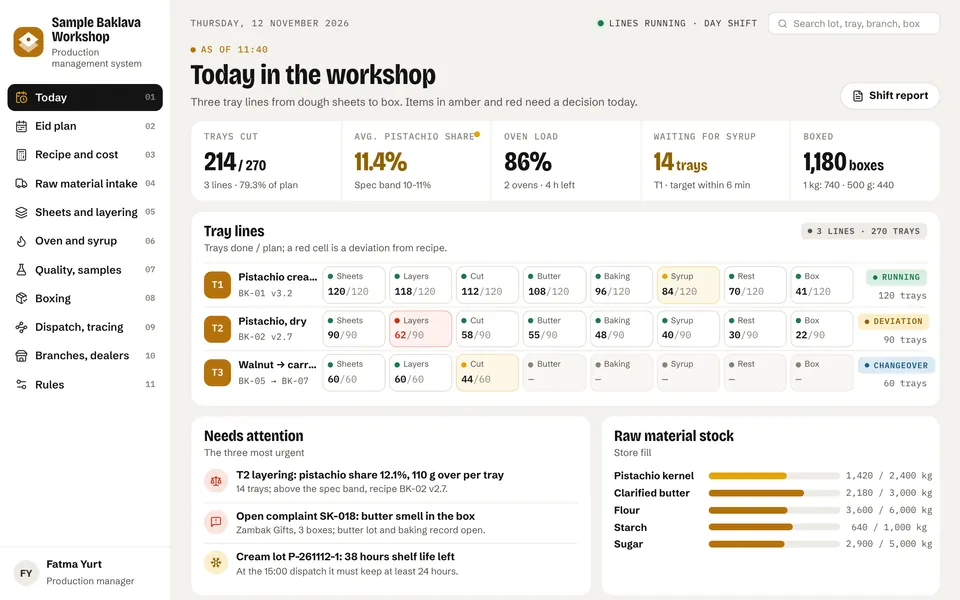
Baklava workshop software home screen: daily tray count, pistachio share, stage-by-stage state of three lines, items needing attention and raw material stock
One record per tray One chain from the pistachio and butter lot to the tray, the oven, the box, the branch or the parcel.
Spec band as a rule The share band in the Antep Baklavası PGI document, aflatoxin limits and labelling rules enter the system as tables; a deviation shows before the tray reaches the oven.
Without touching your ERP Accounting, e-invoice and e-waybill stay in your current program; the transfer is settled in discovery by version.
Eid, months ahead The tray plan by product and day is checked against ovens, shifts and the pistachio reserve; the shortfall shows weeks before the festival.

This page is a branch of Food and Beverage Manufacturing software; the wider picture and the other branches are there.

Does this sound familiar?

In baklava, margin is lost in the pistachio, reputation in the tray, and the rush at Eid.

These are the topics we meet most often on the floor of baklava and syrup dessert producers. If even one sounds familiar, this page was written for you.

  • The pistachio share in the recipe and the pistachio that goes into the tray are not the same: the layering baker's hand, the shift and the product change the weight, and the difference shows up as shrinkage at the month-end count.
  • The share band written in the official document for Antep Baklavası (pistachio 10-11%, clarified butter 15-20%, syrup 35-36% and so on) sits on paper or in the baker's memory in most workshops; actual weighing is not compared with it.
  • The aflatoxin result of green pistachio kernels and walnuts, their place in the store and the recipe they will enter live in different places; because the limit for product to be sorted differs from the limit for product reaching the consumer, a wrong lot can reach a wrong tray.
  • Before Eid and Ramadan production climbs to several times a normal day; with ovens, shift crews and the pistachio reserve not on one table, the shortfall is noticed in the last week and urgent buying is expensive.
  • Fresh baklava with cream has a short shelf life and dry baklava a long one; which product can leave on which channel (branch, dealer, parcel, export) with how much life left sits in the sales team's memory.
  • The true cost from tray to box is unknown: weight change in baking and syrup, cutting waste, giveaway, packaging and labour are not calculated per box, so the price list lags behind current pistachio and butter prices.
  • Adulteration lists and inspections are published with company names; the recipe version, lot and weighing record that would show compliance with the additive ban and the pistachio share are rarely gathered in one file.
  • Branch, dealer and parcel orders arrive by phone, message and spreadsheet; the production plan is built from them by hand and remaining shelf life is not checked at dispatch.
  • When a complaint arrives (say, a butter smell in the box), finding the tray, the butter and pistachio lot and everyone else who received that lot means leafing through notebooks, waybills and messages.
  • Dry-product wording, allergen emphasis, date and lot codes and export or parcel carton information are prepared by hand; old-label boxes in stock are not scanned before the labelling deadline of 31 December 2026.
The software landscape today

Which software do baklava and dessert workshops use today, and where does it fall short?

We did not find an end-to-end production software specific to baklava and syrup desserts whose screens and scope are openly presented. Workshops usually run several layers side by side, and the gap is closed with spreadsheets and notebooks. For product names the table below relies only on what we saw on the makers' own pages.

LayerSoftware in use todayThe gap it leaves
General ERP and accounting (horizontal backbone) Logo, Mikro, Netsis and similar general ERP and accounting programs Solid and should stay in place for ledgers, stock, invoices and e-documents. The share band of the tray recipe, actual pistachio weighing, Eid capacity and the channel rule for dry versus cream products are not their natural job and mostly run outside them.
Local ERP and production tracking modules caniasERP, Aaro, Bilsoft production tracking module The makers' pages describe recipe-based production planning, work orders, costing, serial and lot tracking, stock and order links; the food page of caniasERP also covers tracing from raw material to finished goods, and the Aaro page mentions branch and dealer definitions. The same pages do not list baklava or desserts, share control against a specification band, Eid capacity or a remaining shelf life rule.
Foreign ERPs aimed at confectionery and bakery makers BatchMaster (ERP for Sweets), FlexiBake BatchMaster's confectionery page describes version-tracked formulas, shelf life determination, bi-directional lot tracing and recall, and separate costing of materials and packaging; the FlexiBake page covers recipes and labels, lot tracing, allergens, wholesale ordering and route management. Neither page lists Turkish regulation, e-documents, a Turkish interface or a specification band check specific to baklava.
Laboratory information management Centra LIMS The page describes sample, analysis and method, equipment, stock, reporting and quality modules, integration with ERP and other systems, and a food industry section. A flow that locks the before and after sorting result of a pistachio lot to a recipe, or food-specific LIMS features, are not listed on the page.
Dough sheet, buttering and cutting machines Makers' machines and listings The machines do the sheeting, buttering and cutting; on the pages we found, no software tying layer counts, tray counts or pistachio weight to a recipe and a lot is described. That data is entered by hand or read from a counter.
Spreadsheets, paper notebooks and message groups Recipe book, Eid plan sheet, order messages, till receipts Flexible but tied to one person; no version or history. In Eid week the order and capacity sheet is updated by hand several times a day; tracing backwards in a complaint or inspection takes days.
Public systems and documents Food business registration and approval, food business QR code, e-document systems Mandatory and fixed; the ministry's food business QR code is compulsory at points of sale and voluntary at production sites. The software's job is to prepare the right data for these from the record: made with which recipe version, from which lots, and when.

Product names are compiled from vendors' public pages (September 2026); PAN is not affiliated with them. The "gap" column summarises situations we commonly meet in discovery and is not a statement about any specific product.

Our approach

Business software that leaves the master baker's hands and your accounting in place and closes the gap between them.

We do not bring a second accounting program or a system that replaces your master baker. We build the record chain from raw material receipt to the box and from the branch to the parcel, and connect it to your existing systems. The system does the arithmetic; the baker, quality lead and management make the decisions.

Raw material receipt and the pistachio lot

When pistachio kernels, walnuts, butter, flour, starch and sugar arrive, a record opens: supplier, net kg, moisture, aflatoxin result, sampling plan and decision. The limit for the intended use works from a rule table; the before and after sorting result stays in one record, and a lot that fails the limit is not linked to a recipe.

Tray recipe and share band

Each recipe is versioned: dough, pistachio, cream, butter and syrup share, tray weight, layer count. The Antep Baklavası share band is a rule; actual weighing shows beside it, and a tray outside the band is recorded with its shift, baker and lot.

Cost from tray to box

Current unit prices, weight change in baking and syrup, waste, labour, energy and packaging are calculated per tray and box. When pistachio weight rises above the recipe, the extra kilos and their cost are visible.

Eid and campaign planning

The tray plan by product and day is checked against ovens, shifts, dough sheeting capacity and the pistachio reserve. The day needing a third shift, the shortfall and the last day to order show weeks ahead.

Branches, dealers, parcels and export

Branch and dealer orders gather in one place and link to the production plan. On every dispatch, remaining shelf life, temperature class and label are checked; a fresh cream product is blocked from an unsuitable channel such as parcel; the PGI label is prepared for the export carton.

Traceability and recall

In a complaint or inspection the chain from box to tray and on to the butter and pistachio lot opens in seconds; others who received the same lot are listed. The record showing no additives and the share band sits in one file.

Modules we can build

Modules we can set up for a baklava and dessert workshop

You do not need all of them at once. In most workshops we start with recipe, cost and raw material receipt, and grow into Eid planning, dispatch and traceability.

INTAKE

Raw material receipt and lot lock

Weighbridge, sample and analysis results, aflatoxin limit for pistachio and walnut, before and after sorting result, accept, conditional accept and reject decisions, store location and the lock to a recipe.

RECIPE

Tray recipe, share band and cost

Versioned recipe, specification band, actual weighing, pistachio weight deviation, cost from tray to box, waste and giveaway, price list comparison.

PLAN

Eid and campaign planning

Tray plan by product and day, oven and shift capacity, dough sheeting capacity, pistachio and butter need against reserve, last order day for supply.

TRACE

Traceability and recall

Backwards from box, tray or waybill to butter, pistachio and flour lots, forwards to branch, dealer and customer; list of those who received the same lot, complaint closing record.

What it looks like on screen

What baklava and dessert software looks like on screen

These screens come from the demo we prepared for baklava and syrup-dessert producers. The figures are sample data; the system is set up around your own recipes, lines and branches.

Today in the workshop. The stage-by-stage state of three tray lines from dough sheets to box, the average pistachio share and the decisions waiting today on one screen: which layering drifted from recipe, which tray waits for syrup, which lot is running out of shelf life.
Eid week plan. The Eid week tray plan by product and day is shown against oven capacity, shift count and the pistachio kernel reserve; the days that need a third shift and the last day to order pistachios are known in advance.
Recipe and cost. The tray recipe is compared with the spec share band, actual weighing and current unit prices; when the pistachio share leaves the band, the cost per box and the extra kilos of pistachio are visible.
Raw material intake. Kernel pistachio and walnut lots are sampled on a plan and checked against the aflatoxin limit for their use; the before and after results of a lot to be sorted stay in one record, and a rejected lot never reaches a recipe.
Dispatch and tracing. Remaining shelf life, temperature class and label are checked at dispatch for dry, fresh and cream products; a cream product is blocked from an unsuitable channel such as parcel. One chain opens from the complained carton to the butter lot and every other dispatch that used it.

Company names, people and figures on these screens are sample data. The system is built around your own processes, document names and rules. We walk you through the demo in a call: request a demo

Integration with your existing ERP

Your accounting program, your master baker and your ovens all stay in place.

Baklava workshops already have two solid arrangements: the accounting and e-document program on one side, the daily work of the baker, the oven and the branches on the other. What is missing is the workflow in between: receipt decision, recipe and share control, Eid planning, channel rule and the lot chain. We write that layer and set up data exchange with both sides. Accounting and official documents stay in your current program; tray, oven and box data is taken from the floor and not typed again.

Our integration approach →
  • Transfer of ledgers, stock, purchase documents, waybills and invoices with Logo, Mikro, Netsis or whatever program you use; double entry ends.
  • Reading data from the weighbridge indicator, scales and laboratory instruments; tray weighing is not typed. Settled in discovery by device model and output.
  • Carrying daily sales and order data from the branch till and the online sales channel into the production plan; the system in use is settled in discovery.
  • Matching carrier and dispatch documents to box and carton lots; remaining shelf life and temperature class are checked at dispatch.
  • A daily summary readable on a phone for management: trays made, average pistachio share, pending dispatches, critical shelf life and open complaints.
Outcomes

What changes in the workshop when this layer goes live?

  • The aflatoxin result, decision and destination recipe of every pistachio and walnut lot sit in one record; a lot that does not pass the limit never enters a recipe.
  • Pistachio weight shows by tray and shift; pistachio above the recipe is noticed without waiting for the month-end count.
  • Every tray is checked against the share band; a tray outside the band goes back to the baker before reaching the oven.
  • Box cost is calculated with current pistachio and butter prices; the price list no longer lags behind cost.
  • The Eid week shortfall, capacity limit and last day to order pistachios show weeks ahead; urgent buying falls.
  • Dry, fresh and cream products leave on the right channel with the right remaining shelf life; a product unsuitable for parcel is stopped by the system.
  • Branch and dealer orders link to the production plan on their own; orders by phone and message are not gathered by hand.
  • In a complaint the chain opens within minutes; dispatches and customers that used the same lot are already listed.
  • The recipe, lot and weighing record showing no additives and the share band is presented from one file in an inspection.
  • Management reads yesterday's output and the riskiest dispatch on a phone every morning.
Process

A realistic five-stage path that begins with discovery.

  1. 01

    First conversation and screen walk-through

    1 week

    We listen to your lines, product range, dry and fresh split, branch and dealer structure, channels and accounting program, and walk through the gallery screens together.

  2. 02

    Discovery in the workshop

    1-2 weeks

    We watch the flow from dough sheet to box on site and collect your recipes, tray weights, supply routine, Eid plan sheet, branch orders and label records, taking your field names as they are.

  3. 03

    Scope, priority and budget

    1 week

    We present in writing the module order that starts where it hurts most, the integration paths, the time and the budget; the first phase is most often recipe, cost and raw material receipt.

  4. 04

    Development and pilot

    6-10 weeks

    We deliver modules one by one and try them with real lots, trays and orders. The layering baker, quality lead and dispatch use the screen at every delivery.

  5. 05

    Go-live and maintenance

    Ongoing

    Training, data transfer and go-live are followed by maintenance and support. When a new product, a new branch, a new channel or a new regulatory rule arrives, the system grows with you.

Why Pan Innovation House?

A team that speaks the baker's language and follows the tray and the pistachio on the floor.

You see the screens first

Not promises but a showing: the screens are in the gallery on this page. We go through them together in a meeting and build your system from this core with your own rules.

We work in the baker's terms

Green pistachio kernel, clarified butter, semolina cream, layering, cutting, syrup, resting, dry and fresh type, tray and box appear on screen under the names you use; staff do not learn a new language.

We put regulation and the specification in as rules

The share band in the Antep Baklavası specification, aflatoxin limits and labelling rules are entered as a rule table; when the regulation changes the table is updated and the software is not rewritten.

Your accounting and your baker stay in place

We do not tear out what works; we close the gap between the parts. That keeps transition risk low and brings the first benefit early.

We are based in Gaziantep and we come to your site

We are headquartered in Gaziantep with an office in London. The protected name of baklava in the EU is tied to the boundary of Gaziantep province; we go for discovery to a workshop in this city or to a plant in any other province of Türkiye and run the pilot on site.

The data and the code are yours

You choose the server; your data and the code written for you are yours. The system keeps working even when the maintenance contract ends.

Frequently asked questions

Baklava and Syrup Dessert Production software: common questions

What is different in the system between Antep Baklavası and ordinary baklava?

Antep Baklavası/Gaziantep Baklavası has been a protected geographical indication (PGI) in the EU since 2013. According to the single document, dough preparation, baklava making and baking must take place in Gaziantep province, Antep pistachio is compulsory, and the fresh type's share band is dough 25%, pistachio 10-11%, semolina cream 12-13%, clarified butter 15-20% and syrup 35-36% (±3 tolerance). If your product falls under this specification, the band is entered as a rule; if not, you define your own band.

Are separate rules entered for fresh and dry baklava?

Yes. According to the same document, the dry type has no semolina cream, the dough share is 30% and the butter share 20-25%, and the packaging of a product sold dry must carry the word "kuru" (dry). The system keeps separate recipes and label templates for the two types; the shelf life and temperature class of the fresh cream type are defined separately.

Which values does the specification give for syrup and butter?

According to the document, about 350-360 g of syrup is added to 1 kg of baklava mixture and honey is not used; the clarified butter must be 99.9% pure, unsalted and free of additives. For the semolina cream, milk is brought to 105-108 °C, 100 g of semolina is added per 1 kg of milk and the mixture is heated at 100 °C until it sets.

What is the rule on additives in baklava and how does the system track it?

The Turkish Food Codex Regulation on Food Additives (Official Gazette 13.10.2023, issue 32338 repeated) lists baklava in its temporary article 2 among traditional products that must comply; an announcement by the Ordu Provincial Directorate of Agriculture and Forestry reports that all food additives are banned in baklava. In discovery we read the annex together and set up a control point confirming recipes contain no additives.

Is there a separate Turkish Food Codex communiqué for baklava?

In our research we did not find a separate communiqué for baklava; a 2025 conference paper notes that baklava was assessed only under general labelling rules because no product-specific codex exists. Labels, allergens, dates and lot rules are therefore checked against the general regulation; we re-confirm the current position in discovery.

How are aflatoxin limits for pistachio and walnut checked?

Under the Turkish contaminants regulation, for Antep pistachio the limit is B1 12.0 and total 15.0 µg/kg for product to be sorted, and 8.0 and 10.0 µg/kg for product going to the final consumer or used as an ingredient; for walnut (other tree nuts) the final consumer or ingredient limit is 2.0 and 4.0 µg/kg. The system picks the right limit for the intended use, keeps the before and after sorting result in the same lot, and applies a stricter internal rule of yours if you have one.

How does the sampling plan work for nuts?

The EU sampling rule for tree nuts and coarse spices is stepped by lot weight; for example a lot of 2-5 tonnes calls for 60 incremental samples, a 12 kg aggregate sample and 2 laboratory samples. The system derives the plan from lot weight and writes the result to the lot.

What is the Eid week plan built from?

Target trays by product and day, oven and shift capacity, dough sheeting capacity, the need to make cream products late because of shelf life, and the pistachio and butter reserve are assessed together. The output: days over capacity, the need for a third shift, the raw material shortfall and the last day to order for supply.

Which rules enter the system for parcel and online sales?

Article 17 of the Food Labelling Regulation requires that, for food sold by distance communication, the mandatory information is available before the purchase is completed and all of it is provided on delivery. The system prepares this information from the product card. We did not find a regulation specific to sending food by parcel; which channel a cream product can use is entered as a rule from your own shelf life and temperature validation.

Do you set the shelf life rule?

No. We did not find an official period for the shelf life and temperature class of dry, fresh and cream products; these rest on the producer's own validation. The system keeps the periods you set and the customer's or channel's minimum remaining life as rules and checks them at dispatch.

Does the labelling deadline of 31 December 2026 concern us?

Food that does not comply with the 06.04.2024 amendment of the Food Labelling Regulation can no longer be on the market after 31.12.2026. The system scans old-label boxes and packaging versions in stock and shows which product was made with which label version.

How fast can I trace in a complaint?

From a box or carton lot to the tray, and from there to the butter, pistachio and flour lots, the chain opens in seconds and dispatches and customers that used the same lot are listed. For food traceability, IFS Food asks that tracing from finished product to raw materials and customers can be done within at most 4 hours; the system makes that routine.

Do we have to change the accounting program we use?

No. Logo, Mikro, Netsis or whatever you use stays for ledgers, stock and e-documents. The transfer path is settled in discovery by version and licence; the data and the code stay yours.

Next step

Let us walk through the screens together, then come to your workshop

A baklava workshop's system cannot be written remotely. Let us first walk through the gallery screens together; then we will see your dough table, ovens, syrup kettle, branches and document routine on site and propose the first phase in writing.

Related services

Related areas worth considering

Pan Innovation House

Call us

By phone

+90 543 930 12 72

Our phone line is open every day.

WhatsApp on your phone

Scan with your phone camera. The chat opens with your message ready.

Prefer that we call you? Leave your details