Pan Innovation House Pan Innovation House
INDUSTRY SOFTWARE · DAIRY

From the tanker gate to the ripening room, dairy software that keeps the books on milk

Pan Enterprise Solutions, the software arm of Pan Innovation House · based in Gaziantep, Türkiye, with a London office

We bring raw milk intake, antibiotic and cold-chain decisions, producer accounts, fat balance, yogurt and cheese batches, the ripening calendar and dispatch into one chain of records. Logo, Mikro, Netsis or whichever accounting program you use stays where it is; a dairy layer is built beside it.

Asking about price? We listen to the scope in a short call and share the budget frame and timeline in writing. The first 30-minute call is free; the scope of an on-site discovery, and its fee if any, is agreed in writing during that call.

We work on site for plants in and around Gaziantep; elsewhere in Türkiye and abroad, discovery starts by video call and a visit is planned if needed. Our London office is at Unit 6 Cranford Way, Hornsey, London N8 9DG.

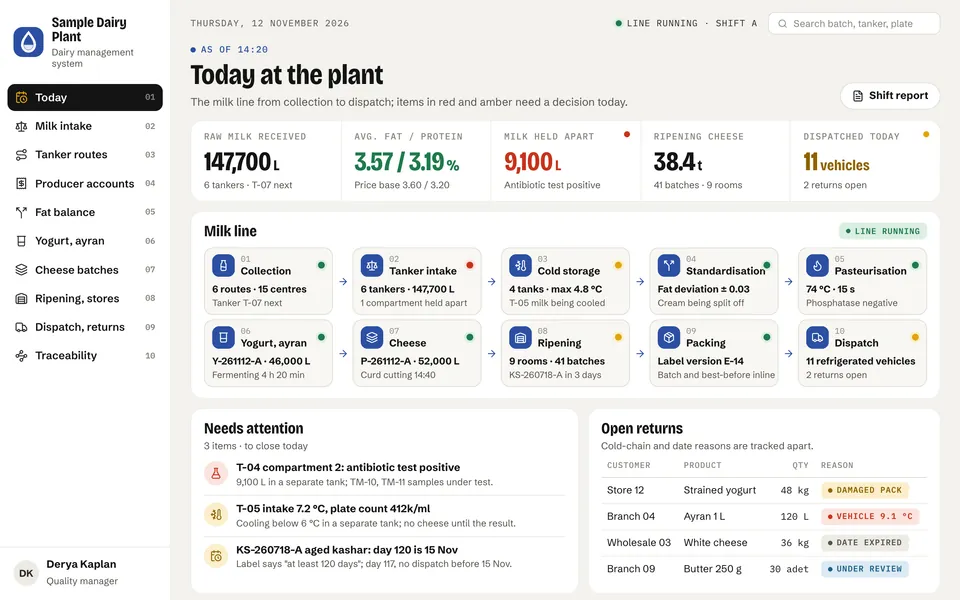
Dairy plant software home screen: daily raw milk, average fat and protein, ten-stage milk line diagram, items needing attention and open returns
Intake decision on one row Temperature, fat, protein, cells, bacteria and antibiotic result per tanker compartment; a positive compartment is held back and the rest of the milk enters the line.
Fat in kilograms How the fat in raw milk was shared across drinking milk, yogurt, cheese milk and ayran, and how much became cream and butter; deviation from target is shown in kg.
Minimum days locked to the label No dispatch order opens before the minimum days stated on a ripening cheese label are met; the 4-month rule for raw-milk cheese is tracked on the calendar.
Without touching your ERP Accounts, stock, invoices and producer receipts stay in your current program; the transfer method is settled at discovery, per version.

This page is a branch of Food and Beverage Manufacturing software; the wider picture and the other branches are there.

Does this sound familiar?

In a dairy, margin is lost not in the milk price but inside intake, fat and ripening.

Plants that collect and process milk look strikingly alike. If even one of the lines below sounds familiar, this page was written for you.

  • When a tanker reaches the weighbridge, litres go into one program, the analysis into a lab notebook and the antibiotic test onto paper; which compartment came from which centre is matched at month end, or never.
  • Whether the whole tanker or only one compartment is held back after a positive antibiotic test is left to whoever is on duty; a wrong call either wastes a tank of milk or lets residue onto the line.
  • Raw milk must be below 6 °C at intake; how long a warm tanker waited, which tank it went into and when it was processed is information nobody can see on one screen.
  • Producer accounts depend on fat, protein, cell count and bacteria, but these differences are carried to the producer receipt by hand; the bonus and deduction argument reopens every month.
  • In standardisation the fat of raw milk is split across five product lines; a deviation of a few hundredths turns into kilograms of fat and cost by the end of the day, but nobody sees it during the day.
  • In the cheese room, which day a batch is on, when the minimum days on the label are met and which room has drifted in temperature are read from a notebook or from memory; shipping a batch early is the costliest mistake.
  • Label rules for yogurt, ayran and cheese keep changing; since nobody knows which batch or stock still holds old-label packaging, the changeover day puts dispatch at risk.
  • When a return or complaint arrives, finding which tanker and which collection centre a batch drew its milk from becomes a search that takes hours.
  • Records such as the collector's and storage manager's certificate status, a tank's function in the support system and sales documents sit in separate files; when the support period comes round, something is missing.
  • The accounting program knows litres and invoices but not milk quality, batch or ripening day; product cost is therefore estimated from averages.
The software landscape today

Which software do dairies use today, and where does it fall short?

Reading the vendors' own pages, we found milk collection, producer accounts and the laboratory side well covered. We did not find a page that describes one chain of records from intake to ripening together with fat balance and label and minimum-day control; the gap is filled with Excel and notebooks.

LayerSoftware in use todayThe gap it leaves
General ERP and accounting (horizontal backbone) Logo (Tiger, GO, Netsis), Mikro, ETA, Canias, Uyumsoft, DİA Solid for accounts, stock, invoices, e-waybills and producer receipts, and should stay in place. Dairy-specific concepts do not appear in their standard scope: milk is often a single stock item, while tanker compartments, fat balance, ripening day and label version are kept outside these programs.
Milk collection and producer accounts software (Türkiye) BTI Süt Alım Çözümü (BTI), Sütçü Mobil, TarımCan Süt Toplama, aves Kooperatif (Data Media) Vendor pages describe tanker intake, scale and analyser connection, bonus and penalty by fat, protein, cell count and bacteria, producer receipts and e-müstahsil, and mobile collection; the BTI page lists full integration with Logo Tiger. The same pages do not describe cheese and yogurt batches, fat balance or ripening.
Dairy and milk processing production software (Türkiye) Vio Süt (Vio Yazılım) The vendor page describes purchase, tanker collection, milk inspection, distribution of milk to departments, milk production formulas, formula-based batch production and period pricing. Which product types are supported, fat balance and the ripening room do not appear on the page.
Milk analysers and laboratory software FOSS MilkoScan 7 RM, Centra LIMS The FOSS page describes raw milk analysis of 17 parameters including fat, protein, lactose and freezing point at 100 to 600 samples per hour, plus adulteration screening; the Centra LIMS page lists sample, analysis, instrument and quality management. Both produce results; tying a result to the intake decision, the tanker compartment and the product batch is a separate workflow.
Excel, paper and messaging Excel, notebooks, messaging groups In small and mid-size dairies tanker results, the ripening notebook and the returns list are often kept this way (our inference). Fast and flexible, but the chain from intake to dispatch is broken, a recall means hours of searching and deviations show up only at month end.

Product names are compiled from vendors' public pages (September 2026); PAN is not affiliated with them. The "gap" column summarises situations we commonly meet in discovery and is not a statement about any specific product.

Our approach

A dairy layer that fills the gap between accounting and milk collection software.

We do not bring a second accounting program into your plant. We build the chain of records from the tanker gate to dispatch and connect it to your existing systems. The system does the arithmetic, you make the decisions; every rule comes from your own table.

Tanker intake and decision record

A record opens as the tanker reaches the weighbridge: plate, route, litres per compartment, temperature, fat, protein, somatic cells, total bacteria and antibiotic result. Accept, conditional accept or reject follows your own intake rule. A positive compartment is written to a separate tank and the rest of the milk enters the line.

The chain from collection centre to batch

Which collection centre and producer each tanker drew from, which cooling tank it entered and which yogurt, cheese or drinking milk batch it went to stays in one chain. When a return or complaint arrives, the affected batches and customers are listed within minutes.

Milk fat balance

The fat of raw milk is split across target product lines; the surplus shows up as cream and butter. End-of-line measurements are compared with targets, deviation is calculated in kilograms of fat and a product beyond its limit raises an alert during the day.

Yogurt and cheese batches

Standardised milk, culture or rennet, curd, brine, fermentation and packing sit in one batch record. Batch number, recipe version and packaging lot match the label, and the intake milk the batch came from is visible.

Ripening and store calendar

A cheese batch is recorded the day it enters a room, and the minimum days stated on the label go on the calendar. No dispatch order opens before that day. If a room goes out of range, the batches in it are listed.

Producer accounts, support and dispatch

Period price, base fat and protein difference, bonuses and deductions flow into the producer receipt automatically; support records such as sales documents, tank code and certificate status stay in the same place. Dispatch records FEFO, refrigerated vehicle temperature and the reason for each return.

Modules we can build

Modules we can build for dairy

You do not need all of them at once. Most plants start with milk intake and producer accounts and grow into fat balance, cheese and ripening. When you ask, we walk through most of these modules together in a meeting.

INTAKE

Milk intake and sampling

Weighbridge reading, tanker compartments, temperature, fat, protein, cell count, bacteria, antibiotic and aflatoxin M1 results; accept, conditional accept and reject; separate-tank record; draft notification to the Ministry.

ROUTE

Tanker routes and collection centres

Route, stop, litres, tanker fill, estimated arrival; recent quality by collection centre and producer; cooling tank code and temperature record; collector certificate.

ACCOUNTS

Producer accounts and bonuses

Period price, base fat and protein, fat-protein difference, quality bonus and deductions; producer receipt, e-müstahsil transfer and sales document; tank and certificate records for the support system.

BALANCE

Standardisation and fat balance

Separator feed, target fat, cream split, end-of-line fat check, deviation in kilograms, butter estimate and fat mass balance; a target table per product.

HEAT

Pasteurisation and cold storage

Temperature and time record, alkaline phosphatase result, tank age, cooling tank fill, pasteuriser cleaning record; corrective action on deviation.

FERMENTED

Yogurt, ayran and kefir

Culture code, fermentation time and pH, strained and concentrated products, salt in ayran, fruit share in fruit yogurt, batch and label version, cold store.

CHEESE

Cheese batches and ripening

Rennet lot, curd cutting, brine, scalding, pressing, batch and room calendar, minimum days, room temperature and humidity, separate tracking for cheese made from raw milk.

BUTTER

Cream, butter and ghee

Cream batch, churning, milk fat and water share, salted and flavoured varieties, ghee batch, batch label.

DISPATCH

Dispatch, returns and traceability

FEFO picking, refrigerated vehicle temperature, remaining shelf life by branch and store, return reason, forward and backward tracing by batch, recall list.

What it looks like on screen

What dairy software looks like on screen

The screens below are a sample design prepared for plants that collect milk and make cheese, yogurt, ayran and butter. Companies, centres, people and figures are fictional; the system is set up around your own routes, products and rules.

Today at the plant. The ten-stage milk line from collection to dispatch, milk held apart at intake and open returns on one screen: which tanker is on hold, which milk is still cooling, which kashar has not reached its minimum days.
Milk intake and sampling. As the tanker reaches the weighbridge, temperature, fat, protein, cell count, bacteria and antibiotic result sit on one row; a positive compartment goes to a separate tank and the rest of the milk enters the line.
Tanker routes and quality map. Six tanker routes, fifteen collection centres and each centre's last seven days of quality on one map: where each tanker is, how loaded, and whose milk is being held apart.
Milk fat balance. How the fat in raw milk was shared across drinking milk, yogurt, cheese milk and ayran lines, how much became cream and butter, and which product drifted from its target fat at the end of the line: in kilograms, in one flow.
Ripening and stores. Which day each cheese batch is on in the room, when the label minimum is met and which room has drifted in temperature, in one calendar: no batch ships early.

Company names, people and figures on these screens are sample data. The system is built around your own processes, document names and rules. We walk you through the demo in a call: request a demo

Integration with your existing ERP

Your accounting program and your collection software both stay where they are.

Most dairies already have two solid systems: an accounting and e-document program on one side, and the software of the weighbridge, pasteuriser and analyser on the other. What is missing is the workflow between them: the intake decision, the chain, fat balance, ripening and label control. We build that beside them.

Our integration approach →
  • Account, stock, purchase document, waybill, e-müstahsil and invoice transfer with Logo, Mikro, Netsis, ETA, Canias or whatever program you run; double entry goes away.
  • Weighbridge readings, fat, protein and other results from the milk analyser, rapid antibiotic tests and laboratory results are read in; hand-entered results are recorded too. The method is settled at discovery, per device and version.
  • Pasteuriser, cooling tank and ripening room temperature data is taken from existing automation; automation keeps running the machines, we read the data and tie it to records and decisions.
  • If your current milk collection or producer accounts program works well, we talk to it; we do not insist on a second collection program.
  • Data and code belong to the customer; on-premises server, cloud or your own data centre, you choose the server.
Outcomes

What changes in the plant once this layer is live?

  • Each tanker's analysis, decision and compartment result sit in one record; when an antibiotic test is positive, only the suspect compartment is held back.
  • Because it is known which collection centre each tanker drew from, quality problems become visible by centre and producer.
  • The bonus and deduction argument is settled by a rule in one table, not by sorting through files at month end.
  • Fat deviation shows in kilograms during the day; a product line that drifts above target is corrected without waiting for month end.
  • For milk that arrives above 6 °C, which tank it went into, for how long and when it was processed is on record.
  • A cheese batch's day in the room and the date its minimum days are met stay on the calendar; no batch ships early.
  • Label version and batch are matched; when a rule changes, the stock still holding old-label packaging is listed.
  • On a return or complaint, the affected batches, tankers and customers come out within minutes; the scope of a recall is not left to guesswork.
  • Support and document records (tank function, sales document, certificate) sit in one place, so no document is missing at period end.
  • Product cost is calculated per batch from the price of the milk used, fat balance and ripening time, not from an average.
Process

A realistic five-stage path that begins with discovery.

  1. 01

    First conversation and screen walkthrough

    1 week

    We listen to your plant's capacity, the number of routes and collection centres, product groups and the accounting and collection software you use. We walk through the screens in the meeting and discuss which one maps to your own.

  2. 02

    Discovery at the plant

    1-2 weeks

    We follow the flow on site from the tanker weighbridge to the ripening room. We collect your intake rule, bonus table, recipes, room layout and label records; your field names are taken as they are.

  3. 03

    Phase one: intake and chain

    4-8 weeks

    Tanker intake, analysis, decision and cooling tank records go live. Quality by collection centre and producer starts to build up. Purchase and waybill transfer to the existing accounting program is set up.

  4. 04

    Phase two: fat balance, yogurt and cheese

    6-10 weeks

    Standardisation, yogurt and cheese batches, the ripening calendar and label matching come in. Pasteuriser and room temperature data are connected.

  5. 05

    Dispatch, returns and tuning

    Ongoing

    Dispatch, return and recall screens open; at period end we look together at what worked. When a new product, room or rule is added, the system grows with you.

Why Pan Innovation House?

A team that speaks the dairy's language and builds the chain of records on site.

Discovery first, then a quote

A dairy's system cannot be written remotely. We see your tanker weighbridge, cooling tanks, pasteuriser and ripening rooms on site, and propose the first phase in writing.

We work in the plant's own terms

Compartment, cooling tank, standardisation, cream, curd, brine, ripening and minimum days show on screen under the names you use; staff learn no new language.

We build regulation as rules

Intake temperature, bacteria criteria, pasteurisation limits and label fields are entered as a rule table; rules whose source is in official text are shown on screen with their source. When regulation changes, the table is updated.

We do not touch your ERP or collection software

Accounting and the existing collection program keep recording. The layer is built beside them; data and code are yours.

You see the screens first

Not words but a walkthrough: when you ask, we go through the intake, route, fat balance and ripening screens together in one meeting. Your own system is built from this core with your own rules.

Headquarters in Gaziantep, an office in London

The team is in Gaziantep and there is an office in London. We come to the plant for discovery and support; for dairies that export we raise the second language and foreign label needs from the start.

Frequently asked questions

Dairy (Milk, Cheese, Yogurt, Butter) software: common questions

What is the difference between milk collection software and dairy software?

Milk collection software takes milk from producers, weighs it, prices it on the analysis result and keeps producer accounts. Dairy software follows what happens to the milk once it enters the plant: standardisation, yogurt and cheese batches, ripening, labels and dispatch. They are two halves of one chain; our layer talks to your existing collection program or, where needed, covers the intake side too.

What happens to milk that tests positive for antibiotics?

Under the Regulation on Specific Hygiene Rules for Foods of Animal Origin, raw milk with antibiotic residues above the veterinary drug limits cannot be placed on the market; when raw milk does not meet the criteria the food business operator informs the Ministry and takes measures to correct the situation. In the system a positive result is recorded per compartment, the suspect milk is written to a separate tank and a draft notification is prepared.

What temperature must raw milk be at intake?

Raw milk to be used in dairy products is cooled rapidly to 6 °C or below on acceptance at the plant. Cooling may be skipped if the milk is processed immediately after milking or accepted and processed within 4 hours; if technology needs a higher temperature, Ministry permission is required. The system records intake temperature and processing time together.

What is the bacteria limit for raw milk used in dairy products?

The same regulation sets, for cow's milk used to make dairy products, a plate count below 300,000 colonies per millilitre at 30 °C for raw milk and below 100,000 for heat-treated milk. If the criterion is not met the operator informs the Ministry and takes measures. Somatic cell and other quality values are defined in the regulation's annex and in other legislation; the system keeps these tables as rules.

What is milk fat balance and why does it matter?

The fat in raw milk is usually higher than the fat target of the products you sell. The surplus is separated as cream and products are standardised to their target fat. A deviation at the end of the line that looks tiny turns into kilograms of fat across thousands of litres. The system balances input fat, product targets and measurements in kilograms and gives a cream and butter estimate.

How are ripening and minimum days tracked for cheese?

Under the Turkish Food Codex Cheese Communiqué, a matured cheese states its minimum ripening period in days on the label, and unscalded cheese made from raw or thermised milk is ripened for at least 4 months before sale. In the system a batch is recorded the day it enters the room, the minimum days go on the calendar and no dispatch order opens before that day. The day count for products such as white cheese comes from your own recipe.

How long must aged kashar wait?

The Cheese Communiqué allows the word "aged" on a label only for kashar matured for at least 120 days. The system counts the days of a kashar batch and does not allow an "aged kashar" label or dispatch order before day 120.

What does legislation check for butter and yogurt?

The Butter and Ghee Communiqué (2025/9) asks for at least 82 percent milk fat in unsalted butter, at least 80 percent in salted or flavoured butter and at most 16 percent water, and at least 99 percent milk fat in ghee. The Fermented Milk Products Communiqué defines the cultures for yogurt and ayran, caps salt in ayran at 0.8 percent, asks for at least 8 percent protein in strained yogurt and bans words such as village, home, traditional, farm and 100 percent on labels. These fields are tracked as rules in the batch record.

How do the new drinking milk rules affect the system?

The Turkish Food Codex Drinking Milk Communiqué was amended in the Official Gazette of 16 September 2026; according to the Ministry's announcement it introduced a new fat class structure, limits on added and total sugar in flavoured milk and a protein level for buffalo milk. Fat class, flavour and label fields on product cards are updated from the rule table, and products that follow the new rule are listed.

What do you do about milk support and BSKS records?

Under the Raw Milk Support and Milk Market Regulation Implementation Communiqué, sales are entered in the Ministry's Milk Registration System with a sales document. The amendment of 14 October 2026 requires the tanks in milk collection centres to be linked in the system to collection and storage functions and adds a supplementary coefficient for milk collected by staff holding a professional qualification certificate. We keep tank, certificate and sales records in one place and list gaps before a period ends; your authorised users make the entry into the official system.

We use Logo, Mikro or Netsis; do you replace them?

No. Accounts, stock, invoices, e-waybills and e-müstahsil stay in your accounting program. We build the intake decision, the tanker and batch chain, fat balance, the ripening calendar and label control beside it. The transfer method is settled at discovery, according to the program version.

How are aflatoxin M1 and other contaminant limits handled?

The Turkish Food Codex Contaminants Regulation sets the aflatoxin M1 limit for raw and heat-treated milk at 0.050 micrograms per kilogram. At intake analysis this value is read from the rule table and a result above it raises an alert. For the feed side of milk quality, see our feed mill page.

How do traceability and recall work for dairy products?

Food law expects the operator to maintain a traceability system and, for unsafe product, to withdraw it and inform the Ministry and consumers. In the system every batch is tied back to the intake tanker and collection centre and forward to the customer and dispatch line. When a tanker or centre turns out to be a problem, the affected batches and customers come out in one list and a draft notification is prepared.

What decides duration and cost?

The number of routes and centres, the product groups, your existing software and which modules you start with. We propose price after discovery, with scope and phases in writing; we do not quote a figure before discovery.

Next step

Let us walk the screens together, then come to your plant

A dairy's system cannot be written remotely. First let us go through the intake, route, fat balance and ripening screens together in a meeting; then we see your weighbridge, cooling tanks and cheese rooms on site and propose the first phase in writing.

Related services

Related areas worth considering

Pan Innovation House

Call us

By phone

+90 543 930 12 72

Our phone line is open every day.

WhatsApp on your phone

Scan with your phone camera. The chat opens with your message ready.

Prefer that we call you? Leave your details