Pan Innovation House Pan Innovation House
INDUSTRY SOFTWARE · MEAT AND POULTRY PROCESSING

From the ear tag to the packed product, a meat and poultry plant that keeps the carcass accounted for

Pan Enterprise Solutions, the software arm of Pan Innovation House · based in Gaziantep, Türkiye, with a London office

We bring livestock intake and tag matching, carcass weight and grade, cutting yield, charcuterie recipes and Communiqué limits, cold room and vehicle temperature, and the farm-to-plant lot chain into one record. Your accounting program (Logo, Mikro, Netsis or another) stays; we do not touch your scales, label printers or line automation, and build the business software alongside them. Screens are in the gallery.

Asking about price? We listen to the scope in a short call and share the budget frame and timeline in writing. The first 30-minute call is free; the scope of an on-site discovery, and its fee if any, is agreed in writing during that call.

We work on site for plants in and around Gaziantep; elsewhere in Türkiye and abroad, discovery starts by video call and a visit is planned if needed. Our London office is at Unit 6 Cranford Way, Hornsey, London N8 9DG.

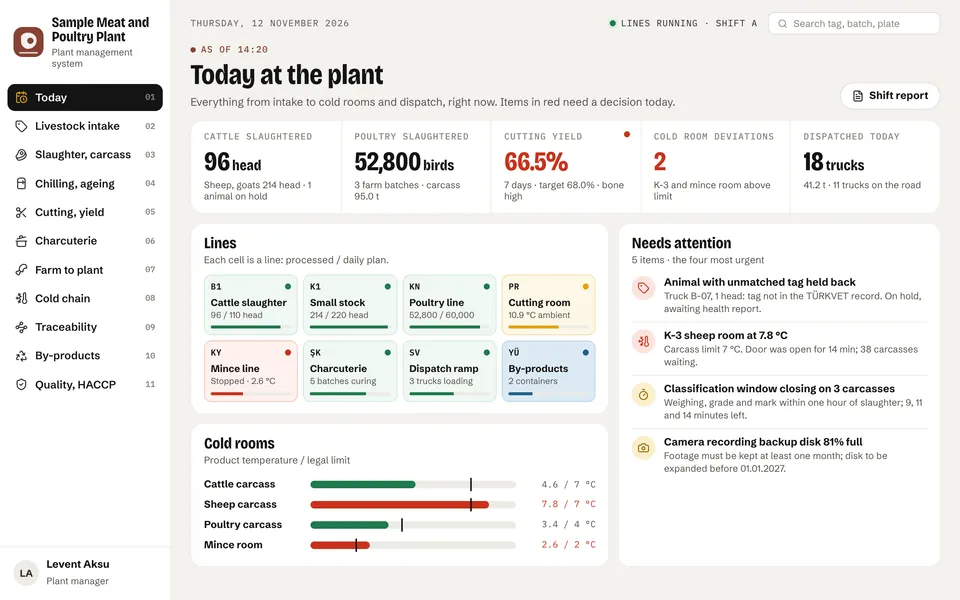
Meat and poultry plant home screen: daily slaughter, cutting yield, line status, cold room temperatures and items needing a decision today
Yield line by line Where the carcass went: prime cuts, dice, mince, bone, fat and loss, with saleable meat yield shown beside the target.
Four temperature limits Offal 3, red meat 7, poultry 4, mince 2 °C: every room and vehicle is watched against the limit of the product it carries.
Cameras: 01.01.2027 Camera and digital tracking become mandatory in slaughterhouses; the record that ties footage to transaction data can be set up before then.
Communiqué: 31.03.2027 Last day to comply with the new meat Communiqué; the limit check on each recipe and the label check run on every batch automatically.

This page is a branch of Food and Beverage Manufacturing software; the wider picture and the other branches are there.

Does this sound familiar?

In a meat and poultry plant, profit is lost not at the butcher's knife but in the carcass record.

Meat and poultry plants tend to look alike: slaughter in one ledger, weighing elsewhere, cutting in a spreadsheet, temperature on a paper chart, and accounting piecing it together afterwards.

  • Saleable meat, bone, fat and loss are not recorded per carcass, so loss hides inside total shrink; a few carcasses with a high bone share drag down the whole batch yield, yet nobody knows which ones even at month end.
  • An animal whose tag does not match the TÜRKVET record, or whose health report is missing, goes onto the line if nobody notices at the gate; pulling it back and finding which cuts its carcass became takes days.
  • For cattle carcasses, weighing, grading and marking must be done within one hour of slaughter. When the line speeds up that window slips away quietly; which carcass has run out of time cannot be followed on paper at the rail.
  • Temperature is logged against a single threshold, yet the limits differ by product: 3 °C for offal, 7 °C for red meat, 4 °C for poultry, 2 °C for mince. 2.6 °C in the mince room goes unnoticed, and which lots a room with an open door affected cannot be found later.
  • Camera and digital tracking become mandatory in slaughterhouses on 01.01.2027. Footage must be kept for at least a month and the provincial or district directorate can access it; if footage is not tied to transaction data, the archive is just a pile of files.
  • The limits in the new meat Communiqué are calculated by hand on the recipe. A sucuk batch that exceeds a limit is noticed only when curing ends, that is after it has been fully produced.
  • Changes such as fat and collagen ratio on mince labels, the end of "100%" wording and the 72 °C notice on raw poultry are tracked by hand; when the recipe version changes, nobody can be sure the label was approved again.
  • Without a record linking carcass number to ear tag, cut to carcass and mince to cuts, a recall spends days searching for which animal went to which customer, while customers and the Ministry wait and product sits on the shelf.
  • In white meat, farm lot, age, live weight and medication records sit in another corner of the integrated system; the number of birds slaughtered is compared with the number sent from the farm by hand.
  • By-products such as bone, fat and blood fall into different categories and need a commercial document and transport record when shipped, yet which container went to which category is usually written in a notebook.
The software landscape today

Which software do meat and poultry plants use today, and where do they get stuck?

Looking at public product pages we see three separate worlds: accounting and trade programs, the software of the slaughter and processing line itself, and weighing and labelling systems. Below are only the names and features we saw on the manufacturers' own pages.

LayerSoftware in use todayThe gap it leaves
General ERP and accounting (horizontal backbone) Logo (Tiger, Netsis), Mikro, ETA Solid for ledger, stock, invoicing and e-documents, and they should stay. Carcass number, ear tag, cut yield, product-specific temperature limits and Communiqué limits do not appear in their standard setup; meat is often held as a single stock item.
ERP aimed at meat production (Türkiye) Safa Bilişim (Mezbaha Kesim Otomasyonu, built on Verim SQL ERP) The manufacturer's page describes tracking by ear number from slaughter to cutting, barcodes on all cuts, tracking by line and staff, cost per product, work-in-progress and finished goods tracking for sucuk and salami, and handheld terminals. The same page does not mention footage matching, Communiqué limits or room and vehicle temperature.
Slaughter and processing line software (line makers) JBT Marel (Pork / Beef Primary Process Solution, Recipe Manager, Labeling, Inventory, AXIN) The manufacturer's pages describe primary processing from live animal intake to carcass chilling, veterinary checks, animal traceability, recipe and mixing control, labelling and data export to ERP. These are conceived with line hardware; Turkish Communiqué limits are not described on the page.
Poultry processing software BAADER (BAADER One Software Suite: Machine Visibility, Process Monitoring, White Meat Deboning, Traceability and Compliance) The manufacturer's home page menu lists machine visibility, process monitoring, white meat deboning and traceability.
Weighing and labelling systems Bizerba (slicing, weighing and labelling solutions for meat and charcuterie) The manufacturer's pages describe a slicing line, weighing, automatic loading and labelling, and weighing and traceability stories. The label and scale point is strong; yield and cold rooms are not visible from there.
General production ERP Aaro Online ERP, Han ERP12 The manufacturers' pages describe recipes, work orders, costing, serial and lot tracking, production terminals and cash register integration. The pages do not mention carcass, ear tag, meat processing or Communiqué limits; those concepts have to be added during setup.

Product names are compiled from vendors' public pages (September 2026); PAN is not affiliated with them. The "gap" column summarises situations we commonly meet in discovery and is not a statement about any specific product.

Our approach

Business software that closes the gap between your line and your accounting.

We do not bring a second accounting program or a new line automation to your plant. We build the record chain from livestock intake to dispatch and connect it with the systems you already have. The system does the arithmetic; the vet, the quality manager and the plant manager make the decisions.

Intake, tag and slaughter record

A record opens when the truck reaches the weighbridge: plate, farm, species, head count, tag numbers, health report and the ante-mortem decision. An animal whose tag does not match TÜRKVET is put on hold and does not enter the slaughter queue.

Carcass and grade record

Each carcass is weighed and takes its number, tag, category, hot weight and grade. Time since slaughter is visible; carcasses whose one-hour window is closing rise to the top of the list.

Yield flow in cutting

Chilled carcass weight is split into cuts, mince raw material, bone, fat and loss, and each line is compared with its target. In a batch that falls short, you see line by line which carcasses had a high bone share and what it did to cut value.

Charcuterie recipe and Communiqué limit

Sucuk, salami, sausage, pastırma, kavurma and ham recipes are kept versioned. On every batch meat protein, moisture and fat ratios, collagen, pH and banned additives are calculated against the Communiqué limits; a value still above its limit while curing runs is shown separately. When a recipe version changes, label approval reopens.

Cold chain and dispatch

Cold room and vehicle sensors are read against product limits; offal, red meat, poultry, mince and frozen product each have their own. When a limit is crossed, which lots are in the room and which dispatches are affected appear on one screen.

Traceability and recall

The chain from ear tag to carcass, carcass to cut, cut to mince and product, and on to the customer is a single record; in white meat the same logic links the farm lot to the packed product. In a recall, affected lots and customers are listed within minutes and the mass balance sits on the same screen.

Modules we can build

Modules we can set up for a meat and poultry plant

You do not need all of them at once. Most plants start with intake, slaughter and yield, then grow into charcuterie, cold chain and traceability.

INTAKE

Livestock intake and ante-mortem inspection

Truck, farm, species and head count; tag reading and TÜRKVET matching; health report; lairage time; the vet's accept, conditional and reject decision; slaughter order.

SLAUGHTER

Slaughter, carcass and grading

Carcass number, tag, category, hot weight, S-E-U-R-O-P grade, fat number and marking; time since slaughter; weight difference after chilling.

YIELD

Cutting and yield

Flow from carcass to cuts, dice, mince raw material, bone, fat and loss; deviation from target; value by cut and line; yield comparison by carcass and by cutter.

CHARCUTERIE

Charcuterie recipe and curing

Recipe version, lot and mix; curing room, day and weight loss; limit check against Communiqué limits; separate criteria sets for sucuk, pastırma, kavurma, ham and emulsified products.

POULTRY

Farm to plant

Farm and lot, age, live weight, medication and withdrawal record; number of birds slaughtered; carcass and cut weight; yield and farm-level feedback.

COLD

Cold room and vehicle temperature

Room, store and vehicle sensors; product-specific limits and separate alarms; door-open duration; affected lots and dispatches when a limit is crossed.

LABEL

Label and Communiqué compliance

Fat and collagen ratio on mince labels, species wording, cooking temperature notice on poultry; linking recipe version to label approval; scanning stock with old labels.

TRACE

Traceability and recall

Chain from ear tag to pack and customer; mass balance; list of affected lots and customers; notification letter and disposal or rework record.

BY-PRODUCT

By-products and disposal

Category, quantity, carrier and commercial document of bone, fat, blood and other by-products; dispatch record; delivery to disposal or processing.

QUALITY

Quality and HACCP records

Critical control point measurements, deviations and corrective actions, metal detector and tool sterilising records, approvals by vets and quality staff.

What it looks like on screen

What meat and poultry software looks like on screen

These screens come from a sample design we prepared for meat and poultry plants. The figures are sample data; the system is set up around your own lines, products and rules.

Today at the plant. The plant at a glance from intake to dispatch: animals processed line by line, cold room temperatures against their limits, animals held back and carcasses nearing the classification deadline.
Intake and slaughter. One record from the truck at the gate to the slaughter line: an animal whose tag does not match TÜRKVET is not slaughtered, and carcass weight and grade close before the one-hour window ends.
Carcass to cut yield. Every kilo from chilled carcass weight to dice, mince, bone and loss is visible. You read why yield fell below target by carcass and line.
Charcuterie and recipes. Sucuk, pastırma and kavurma batches are followed from recipe to curing room; meat protein, moisture and fat ratios, pH and banned additives are checked against the Communiqué limits for every batch.
Cold chain and dispatch. Every room and vehicle for carcass, offal, mince, poultry and frozen product is watched against its own limit; when one is crossed you see which lots are inside.

Company names, people and figures on these screens are sample data. The system is built around your own processes, document names and rules. We walk you through the demo in a call: request a demo

Integration with your existing ERP

Your accounting program and your scale and line automation both stay where they are.

Most meat and poultry plants already have two solid systems: an accounting and e-document program on one side, scales, labelling and line automation on the other. What is missing is the workflow between them: intake decision, carcass record, yield, recipe, temperature and traceability. We write that layer and set up data exchange with both sides. Accounting and official documents stay in your current program; scale and line data is tied to the record and the batch. Data and code belong to the customer; you choose the server.

Our integration approach →
  • With Logo, Mikro, Netsis, ETA or whichever program you use: ledger, stock, purchase documents, delivery notes and invoices are exchanged, so double entry ends.
  • Weight and label data are read from scales, label printers and weighbridge devices; the method is settled during discovery according to device and version.
  • Temperature data from cold room and vehicle sensors is taken from your existing monitoring system or directly from the sensor interface.
  • Your camera system stays as it is; footage is tied to the carcass and event record by timestamp, and the footage stays in your own system.
  • For animal and farm data, the connection to TÜRKVET and Ministry systems is determined during discovery according to the technical rules in force.
Outcomes

What changes in the plant once this layer is in place?

  • Each animal's tag, inspection and carcass record sit in one record; a tag mismatch at the gate is settled before slaughter.
  • Cutting yield is visible by cut and by carcass; the reason a batch falls below target is found without waiting for month end.
  • A carcass whose grading window is running out rises to the top of the list; the one-hour window closes without slipping.
  • Offal, red meat, poultry and mince are watched against separate limits; a deviation raises an alarm and affected lots are listed.
  • Footage and transaction data match; after 01.01.2027, finding the footage during an inspection stops being a search through files.
  • A charcuterie batch's Communiqué limits are tracked throughout curing; a batch that will exceed a limit is spotted midway, not at the end.
  • Recipe version and label approval are linked; the transition to the new Communiqué is managed with a scan of stock carrying old labels.
  • In a recall, the list of affected carcasses, cuts, products and customers is ready in minutes.
  • Reconciliation with accounting is done from a list taken from the same record, not by gathering files.
Process

A realistic five-stage path that begins with discovery.

  1. 01

    First conversation and screen walkthrough

    1 week

    We listen to how your red meat, white meat and charcuterie lines run, your daily slaughter capacity, and the accounting, scale and line systems you use. We walk through the screens in the gallery together and talk about which ones match your plant.

  2. 02

    Discovery at the plant

    1-2 weeks

    We follow the flow from the receiving dock to dispatch on site. We collect your intake and inspection records, slaughter line and cold room layout, cutting and mince flow, recipes and labels; we take your field names as they are.

  3. 03

    Phase one: intake, slaughter and yield

    4-8 weeks

    Livestock intake, tag matching, carcass record and cutting yield go live. Purchase and delivery note exchange with your current accounting program is set up, and scale data starts being read.

  4. 04

    Phase two: charcuterie, cold chain and labels

    6-10 weeks

    Recipes come in with their versions and Communiqué limit rules are set up; cold room and vehicle temperature are watched against product limits; the label check goes live.

  5. 05

    Traceability and beyond

    ongoing

    The chain from tag to customer and the recall list are completed; footage matching and by-product records are added. New products, lines and reports follow as needed.

Why Pan Innovation House?

A team that speaks the language of the slaughter floor and the charcuterie room, and builds the record chain on site.

Discovery first, then a quote

A meat plant's system is not written remotely. We see your slaughter line, cold rooms, cutting flow and recipes on site, and propose the first phase in writing.

We work in the plant's own terms

Carcass, tag, hot and chilled weight, dice, mince raw material, curing, ageing and shrink loss appear on screen under the names you use; staff do not learn a new language.

We set regulation up as rules

Temperature limits from the Hygiene Regulation, the carcass grading window and the composition limits of the Meat Communiqué are set up as a rules table. Numbers come from the official text; when regulation changes, the table is updated.

We do not touch your line or your ERP

Your scales, labelling, line automation and accounting program stay where they are. We build the workflow between them and exchange data with both.

Gaziantep headquarters, London office

We are based in Gaziantep and have an office in London. Meetings and documents can be in Turkish or English.

It grows phase by phase

You start with intake, slaughter and yield; charcuterie, cold chain and traceability follow in later phases. Data and code are yours, and you choose the server.

Frequently asked questions

Meat and Poultry Processing software: common questions

What is the camera and digital tracking requirement coming to slaughterhouses?

Under the amendment to the Regulation on Specific Hygiene Rules for Foods of Animal Origin published in the Official Gazette on 21.07.2026, slaughterhouses set up infrastructure so that slaughtered animals can be tracked digitally. Wide-angle, high-resolution camera systems able to record for at least one month cover the lairage, hanging, slaughter, evisceration, chilling, cutting and packing areas, and the provincial and district agriculture directorate can access the footage. Poultry slaughter also needs a system that counts the birds slaughtered; fixing an animal only by mechanically shackling its feet and hanging it while conscious are banned. The change takes effect on 01.01.2027.

What are the grading window and letters for cattle carcasses?

Under the Regulation on Classification of Cattle Carcasses (Official Gazette 12.12.2020/31332), weighing, grading and marking of the carcass are done within one hour of slaughter and bleeding at the latest. Conformation is shown with the letters S, E, U, R, O and P and fat cover with a number; the categories are A, B, C, D, E and Z (Z covers animals of 8-12 months). Approved slaughterhouses that kill on average 150 head of cattle a week or fewer are not required to classify.

What are the temperature limits for meat and poultry?

Under the Regulation on Specific Hygiene Rules for Foods of Animal Origin, chilling after slaughter continuously lowers temperature to no more than 3 °C for offal and 7 °C for other meat; for poultry meat the limit is 4 °C. In the cutting room meat must stay within these limits and ambient temperature must not exceed 12 °C (or an equivalent system). Minced meat must be at most 2 °C core temperature after production and meat preparations at most 4 °C. Frozen product is stored at -18 °C.

What limits are in the new Meat Communiqué, and when must we comply?

The Turkish Food Codex Communiqué on Meat, Meat Preparations and Meat Products (2026/15) was published in the Official Gazette on 16.09.2026 and repealed Communiqué 2018/52. Existing businesses must comply by 31.03.2027; products placed on the market before then may be sold until their shelf life ends. For example, meatballs and burgers from mince need at least 10% total meat protein, at most 25% fat and at most 2% salt; sucuk needs at least 15% meat protein, at most 20% collagen, moisture/protein and fat/protein ratios below 2.6, and pH at most 5.4.

What are the new rules on mince and labels?

Under the Communiqué, mince, poultry mince and meat preparations may be prepared at retail only on the consumer's request; uncooked meatballs and regional products such as Kilis tava may be made daily. On mince labels the wording "fat at most …%" and the collagen ratio must be at least two thirds the size of the product name; for poultry products the notice "core temperature must reach at least 72 °C during cooking" is mandatory; wording such as "100%" cannot be used.

How are sucuk and pastırma limits calculated?

Under article 9 of the Communiqué, sucuk needs at least 15% meat protein, at most 20% collagen, moisture/protein and fat/protein ratios below 2.6 and a pH of at most 5.4; heat-treated sucuk has different values. Pastırma allows at most 50% moisture, pH at most 6.0, salt at most 10% of dry matter and çemen at most 10%. Because moisture ratio falls throughout curing, the software shows the measurement beside the limit and separates "still curing" from "out of limit".

What records are needed for by-products?

The Regulation on Animal By-products Not Intended for Human Consumption sorts by-products into categories 1, 2 and 3; use and disposal method depend on category. A commercial document, or a health certificate where required, travels with the load and states origin, destination, quantity and description; the sender, carrier and receiver keep a dispatch record.

Where does a halal certificate sit in the software?

Halal conformity assessment in Türkiye is voluntary; the Halal Accreditation Agency (HAK) does not issue halal certificates, it accredits the bodies that do. A report by the Ministry of Health's National Nutrition Council states that all licensed poultry slaughterhouses hold a TSE halal certificate. The software links the certificate number and validity date to product and dispatch.

What is tracked on the white meat side?

Farm and lot, age, live weight, medication and withdrawal period; at slaughter the number of birds, carcass and cut weight and yield; chilling temperature of poultry carcasses. Broilers reach about 2.5 kg slaughter weight in roughly 42-45 days, and antibiotics in poultry are for treatment only.

We use Logo, Mikro or Netsis. Do we have to change?

No. Your accounting, ledger, stock and e-document program stays. We build the workflow between them and handle purchase, delivery note and invoice exchange. We do not touch your scales and label devices either.

We are a small plant. Is this for us?

Yes. You can start with intake and slaughter records; cutting yield and charcuterie are added in later phases. The rules table is set up for your capacity, including the grading exemption for 150 head a week or fewer.

Who keeps our data, and who chooses the server?

Data and code belong to the customer. You choose the server; the system runs in your own infrastructure or in a cloud service you pick.

Are the figures in the gallery real?

No. The gallery screens are a sample design; company, farm and person names and the figures are fictional. Regulatory limits come from official texts; the system is set up around your own lines and rules.

Next step

Let's walk through the screens together, then visit your plant

A meat and poultry plant's system cannot be written remotely. Let's first walk through the screens together; then we visit your slaughter line, cold rooms and recipes and propose the first phase in writing.

Related services

Related areas worth considering

Pan Innovation House

Call us

By phone

+90 543 930 12 72

Our phone line is open every day.

WhatsApp on your phone

Scan with your phone camera. The chat opens with your message ready.

Prefer that we call you? Leave your details