Pan Innovation House Pan Innovation House
INDUSTRY SOFTWARE · OLIVE OIL AND TABLE OLIVES

From the olives on the weighbridge to the claim on the label, olive oil mill software that keeps every batch's temperature, category and record

Pan Enterprise Solutions, the software arm of Pan Innovation House · based in Gaziantep, Türkiye, with a London office

We bring olive intake (purchased and toll-milled), the washing, crushing, malaxer and decanter line, tank analysis results and category decisions, blending and filling orders, label rules and the salt and pH of table olive tanks into one record. Your accounting and ERP program and your line automation stay where they are; we build the operations layer next to them. Scope is set at discovery; not every plant needs every module.

Asking about price? We listen to the scope in a short call and share the budget frame and timeline in writing. The first 30-minute call is free; the scope of an on-site discovery, and its fee if any, is agreed in writing during that call.

We work on site for plants in and around Gaziantep; elsewhere in Türkiye and abroad, discovery starts by video call and a visit is planned if needed. Our London office is at Unit 6 Cranford Way, Hornsey, London N8 9DG.

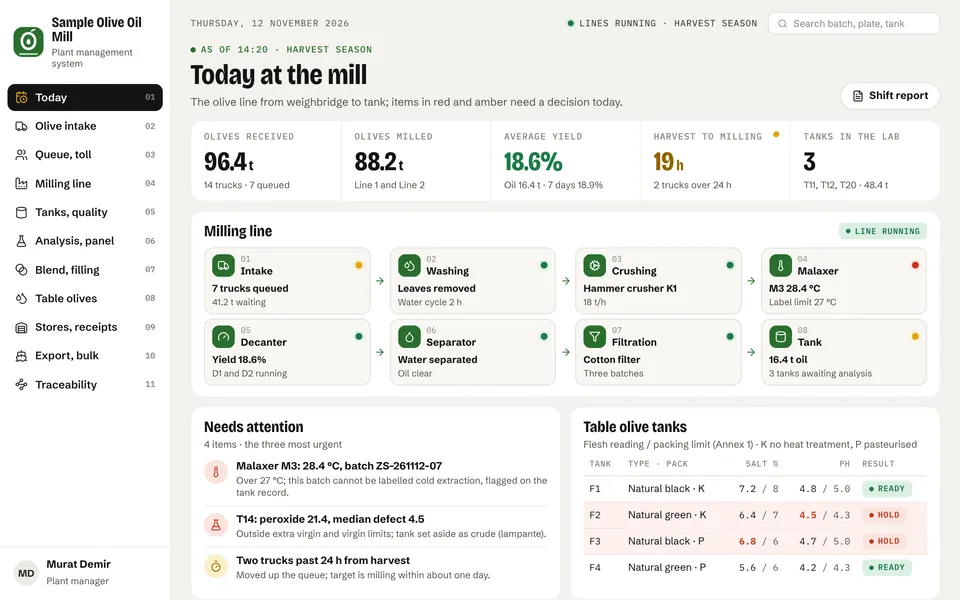
Olive oil mill software home screen: daily olive intake, eight-stage milling line diagram, malaxer temperature alert, tank analysis alert and salt and pH table of table olive tanks
Malaxer temperature goes on the batch The cold-extraction claim depends on processing below 27 °C; every batch keeps its highest temperature on record, and for a batch that crossed the limit the claim closes on screen.
Tank category comes from the limits Acidity, peroxide, K232, K270, ΔK and the sensory result are read against the notification table; each tank shows on the map as extra virgin, virgin or crude.
Toll and purchase are separate records A grower's olives and oil never mix into the mill's stock; olives, oil and service fee are tracked apart and a handover record is issued.
Scope set at discovery It starts with intake and weighbridge and grows with the milling, tank, blending, table olive and export modules as the need arises.

This page is a branch of Food and Beverage Manufacturing software; the wider picture and the other branches are there.

Does this sound familiar?

In olive oil, quality and profit disappear not inside the tank but inside the tank's record.

This is the picture from how the sector works: the harvest is squeezed into a few weeks, the crop doubles or halves from one year to the next, olives may belong to the grower, and the category of the oil hangs on an analysis report. If any of the points below sounds familiar, this page was written for you.

  • The crop swings widely: according to TEPGE, the research institute of the Ministry of Agriculture and Forestry, total olive production was 1,520 thousand tonnes in 2023 and 3,750 thousand tonnes in 2024. Planning tanks, labour and packaging against the harvest peak is redone every year.
  • On the busiest days the truck queue is run in a notebook, on the phone and by voice; which grower is on which machine and who is toll and who is purchase sits in the memory of whoever is on shift.
  • When intake does not separate purchase from toll, a grower's olives mix into the mill's stock, and when the oil is handed back an argument starts about how many kilos of oil came from how many kilos of olives.
  • Ankara University teaching notes advise milling olives within about one day of harvest and, if they must be stored, keeping them in crates with a low stack height. Because time since harvest is not written at the weighbridge, a late load is treated like all the others.
  • Malaxer temperature and time sit on the line panel and are not written to the batch. Yet under the Olive Oil and Pomace Oil Notification, the claims “cold extraction” and “first cold pressing” depend on processing below 27 °C; the evidence for the claim on the label is not in any record.
  • The tank analysis (free acidity, peroxide, K232, K270, ΔK, sensory panel) lives in a lab report, an e-mail and one person's list. The limit for extra virgin is 0.8 per cent acidity and for virgin 2.0; that a tank with K270 above 0.22 drops to virgin is not on a map, only in someone's head.
  • In blending, acidity, peroxide and K values of the mix are worked out on a calculator; since the sensory result cannot be calculated, a panel and a re-sample are needed after blending, but which blend is waiting for approval is not tracked.
  • When the same tank feeds both bulk sales and filling, the remaining quantity and its link to the milling batch get lost; finding which tank, which milling batch and which grower's olives a bottle came from takes days.
  • Label rules are scattered: if acidity is stated, peroxide, waxy matter and UV values must be stated too, pomace oil cannot be called olive oil, and a geographical indication may appear only on extra virgin and virgin olive oil labels. These rules live in a person's knowledge, not in the design file.
  • In table olive tanks, salt and pH are measured on paper; the limits in the notification differ by pack type (at most 6 per cent salt in a pasteurised pack), and which tank can be packed is compared by hand.
The software landscape today

Which software do olive oil mills use today, and where does it get stuck?

Ready-made programs for olive oil mills exist; on their public pages they cover queue, weighbridge, stock and accounting well. We did not see a page that explains category decisions for tanks against the notification limits, a limit check on blends, or tying the label claim to a temperature record. In most plants the gap is closed with Excel and notebooks.

LayerSoftware in use todayThe gap it leaves
Accounting and ERP (the horizontal backbone) The plant's own accounting, pre-accounting and e-document program Solid and should stay for ledgers, stock, invoices, e-invoices and e-waybills. In general accounting programs, milling-specific records such as olive crate, batch and tank movements, toll ownership and malaxer temperature usually wait to be defined plant by plant.
Olive oil mill programs OliveOS, AtiOlea (Ati Kurumsal Yazılım) OliveOS's page lists malaxer automation (temperature, time and capacity tracking), quality control and analysis records (acidity, moisture, colour, sensory), weighbridge and invoicing; we did not see a tank and filling module on the page. AtiOlea's page lists queue management, calling (machine and tank assignment), weighbridge and scale integration, shifts, olive, oil, drum and tin stock, pre-accounting and e-document modules. Category decisions for tanks against the notification limits are not described on these pages.
Accounting-led and tank-focused mill programs ZeytinFabrika (Olive Edremit Zeytincilik), Zeytinyağ Fabrikam (Codeco Soft) ZeytinFabrika's opened page describes invoicing, current accounts, cash flow and expense management; it names grower tracking, tank and warehouse, mobile, e-producer receipt, weighbridge and analytics modules without describing them. Zeytinyağ Fabrikam's page mentions production tracking, stock, tank, drum and tin movements and season comparison. Decisions such as the blend recipe and label rules are not described on these pages.
Mill system and traceability platform Oleo Master (Nob Tech) Its page lists a mill system covering harvest, production, storage and shipping, a traceability and sustainability infrastructure, and 14 modules (appointments, logistics, warehouse, production, harvest evaluation, quality, e-invoicing, e-commerce and retail POS among them); what the traceability covers is not spelled out.
Customer relations and sales ÖzgürKod Focused on collecting harvest-season orders in one inbox, announcing the new harvest to repeat buyers and shipping follow-up; the page has no production, tank or batch record. It strengthens the sales side and does not replace milling and quality records.
Laboratory management (LIMS) Centra LIMS Designed to manage samples, analyses, equipment and reporting on the laboratory side; its page names pharmaceuticals, food, chemicals and laboratories as target sectors and does not mention olive oil. The link between the lab result and the tank's category decision waits to be built separately.
Excel and notebooks Queue notebook, weighbridge slip, lab report e-mail, tank sheet Still the most used layer in many plants. In the busy weeks every new row is a risk of error; the link between a tank's category, the malaxer temperature and the toll balance sits in someone's head.

Product names are compiled from vendors' public pages (September 2026); PAN is not affiliated with them. The "gap" column summarises situations we commonly meet in discovery and is not a statement about any specific product.

Our approach

An operations layer that closes the gap between the machine and the ledger, with the batch and the tank at its centre.

We do not bring your plant a second accounting program or new line automation. We build a record layer that runs on your rules along the chain from weighbridge to label, tied to the batch, and talks to both accounting and line data.

A record that starts at the weighbridge

A record opens when the truck reaches the scale: plate, grower, source (purchase or toll), crate or bulk, net weight, time since harvest, foreign matter and bruised fruit rate. Against your rule table the result is acceptance, a separate batch or a return. Purchased olives go to the mill's stock, toll olives to the grower's account.

Milling batch and malaxer record

Each milling batch gets a code; malaxer temperature and time, decanter yield and the oil obtained are written to the batch. When 27 °C is crossed, the cold-extraction claim closes for that batch's oil; yield is reported per batch and per grower.

Tank farm and quality map

Each tank's acidity, peroxide, K232, K270, ΔK and sensory result are read against the notification table; the tank colours on the map as extra virgin, virgin, crude or refined. A value over the limit and a category drop are stated on screen, and the table is held as a dated rule.

Blend recipe and limit check

From the amounts drawn from each tank, the blend's weighted acidity, peroxide and K values are computed and shown beside the limit. Because the sensory result cannot be calculated, the panel and re-sample step after blending enters the record; an unapproved blend cannot move to a filling order.

Filling, label check and traceability

A filling order is checked against label rules: category name, peroxide, wax and UV values beside any acidity claim, the cold-extraction right, geographical indication and pack. From bottle to tank, from tank to milling batch and the grower's crate, a two-way chain appears on one screen.

Table olives, sales and export record

Salt and pH of table olive tanks are compared with the notification limit by pack type; tanks that can be packed show up. Bulk and packed sales and export papers are tied to the lot, and for EU shipments the origin statement is prepared from the batch record.

Modules we can build

Modules we can build for an olive oil and table olive plant

You do not need all of them at once. Most plants start with intake, weighbridge and the milling batch record; tank, blending, table olive and export modules are added as the need arises.

INTAKE

Olive intake and weighbridge

Truck and grower record, purchase and toll split, crate or bulk, time since harvest, foreign matter and bruised rate, acceptance, separate batch and return decisions, grower scorecard.

QUEUE

Queue, calling and toll accounts

Truck queue in the busy season, machine and tank assignment, the toll owner's olive and oil balance, service fee and handover record, the purchase record behind an e-producer receipt.

MILL

Milling line and malaxer

Washing, crushing, malaxer, decanter and separator stages, malaxer temperature and time, milling batch, yield, and the cold-extraction right read from the record.

TANK

Tank farm and batch quality map

Tank fill, transfers, automatic category from analysis results, alerts for values over the limit, stock by category, bulk sales deducted from the tank.

ANALYSIS

Analysis and sensory panel record

Sampling, laboratory result (acidity, peroxide, K232, K270, ΔK), panel result (median of defects, fruity median), dated rule table, result import from your laboratory software.

BLEND

Blend recipe and filling order

Amounts drawn from tanks, computed blend values, post-blend panel step, filling order, pack and quantity, refined-to-virgin ratio for blended olive oil.

LABEL

Label check

Category name, acidity statement and accompanying values, the cold-extraction and first-cold-pressing right, geographical indication condition, pomace oil naming rule, loose-sale check.

TABLE

Table olive tanks

Type (green, colour-changing, black; natural or treated), tank and barrel record, salt and pH measured in the flesh, limit by pack type, fruit size grade.

TRACE

Traceability, stores and export

Chain from bottle to tank and milling batch, matching licensed warehouse receipts with the mill's stock, bulk and packed dispatch, EU origin statement, a ready list when a buyer complains.

What it looks like on screen

What olive oil and table olive software looks like on screen

The screens below are a sample design prepared for plants that process olive oil and table olives. Companies, people and figures are fictional; the system is set up around your own lines, tanks and rules.

Today at the mill. During the harvest season, the eight-stage milling line from weighbridge to tank, malaxer temperature, time from harvest to milling and the salt and pH of table olive tanks on one screen: which batch crossed 27 °C, which tank is out of limits, which tank is ready to pack.
Olive intake and weighbridge. Purchased and toll-milled olives share one weighbridge but stay in separate records; time since harvest, foreign matter and bruised fruit are read against the mill’s rule table, and a late or damaged load goes to a separate batch or back to the grower.
Milling line and malaxer. Each malaxer batch records its temperature, time and oil yield; once a batch crosses 27 °C, the "cold extraction" claim closes for its oil, so what a batch may say on the label is read from the record.
Tank farm and quality map. Fill level and category of 24 tanks on one map; each tank’s acidity, peroxide, K232, K270, ΔK and sensory result are checked against the notification limits, and a tank with K270 at 0.23 drops from extra virgin to virgin.
Blend, filling and label. The amount drawn from each tank computes the blend’s acidity, peroxide and K values, and the filling order is checked against label rules: the "cold extraction" claim stays open only for batches milled below 27 °C.

Company names, people and figures on these screens are sample data. The system is built around your own processes, document names and rules. We walk you through the demo in a call: request a demo

Integration with your existing ERP

Both your accounting program and your line automation stay where they are.

Most plants already have two layers: accounting, pre-accounting and e-document software on one side, and the weighbridge, malaxer and decanter panels on the other. What is missing is the workflow between them: acceptance decision, toll owner, milling batch, tank category, blend, label claim and dispatch. We write this layer and set up data exchange with both sides. Accounting and official documents stay in your current program; line data is read from the device wherever possible, not typed.

Our integration approach →
  • Transfer of accounts, stock, purchase documents, waybills and invoices with Logo, Mikro, Netsis or whichever accounting and pre-accounting program you use; double entry goes away.
  • Reading weights from weighbridge indicators and scales; depends on the device model and output and is settled at discovery, and a quick manual entry screen is built for devices that cannot be read.
  • Linking the temperature, time and yield data that malaxer and decanter panels can export to the batch; which data they provide in which format depends on the manufacturer and version and is settled at discovery.
  • Importing results from your laboratory's report format or LIMS output; acidity, peroxide, K values and the panel result are tied to the right tank.
  • Data exchange with the e-producer receipt, the licensed warehouse operator and official systems: we prepare from the record as much as the plant can, and the authorised person makes the official entry from their own account.
Outcomes

What changes in the plant when this layer is in place?

  • Each truck's source, time since harvest, foreign matter and bruised rate, and decision sit in one record; month-end reconciliation is not spent adding up notebooks.
  • Purchase and toll are separate; a grower's olives and oil never mix into the mill's stock, and at handover a record speaks instead of an argument about kilos.
  • Each milling batch's malaxer temperature is on record; oil that may say cold extraction is separated from oil that may not.
  • Yield is tied to batch, grower and machine; which source's olives lower the yield becomes visible in mid-season.
  • A tank's category comes out of its analysis result; a tank over a limit is called out on the map, and the quantity that drops to virgin or crude is no longer someone's private knowledge.
  • Computed blend values sit beside the limit; an unapproved blend does not move to a filling order and the panel step is not forgotten.
  • Label rules are checked on the filling order; a missing value beside an acidity claim, a claim without the right, or a wrong name is caught before printing.
  • Salt and pH of table olive tanks are compared with the pack limit; which tank can be packed is stated by record, not by guess.
  • When a buyer complains or an inspector calls, the chain from bottle to tank, milling batch and grower comes out in minutes.
Process

A realistic five-stage path that begins with discovery.

  1. 01

    First conversation

    1 week

    We listen to your lines and capacity, the purchase and toll split, number of tanks, laboratory and weighbridge set-up, whether you do table olives or export, and the programs you use. We talk through which screen each of your problems maps to.

  2. 02

    Discovery at the plant

    1-2 weeks

    We watch the flow from intake to the filling line on site. We collect your acceptance rule, queue and toll notebook, malaxer and decanter records, tank and analysis sheet and label files; your field names are taken as they are.

  3. 03

    Scope, priority and budget

    1 week

    We present a module order that starts where it hurts most, integration routes, timeline and budget in writing. The first phase is most often intake, weighbridge and the milling batch record; we suggest placing go-live outside the harvest peak.

  4. 04

    Build and pilot

    6-10 weeks

    We deliver module by module and test with real trucks and real batches. The weighbridge operator, the oil maker, the lab lead and the plant manager use the screens at each delivery; corrections come from the floor.

  5. 05

    Go-live and maintenance

    Ongoing

    After training, data migration and go-live, maintenance and support continue. When a new tank, a new line or a changed label rule arrives, the system grows with you. The data and source code are yours; you choose the server.

Why Pan Innovation House?

A team that learns the language of the batch, the tank and the label, and builds the record chain on the shop floor.

Your rules first

The acceptance table, machine and tank names, the yield calculation and the blend rule are taken from your product card; the screens show the field and stage names you use.

Regulation as rule tables

The category limits and label provisions of the Olive Oil and Pomace Oil Notification and the salt and pH limits of the Table Olive Notification enter the system as dated rule tables; when a notification changes, the software is not rewritten, the table is updated.

We ask the floor questions

At discovery we map the order of washing, crushing, malaxer, decanter, separator and tank stages, where each measurement is taken and which tank is fed by which line.

Beside your systems, not between them

Your accounting and ERP program, line automation and laboratory system stay where they are. Our job is to write the flow between them.

Headquartered in Gaziantep, office in London

We are headquartered in Gaziantep, which according to Ministry data is among the top ten provinces in oil olive production. Our London office makes it easier to talk with plants that supply the European market. Site visits and meetings can run in both directions.

Your data and code

Records and the code we develop belong to the customer. You choose the server; the system does not tie you to us.

Frequently asked questions

Olive Oil and Table Olives software: common questions

Which categories does olive oil fall into, and how does the software decide?

The Turkish Food Codex Olive Oil and Pomace Oil Notification defines extra virgin, virgin, crude, refined, blended olive oil (called Riviera in Turkish), crude pomace, refined pomace and pomace oil. In the Annex 1 table, extra virgin needs free acidity of at most 0.8 per cent, peroxide at most 20, K232 at most 2.50, K270 at most 0.22 and ΔK at most 0.01, with a median defect of zero and a fruity median above zero. Virgin allows 2.0 per cent acidity, K232 2.60, K270 0.25 and a median defect of at most 3.5. The system holds these limits as a dated rule table, compares each tank's analysis result and shows the category on the map; when the notification changes, the table is updated.

What does it take to write “cold extraction” on a label?

Under the labelling article of the notification, “first cold pressing” may be used only for extra virgin and virgin oil from the first mechanical pressing of the paste in a hydraulic press below 27 °C, and “cold extraction” for paste processed by percolation or centrifuging below 27 °C. That is why we write malaxer temperature to the batch: for a batch over the limit the claim closes, and a blend that contains that batch affects the blend's label right.

We do toll milling; the olives and the oil belong to the customer. How does the software treat that?

Toll olives do not enter the mill's stock; in the record the owner stays the grower and the mill provides a service. Olive weight, milling batch, oil obtained and yield are kept per grower, the balance shows if oil is waiting in a tank, and a handover record is issued. The service fee is tracked separately, so the answer to “how many kilos of oil from how many kilos of olives” sits in the record.

We buy olives from growers. How does that relate to the e-producer receipt?

We keep the purchase record (who, how much, which date, what price) from the weighbridge on and prepare the information the receipt needs. The official issue of the receipt is made by the authorised person through an integrator or the Revenue Administration portal. The scope of the obligation and the deadlines for electronic (SMS) verification change with Revenue Administration announcements; we suggest asking your accountant whether and how it applies to you.

Does the blend calculation also work out the sensory result?

No. For acidity, peroxide and K values the weighted average of tank batches gives an estimate shown beside the limit; the sensory result (median of defects and fruity median) is determined by a panel and cannot be calculated. The system records the post-blend panel and re-sample step and does not let an unapproved blend move to a filling order.

If we state acidity on the label, what else must appear?

The notification requires that if acidity or maximum acidity is stated on the label, the peroxide value, waxy matter and UV absorbance values must be stated with it in the same size. The label check looks for these fields at filling-order time; it also reminds you that pomace oil cannot be called olive oil and that a geographical indication may appear only on extra virgin and virgin oil.

What do you track for table olives?

The Table Olive Notification gives salt and pH limits for packed product in its annex. For example, natural black olives take a pH of at most 5.0 and natural green olives 4.3; the salt limit is 8 and 7 per cent in packs without heat treatment and 6 per cent in pasteurised packs. Tank and barrel records, salt and pH measured in the flesh, pack type and the fruit size grade (count-per-kilo ranges) are kept together; a tank over a limit does not enter the packing list.

In which Turkish provinces are olive oil mills concentrated?

According to the July 2025 report of TEPGE at the Ministry of Agriculture and Forestry, the shares of oil olive production in 2024 were İzmir 17.9 per cent, Manisa 16.9, Aydın 14.1, Balıkesir 9.8, Mersin 6.8, Hatay 6.5, Çanakkale 6.2, Muğla 6.0, Gaziantep 4.1 and Osmaniye 3.2. Because the province changes the harvest calendar, olive variety and buyer profile, we talk through these separately at discovery.

What does the system do for bulk and export sales?

Bulk dispatch from a tank and filling of drums, tins and bottles are tied to the lot in separate dispatch records. In 2023 the Ministry of Trade introduced measures on bulk and barrelled olive oil exports and announced that there was no measure on packed exports; because the current status of those measures can change, the market rule is held as a dated table in the system. For EU shipments Regulation (EU) 2022/2104 ties the origin statement to the country where the olives were harvested and the mill is located; the system prepares the origin statement from the batch record.

Do you replace the olive mill program we already use?

No. The program you use for queue, weighbridge, stock and accounting can stay. We build the decision layer next to it, such as tank category, the label right tied to malaxer temperature, the blend limit check and table olive tanks, and write the data exchange between the two. At discovery we look at what your current program already covers and do not rewrite it.

Next step

Let us talk through your line, your tanks and your toll set-up, then we will come to your plant

A plant's system cannot be written remotely. Let us first hear about your line, tank and toll set-up, label and export flow and the programs you use; then we see your weighbridge, malaxer and laboratory on site and propose the first phase in writing.

Related services

Related areas worth considering

Pan Innovation House

Call us

By phone

+90 543 930 12 72

Our phone line is open every day.

WhatsApp on your phone

Scan with your phone camera. The chat opens with your message ready.

Prefer that we call you? Leave your details