Pan Innovation House Pan Innovation House
INDUSTRY SOFTWARE · FOUNDRY AND METAL CASTING

Foundry software that keeps the books on every casting, from the charge to the customer's part

Pan Enterprise Solutions, the software arm of Pan Innovation House · based in Gaziantep, Türkiye, with a London office

We bring patterns and cores, the green sand laboratory, melting and charge calculation, chemistry correction, the mould line, cooling and shake-out, fettling, inspection and scrap into one chain of records. Logo, Mikro, Netsis or whichever ERP you use stays in place; furnace-side, sand laboratory and line data are added as a layer next to it. Scope is set at discovery.

Asking about price? We listen to the scope in a short call and share the budget frame and timeline in writing. The first 30-minute call is free; the scope of an on-site discovery, and its fee if any, is agreed in writing during that call.

We work on site for plants in and around Gaziantep; elsewhere in Türkiye and abroad, discovery starts by video call and a visit is planned if needed. Our London office is at Unit 6 Cranford Way, Hornsey, London N8 9DG.

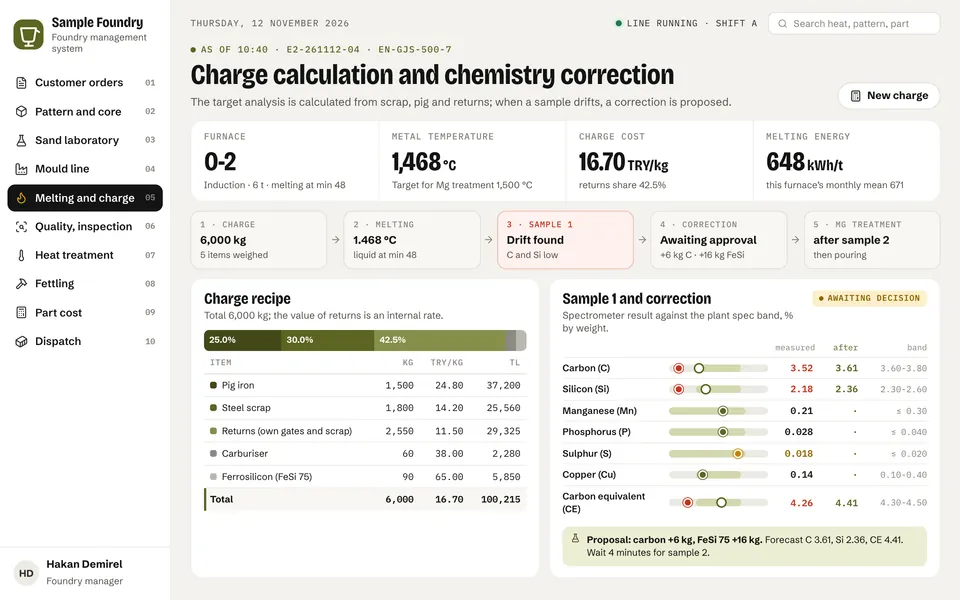
Foundry software charge screen: charge recipe and cost, the chemical analysis of sample 1 with spec band and post-correction forecast
The charge on record Pig iron, scrap, returns and alloy additions are tied to the heat number with the weighed amounts; when a sample drifts, the correction shows before pouring.
From sand to scrap The green sand sample, the mould and the scrap cause sit in one chain, so which half-hourly sample a sand inclusion belongs to is read from the record.
Cost per part Liquid metal, energy, sand, labour, fettling and scrap allowance are spread to the customer part; cost per kg and per piece show side by side.
Demo on request We walk through the charge, sand, mould line, inspection and cost screens with sample data in one meeting; scope is settled at discovery.

This page is a branch of Machinery Manufacturing and Metalworking software; the wider picture and the other branches are there.

Does this sound familiar?

In a foundry, profit is lost in the sand, the charge and the scrap, not in the metal price.

We read in industry publications and association statements that the picture below is common in foundries. If even one line looks familiar, this page was written for you.

  • The charge is worked out at the furnace on paper, a calculator or an Excel file; the ratio of pig iron, scrap and returns shifts with the experience of the day, and two heats of the same part turn out to be poured from different charges.
  • The spectrometer sample sits on a screen while the carbon equivalent and silicon correction is worked out in the furnace operator's head; in ductile iron, the time since magnesium treatment and the inoculation stay as a separate note.
  • The green sand laboratory's moisture, compactability and active clay results live on paper or in a separate sheet; when a sand inclusion shows up, nobody can find which half-hourly sample had drifted.
  • The mould number, part, heat number and pouring time are not kept together; a mould shaken out before its cooling time is over shows up later as distortion or a hardness defect.
  • How many moulds a pattern or core box has made and when it was last inspected is unrecorded; a worn pattern becomes an out-of-size part and then a customer complaint. In many places it is not written down whether the pattern belongs to the customer or the foundry.
  • Scrap is written to a total, not a cause: sand inclusion, gas porosity, shrinkage and cold shut merge in one "scrap" line, and action is taken without knowing which part, which mould and which shift.
  • The cost of a customer part is worked out at an average metal price per kg; fettling and grinding labour, heat treatment, energy and the scrap allowance are not spread to the part, and the gap to the quote is only understood at month end.
  • Fettling, grinding, heat treatment and machining go to subcontractors; parts sent and returned, scrap and reconciliation are tracked by phone and photos of delivery notes.
  • When a customer complains, or an automotive customer assesses the foundry, the answer to "which heat, which sand and cores, which mould did this part come from" takes days of file searching.
The software landscape today

Which software do foundries use today, and where does it fall short?

In Turkey we could not find a business software openly presented as covering charge calculation, the green sand laboratory and customer part cost together for foundries. Foundries usually run several layers side by side, and Excel, notebooks and the furnace operator's experience carry the work in between. The product names below were opened and read on the vendors' own pages; the features are limited to what those pages show.

LayerSoftware in use todayThe gap it leaves
General ERP and accounting (horizontal backbone) Logo (Tiger, Netsis), Mikro, CanIAS Should stay for accounts, stock, invoices and e-waybills. In this study we did not see a foundry-specific page or concepts (pattern, core, charge correction) on these vendors' pages; CanIAS lists "Metal Industry" among its sectors without mentioning casting. Foundry detail often moves into a separate sheet.
Turkish ERP with a foundry sector page Uyumsoft Liox ERP The vendor's site has a Foundry Sector ERP page with headings for raw material, production planning, quality control and certification, cost calculation and batch tracking. The page mentions moulds, alloys, melting and traceability; cores, charge and scrap do not appear. Charge correction and sand laboratory depth are questions for discovery.
Foundry-specific ERP from abroad Odyssey ERP (B&L Information Systems), Fluentis ERP Foundry The Odyssey page shows metal recipes, a pattern usage counter with review limits, scrap and returns tracking and outside-processing tracking; the Fluentis page shows mould management, barcode heat traceability, analysis certificates, spectrometer and PLC integration and casting cost. Turkish e-document and local accounting fit was not read on the vendor pages; how it would work with your current ERP is a discovery question.
Casting simulation MAGMASOFT, ProCAST, NovaFlow&Solid, SOLIDCast and FLOWCast They predict mould filling, solidification, shrinkage and porosity; the MAGMASOFT page mentions sand burn-on and penetration prediction, and the ProCAST and SOLIDCast pages mention gating and riser design. These are engineering tools: tying the prediction to the furnace-side charge record, the sand laboratory and the real scrap cause is a separate job.
Spectrometer and laboratory software Bruker spark-OES (Elemental.Suite software) The vendor page lists foundries, steel, copper and aluminium plants as users; instrument software produces the analysis result. Keeping the result on one screen with the plant's spec band, the charge correction and the heat number sits outside the instrument software.
Excel, notebooks and furnace-side notes Excel, charge book, sand book, shift forms Alive in every foundry and carrying most of the work. The weak side: a formula or notebook depends on one person, the link between heat number, sand sample and scrap record is broken, and part cost becomes a month-end estimate.

Product names are compiled from vendors' public pages (September 2026); PAN is not affiliated with them. The "gap" column summarises situations we commonly meet in discovery and is not a statement about any specific product.

Our approach

A business layer that closes the gap between the furnace, the sand laboratory and accounting.

We do not bring your foundry a second accounting program or a new furnace automation. We build the chain of records from charge to dispatch and connect it to the systems you already have. The data and source code are yours, and you choose the server.

A record that ties charge and sample to the heat number

Pig iron, steel scrap, your own returns, carbon and ferroalloy additions are calculated with your recipe; the actual weighing, furnace, temperature and spectrometer sample are written to the same heat number. If the result is outside the band, the correction amount and forecast show before pouring starts; you set the rule, the software calculates and keeps the record.

A chain from mould to part

The sand sample, core batch, pattern, mould number, heat number and pouring time sit in one chain. Shake-out cannot start before the part's minimum cooling time is over; every part is traced back through its serial and mould number.

Laboratory and inspection results on record

Green sand moisture, compactability, green compression strength, permeability and active clay; in ductile iron the tensile bar, nodularity and hardness; non-destructive test results. Bands and limits come from the plant's own specification, and a drift becomes an alert.

An interface that talks to the ERP and machines

Account, stock, sales order, delivery note and invoice transfer with Logo, Mikro, Netsis or whichever program you use; data exchange with the spectrometer, furnace and line PLC where that machine offers an export path. Which machine gives how much data is settled at discovery.

A record shared with subcontractors and customers

Parts sent for fettling, heat treatment and machining; sent, returned and scrapped pieces and kilos, and reconciliation. Customers can be given the heat number, material analysis and inspection result per part; you decide what goes to whom.

Part cost and scrap dashboards

Liquid metal, energy, sand and cores, labour, fettling, heat treatment, scrap allowance and overhead are spread to the customer part; cost per kg and per piece, margin and drift from the quote show. Scrap cause becomes a dashboard by part and shift.

Modules we can build

Modules we can build for a foundry

You do not need all of them at once. In most foundries we start with charge and sample records or scrap causes, then grow with the sand, line, cost and subcontractor modules. On request we walk through most of these modules in a demo.

CHARGE

Melting, charge calculation and chemistry correction

Furnace and ladle record, charge recipe and cost, scrap and returns stock, sample and spectrometer result, spec band, carbon equivalent, correction proposal, temperature, magnesium treatment and inoculation time, heat number.

SAND

Green sand laboratory

Moisture, compactability, green compression strength, permeability, active clay and temperature samples, control chart and band, mixer correction proposal, link to sand inclusion and gas defects, sand reclamation.

LINE

Mould line and pouring flow

Sand preparation, core, moulding, pouring, cooling and shake-out stations, moulds per hour, mould number and heat number link, minimum cooling time, early shake-out block, stops.

PATTERN

Pattern, core box and tooling inventory

Pattern and core box card, customer or foundry ownership, usage count and review limit, maintenance and repair history, location, customer tooling inventory, link to wear-related size errors.

QUALITY

Inspection, scrap and certificates

Visual, size and hardness records, tensile bar and nodularity for ductile iron, non-destructive test results, scrap cause (sand inclusion, gas porosity, shrinkage, cold shut, size), pareto by part and shift, trace back, material certificate to the customer's requirement.

PROCESS

Heat treatment and fettling

Heat treatment furnace batch, temperature and time record, link to part and heat number; work order for gate cutting, grinding and deburring, labour time, second inspection after fettling.

COST

Cost by customer part

Liquid metal and the value of returns, energy, sand and cores, labour, fettling, heat treatment, scrap allowance and overhead; cost per kg and per piece, margin, drift from the quote, how margin moves when the scrap rate rises.

PLAN

Orders, quotes and pouring plan

Customer order and call-off, material grade per part, furnace capacity and pouring sequence, moulding line load, pattern availability, due date, subcontractor capacity and dispatch plan.

ENERGY

Energy and emissions data

Furnace, holding and ladle preheating energy, kWh per tonne of liquid metal, idle holding, cupola or gas use, dust and filter maintenance records, the data file an EU customer will ask for when you export.

What it looks like on screen

What foundry software looks like on screen

These screens come from the demo design we prepared for foundries pouring cast iron, ductile iron, steel and aluminium parts. The figures are sample data; the system is set up around your own melting, moulding and inspection routine and existing ERP.

Charge calculation and chemistry correction. The target analysis and charge cost are calculated from pig iron, steel scrap, returns and alloy additions. When a spectrometer sample leaves the spec band, the correction amount and forecast show before pouring starts.
Mould line and pouring flow. Every station from sand preparation to shake-out appears on one line diagram, and every mould is tagged with its heat number. Shake-out is blocked before cooling time is over, and a pattern near its mould-count limit is called for inspection.
Green sand laboratory. Moisture, compactability, green strength, permeability and active clay are plotted against the plant’s own band. When a drift appears, a water, bentonite and new-sand correction is proposed for the mixer, and sand-related scrap is traced from the measurement to the mould.
Inspection, scrap and heat trace. Every scrapped part carries its cause, mould, heat number and sand sample, and the largest scrap cause is visible part by part. Tensile bar and non-destructive test results become the source of the lot certificate.
Cost by customer part. Liquid metal, energy, sand and cores, labour, fettling and scrap allowance are spread to the customer part, with cost per kg and per piece side by side. The margin of a part whose scrap rate rises shows together with how far it drifted from the quote.

Company names, people and figures on these screens are sample data. The system is built around your own processes, document names and rules. We walk you through the demo in a call: request a demo

Integration with your existing ERP

Your accounting program, your furnace and your line all stay in place.

Most foundries already have two solid systems: accounting and e-document software on one side, machines and automation running the furnace and line on the other. What is missing is a layer that keeps the work between them in one chain of records. That layer is what we build.

Our integration approach →
  • Account, stock, sales order, dispatch note and invoice transfer with Logo, Mikro, Netsis or whichever program you use; double entry disappears and accounting stays where it is.
  • Spectrometer, furnace and line PLC data is taken through that machine's own export path; the machine's software is not touched. Which device gives how much data is settled at discovery, and what cannot be taken is entered by hand or from a file.
  • Charge recipes, sand books and part cost sheets living in Excel are imported; we move the formulas from one person into the software.
  • Subcontractors and customers see only the parts and records that concern them; you decide what is shared.
  • Data and source code are yours; you choose the server, on site or in the cloud. With an on-site installation we can work on the same network as the furnace and line devices.
Outcomes

What changes in the foundry once this layer is in place?

  • Every heat's charge, sample, correction and heat number sits in one record; the calculation at the furnace moves from the operator's experience to a rule that can be followed.
  • The spectrometer result shows against the spec band and the proposed correction on one screen; a drift is noticed before pouring starts.
  • When a sand inclusion or gas defect appears, the sand sample and mixer record for that mould's pouring time are a few clicks away.
  • Shake-out cannot start before a part's minimum cooling time is over; distortion and hardness faults from early shake-out are reduced on the basis of the record.
  • Pattern usage count and review limit are visible; a worn pattern is called for inspection before it pours out-of-size parts.
  • Scrap is read by cause, part, mould and shift; instead of "what percent is scrap" the question "on which part, for which cause" is answered.
  • Cost per kg and per piece of a customer part comes out from actuals; when the scrap rate rises, how much margin melts away shows as the gap between quote and actual.
  • In a customer complaint or a customer's casting system assessment, the heat number, mould, sand and core record trace back from the part within minutes.
Process

A realistic five-stage path that begins with discovery.

  1. 01

    First meeting and demo

    1 week

    We listen to your material types (grey, ductile, steel, aluminium), furnace type, moulding line, sand laboratory, customer structure and the accounting program you use. We walk through the screens together and discuss which ones match yours.

  2. 02

    Discovery and scope

    1-2 weeks

    We see the furnace side, the sand laboratory, the line and the inspection room on site, examine your existing Excel, notebook and program data and the spectrometer and PLC exports, and measure which area loses the most. The boundary and timeline of phase one are written down.

  3. 03

    Phase one build

    depends on scope

    We mostly start with charge and sample records plus scrap causes, or with the sand laboratory; the ERP transfer and the first dashboards are built. Recipes, bands and certificate format come from your own specification.

  4. 04

    Shop-floor pilot

    a few weeks

    Live use on one furnace and one line with the furnace operator, sand laboratory and quality staff. Calculated values are compared with what happens on the floor, and screens and rules are corrected accordingly.

  5. 05

    Expansion and handover

    ongoing

    Mould line, pattern, cost, subcontractor and energy modules are added in turn. Data and source code stay with you; training and documentation let your team run it, with support afterwards under a support agreement.

Why Pan Innovation House?

A team that speaks the language of casting and builds the chain of records on the floor.

You see the screens first

Not promises but a demonstration: on request we walk through the charge, sand, mould line, inspection and cost screens in one meeting. Your system is built from this core around your foundry.

We work in the foundry's terms

Charge, returns, heat, core, pattern, gating, riser, shake-out, compactability, nodularity and scrap cause appear on screen under the names you use; staff do not learn a new language.

We leave your accounting alone

Logo, Mikro, Netsis or another program stays where it is. We fill the gap on the furnace side, sand, line and part cost.

Data and code are yours

Source code and data belong to the customer; you choose the server. If you ever want to leave us, the system stays in your hands.

We start with discovery

First we see your furnace, laboratory and line; scope and timeline are written after that. Capacity and price are settled by the work you actually need.

Based in Gaziantep, with a London office

The team is in Gaziantep and there is an office in London. We can come to the site or support remotely, and for exporting foundries we can discuss EU-side data requests too.

Frequently asked questions

Foundry and Metal Casting software: common questions

Does foundry software replace the existing ERP?

No. Logo, Mikro, Netsis or whichever program you use stays in place for accounts, stock, invoices and e-waybills. Foundry software builds the chain of records on the furnace side, sand, line, inspection and part cost, and talks to the ERP. How the transfer is done depends on the version of the program and is settled at discovery.

How is charge calculation done in software?

The target analysis, the analysis of the materials used (pig iron, steel scrap, your own returns, carbon and ferroalloys) and the plant's loss and recovery factors give the recipe; the actual weighing that goes into the furnace is recorded. When the spectrometer sample drifts, a correction amount is proposed. Rules and bands come from your metallurgy staff; the software calculates, keeps the record and does not decide.

How is it different from casting simulation software (MAGMASOFT, ProCAST and others)?

Simulation tools are engineering software that predicts events such as mould filling, solidification, shrinkage and porosity before casting; the vendors' pages describe this work. Foundry software keeps the record of real castings: charge, sample, sand, mould, scrap and cost. One does not replace the other; a simulation result and the real scrap cause can sit side by side on the part card.

Why should green sand laboratory data go into the software?

Compactability and moisture are among the most watched controls in green sand moulding, and a drift is linked to scrap causes such as sand inclusions and gas defects. If the sample is tied to the pouring time and mould number, looking up the cause when scrap appears is not a file search. Band values differ from plant to plant; we use yours.

How are scrap causes tracked?

For every rejected part the cause (sand inclusion, gas porosity, shrinkage, cold shut, out of size, in the names you use), part number, mould, heat number, shift and quantity are recorded. The dashboard reads by part, cause and shift; the cost of a scrapped part flows into the cost of the customer part.

Which records matter in ductile iron casting?

In ductile iron the heat number, the time of magnesium treatment and inoculation, the time and temperature at pouring, the tensile bar results (tensile strength, yield, elongation), nodularity and hardness go on record. Ductile iron is defined in the EN 1563 family (current edition 2018); grade names and certificate fields are set to whichever standard you and your customer require. The standard text is paid; the software does not hold limit values, it takes them from your specification.

How is cost by customer part calculated?

The finished weight of the part, the cast weight including gating and risers, the scrap rate and the value of returns give the liquid metal needed; energy, sand and cores, labour, fettling, heat treatment, scrap allowance and overhead are added. Cost per kg and per piece and the margin come out. Unit prices and allocation rules come from your accounting; PAN does not impose accounting rules.

Are foundries within the scope of CBAM?

It depends on the tariff position of the part. Annex I of EU Regulation 2023/956 lists, for iron and steel, cast iron tubes (7303 00), pipe fittings (7307) and "other articles" (7326), and for aluminium 7616; "other cast articles" 7325 is not in Annex I. The Commission's December 2025 downstream proposal would add 7325; Council and Parliament have set their positions and the trilogue has reached no agreement. The obligation sits with the EU importer, and you are the data provider. Confirm your part's position with your customs broker.

What occupational safety class is a foundry in?

In Annex 1 of the Workplace Hazard Classes Communiqué, iron casting, steel casting, light metal casting and non-ferrous casting activities are listed as "very hazardous". Software does not replace the safety specialist or the workplace physician; it can tie equipment maintenance, training and measurement records to the furnace and line record. We give no numeric limit for substances such as crystalline silica on this page; for current limits look at the legislation and your safety specialist.

Which material standards appear on the screens?

Depending on your materials: EN 1561 for grey cast iron (current edition 2023, replacing the 2011 edition), EN 1563 for ductile iron, EN 10293 for steel castings, EN 1706 for aluminium castings (2020 and A1:2021), EN 1560 for the designation system and EN 1559-1 for delivery conditions. They are set up only as grade names and certificate fields; limit values come from your specification and the customer drawing. We suggest confirming the TSE adoption year in the TSE catalogue.

What if an automotive customer asks for a casting system assessment?

AIAG's CQI-27 Casting System Assessment (2nd edition, 2018) is an assessment applied to automotive casting suppliers, with separate tables for iron and steel sand casting, aluminium and other processes. Software does not replace the assessment, but it keeps charge, sand, mould, heat and inspection records ready to show at an audit. For PPAP and customer approval flow, see our automotive page.

Is there a benchmark for energy and yield?

EU Decision 2024/2974 gives, for foundries, energy per tonne of liquid metal of 600-1,200 kWh per tonne for cast iron induction furnaces, 600-1,200 for steel foundry furnaces and 600-2,000 for aluminium (indicative yearly-average ranges). For material yield including gating it gives 50-97 percent for cast iron foundries as an indicative level. These are European references and not binding in Turkey; measuring your own figure means recording furnace and line data.

How long does it take and is there a demo?

Time and price depend on scope; discovery comes first and a written scope follows. Phase one usually starts with one area such as charge and sample records or scrap causes. A demo is given on request, in one meeting with sample data.

Next step

Let us walk through the screens, then come to your foundry

A foundry's system cannot be written from a distance. First let us walk through the charge, sand, line, inspection and cost screens together; then we will see your furnace, laboratory and line on site and put phase one in writing.

Related services

Related areas worth considering

Pan Innovation House

Call us

By phone

+90 543 930 12 72

Our phone line is open every day.

WhatsApp on your phone

Scan with your phone camera. The chat opens with your message ready.

Prefer that we call you? Leave your details