Pan Innovation House Pan Innovation House
INDUSTRY SOFTWARE · COSMETICS AND CLEANING PRODUCTS

From formula to filling lot, cosmetics and cleaning products software that keeps the product information file in order

Pan Enterprise Solutions, the software arm of Pan Innovation House · based in Gaziantep, Türkiye, with a London office

We bring the INCI-named formula, version changes, raw material lots, bulk production, net content on the filling line, the stability calendar, the product information file and the data that goes into the ÜTS notification into one chain of records. It is built for cosmetics plants, detergent and disinfectant makers, and contract manufacturers. Logo, Mikro, Netsis or whichever ERP you use stays in place; we build the production and compliance layer beside it. On request, we walk you through the screens in a meeting.

Asking about price? We listen to the scope in a short call and share the budget frame and timeline in writing. The first 30-minute call is free; the scope of an on-site discovery, and its fee if any, is agreed in writing during that call.

We work on site for plants in and around Gaziantep; elsewhere in Türkiye and abroad, discovery starts by video call and a visit is planned if needed. Our London office is at Unit 6 Cranford Way, Hornsey, London N8 9DG.

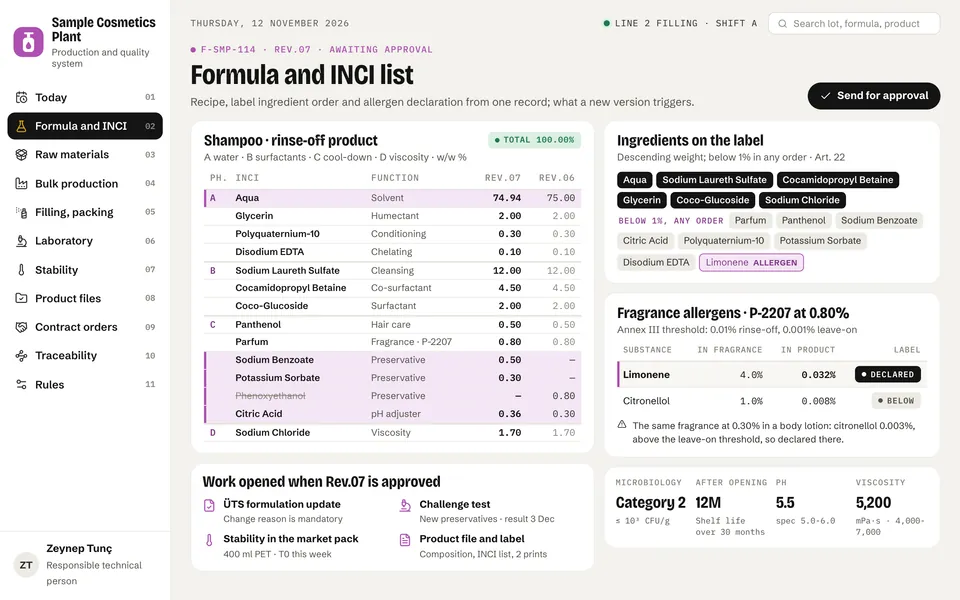
Cosmetics formula screen: shampoo phases, INCI names and percentages, version differences, the label ingredient list, fragrance allergen calculation and the work a new version triggers
Demo on request We walk you through the formula, filling line, traceability, stability and contract order screens with sample data in a meeting.
Regulation as rules Label and product file requirements of the Turkish Cosmetic Products Regulation, Annex III allergen thresholds and prepackage tolerances come built in as rule tables.
Your ERP untouched Logo, Mikro, Netsis or SAP stays; accounting and e-documents continue there, and the integration route is agreed in writing during discovery.
Scope set in discovery It starts with formulas and raw material lots and grows module by module; not every plant needs every module.

This page is a branch of Chemicals and Chemical Production software; the wider picture and the other branches are there.

Does this sound familiar?

In cosmetics, risk hides less in the tank than in the formula version and the missing page of the product file.

If even one of these sentences describes your plant, this page was written for you. For paint and general chemical production, see our chemicals software page.

  • The formula lives in an R&D spreadsheet; the INCI list and label ingredient order are typed by hand, and when the fragrance changes the allergen declaration on the label can stay out of date.
  • When a preservative or surfactant changes, which of the ÜTS formulation, product information file, safety report, stability study and label print needs renewing lives in one person's memory.
  • Every brand owner you make products for asks for a GMP statement, method of manufacture, certificate of analysis and stability report; the documents sit in email attachments and nobody is sure which is current.
  • A raw material lot can leave quarantine before its result is in; when a batch arrives with the microbiology field blank on its certificate and goes into production, nobody notices.
  • After a complaint, getting from the filling lot to the bulk batch, then to the raw material lot and every other product that used it takes hours; the recall list is built by hand.
  • The checkweigher measures, but the result is not tied to the filling lot; the set point is raised because one nozzle fills low, and overfill quietly costs money every day.
  • Bottle, cap, pump and label lots are not written against the finished product lot; when caps leak, nobody can say which packaging batch was used.
  • Stability pull dates sit in a diary; once a pull is missed, the justification for the period after opening and the shelf life gets weaker.
  • Retained samples are on a shelf, but their location and disposal date are unclear; finding the right sample after a complaint takes half a day.
  • For detergents and cleaning products, the CLP label, the percentage bands on the detergent label and the ingredient data sheet are updated separately each time the formula changes; for disinfectants, stock made while waiting for authorisation is set aside by hand.
The software landscape today

Which software do cosmetics and cleaning product makers use today, and where does it fall short?

In Turkey we could not find an end-to-end local business system built for cosmetics and cleaning product makers whose screens and scope are openly presented. Plants usually run an ERP, public systems and spreadsheets side by side; abroad there are cosmetics-focused process ERPs and formulation software.

LayerSoftware in use todayThe gap it leaves
General ERP and accounting (horizontal backbone) Logo (Netsis 3 Enterprise, Tiger 3 Enterprise, Edge WMS), Mikro, Canias ERP, ETA, SAP, Microsoft Dynamics 365 Solid for accounts, stock, purchasing, invoicing and e-documents, and should stay. Logo's chemicals sector page lists FIFO, FEFO, lot and expiry tracking in the warehouse; cosmetics, detergents or cleaning products are not named separately. The INCI list, product information file and ÜTS data do not appear as standard items in the material we reviewed.
Cosmetics-focused process ERPs (abroad) Deacom ERP (ECI Software Solutions), BatchMaster Their own pages highlight formula versions, two-way lot traceability, quality checkpoints that cannot be bypassed, INCI ingredient reports and certificates of analysis; BatchMaster links several fill sizes to one formula. In Turkey, ÜTS notification, Turkish labelling rules, e-documents and local accounting need a local layer or integration.
Formulation and regulatory software (PLM) Coptis PLM Dedicated to cosmetics; offers formulation, global regulatory compliance and an ingredient database. Its page focuses on R&D; raw material lots, the filling line and contract order tracking are not mentioned there.
SDS and label software (cleaning products) Lisam ExESS, Telematic EPY X Produce safety data sheets and CLP-type labels; more on our chemicals software page. Matching the percentage bands on the detergent label and the ingredient data sheet to the formula version is separate work that has to be set up.
Public and EU notification systems ÜTS (TİTCK Product Tracking System), EBS (TİTCK Electronic Application System), CPNP (European Commission) Cosmetic product notification is made in ÜTS, authorisation of biocides that touch the human body in EBS, and EU notification in CPNP; transactions run on e-signature. The production system's job is to keep the formulation, barcode, label and document data for those screens ready and consistent.
Filling machine and checkweigher software Software and statistics screens from filling machine, checkweigher and scale makers Measures weight accurately and runs the line. Unless the result is linked to the filling lot, the packaging material lot and the cost of overfill, it stays on the device screen.
Spreadsheets, email and paper Formula file, INCI list, stability calendar, batch record form, document folders sent to brand owners Flexible but tied to individuals; no versions, approvals or history. Tracing back after a complaint and assembling the product information file take days.

Product names are compiled from vendors' public pages (September 2026); PAN is not affiliated with them. The "gap" column summarises situations we commonly meet in discovery and is not a statement about any specific product.

Our approach

A layer that records the work between your ERP and the filling line, and builds the product file from those records.

We do not bring you a new accounting program. We build the chain from formula to raw material lot, from bulk to filling lot, from stability to product information file, and connect it to your existing ERP and line. The system does the maths and the reminders; R&D owns the formula, and the responsible technical person and management make the decisions.

INCI formulas and the version chain

The formula is kept phase by phase with INCI name, CAS number, function and percentage. The label ingredient list builds itself in descending weight; from the fragrance supplier's allergen declaration, the system works out which substances must be declared under the rinse-off and leave-on thresholds. When a version changes, the ÜTS, stability, product file and label tasks open.

From raw material intake to bulk

A raw material lot comes in with its certificate of analysis, expiry or retest date and quarantine status; it cannot be allocated to production before its result is in. Weighing and bulk production steps are recorded with the lot, and FEFO order comes from the system.

Net content and overfill on filling

Checkweigher data is tied to the filling lot. The tolerable negative error under the prepackage rules, the batch mean and the deviation by nozzle sit on one screen, with the daily litres and lira of overfill. Bottle, cap and label lots are written against the finished product lot.

The product file comes from records

Composition, stability, microbiology, packaging and use data that feed the safety report headings are already in the system, so the file is not gathered piece by piece. Missing sections, reports waiting with the assessor and data due for ÜTS show on one list.

Lot trace and recall list

Back from a complaint to the filling lot, bulk batch and raw material lot; forward to every product that used the same lot, units in stock and already shipped, and the brand owner, on one screen. Lots in stock are locked for shipping in one step.

Document flow with brand owners

For every brand owner's product, formula approval, stability, product file, ÜTS status, barcode and packaging material are tracked on one line. The GMP statement, method of manufacture and certificate of analysis go to the brand owner as a pack; whatever is missing holds filling.

Modules we can build

Modules we can build for a cosmetics and cleaning products plant

You do not need them all at once. Most plants start with formulas and raw material lots and grow into filling and the product file. On request, we walk you through most of these modules in a demo.

FILLING

Filling, packaging and net content

Filling lots, packaging material lots, checkweigher data, tolerable negative error, nozzle drift, overfill cost, and lot and period-after-opening printing.

What it looks like on screen

What cosmetics manufacturing software looks like on screen

These screens come from the demo design we prepared for cosmetics and cleaning product plants and contract manufacturers. Figures and names are sample data; the system is set up around your own formulas, lines and existing ERP.

Formula and INCI. The formula is kept phase by phase with INCI names; the label ingredient order and fragrance allergen declaration are calculated from the same record. When a preservative changes, the ÜTS update, challenge test, stability study and product file tasks open automatically.
Filling line. Every station from bulk tank to case is tracked together with bottle, cap and label lots. Checkweigher data is assessed against the prepackage rules; a drifting nozzle and the daily litres and lira of overfill are visible.
Traceability. Back from a complaint to the filling lot, bulk batch and raw material lot, and forward to every product and brand owner that received the same lot, on one screen. Retained sample results and the shipping lock sit on the same record.
Stability calendar. Accelerated and real-time pull points for every formula and pack pair in one calendar. A result drifting toward its limit shows before the next pull, and the challenge test and the period-after-opening justification attach to the same record.
Contract orders and files. At a contract manufacturer, formula, stability, product information file, ÜTS notification and packaging are tracked on one line for every brand owner’s product. Cleaning products need the CLP label and ingredient data sheet, disinfectants an authorisation; anything missing locks filling and shipping.

Company names, people and figures on these screens are sample data. The system is built around your own processes, document names and rules. We walk you through the demo in a call: request a demo

Integration with your existing ERP

Your ERP, e-document program and line automation all stay in place

Most plants already have an ERP running accounts and e-documents, the filling machine's and checkweigher's own software, and TİTCK's ÜTS screens. What is missing is the work in between: formula versions, raw material lots, bulk and filling records, stability, the product file and the documents that go to brand owners. We write that layer and set up data exchange with your existing systems. ÜTS and EBS transactions are still made on the agency's screens with an e-signature; the system keeps the data for them ready and consistent. For SDS, KKDİK tonnage and ADR, the approach on our chemicals software page applies.

Our integration approach →
  • Accounts, stock, purchasing, delivery note and invoice transfer with Logo, Mikro, Netsis, Canias, SAP or whichever ERP you use; the same information is not keyed twice.
  • Reading data from checkweighers, scales and line counters; agreed during discovery depending on device model and output, without touching machine control.
  • Preparing the formulation, barcode, label and pack image data for the ÜTS notification; the application and e-signature stay with the responsible person.
  • Taking safety data sheet and CLP label data from your existing SDS and label software (for example Lisam ExESS) through the export or interface it offers.
  • A phone-readable summary for management and brand owners: units filled today, documents pending, locked lots and upcoming stability pulls.
Outcomes

What changes in the plant once the chain of records is in place?

  • The label ingredient list and allergen declaration are calculated from the formula; typing errors disappear.
  • When the formula version changes, every task to renew opens; ÜTS, the product file and the label do not stay on the old version.
  • A raw material lot without its result cannot enter production.
  • After a complaint the lot chain opens in minutes; the recall list and the lock on stock are ready.
  • The lira cost of overfill is visible every day; a drifting nozzle is not hidden behind a higher set point.
  • Packaging material lots are tied to finished product lots, so cap and bottle complaints can be traced.
  • Stability pulls are not missed; the period after opening is backed by records.
  • The product information file is not gathered piece by piece; missing sections show from the start.
  • The document pack for a brand owner is prepared in one click; nobody argues about which document is current.
  • For cleaning products the CLP label, detergent label and ingredient data sheet update with the formula; a disinfectant without authorisation cannot ship.
Process

A realistic five-stage path that begins with discovery.

  1. 01

    First meeting and demo

    1 week

    We listen to your product groups (cosmetics, detergents, disinfectants), whether you make for brand owners or under your own brand, how many lines you run and which ERP you use. We walk through the demo together and discuss which screen matches your work.

  2. 02

    Discovery at the plant

    1-2 weeks

    We follow the flow from raw material intake to filling and dispatch on site. We collect your formula files, labels, batch record forms, stability calendar and the document set you send to brand owners, and keep your field names as they are.

  3. 03

    Scope and written proposal

    1 week

    We set out in writing which module comes first, which devices data is read from, the ERP transfer points, timeline and budget. The first phase is often formulas, raw material lots and traceability.

  4. 04

    Development and pilot line

    By scope

    We deliver modules in order and test them on one line with real formulas and real filling lots. The responsible technical person, lab staff and line lead use the screens at every delivery, and we take corrections from the floor.

  5. 05

    Go-live and support

    Ongoing

    After training, data transfer and go-live, support continues. When regulation changes the rule tables are updated; when a new product group, line or brand owner arrives, the system grows with you.

Why Pan Innovation House?

A team that speaks the language of formulas, lots and product files, and builds the chain on site.

You see the screens first

Demonstration, not promises: on request we walk you through the formula, filling line, traceability, stability and contract order screens in a meeting. Your system is built from this core with your own rules.

We use your plant's terms

INCI, phase, bulk, filling lot, retained sample, challenge test, period after opening and product information file appear on screen under the names you already use; staff do not have to learn a new language.

Regulation becomes rules

Label and file requirements of the Cosmetic Products Regulation, Annex III allergen thresholds, prepackage tolerances and detergent label bands are entered as rule tables; when regulation changes, the table is updated, not the software.

What works stays in place

Accounting, ERP, e-documents, the filling machine and the checkweigher stay. We build the production and compliance layer beside them; there is nothing you are forced to replace.

Based in Gaziantep, we come on site

We are based in Gaziantep with an office in London. According to 2018 data from the TOBB industry database, Gaziantep ranks second after Istanbul by number of cleaning product plants and fourth in cosmetics. We travel to plants anywhere in Turkey for discovery.

Your data, your code

You choose the server; your formulas, your data and the code written for you are yours. Formula percentages are open only to R&D and authorised people through role-based access.

Frequently asked questions

Cosmetics and Cleaning Products Manufacturing software: common questions

What is the product information file, and how long is it kept?

Under Article 14 of the Turkish Cosmetic Products Regulation (Official Gazette 08.05.2023, No. 32184 repeat), the responsible person keeps the product information file for ten years after the last batch is placed on the market. It contains the product description, the safety report, the method of manufacture and a statement of compliance with good manufacturing practice, proof of claimed effects and animal testing data; it is prepared in Turkish or English and kept ready for the agency at the address on the label.

Which headings does the cosmetic product safety report cover?

Under Annex I/B of the regulation, Part A has ten headings: quantitative and qualitative composition, physical and chemical characteristics and stability, microbiological quality, impurities and packaging material, normal use, exposure to the product, exposure to substances, toxicological profile, undesirable effects and other information. Part B holds the assessment conclusion, label warnings and reasoning. The system prepares most Part A data from production and laboratory records; the qualified safety assessor carries out the assessment.

How is a cosmetic product notified in ÜTS?

According to TİTCK's electronic procedures guideline, ÜTS is the national database for cosmetic product notifications and transactions are completed with an e-signature. Notification has three stages: add the formulation, add the product, then create the application. Barcodes must follow GS1 and differ for each product; if the formula changes in an update, a reason for the change is mandatory. Our system prepares the data for these screens; the application is signed by the responsible person.

How is the INCI list ordered on the label?

Under Article 22 of the regulation, ingredients are listed in descending order of weight at the time they are added; those below 1% may follow in any order after those above 1%. Perfume and aromatic compositions are listed as “parfum” or “aroma”, and ingredients present as nanomaterials are followed by “(nano)”. Because the formula is kept with INCI names, the list builds itself.

When must fragrance allergens be declared on the label?

Fragrance substances with an entry in the “other” column of Annex III (for example limonene and citronellol) are listed separately when they exceed 0.001% in leave-on products or 0.01% in rinse-off products (Annex III as updated by the Official Gazette of 05.03.2024, No. 32480). The figure is the fragrance level in the product multiplied by the level in the supplier's allergen declaration. The same fragrance can stay below the threshold in a shampoo and exceed it in a body lotion; the system calculates this per product.

Who is the responsible person in contract manufacturing?

The regulation defines the manufacturer as the person who makes the product, or has it designed or made and places it on the market under their own name or brand; for products made in Turkey the responsible person is the manufacturer. So the brand owner keeps the product file and makes the ÜTS notification; since the 2024 amendment, the manufacturer can also appoint another person as responsible person by written mandate. The contract manufacturer supplies the method of manufacture, GMP statement, batch records, analyses and stability data; the system tracks this flow per brand owner.

Is ISO 22716 certification mandatory?

Article 11 of the regulation requires cosmetic manufacturing to comply with good manufacturing practice, which is presumed when manufacturing follows the relevant harmonised standard. The standard here is EN ISO 22716:2007. According to TİTCK's guideline, the compliance statement in the product file is verified through internal audit or by an expert service provider checking ISO 22716 conformity. The system keeps the evidence behind that statement through batch, cleaning, calibration and deviation records.

When is the period after opening shown instead of a date?

The date of minimum durability goes on the label; for products whose durability exceeds thirty months a date is not required, and instead the period after opening in which the product can be used safely is shown in months with the symbol. TİTCK's safety assessment guideline asks for this period to be justified and for stability to be tested in the packaging used on the market; the stability calendar backs that justification with records.

What are the microbiological limits for cosmetic products?

In TİTCK's microbiological control guideline, products for children under three, the eye area, mucous membranes and leave-on products are Category 1, with total viable aerobic mesophilic microorganisms not above 10² CFU/g. Other and rinse-off products are Category 2, with a limit of 10³ CFU/g. In both categories S. aureus, P. aeruginosa, C. albicans and E. coli must be absent. The system applies the limit by product category and locks a lot that falls outside it.

Which rule applies to net content on filling?

The Turkish regulation on determining the net quantity of prepackages by weight and volume (Official Gazette 04.06.2015, No. 29376) requires the batch mean not to fall below the nominal quantity; the tolerable negative error is 3% for 300-500 ml and 15 ml for 500-1,000 ml. A pack short by more than twice this tolerance cannot carry the ℮ mark or be placed on the market, and volume is assessed at 20 °C. The system ties checkweigher data to the filling lot and shows overfill too.

What must a detergent or cleaning product label show?

Under the Turkish Detergents Regulation (Official Gazette 27.01.2018, No. 30314), the pack shows the product name, the party responsible for placing it on the market, and the address and phone number where the ingredient data sheet can be obtained. Ingredient classes above 0.2% by weight are given in the bands below 5%, 5-15%, 15-30% and 30% or more; enzymes, disinfectants, optical brighteners and perfumes are listed regardless of level. CLP-type labelling rules also apply, while finished cosmetics fall outside them.

We make disinfectants; how does authorisation show in the system?

Under the Turkish Biocidal Products Regulation, a biocidal product cannot be placed on the market without authorisation or registration. Biocides in direct contact with the human body (Product Type 1 and Product Type 19) fall under TİTCK, and applications are made through EBS. The system locks filling and shipping of a formula without authorisation and tracks batches made with the authorised formula separately.

Do we need to replace our ERP?

No. Accounting, customer accounts, e-invoices and e-delivery notes stay in your current system. Stock movements, purchasing and delivery notes are transferred through routes the ERP vendor supports (API, service layer or approved import); we do not write directly into the ERP database. The connection route depends on version and licence and is agreed in writing during discovery.

How is this different from your chemicals software page?

The chemicals page covers recipes, batches, the laboratory, SDS, KKDİK tonnage and ADR shipping for paint, adhesive and industrial chemical makers. This page focuses on what is specific to cosmetics and cleaning products: INCI, the product information file, ÜTS notification, stability, net content on filling, detergent labels, biocide authorisation and the brand owner flow in contract manufacturing. In a plant that does both, the same chain of records carries both branches.

Next step

Let's walk through the demo, then visit your plant

A plant's system cannot be written from a distance. Let's go through the screens together first; then we will see your raw material store, laboratory and filling line on site and propose the first phase in writing. Your ERP and line automation stay in place.

Related services

Related areas worth considering

Pan Innovation House

Call us

By phone

+90 543 930 12 72

Our phone line is open every day.

WhatsApp on your phone

Scan with your phone camera. The chat opens with your message ready.

Prefer that we call you? Leave your details