Pan Innovation House Pan Innovation House
INDUSTRY SOFTWARE · SUPERMARKET AND RETAIL CHAINS

Retail software that keeps a chain's books from the shelf label to the shrink, from every store back to the DC

Pan Enterprise Solutions, the software arm of Pan Innovation House · based in Gaziantep, Türkiye, with a London office

We bring store order suggestions, dispatch from the distribution centre, price changes and shelf labels, the real impact of promotions, and freshness and shrink by department into one chain of records. Your till software, your fiscal cash registers and Logo, Mikro, Netsis or whichever accounting package you use stay where they are; chain management is built alongside them. For a single-store grocer, deli, butcher or greengrocer we have a separate ready-made system.

Asking about price? We listen to the scope in a short call and share the budget frame and timeline in writing. The first 30-minute call is free; the scope of an on-site discovery, and its fee if any, is agreed in writing during that call.

We work on site for plants in and around Gaziantep; elsewhere in Türkiye and abroad, discovery starts by video call and a visit is planned if needed. Our London office is at Unit 6 Cranford Way, Hornsey, London N8 9DG.

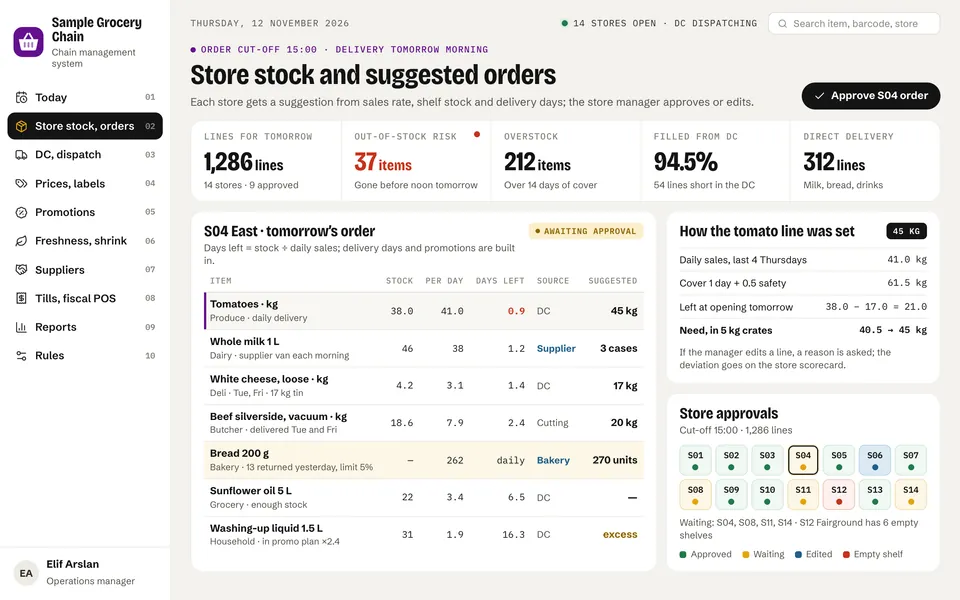
Supermarket chain store ordering screen: out-of-stock risk, stock, daily sales, days of cover and suggested order per item for one store, the calculation and approval status of 14 stores
Every store, its own order Tomorrow's order comes from that store's own sales rate, shelf stock and delivery days; the calculation is open and the store manager approves it.
Label and till at the same hour A price changed at head office reaches paper labels, electronic labels, scales and tills from the same list, so shelf and till never disagree.
Shrink by department Shrink in produce, bakery, deli, butcher and dairy is measured store by store; items near their use-by date go to markdown in time.
Demo on request We walk you through the ordering, dispatch, pricing and labels, promotion and shrink screens with sample data in a call.
Does this sound familiar?

In a supermarket chain, margin is lost not at the till but between the shelf, the label and the shrink.

A regional chain runs thousands of lines, several fresh counters and stores that each work a little differently, all at once. With thin margins, a small leak becomes a visible gap by the end of the month. If even one of the points below sounds familiar, this page was written for you.

  • Store orders depend on each manager's experience; one store has an empty shelf while another sits on the same item for weeks, and transfers are worked out by hand.
  • Goods from the DC, meat cut centrally and supplier deliveries straight to the store live on separate lists; milk and bread orders show up in nobody's report.
  • Chilled goods do not arrive before the store opens; which truck will be overloaded or which store will miss its delivery window only becomes clear once loading has started.
  • Prices change at head office but labels go up late in the stores; when shelf and till disagree the lower price applies to the customer and the loss lands in nobody's books.
  • For loose cheese, olives and meat, the scale price and the unit price on the shelf are updated separately; when one is forgotten the customer sees two prices.
  • A discount label is printed for an item just out of a promotion, overlooking that the reference price is the lowest price of the last ten days.
  • The sales a promotion brings in are visible; the margin given away, the items it pushed off the shelf and the dip in the following week are not.
  • When supplier funding, leaflet fees and turnover rebates are not clearly written into the contract, they either go uncollected or turn into disputes.
  • Shrink in produce, deli, butcher and bakery is not measured by store and department, and people assume fresh shrink can be passed back to suppliers.
  • The till system holds sales and stock, but store order suggestions, dispatch waves, label rules, promotion analysis and shrink live in a few people's spreadsheets.
The software landscape today

What software do supermarket chains use today, and where does it get stuck?

Türkiye has till and retail software for supermarkets, general accounting packages, new-generation fiscal cash registers, electronic shelf labels and label-printing scales, and most of them do their own job well. Chains usually run several side by side, and the rules in between are joined up in Excel. The product names below were read on the makers' own pages, and the cash registers on the Revenue Administration's list of approved devices; features are limited to what those pages say.

LayerSoftware in use todayThe gap it leaves
Supermarket and retail software Logo Diva RETAIL and Logo Diva SHOP, Mikro Market Programı, AKINSOFT WOLVOX Süpermarket Yönetimi, LS Central Tills, barcode sales, stock, promotion set-up and store management are what these products do. Store-level order formulas, dispatch waves, label rules and department shrink differ from chain to chain, so in most places they bend only as far as the product's own set-up allows.
General ERP and accounting (the horizontal backbone) Logo, Mikro, Netsis, DİA, ETA Solid for accounts, invoicing, e-documents and the general ledger, and they should stay. Store ordering, fresh counters and promotion analysis are not their main ground.
New-generation fiscal registers and payments Approved new-generation fiscal registers (e.g. Hugin, Beko, Profilo, Ingenico), bank card terminals, e-invoice and e-archive integrators Mandatory and fixed. The software's job is to close till sales, cards, meal cards and e-archive payments into one end-of-day reconciliation.
Electronic shelf labels Vusion, Hanshow, Pricer, SOLUM They put a price on the shelf in seconds. Which price goes to the label, from which date and under which discount rule still depends on the price record at head office.
Label-printing scales Bizerba, Dibal They weigh and label at the deli, butcher and produce counters. Updating the item and price list on the scales at the same time as the shelf labels needs its own link.
Excel, WhatsApp and notebooks Order lists, price change sheets, promotion files, shrink logbooks Flexible but tied to individuals, with no versions, approvals or history. When a buyer or a store manager leaves, the rules leave with them.

Product names are compiled from vendors' public pages (September 2026); PAN is not affiliated with them. The "gap" column summarises situations we commonly meet in discovery and is not a statement about any specific product.

Our approach

A chain layer that picks up where the till and the accounts stop and runs out to every store.

We do not bring you a second till system or a second accounting package. We build the chain of records from the store order through dispatch, pricing and labels, promotions and shrink, and connect it to your till software, your scales and your accounting package. The system does the arithmetic; you make the ordering, pricing and promotion decisions.

Store-level order suggestions

Tomorrow's order is suggested from each store's sales rate, shelf and back-room stock, delivery days and safety stock. Promotions and special days are added, excess stock is offered as a transfer to another store, and the manager approves or edits with a reason.

DC to store dispatch

Approved orders are split into chilled and dry waves, trucks and docks. Truck load, store delivery windows and temperature are visible before loading starts, and direct supplier deliveries sit in the same plan.

Price changes and shelf labels

Price changes are calculated with unit prices; paper labels, electronic labels, scales and tills all feed from the same list. The reference price rule is checked on discount labels, and shelf-to-till differences are caught by scanning.

The real impact of promotions

Extra sales, margin given away, supplier funding, items pushed off the shelf and the post-promotion dip are calculated item by item. The next promotion is planned on those results.

Freshness and shrink

Shrink is logged by store and department with a reason code. Items nearing their use-by date are counted day by day and markdown labels go out in time; an item past its date is blocked from sale.

Links to tills, scales and accounts

Sales and stock are read from the till software and prices and item records are written back; item and price lists go to the scales. Invoices, supplier accounts and stock movements flow into your accounting package.

Modules we can build

Modules we can build for supermarket chains

You do not need all of them at once. Most chains start with store ordering and pricing and labels, then grow into dispatch, promotions and shrink. On request we walk through most of these modules together in the demo.

PROMOTIONS

Promotion planning and impact

Weekly offers, multi-buys and loyalty card promotions, poster dates, extra sales, margin, cannibalisation and post-promotion dip analysis.

FRESHNESS

Freshness, shrink and use-by dates

Shrink by department and store, reason codes, use-by horizon, markdown labels, disposal records, cutting loss at the butcher counter.

ERP

Accounting and e-document integration

Exchange of supplier accounts, stock, invoices and supplier movements with Logo, Mikro, Netsis and other packages; the connection route is settled during discovery according to version and licence.

What it looks like on screen

What retail chain software looks like on screen

These screens come from the demo we built for supermarket chains. The figures are sample data; the system is set up around your own stores, departments, pricing and promotion rules.

Store stock and orders. Tomorrow’s order for each store comes from its own sales rate, shelf stock and delivery days. Lines from the DC, the cutting room or direct suppliers are kept apart; the calculation is open and the manager approves it.
DC and dispatch. Store-approved orders are split into chilled and dry waves, trucks and docks. An overloaded truck or a store that will miss its delivery window shows up before loading starts.
Prices and labels. Tomorrow’s price changes are calculated with unit prices; paper labels, electronic labels and scales all feed from the same list. A discount that clashes with the lowest price of the last 10 days is stopped before any label is printed.
Promotion impact. Extra sales in the promotion week, gross profit given away item by item, contracted supplier funding and the net effect in one table. Cannibalisation, basket growth and the post-promotion dip are visible too.
Freshness and shrink. Shrink is coloured against target across 14 stores and 6 departments, and lines nearing their use-by date are counted day by day. Fresh shrink cannot be passed back to suppliers, so order sizes and markdown timing are tuned here.

Company names, people and figures on these screens are sample data. The system is built around your own processes, document names and rules. We walk you through the demo in a call: request a demo

Integration with your existing ERP

Your till software, fiscal registers and accounting package stay where they are.

Most chains already have till software that holds sales and stock, approved fiscal cash registers and an accounting package that keeps the invoices. What is missing is the chain flow between them: store ordering, dispatch, pricing and label rules, promotion analysis and shrink. We write that layer and set up the data exchange with your existing systems. Official documents stay in your current set-up; the transfer route is settled during discovery according to the package version and licence.

Our integration approach →
  • Sales, returns and stock movements read from the till software; prices and item records written back.
  • Item and price lists sent to label-printing scales; prices and dates passed to the electronic shelf label system.
  • Supplier accounts, purchase invoices, stock and expenses exchanged with Logo, Mikro, Netsis, DİA, ETA or whichever package you use, so nothing is keyed in twice.
  • Receiving, stock counts and shelf label scans in store with handheld terminals; the device model is settled during discovery.
  • A daily summary management can read on a phone: store sales, approved orders, dispatch, price changes and shrink.
Outcomes

What changes in the chain once this layer is in place?

  • Each store's order comes from its own sales rate; empty shelves and overstock are spotted the same day.
  • DC, central cutting and direct supplier deliveries are visible in one plan.
  • An overloaded truck or a store that will miss its delivery window is known before loading starts.
  • Price changes reach labels, scales and tills at the same hour; shelf-to-till differences are caught by scanning.
  • A discount label that breaks the rules is stopped before printing, and poster dates are never left off.
  • Extra sales, margin given away and supplier funding are visible item by item for every promotion.
  • Supplier funding and fee lines are tied to the contract, so receivables do not go uncollected.
  • Shrink is measured by store and department; items near their use-by date go to markdown in time.
  • Tills, fiscal registers and accounts stay as they are; the same data is never keyed in twice.
Process

A realistic five-stage path that begins with discovery.

  1. 01

    First call and demo

    1 week

    We listen to how many stores and formats you have, your departments, your DC set-up and the till, scale and accounting packages you use. We walk through the demo together and talk about which screens match your operation.

  2. 02

    Discovery in store and at the DC

    1-2 weeks

    We watch a morning dispatch at the DC and see ordering, label changes and the fresh counters in two stores. We collect your ordering rules, pricing and promotion processes and shrink records, and keep your own field names.

  3. 03

    Scope, priorities and budget

    1 week

    We present in writing the module order, starting where it hurts most, along with integration routes, timing and budget. The first phase is usually store ordering together with pricing and labels.

  4. 04

    Development and pilot

    6-10 weeks

    We deliver the modules in sequence and try them first in two pilot stores. Store managers, department leads, the DC and head office use the screens at every delivery, and we take corrections from the floor.

  5. 05

    Go-live and maintenance

    Ongoing

    Training, data migration and roll-out to every store are followed by maintenance and support. When a new store, department, warehouse or promotion type arrives, the system grows with you.

Why Pan Innovation House?

A team that speaks the supermarket's language and builds the chain flow in store.

You see the screens first

Not promises but a demonstration: on request we walk you through the ordering, dispatch, pricing and labels, promotion and shrink screens in a call. Your system is built from that core with your own rules.

We work in supermarket terms

Departments, weekly offers, leaflet fees, turnover rebates, unit prices, scales, use-by dates, shrink and delivery windows appear on screen under the names you already use; nobody has to learn a new vocabulary.

Regulation becomes rules

Required label fields, the reference price rule for discounts, promotion dates and the fresh shrink rule are entered as rule tables; when the regulation changes, the table is updated and the software is not rewritten.

Tills and accounts stay in place

We do not rip out working till software, fiscal registers or accounting packages; we close the gap between them. That keeps migration risk low and brings the first benefits early.

Based in Gaziantep, we come on site

We are headquartered in Gaziantep with an office in London. We travel to chains anywhere in Türkiye for discovery and run the pilot in the store.

Your data, your code

You choose the server; your data and the code written for you are yours. The system keeps running even if the maintenance contract ends.

Frequently asked questions

Supermarket and Retail Chains software: common questions

What is supermarket chain software?

It is business software that keeps store ordering, dispatch from the distribution centre, prices and labels, promotions, and freshness and shrink for a multi-store supermarket in one set of records. The till software holds sales and the accounting package holds invoices; chain software follows the path goods take from supplier to shelf and prices take from head office to label.

We have a single store. Is this too much for us?

If you run a single grocery, convenience store, deli, butcher or greengrocer, the ready-made set-up for these trades in our ready-made system (in Turkish) is the better fit: barcode sales at the till, a credit book and stock that drops with each sale come ready; its till screen does not replace a fiscal cash register. The system on this page is built module by module for chains with several stores, a DC and their own ordering, pricing, promotion and shrink rules.

Do we have to replace our till software and fiscal registers?

No. Your till software and approved new-generation fiscal cash registers stay; sales and stock are read from them and prices and item records are written back. New-generation registers come in two types: EFT-POS models with a bank card terminal built in, and computer-connected models that link to an external terminal. Tax Procedure Law General Communiqué No. 593 (May 2026) also opened the way for e-documents to be issued from these devices; the approved makes and models are announced on the Revenue Administration's fiscal register site.

What must a shelf label show in Türkiye?

Under the Price Label Regulation, a label shows where the goods were made, their distinguishing feature, the sale price including all taxes, the unit price and the date those prices apply from; goods made in Türkiye also carry the ministry's domestic production logo. Labels may be written, digital or electronic. For loose goods such as cheese, olives or meat the unit price alone is enough, and if the unit price equals the sale price it need not be shown. The system makes these fields mandatory in the label template.

What happens if the shelf price and the till price differ?

Under Article 10 of the Price Label Regulation and Article 54 of the Consumer Protection Law, the price more favourable to the customer applies. For label breaches in 2026, the administrative fine is TRY 3,973 for each transaction found in breach. That is why the system sends price changes to labels, scales and tills from the same list and catches differences when the shelf is scanned with a handheld terminal.

How is the reference price set on a discount label?

Since the amendment of 11 October 2025, for goods the pre-discount price is the lowest price applied in the ten days before the discount starts. For perishables such as fruit and vegetables, the discount is calculated against the previous price, and the burden of proof is on the seller. Printing a discount label for an item that has just come out of a promotion before ten days have passed is therefore a mistake; the system checks the price history and stops the label before it is printed.

What should we watch on promotion posters and durations?

The Retail Trade Law prohibits discounts without a stated start and end date; the 2026 fine for breaching this is TRY 90,195, applied five times over for large stores and chain stores. The implementing regulation requires the start and end dates to be clearly readable when a promotion is announced on posters, banners or a website rather than only on the price label. Passing promotion costs to a supplier that did not want to take part is also an unfair trading practice; the supplier side is covered in detail on our wholesale distribution page.

Can we return fresh shrink to the supplier?

For agricultural and food products that spoil within thirty days of production, passing post-delivery spoilage or loss costs to the supplier is always an unfair trading practice unless the other party was at fault, and the party passing the cost must prove that fault. The regulation also treats returning these goods after delivery because they did not sell as an unfair practice. For goods whose maximum price is set by tariff, at most five percent of a day's delivery may be returned. So in dairy, deli, meat and produce, shrink is largely the chain's own cost, and order sizes and markdown timing decide how big it gets.

Do we count as a chain store, and does that bring extra duties?

Under the law, a business counts as a chain store with at least five branches of which at least one is a large store of 400 square metres or more, or at least ten branches each under 400 square metres. Large stores and chain stores set aside shelf space equal to at least one percent of their sales area for local products made in the province; on private-label goods the producer's name appears in the same typeface as the store brand and at least a quarter of its size. Chains selling fast-moving consumer goods with more than two hundred branches transfer their product and branch data to the ministry's system.

How are scales and tare handled for loose goods?

A provision added to the Price Label Regulation in 2025 requires the weight of the container (tare) to be deducted when the net quantity of loose goods is set; bags, cling film and paper bags that do not affect the unit price are excluded. The periodic inspection interval for weighing instruments is two years, and for those due, applications run from the start of January to the end of February the following year. The system sends items, prices and tare to the scales from head office and tracks inspection dates store by store.

What food registration does a new store need?

Food retail premises register with the Ministry of Agriculture and Forestry under Law No. 5996. The registration certificate is valid for the trade name, person, premises address and activity written on it; if any of these changes, it lapses and a new application is due within three months. Each new store therefore opens with its own certificate. The law requires traceability at every stage including distribution, and offering goods past their use-by date for sale is grounds for an administrative fine and seizure.

How is the produce traceability tag shown in the produce department?

Under the communiqué on fruit and vegetable tags, goods sold in a crate or package carry the label-format tag on the package; for goods taken out of their packaging and sold loose, the barcoded tag is placed at the point of sale separately from the price label, where customers can easily see it, and may not be covered. The system links the tag number to the batch at DC receiving and prints it separately on the department label sent to the store.

Do we have to replace our accounting package?

No. Accounting, customer accounts, e-invoices and e-archive invoices stay in your current package and with your integrator. Purchase invoices, supplier accounts, stock and expense movements are passed to it; the connection route is settled during discovery according to the package version and licence.

How long does implementation take and how is the budget set?

After discovery we give a written timeline and budget by module order. In most chains the first phase reaches a pilot store within a few weeks; full scope including the pilot usually takes two to three months. The budget depends on the number of modules, stores and tills, and the integration routes.

Can we see a demo, and where will our data live?

Yes. On request we walk you through the ordering, dispatch, pricing and labels, promotion and shrink screens with sample data in a call; we do not publish the demo openly. The system runs on the server or cloud account you choose; your data and the code written for you are yours. Separate permission roles are set up for store managers, department leads, the DC, purchasing and management.

Next step

Let us walk through the demo, then visit your stores

A chain's ordering and label set-up cannot be designed from a distance. First we walk through the screens together; then we see a morning dispatch at your DC and a day in one of your stores, and propose the first phase in writing. Your till software and accounting package stay where they are.

Related services

Related areas worth considering

Pan Innovation House

Call us

By phone

+90 543 930 12 72

Our phone line is open every day.

WhatsApp on your phone

Scan with your phone camera. The chat opens with your message ready.

Prefer that we call you? Leave your details