Pan Innovation House Pan Innovation House
INDUSTRY SOFTWARE · HOTELS AND ACCOMMODATION

Your PMS and channel manager stay in place; hotel software that ties housekeeping, maintenance and revenue into one record

Pan Enterprise Solutions, the software arm of Pan Innovation House · based in Gaziantep, Türkiye, with a London office

We do not replace your property management system (PMS) or your channel manager. Alongside them we build a room status board, housekeeping assignment, guest request and fault tracking, stores and minibar, purchasing, staff shifts and a revenue report by channel. Reservations, folios and the identity notification stay in the PMS; we read from it and close the gap between departments. On request we walk through the screens together in a meeting.

Asking about price? We listen to the scope in a short call and share the budget frame and timeline in writing. The first 30-minute call is free; the scope of an on-site discovery, and its fee if any, is agreed in writing during that call.

We work on site for plants in and around Gaziantep; elsewhere in Türkiye and abroad, discovery starts by video call and a visit is planned if needed. Our London office is at Unit 6 Cranford Way, Hornsey, London N8 9DG.

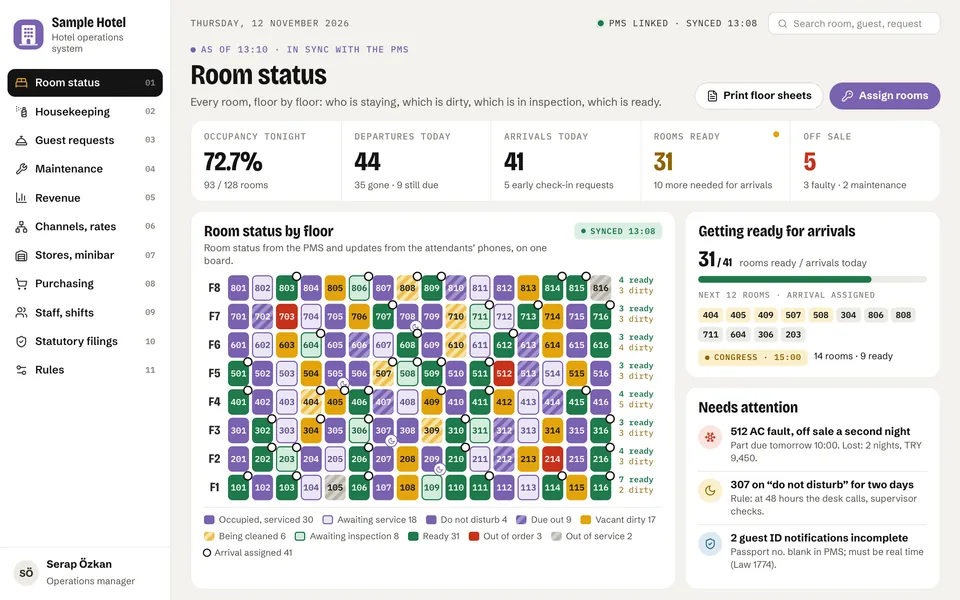
Hotel software room status screen: colour-coded board of 128 rooms on 8 floors, occupancy tonight, arrivals and departures, arrival readiness and items needing attention
PMS stays Reservations, check-in and check-out, folios and the identity notification stay in your current PMS; the layer reads from it and, where possible, writes room status back.
Floor by floor Occupied, dirty, being cleaned, awaiting inspection, ready and out-of-order rooms on one board; the front desk stops asking for ready rooms over the radio.
Rules, not memory The accommodation tax rate, tourism levy, daily data transfer to the Ministry and identity notification checks are held as rule tables.
Demo on request We walk through the room status, housekeeping, guest request, revenue and stores screens with sample data in a meeting.
Does this sound familiar?

In a hotel, money is not lost in reservations but between departments.

Most hotels keep reservations and folios in good order. The trouble starts after the guest reaches the room, when housekeeping, maintenance, stores and the front desk are joined up by radio, phone and WhatsApp groups. If even one of the points below sounds familiar, this page was written for you.

  • Check-in opens at 14:00 and the front desk radios for ready rooms; the housekeeping supervisor checks the list, the room is waiting for inspection and nobody has inspected it. The guest waits in the lobby.
  • Room attendants are given work in the morning by room count. A departure, a stayover and a suite count the same, so one attendant is idle at 14:00 while another is still cleaning at 16:40; the overtime shows up at the end of the month.
  • Guest requests come in by phone, WhatsApp or at the front desk. Who took it, when it was done and whether anyone went back to the guest is not on record; when a complaint arrives, people argue about who was responsible.
  • The same room's air conditioning fails for the third time and the room goes off sale again. The lost nights appear in no report, so the decision to service the whole unit group is put off.
  • The channel report shows gross rates. Nobody notices that the online agency with the highest rate falls below the corporate contract once commission is taken off; pricing is decided on gross figures.
  • Minibar consumption is found after the guest has left and cannot be posted to the folio. Each amount is small, but it happens every day and adds up to a real line by the end of the year.
  • The floor pantry runs out of shampoo or slippers and the attendant goes down to the main store. The purchase request is on paper, quotes are in email, approval is by phone; amenity cost per occupied room is never calculated.
  • The accommodation tax rate changed in 2026; whether food, drink, pool and other services sold with the stay are included in the base, and shown on a separate invoice line, is checked by hand every month.
  • Since April 2026 the Ministry has wanted daily data from the PMS. Nobody checks whether it was sent; a gap comes to light with an official letter.
  • The shift plan lives in Excel. The four-month averaging period for tourism, the night work limit and the rest period between shifts are tracked by hand and get muddled at the start of the season.
The software landscape today

What software do hotels use today, and where does it get stuck?

Hotels in Türkiye almost always have a mature PMS and a channel manager. The product names below were opened and read on the vendors' own pages; features are limited to what those pages show. The gap is not in these products but in the work that flows between departments under each hotel's own rules.

LayerSoftware in use todayThe gap it leaves
Property management system (PMS) Elektraweb Front Office, HotelRunner Hotel Management System, Oracle OPERA Cloud Property Management, Protel Cloud PMS (Planet) The backbone for reservations, room assignment, check-in and check-out, folios, the night audit and room status; it should stay. Some Turkish products also offer stock, purchasing and payroll modules. The hotel's own credit rules, inspection queue and service targets between departments usually sit outside the PMS's standard screens.
Channel manager and booking engine HotelRunner Channel Manager, Elektraweb Channel Management and Online Booking Engine, Reseliva Channel Manager and Booking Engine Keeps rates, availability and reservations in step across online agencies, metasearch and the hotel website. Rate after commission by channel, allotment use and each channel's real contribution are usually worked out in a separate spreadsheet.
Hotel ERP and accounting Elektraweb ERP (accounting, stock, purchasing, fixed assets, payroll), Logo, Mikro, DİA, ETA Solid for invoices, e-documents, accounts, stock and payroll, and it stays. Floor pantry par levels, amenity cost per occupied room and the minibar-to-folio check are set up differently in every hotel.
Guest experience and messaging Hotech Otello GEM and GuestApp, Elektraweb Guest App and WhatsApp API, HotelRunner Guest Relationship Management Opens contactless check-in, a guest app and a messaging channel. Which department a request goes to, with what target time, and how a repeat fault turns into lost revenue are the hotel's own rules.
Housekeeping, task and maintenance apps International examples: hotelkit (Housekeeping, Facility Management), Flexkeeping (Housekeeping Suite, Maintenance Suite, Guest Service Management) That this area is sold as separate products shows how thinly a PMS usually covers work inside departments. A Turkish interface, local regulation and the link to your PMS need to be looked at separately during discovery.
Radio, WhatsApp groups, Excel and paper Floor sheets, fault log, minibar form, shift rota, purchase request form Fast and flexible but leaves no trail. Who did what and when, how many times a room has failed and which channel really pays only become visible when someone compiles them by hand.
Public systems Police and Gendarmerie identity notification system (KBS), the Ministry of Culture and Tourism central tourism database, Revenue Administration e-document and tax return systems Mandatory and fixed. The hotel software's job is to have the right data ready on time, check that it was sent and catch a missing record during the day rather than at night.

Product names are compiled from vendors' public pages (September 2026); PAN is not affiliated with them. The "gap" column summarises situations we commonly meet in discovery and is not a statement about any specific product.

Our approach

An operations layer built alongside the PMS, joining the departments up.

We do not bring you a second front office system. Reservations and folios stay in the PMS; we bring room status, housekeeping and maintenance work, guest requests, stores and revenue reporting into one record using data read from the PMS. You set the rules; the system does the arithmetic.

Room status board, floor by floor

Every room is a cell: occupied, awaiting service, do not disturb, due out, vacant dirty, being cleaned, awaiting inspection, ready, out of order, out of service. Rooms with an arrival that are not yet clean are marked; the front desk stops radioing for ready rooms and sees the queue on the board.

Credit-based housekeeping

Attendants get work in credits, not room counts: departures, stayovers, suites and deep cleans carry different values, set from the hotel's own time studies. Who will overrun the shift is visible before lunch, the system suggests a reassignment, and the inspection queue puts rooms with arrivals first.

Guest requests with target times

Phone, WhatsApp, the QR form in the room, the front desk or a booking note: every request becomes a record with a department, an owner and a target time. An overrun goes to the manager's phone, and the call back to the guest is recorded at closing.

Maintenance and rooms off sale

Fault log, waiting for parts, preventive maintenance calendar and a list of repeat faults. Every room taken off sale is turned into lost revenue by nights and average daily rate, so a group service decision is made on numbers.

Night audit and net rate by channel

Occupancy, average daily rate, RevPAR and other revenue are ready in the morning. Channels are compared on the rate after commission, not the gross rate, and the on-the-books curve for the next 30 days sits next to last year's.

Stores, floor pantries, minibar and purchasing

Amenities and minibar stock moving from the main store to the floor pantry and into the room are tracked against par. Minibar consumption goes straight to the folio; items running out turn into a purchase request, a quote comparison and an approval.

Modules we can build

Modules we can build for hotels

You do not need all of them at once. Most hotels start with room status and housekeeping, then grow into guest requests and maintenance; the revenue report and stores come later. On request we walk through most of these modules together in the demo.

ROOMS

Room status board

Room status read from the PMS, updates from the attendants' phones, rooms with an arrival assigned, early check-in requests and group blocks on one board, with ready and dirty counts per floor.

HOUSEKEEPING

Housekeeping and inspection

Credit rules, daily assignment, room order on the attendant's phone, inspection queue, deep clean plan, laundry and lost and found.

REQUESTS

Guest requests

Requests from phone, WhatsApp, QR form and the front desk; department, owner, target time, overrun alert and closing note. Repeat complaints show by room and by guest.

FILINGS

Statutory filing monitor

Alerts for guests with an incomplete identity notification, status of the daily data transfer to the Ministry, accommodation tax and tourism levy accruals, certificate and licence expiry dates.

What it looks like on screen

What hotel software looks like on screen

These screens come from the demo we built for hotels. Your PMS and channel manager stay in place; these screens are the layer built alongside them. The figures are sample data; the system is set up around your own floors, room types and rules.

Room status. All eight floors of the hotel on one board: which room is occupied, dirty, being cleaned or awaiting inspection, and which is ready for check-in. The front desk stops asking for ready rooms over the radio; rooms with an arrival that are not yet clean go to the attendants’ phones in order.
Housekeeping. Attendants get work in credits, not room counts: departures, stayovers, suites and deep cleans carry different values. Who will overrun the shift shows up before lunch, the inspection queue puts rooms with arrivals first and the system suggests a reassignment.
Guest requests. Every request by phone, WhatsApp, the QR form in the room or at the front desk becomes a record with a department, an owner and a target time. Faults that keep coming back to the same room, and the nights lost while a room is off sale, show on the same screen.
Revenue and occupancy. The night audit is ready in the morning: occupancy, ADR, RevPAR and other revenue. Channels are compared on the rate after commission, not the gross rate; accommodation tax, tourism levy and the daily data sent to the Ministry are on the same screen.
Stores and minibar. Amenities and minibar stock moving from the main store to the floor pantries and into the rooms are tracked against par, and items running out turn into purchase requests. Minibar consumption goes straight to the guest folio; anything found after check-out is reported as a loss.

Company names, people and figures on these screens are sample data. The system is built around your own processes, document names and rules. We walk you through the demo in a call: request a demo

Integration with your existing ERP

Your PMS and your channel manager stay where they are.

Most hotels already run two solid systems: a PMS that keeps reservations and folios, and a channel manager that distributes rates and availability. What is missing is the work that flows between departments once the guest is in the room: housekeeping, maintenance, requests, stores, minibar and revenue analysis. We write that layer and set up the data exchange with your PMS and accounting package. Reservations, folios, invoices and identity notification stay in your current systems; nothing is typed twice.

Our integration approach →
  • Reading reservations, room status, arrivals and departures and folio data from the PMS; where the PMS offers a suitable interface, writing back the status of rooms that have been cleaned and inspected.
  • Taking channel, rate and commission data from the channel manager or the PMS, and calculating net rate and allotment use by channel.
  • Passing purchasing, stock movements and costs to your accounting package (Logo, Mikro, DİA, ETA or your ERP); the accounting records stay where they are.
  • Identity notification and the Ministry data transfer stay in your PMS; the layer watches their status and shows a missing record to the front desk during the day.
  • Phone screens for attendants, technicians and managers, and guest requests from WhatsApp or the QR form turned into records automatically.
Outcomes

What changes in the hotel once this layer is in place?

  • The front desk sees ready rooms on the board; rooms with an arrival move up the cleaning and inspection queue, and guests wait less in the lobby.
  • Attendants' workloads are balanced by credits; whoever will overrun the shift is visible before lunch, and overtime stops being a month-end surprise.
  • Every guest request has an owner and a target time; overruns show at once, and the record is ready when a complaint comes in.
  • Repeat faults show by room and nights off sale turn into lost revenue; maintenance decisions are made on numbers, not guesses.
  • Channels are compared on the rate after commission; pricing and allotment decisions are no longer based on gross figures.
  • Minibar consumption reaches the folio before the guest leaves; losses found after check-out are reported separately and shrink.
  • Amenities and minibar stock are tracked per occupied room; an item running out in a floor pantry turns into restocking and a purchase request on its own.
  • The accommodation tax rate, tourism levy and daily Ministry data are watched on one screen; a missing notification is caught during the day, not at night.
  • Shift plans are checked against the averaging and night work rules, so the start of the season is less chaotic.
Process

A realistic five-stage path that begins with discovery.

  1. 01

    First call and demo

    1 week

    We listen to your room count and room types, your housekeeping and maintenance teams, and the PMS, channel manager and accounting package you use. We walk through the demo together and discuss which screens match your hotel.

  2. 02

    Discovery at the hotel

    1-2 weeks

    We spend a morning shift with your housekeeping supervisor and a check-in peak with the front desk. We collect your floor sheets, fault log, minibar form and purchasing flow, and settle with your PMS vendor which interface it offers.

  3. 03

    Scope, priorities and budget

    1 week

    We put in writing the module order, starting where it hurts most, the PMS and accounting link routes, the timeline and the budget. The first phase is usually room status and housekeeping.

  4. 04

    Build and pilot

    6-10 weeks

    We deliver modules one by one and try them first on one or two floors with a real shift. Attendants, technicians and the front desk use the screens at every delivery, and we take corrections from the floor.

  5. 05

    Go-live and support

    Ongoing

    After training and go-live, maintenance and support continue. When a new building, a new room type, a change of season or a regulatory update comes along, the rule tables are updated and the system grows with you.

Why Pan Innovation House?

A team that speaks the hotel's language and joins departments up without touching the PMS.

You see the screens first

A demonstration, not a promise: on request we walk through the room status, housekeeping, guest request, revenue and stores screens together. Your system is built from this core with your own rules.

We work in hotel terms

Inspection, credits, deep clean, do not disturb, allotment, release period, folio, night audit and RevPAR appear on screen under the names you use; nobody has to learn a new vocabulary.

Regulation becomes rules

The accommodation tax rate, tourism levy, Ministry data transfer, identity notification checks and shift limits are rule tables; when the law changes the table is updated, not the software.

PMS and accounting stay

We do not rip out working systems; we close the gap between them. The front desk keeps working in the program it knows, and the switch-over risk stays low.

Based in Gaziantep, we come on site

We are based in Gaziantep with an office in London. We travel to hotels anywhere in Türkiye for discovery and run the pilot on site with a real shift.

Your data, your code

You choose the server; your data and the code written for you are yours. The system keeps running even if the support contract ends.

Frequently asked questions

Hotels and Accommodation software: common questions

What is the difference between hotel software and a PMS?

A PMS (property management system) keeps reservations, room assignment, check-in and check-out, folios and the night audit; it is the hotel's backbone. The hotel software on this page does not replace it; it is an operations layer that runs alongside. It brings work between departments, such as housekeeping assignment, guest requests, maintenance, stores, minibar, purchasing and revenue analysis by channel, into one record using data read from the PMS.

Do we need to change our PMS?

No. Reservations, folios, invoices and identity notification stay in your current PMS. The layer reads data from the PMS and, where the PMS offers a suitable interface, writes back the status of rooms that have been cleaned and inspected. Which data is read and by what route depends on the PMS version and the interface its vendor offers, and is settled in writing during discovery.

What is RevPAR, and how is it different from the average daily rate?

The average daily rate (ADR) is room revenue divided by rooms sold; it only counts occupied rooms. RevPAR is room revenue divided by rooms available, which is the same as ADR multiplied by occupancy. A decision that raises the rate but lowers occupancy can push ADR up while RevPAR falls, so the two are watched together. The system works both out every morning from the night audit, by channel and after commission.

How does a housekeeping credit system work?

A credit is a relative value for how long a job takes. A departure carries more credits than a stayover, a suite more than a standard room and a deep clean more than a normal clean; the hotel sets the values from its own time studies. When work is shared out in credits rather than room counts, loads even out and whoever will overrun the shift is visible before lunch.

What is the accommodation tax rate, and how does the system handle it?

Under Article 34 of the Expenditure Taxes Law No. 6802, accommodation tax is 2%; services sold together with the overnight stay, such as food, drink, activities, pool, sports and thermal facilities, are included, the base excludes VAT and the tax is shown separately on the invoice. Presidential Decision No. 11263, published in the Official Gazette on 1 May 2026, applies a 1% rate until 31.12.2026. The return is filed and paid by the evening of the 26th of the following month. The rate sits in the system as a dated rule and the table is updated when it changes.

What does the system do about identity notification (KBS)?

Under Additional Article 1 of the Identity Notification Law No. 1774, accommodation businesses keep their records on computer day by day and notify the police system in real time; Law No. 7565 doubles the fine for a repeat breach in the same year and cancels the operating licence on the fourth. Staff working at the property are also notified within 24 hours. The notification goes from your PMS to the KBS; our layer shows the front desk any record left incomplete or wrong during the day.

What is the requirement to send daily data to the Ministry?

Circular 2026/1 of the Ministry of Culture and Tourism, dated 16.04.2026, set up a central tourism database. Accommodation businesses connect their PMS to the Ministry's system through a web service; those integrated automatically send data daily, and those entering it by hand send it monthly by the 15th. The transfer is made from your PMS; we set up a check that it goes out every day.

What is the tourism levy?

Under Article 6 of Law No. 7183, accommodation businesses pay a tourism levy of 0.5% of net sales and rental income; for types the Ministry promotes, such as winter, thermal, health and rural tourism, the rate is halved. The system accrues the levy from monthly revenue and passes it to your accounting package.

We are a boutique hotel or a guesthouse. Is this too much for us?

Under the Regulation on the Qualifications of Tourism Facilities, boutique hotels have between 10 and 60 rooms and guesthouses (pansiyon) between 3 and 25. In a small guesthouse the PMS and channel manager's own modules are often enough, and we say so plainly during discovery. In a boutique hotel, as details such as turndown service, room service and personal requests multiply, the guest request and housekeeping modules start to pay off. Screens you will not use are not built.

Does it work for resorts and all-inclusive hotels?

Yes. For multi-building and spread-out resorts the room board is laid out by block and villa, and area stores replace floor pantries. Resort-specific rules such as tour operator allotments, release periods and seasonal staff shifts are entered during discovery according to your own contracts.

Are there obligations for our listings on online agencies?

Under the Ministry's Circular 2026/4 of 14.08.2026, platforms and travel agencies may not promote or sell facilities without a Ministry certificate; listings must carry correct facility details, the certificate number above all, and the Ministry has set up a verification service for this. Showing your certificate number and facility type correctly across all channels is managed from your channel manager; the system tracks certificate and licence expiry dates.

Will room attendants use it on their phones?

Yes. Attendants see their own room order, room notes and the minibar form on the phone and mark a room as cleaned, faulty or ready for inspection. Screens are designed with large buttons and little text; on floors with weak signal the record waits on the phone and is sent when the connection returns.

How long does it take, and how is the budget set?

After discovery we give a written timeline and budget by module order. The first phase (room status and housekeeping) goes live in a few weeks at most hotels; full scope including the pilot usually takes two to three months. The budget depends on the number of modules, the PMS and accounting link routes and the number of buildings.

Where will our data be kept?

The system runs on a server or cloud account of your choice; your data and the code written for you are yours. Guest identity data reaches the layer only as far as needed and only for authorised roles; an attendant sees room and task information, not the guest's identity.

Next step

Let us walk through the demo, then visit your hotel

A hotel's operations system cannot be designed from a distance. First we walk through the screens together; then we spend a morning shift with your housekeeping supervisor and a check-in peak with your front desk, and propose the first phase in writing. Your PMS and channel manager stay where they are.

Related services

Related areas worth considering

Pan Innovation House

Call us

By phone

+90 543 930 12 72

Our phone line is open every day.

WhatsApp on your phone

Scan with your phone camera. The chat opens with your message ready.

Prefer that we call you? Leave your details