Pan Innovation House Pan Innovation House
INDUSTRY SOFTWARE · JEWELLERY MANUFACTURING AND WHOLESALE

Jewellery software that keeps the fine gold behind every gram, from the melting pot to the trade account

Pan Enterprise Solutions, the software arm of Pan Innovation House · based in Gaziantep, Türkiye, with a London office

For gold and silver jewellery workshops, factories and wholesalers, we bring the vault, stock by karat, metal loss at casting, bench and polishing, quotes priced in fineness, gold and TRY accounts, orders, repairs and outwork into one chain of records. Logo, Mikro, Netsis or your accounting package stays; the fine gold layer sits beside it. Single-shop retail jewellers are served by a separate ready-made system.

Asking about price? We listen to the scope in a short call and share the budget frame and timeline in writing. The first 30-minute call is free; the scope of an on-site discovery, and its fee if any, is agreed in writing during that call.

We work on site for plants in and around Gaziantep; elsewhere in Türkiye and abroad, discovery starts by video call and a visit is planned if needed. Our London office is at Unit 6 Cranford Way, Hornsey, London N8 9DG.

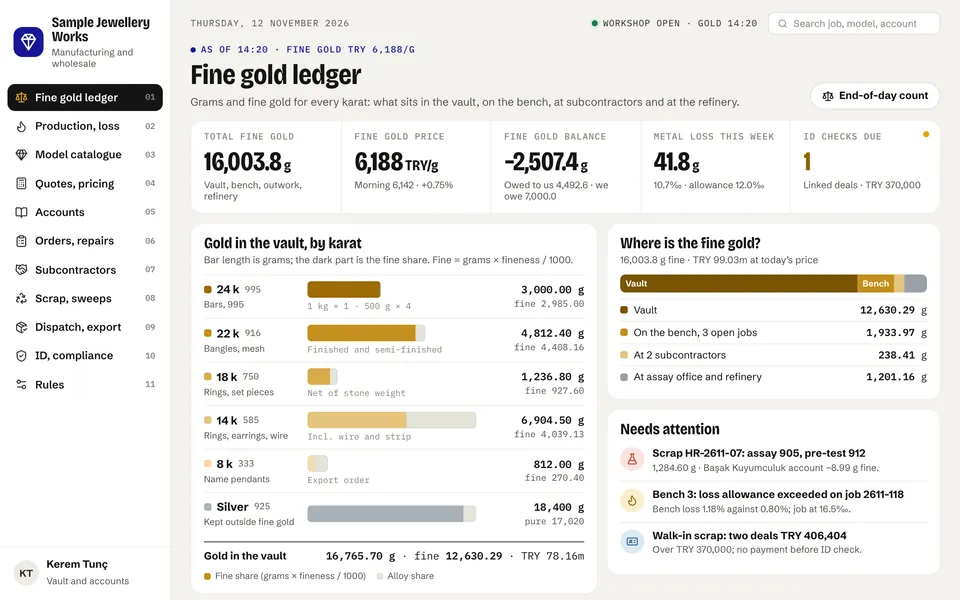
Jewellery software fine gold ledger: grams and fine gold by karat, total fine gold, gold price, account balance in fine gold, weekly metal loss, where the fine gold sits and items needing attention
Grams and fine gold together Every movement is entered with grams, karat and fineness; the fine gold equivalent (grams × fineness / 1000) updates across vault, bench, outwork and accounts at once.
Metal loss by stage Metal is weighed in and out at melting, casting, bench and polishing; sprues and filings go back to the melt, and the loss is checked against the stage and job allowance.
Rules from Turkish law The special VAT base on gold jewellery, the anti-money-laundering ID threshold and year-end valuation of gold balances at exchange price are built in as rule tables.
Demo on request We walk through the fine gold ledger, production and loss, quote, accounts and order screens with sample data in a meeting; scope is set during discovery.
Does this sound familiar?

In jewellery, margin is not lost in the selling price but inside the fineness and the metal loss.

Jewellery manufacturing and wholesale run on grams and parts per thousand; a single per-mille slip becomes real money across a few hundred grams. If even one of these sounds familiar, this page was written for you.

  • The vault, the gram book by karat and each account's fine gold balance live in separate ledgers; the gap between the end-of-day count and the books surfaces at month end.
  • In the accounting package gold is one stock item or a TRY amount; the balance between 14, 18, 22 karat and bars lives in a spreadsheet.
  • Metal loss is worked out with one weighing at the end of the job, so nobody knows whether it happened in melting, casting, at the bench or in polishing.
  • Sprues, tree trunks and filings go back to the melt unweighed, so returned metal and real loss blur together.
  • Sweeps go to the refinery; which period and which bench the returned fine gold belongs to is not on record.
  • Labour in a quote is set from experience; nobody checks whether a model still earns after its real loss and workshop cost.
  • The gold price moves during the day while open quotes keep the morning price, and later nobody can say which quote used which price.
  • On a trade account, sales, scrap, transfers and bar payments convert to fine gold at different fineness and prices; the statement becomes a monthly argument.
  • Gold out for setting, chain making, pressing or plating sits in a notebook; open gold per workshop is not visible at a glance.
  • On jewellery invoices the bullion and labour split is done by hand, and the ID threshold and linked-deal rule depend on staff memory.
The software landscape today

What software do jewellery businesses use today, and where does it fall short?

In this research we could not verify a Turkish product whose own pages present stage-by-stage metal loss and a fine gold balance for jewellery manufacturing. Turkish jeweller programs focus on the till, sales and accounts; jewellery software from abroad stands out in casting and metal loss. Every product name below was checked on the maker's own page, and features are limited to what those pages show.

LayerSoftware in use todayThe gap it leaves
General ERP and accounting (horizontal backbone) Logo, Mikro, Netsis Solid for accounts, stock, invoicing and e-documents, and should stay. By design they need a layer beside them for grams, karat, fineness and the fine gold balance.
Turkish jeweller and bullion dealer programs Hasfiyat, CetaSoft Kuyumcu Programı, Kuyumex (Kuyumsoft) Their pages list live price screens, till, buying and selling, accounts, scrap and coin stock, barcodes, wholesale, e-invoicing and customer ID records. Metal loss through production stages, gold at subcontractors and margin per model are not presented there.
Jewellery manufacturing software from abroad PIRO Fusion (casting management), Uneecops SAP Business One jewellery solution PIRO Fusion presents casting trees, metal issued and returned, and a warning when loss passes the expected rate; the Uneecops solution presents melting, assorting, hallmarking and store transfers. Turkish fine gold accounts and Turkey's VAT and AML rules are not part of these descriptions.
Assay office, refinery and exchange records Assay reports, refinery reports, Borsa İstanbul Precious Metals Market trades through an intermediary These are the basis for karat and fine gold quantity. When a result is copied into the ledger and accounts by hand, the difference between the pre-test and the report gets lost.
Scales, XRF and assay instruments Precision scales, the own software of XRF fineness analysers The measurement is right, but the result stays on the device screen; it is not linked to the job, the scrap lot or the account.
Spreadsheets and notebooks Fine gold book, loss book, outwork book, statement spreadsheet Flexible but tied to one person; no record of gold price, fineness or approvals. The reason for an end-of-day count difference cannot be traced back.
Public systems and documents Revenue Administration e-document systems, the Ministry of Trade jewellery trade information system, financial intelligence unit (MASAK) reports Mandatory and fixed. Jewellery software should feed them correct data: bullion value apart from labour on the invoice, and a flag on any deal that needs an ID check.

Product names are compiled from vendors' public pages (September 2026); PAN is not affiliated with them. The "gap" column summarises situations we commonly meet in discovery and is not a statement about any specific product.

Our approach

Business software that builds the fine gold accounts between your accounting package and your vault.

We do not bring you a second accounting package. We build the chain of records from the vault through production, quotes, accounts and outwork, and connect it to your scales, assay instruments and accounting software. The system does the arithmetic; you set the allowance and the price.

Grams, karat and fine gold in one record

Every movement is recorded with grams, karat and fineness; fine gold is grams × fineness / 1000. The ledger shows fine gold in the vault, on the bench, at subcontractors and at the refinery, and the end-of-day count is compared with the books at once.

Metal loss and sweeps by stage

Grams in and out are weighed at melting, casting, bench and polishing. Sprues, tree trunks and filings return to the melt on record, and loss is checked against the stage and job allowance. Sweeps and the fine gold the refinery returns are tied to bench and period.

Quotes priced in fineness, margin by model

A quote adds labour per gram, in parts per thousand, to the alloy fineness; the fine gold total and its TRY value at today's price appear together. Taking each model's real loss and workshop cost off the labour shows which models earn.

Accounts in fine gold and TRY

A trade customer's fine gold balance and TRY balance run separately. Sales convert at the selling fineness, scrap at its assay result, transfers at that day's price; gold limits and year-end valuation at exchange price sit on the same screen.

Order, repair and outwork cards

A custom order's deposit, design approval and stages; the weight in and out of repairs from retailers; the fine gold and loss allowance on metal sent to subcontractors, all in one card layout.

Invoice, ID and accounting transfer

Jewellery invoices are prepared with bullion value, labour and stones on separate lines. Deals that need an ID check are flagged in advance. Invoices, account and stock movements are transferred to your accounting package, so nothing is typed twice.

Modules we can build

Modules we can build for jewellery manufacturers and wholesalers

You do not need all of them at once. Most businesses start with the fine gold ledger and accounts, then grow into production, loss and quoting. On request, we walk through most of these modules in the demo.

LEDGER

Fine gold ledger and vault count

Grams and fine gold by karat, with bars, finished goods, semi-finished goods and silver kept apart; where the fine gold sits across vault, bench, outwork and refinery; end-of-day count and difference log.

QUOTE

Quotes, pricing and model margin

Selling fineness, prices in fine gold and TRY, the moment the gold price was locked, quote validity and margin after metal loss and workshop cost.

ACCOUNTS

Accounts in fine gold and TRY

Fine gold and TRY balances for customers and suppliers, gold limits, conversion of scrap and transfers to fine gold, statements and year-end valuation at exchange price.

SCRAP

Scrap, assay and sweeps

Scrap lots, pre-test, assay report and the difference posted to the customer's account as a correction; sweeps sent out and fine gold returned by the refinery.

COMPLY

ID checks and documents

Threshold and linked-transaction checks, ID records for customers in an ongoing relationship, document retention and the special VAT base on jewellery invoices.

What it looks like on screen

What jewellery manufacturing software looks like on screen

These screens come from the demo we built for jewellery manufacturers and wholesalers. The figures are sample data; the system is set up around your own karats, models, loss rules and account practice.

Fine gold ledger. Grams, fineness and fine gold equivalent for every karat in one ledger, with the fine gold split between vault, bench, subcontractors and refinery at a glance. When an assay report differs from the pre-test, the account correction is flagged on the same screen.
Production and metal loss. Grams in and out are weighed at every stage from melting to polishing; sprues and filings return to the melt, and the loss is checked against each stage’s allowance. The bench and job that went over show up before the day ends.
Quote and price. Labour per gram is added to the fineness and the quote comes out in both fine gold and TRY. The invoice separates the bullion value from the VAT base, and the real margin per model shows once loss and workshop cost are taken off the labour.
Accounts in fine gold and TRY. Each trade customer runs a fine gold and a TRY balance: sales convert at the selling fineness, scrap at its assay, transfers at that day’s price. Limit breaches and the year-end valuation at exchange price sit on the same screen.
Orders, repairs and outwork. A custom order’s stages, deposit and the receipt note for the customer’s stone; the weight in and out of repairs from retailers; the fine gold and loss allowance on metal sent to subcontractors, all in one layout.

Company names, people and figures on these screens are sample data. The system is built around your own processes, document names and rules. We walk you through the demo in a call: request a demo

Integration with your existing ERP

Your accounting package and your scales both stay where they are.

Most jewellery businesses already have a solid accounting package, and a scale and assay instrument on every bench. What is missing is the fine gold arithmetic between them: how many grams of which karat, how much on the bench or at a subcontractor, where the loss happened, who owes how much fine gold. We write that layer and connect it to both sides. Official records stay in your package; weights come from the instrument, not from typing.

Our integration approach →
  • Account, stock and invoice transfer with Logo, Mikro, Netsis or the package you use; on jewellery invoices bullion value and labour travel on separate lines.
  • Readings from precision scales and XRF fineness analysers, confirmed during discovery by model and output; where a device cannot be read, a fast manual entry screen is provided.
  • The gold price taken into the system several times a day; every quote, conversion and valuation is stored with the price it used.
  • Product tags from a barcode printer carrying weight, karat and model; dispatch and stock counts are done by scanning.
  • A daily summary readable on a phone for management: total fine gold, gold price, weekly metal loss, accounts over their limit and deals waiting for an ID check.
Outcomes

What changes in a jewellery business once this layer is in place?

  • Fine gold in the vault, on the bench, at subcontractors and at the refinery is known at any moment; count differences are settled the same day.
  • Metal loss shows up at its stage, not at the end of the job; the bench and model that went over are caught the same day.
  • Sprues, filings and sweeps come back on record, so recovered metal is not mistaken for loss.
  • Labour is seen next to each model's real loss and workshop cost; pricing rests on records.
  • Each quote keeps the gold price it was given at; when the price moves, open quotes are flagged.
  • A trade customer's fine gold and TRY balances sit on one statement, each line with its fineness and price.
  • The gap between an assay report and the pre-test reaches the right account as a correction.
  • Open gold at subcontractors is visible workshop by workshop, with any allowance breach.
  • Bullion and labour are split on every invoice by the same rule; deals needing an ID check are flagged before payment.
  • At year end, fine gold balances are valued at exchange price in one step, ready for your accountant.
Process

A realistic five-stage path that begins with discovery.

  1. 01

    First meeting and demo

    1 week

    We listen to whether you manufacture, trade or both, the karats you work in, monthly grams processed, your outwork set-up and your accounting package. We walk through the demo together and talk through which screen matches what you do.

  2. 02

    Discovery in your workshop

    1-2 weeks

    We follow the flow from the vault to dispatch on site. We collect your loss book, labour tables, account statements, outwork and repair books, and take your field names and rules as they are.

  3. 03

    Scope, priorities and budget

    1 week

    We present in writing the module order, starting where it hurts most, the routes for connecting scales and accounting, the timeline and the budget. The first phase is usually the fine gold ledger and the fine gold accounts.

  4. 04

    Development and pilot

    6-10 weeks

    We deliver modules in turn and test them on real jobs and real accounts. The vault keeper, craftsmen and accounts team use the screens at every delivery, and we take corrections from the floor.

  5. 05

    Go-live and support

    Ongoing

    Training, transfer of opening fine gold balances and go-live are followed by maintenance and support. When a new karat, a new model family or a new subcontractor arrives, the system grows with you.

Why Pan Innovation House?

A team that speaks the jeweller's language and builds the fine gold accounts on site.

You see the screens first

Demonstration, not promises: on request we walk through the fine gold ledger, production and loss, quote, accounts and order screens in a meeting. Your system is built from that core with your own rules.

We use the trade's own terms

Fine gold, fineness, selling fineness, labour, loss allowance, sprue, sweeps, setting and repairs appear under the names you already use; nobody has to learn a new vocabulary.

Regulation goes in as rules

The special VAT base, the ID threshold, document retention and year-end valuation go into rule tables; when the law changes the table is updated, not the software.

Accounting and scales stay put

We do not rip out working systems; we close the gap between them. That keeps the switch-over risk low and brings the first benefits early.

Based in Gaziantep, we come on site

We are headquartered in Gaziantep with an office in London. We travel to workshops and wholesalers anywhere in Turkey for discovery and run the pilot on site.

Your data, your code

You choose the server; your data and the code written for you are yours. The system keeps running even if a maintenance contract ends.

Frequently asked questions

Jewellery Manufacturing and Wholesale software: common questions

How are fineness and fine gold equivalent calculated?

Fineness is the pure gold in every thousand parts of an alloy; 24 karat is 1000/1000 and 18 karat 750/1000. Fine gold equivalent is weight times fineness divided by a thousand: a 20 gram tag at 585 holds 11.70 grams of fine gold. The system records every movement with grams and fineness and keeps the ledger karat by karat.

What are selling fineness and labour in parts per thousand?

In Turkish jewellery wholesale, labour is often charged in parts per thousand: labour per gram is added to the alloy fineness to give the selling fineness. A 14 karat (585) ring with 70 per mille labour sells at 655, so a 252 gram lot comes to 165.06 grams of fine gold. Quotes show each line's selling fineness, the fine gold total and its TRY value at today's price.

How is a loss allowance set and tracked?

Metal loss is metal that cannot be recovered during work: the difference between weighings before and after, once returned sprues, filings and dust are set aside. The allowance is your rule, per stage as a percentage or per job in parts per thousand, for example 15 per mille on 14 karat cast rings. The system checks every stage against it and flags the bench and model that go over.

How is VAT calculated on gold jewellery invoices in Turkey?

Under article 23/e of the Turkish VAT Law, the VAT base on gold jewellery and gold coins is what remains after deducting the bullion value; gold and silver bullion supplies are exempt under article 17/4-g. The general rate became 20% in 2023 by Presidential Decision 7346. The system shows the pure gold content at the gold price as bullion value and puts labour and stones in the VAT base; the pricing rule for bullion value is set with your accountant.

Are jewellers covered by anti-money-laundering rules, and when is an ID check needed?

Yes. Under article 4/1-k of the Turkish Regulation on Measures, those who trade in precious metals, stones or jewellery, and their brokers, are obliged parties. ID is verified regardless of amount in an ongoing relationship, otherwise when a deal or linked deals reach TRY 370,000; the threshold rose from TRY 185,000 in the Official Gazette of 7 October 2026. Suspicious transactions are reported within ten working days and records kept for eight years. The system flags the threshold before payment.

How are balances held in fine gold valued at year end?

Under article 274/A of the Turkish Tax Procedure Law, gold, silver, platinum and palladium are valued at exchange price, and the rule also applies to receivables and payables in precious metal. When fine gold balances are kept separately in grams, customer and supplier balances convert to lira at the exchange price in one step at year end, ready for your accountant.

What if an assay report differs from the pre-test?

Assay offices in Turkey are authorised by the Turkish Mint (Darphane) under a Ministry of Treasury and Finance communiqué, and in a dispute the Mint's result is final. A scrap lot opens on the scale and XRF pre-test; when the report arrives the lot closes on the report and the difference is posted to the customer's account as a correction.

Can a retail jeweller hold gold in safekeeping for customers?

Article 10/3 of the Turkish Regulation on the Jewellery Trade bars a jewellery business from taking jewellery or any movable property into safekeeping, while repair is a permitted activity. On the retail side a repair card is therefore a repair record, with weight in and out, stone count, photo and receipt note. Gold a manufacturer gives a subcontractor is an outwork record tracked in fine gold.

What changed for laboratory-grown stones?

Since an amendment of 24 June 2026, laboratory-grown or man-made precious stones may only be sold with synthetic, laboratory-grown, man-made or a similar term clearly shown on the tag, certificate, invoice, website and advertising, and kept in a separate section from natural stones. The stone type field in the model catalogue carries this wording onto tags and invoices.

How does the gold import quota affect jewellery exporters?

According to Borsa İstanbul notices, a monthly quota has applied to unprocessed gold imports since 7 August 2023. Jewellery exporters can still buy gold through banks against export declarations, and an extra quota allows up to 25 kilograms a month per exporter to be offset against proceeds from jewellery exports under heading 7113.19. Inward processing imports are exempt. The system links the export declaration, the gold used and the proceeds to offset.

We are a small retail shop. Is this too much for us?

For a one or two person jewellery shop, or a watch and jewellery repairer, we have a separate ready-made system (in Turkish) with the till, credit book, custom order and repair stages set up out of the box. The system on this page is for manufacturers and wholesalers who need a fine gold ledger, production loss, outwork and trade accounts in fine gold, and it is built module by module.

Do we have to replace our accounting package?

No. Accounting, accounts, e-invoicing and e-archive stay in your existing package. Invoices, stock and account movements are transferred to it; the connection route is settled during discovery, depending on version and licence.

How long does it take, and can we see a demo?

After discovery we give a written timeline and budget. The first phase, the fine gold ledger and accounts, reaches the floor in a few weeks at most businesses; full scope with production and loss usually takes two to three months including the pilot. On request we walk through the screens with sample data in a meeting; the demo is not published openly.

Where will our data live?

The system runs on the server or cloud account you choose; your data and the code written for you are yours. Roles are defined separately for the vault, craftsmen, sales and management; gold price, cost and account screens are open only to authorised people.

Next step

Let us walk through the demo, then visit your workshop

Fine gold accounts cannot be built from a distance. First we walk through the screens together; then we see your vault, benches and account practice on site and propose the first phase in writing.

Related services

Related areas worth considering

Pan Innovation House

Call us

By phone

+90 543 930 12 72

Our phone line is open every day.

WhatsApp on your phone

Scan with your phone camera. The chat opens with your message ready.

Prefer that we call you? Leave your details