Pan Innovation House Pan Innovation House
INDUSTRY SOFTWARE · WHOLESALE DISTRIBUTION

Distribution software that keeps a wholesaler's books from the rep's route to the cheque's due date

Pan Enterprise Solutions, the software arm of Pan Innovation House · based in Gaziantep, Türkiye, with a London office

We bring sales rep routes, orders, warehouse picking, van loading, credit risk, cheque and promissory note tracking, price lists and promotion rules, returns and expiry dates into one chain of records. Logo, Mikro, Netsis or whichever accounting package you use stays where it is; the distribution system is built alongside it. For a small wholesaler who only needs an ordering screen for dealers, we have a separate ready-made system.

Asking about price? We listen to the scope in a short call and share the budget frame and timeline in writing. The first 30-minute call is free; the scope of an on-site discovery, and its fee if any, is agreed in writing during that call.

We work on site for plants in and around Gaziantep; elsewhere in Türkiye and abroad, discovery starts by video call and a visit is planned if needed. Our London office is at Unit 6 Cranford Way, Hornsey, London N8 9DG.

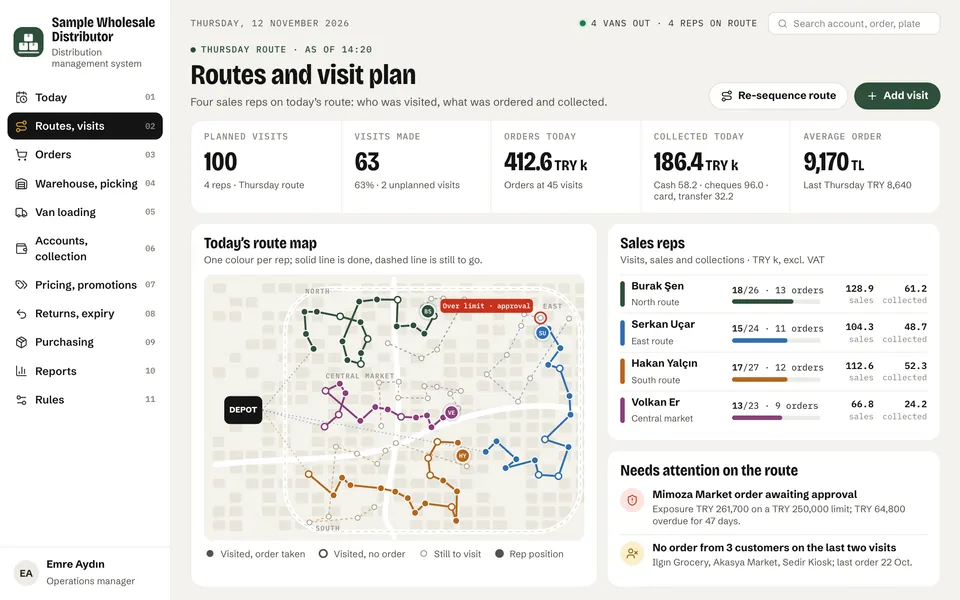
Wholesale distribution software route screen: four sales reps’ daily routes on a map, visit and order status, orders and collections per rep, and items needing attention
Routes and vans in one plan Today's rep visits, the orders taken and tomorrow's van loading come from the same records; an overloaded van shows up before loading starts.
Credit checked before dispatch Balance, overdue amounts, cheques in hand and unshipped orders count against one limit; an order over the limit does not go on the van without approval.
Regulation as rules e-delivery note scope, the dispatch note in the vehicle, payment term limits for food and the expiry date rule are held as rule tables.
Demo on request We walk you through the route, loading, credit, pricing and returns screens with sample data in a call.
Does this sound familiar?

In wholesale, margin is lost not in turnover but between discounts, payment terms and returns.

Wholesale distribution runs on thin margins, many product lines and long payment terms; a small leak becomes a large gap by the end of the month. If even one of the points below sounds familiar, this page was written for you.

  • Orders arrive separately from the rep's notebook, by phone, by WhatsApp and through the dealer portal; an order that comes in after the cut-off misses tomorrow's van or is forgotten.
  • The rep's route lives on paper or in their head; a customer who was skipped, or who has not ordered on two visits, is only noticed in the month-end sales report.
  • Goods go out to customers who are over their limit, overdue, or whose cheque has bounced; the credit check does not count cheques in hand or orders not yet loaded.
  • Customer cheque due dates sit in one file and the cheques given to suppliers in another; the week with a cash gap is not visible in advance.
  • Vans are overloaded or leave half empty; because loading order does not match delivery order, the driver unloads and restacks the body at every stop.
  • When channel discount, line discount, free goods and invoice discount stack up, the real margin on the line disappears; some lines are sold at a loss without anyone noticing.
  • Supplier-funded promotion shares and free goods are not tracked separately, so the supplier support due is never collected.
  • Stock close to its expiry date is forgotten in the warehouse, comes back from the shelf as a return, and by then the window to return it to the supplier has passed.
  • The e-delivery note and the paper in the van are prepared apart from the dispatch list; a customer's partial acceptance or return reaches the account days later.
  • The accounting package keeps invoices and accounts correctly, but routes, vans, credit approvals, promotions and returns sit outside it, in a few people's spreadsheets.
The software landscape today

What software do wholesalers use today, and where does it get stuck?

Türkiye has accounting, field sales, B2B and warehouse products aimed at wholesalers, and most of them cover orders, collections and documents well. Wholesalers usually run several of them side by side, and the rules in between are joined up in Excel. The product names below were opened and read on the vendors' own pages; features are limited to what those pages show.

LayerSoftware in use todayThe gap it leaves
General ERP and accounting (horizontal backbone) Logo (Edge T-Series, Netsis), Mikro (Run, Jump, Fly), DİA, ETA, Nebim Solid for accounts, stock, invoicing and e-documents, and should stay in place. Logo's ERP page lists distribution management as an optional module; routes, van capacity, credit approval and the returns chain still run outside these packages in most firms.
Field sales and sales rep apps Logo Cloud Sales Platform, Univera EnRoute, MobilRut, Sahatek, Fora Mobil (Mikro partnership), BizimHesap field sales Orders, collections, location and routing in the field; some product pages also mention van sales and offline working. A firm's own credit formula, promotion mix and loading plan can be adapted only as far as each product's set-up allows.
B2B and dealer ordering MobilRut B2B dealer ordering, Sahatek B2B, BizimHesap Bizim Sipariş, Logo Cloud Sales Platform Round-the-clock ordering at the dealer's own prices. Linking that order to the same day's route, van and warehouse plan often remains a separate job.
Warehouse and WMS Logo Edge WMS Basic, Univera StokBar, MobilRut warehouse module Barcode receiving, counting and dispatch. Tying picking waves to vans and loading order to delivery order has to follow the firm's own rules.
Public systems and e-documents Revenue Administration e-invoice, e-archive and e-delivery note; licensed integrators; Ministry of Agriculture and Forestry registration for food wholesalers Mandatory and fixed. The distribution system's job is to produce the document from the dispatch record and post the buyer's partial acceptance or rejection correctly to the account and stock.
Excel, WhatsApp and notebooks Route lists, credit sheets, cheque books, promotion files, returns logs Flexible but tied to individuals; no versions, approvals or history. When a rep or accountant leaves, the rule leaves with them.

Product names are compiled from vendors' public pages (September 2026); PAN is not affiliated with them. The "gap" column summarises situations we commonly meet in discovery and is not a statement about any specific product.

Our approach

A distribution layer that picks up where the accounting package stops and runs out to the field.

We do not bring you a second accounting package. We build the chain of records from the order through route, warehouse, van, collection and returns, and connect it to your accounting software and your e-document integrator. The system does the arithmetic; you decide limits, discounts and approvals.

One order record from every channel

Orders from the rep's tablet, by phone, by WhatsApp or through the dealer portal land in the same record. An order received after the cut-off moves to the next route day by itself; a duplicate order from the same customer raises a warning, and stock is reserved as the order is taken.

Route, visit and van plan

Customers are assigned to weekdays and reps, and the daily call plan is followed on a map. Tomorrow's orders are split across vans in route order; weight and volume load, and a loading plan built in reverse delivery order, are ready before loading begins.

Picking and expiry dates

Picking runs in waves per van or route, and within a product the batch with the earliest expiry goes first. An expired batch is blocked and cannot be sold; stock nearing its date is put forward for a promotion or a return to the supplier.

Credit risk, cheques and collections

Balance, overdue amounts, customer cheques in hand and unshipped orders count against one credit limit. Orders over the limit go to approval; the due dates of customer cheques sit next to the cheques you have issued, so a week with a cash gap is known in advance.

Price, discount and promotion rules

Channel price, line discount, free goods, tiered discount and invoice discount apply in a defined order, and each line's margin is checked against cost. A mix that drops below the threshold goes to a manager, and supplier funding is tracked as a separate receivable.

Transfer to accounting and e-documents

Orders, delivery notes, invoices, collections and returns are transferred to your accounting package; e-delivery notes and e-invoices are produced from the dispatch record through your existing integrator. Nothing is keyed in twice.

Modules we can build

Modules we can build for wholesale distribution

You do not need all of them at once. Most wholesalers start with orders, routes and credit risk, then grow into warehouse, van loading and promotion rules. On request we walk through most of these modules together in the demo.

VAN SALES

Van sales and van stock

The van held as its own warehouse, morning loading and end-of-day count, documents issued in the field, and van sales, returns and collections closed in one end-of-day report.

CREDIT

Credit risk, collections, cheques and notes

Credit formula and limits, approval rights, receivables ageing, cheque and promissory note portfolio, a calendar of incoming and outgoing cheques, statements and reconciliation.

RETURNS

Returns, expiry and traceability

Return requests with reason codes, collection by van, warehouse check, return to supplier or disposal, posting to the account; an expiry horizon and a customer list per batch.

ERP

Accounting and e-document integration

Transfer of accounts, stock, delivery notes, invoices and collections with Logo, Mikro, Netsis and other packages, plus the link to your e-document integrator. The route depends on version and licence and is settled during discovery.

What it looks like on screen

What wholesale distribution software looks like on screen

These screens come from the demo we built for wholesalers and distributors. The figures are sample data; the system is set up around your own routes, vans, price lists and credit rules.

Routes and visits. Each sales rep’s daily route on a map: which customers were visited, whether an order was taken, who is still to come. An order from a customer over the credit limit, customers who have not ordered on two visits and a route running late come up as warnings on the same screen.
Picking and loading. Today’s orders are split across vans in tomorrow’s route order. Each van’s weight and volume load, the progress of picking waves and a loading plan built in reverse delivery order sit on one screen; an overloaded van shows up before loading begins.
Credit risk and collections. Each customer’s balance, overdue amount, cheques in hand and unshipped orders count against a single credit limit. Receivables ageing, a weekly calendar of incoming and outgoing cheques and the held order of an account over its limit sit on one screen.
Pricing and promotions. Every step from list price to net price is visible: channel discount, line discount, free goods and invoice discount apply in order, and the line margin is checked against cost. A promotion mix that pushes margin below the threshold goes to approval; supplier funding is tracked separately.
Returns and expiry. Every return is logged with a reason, and the chain is tracked from the rep’s request through collection, warehouse check, return to supplier and posting to the account. Stock is shown on a heat map by days to expiry; batches nearing their date move up while they can still be sold, expired ones are blocked.

Company names, people and figures on these screens are sample data. The system is built around your own processes, document names and rules. We walk you through the demo in a call: request a demo

Integration with your existing ERP

Your accounting package and your e-document integrator stay where they are.

Most wholesalers already have an accounting package that keeps invoices, accounts and e-documents correctly, and some also run a field sales app. What is missing is the distribution flow between them: routes, picking, vans, credit approval, promotion rules and returns. We write that layer and set up the data exchange with your existing software. Statutory documents stay in your current set-up; the transfer route depends on the package version and licence and is settled during discovery.

Our integration approach →
  • Transfer of accounts, stock, orders, delivery notes, invoices and collections with Logo, Mikro, Netsis, DİA, ETA or your own package; double entry goes away.
  • e-invoice, e-archive invoice and e-delivery note through your existing integrator; documents are produced from the dispatch record and the buyer's acceptance or rejection is read back.
  • Scanning in the warehouse and on the van with handheld terminals, barcode scanners and mobile printers; settled by device model during discovery.
  • If you already use a field sales or B2B app, orders are read from it; you can move over without removing it.
  • A daily summary that reads well on a phone for management: orders taken, vans loaded, cash collected, limit breaches and returns.
Outcomes

What changes in distribution once this layer is in place?

  • Orders from every channel sit in one record; cut-off and route-day rules run in the system, not by hand.
  • The rep's day is visible on a map; a skipped customer or one who has stopped ordering is noticed the same day.
  • Limit breaches are caught before dispatch; goods go to a risky customer only with a recorded approval.
  • Incoming and outgoing cheques share one calendar; a week with a cash gap is known weeks ahead.
  • Van capacity is checked before loading starts, and the loading order is prepared in reverse delivery order.
  • The real margin of every order line is visible; a discount mix that pushes margin below the floor does not pass without approval.
  • Supplier-funded promotions and free goods are tracked as separate receivables, so support due is not left uncollected.
  • Stock nearing its expiry date is moved forward while it can still be sold; an expired batch does not go out.
  • Returns are followed from request to account posting; the window for returning goods to the supplier is not missed.
  • Accounting and e-documents stay as they are; nothing is entered twice.
Process

A realistic five-stage path that begins with discovery.

  1. 01

    First call and demo

    1 week

    We listen to your product groups, number of customers and dealers, rep and van set-up, and the accounting and field sales software you use. We walk through the demo together and discuss which screens match your business.

  2. 02

    Discovery in the warehouse and the field

    1-2 weeks

    We spend a route day with a rep and watch picking and van loading in the warehouse. We collect your price lists, discount and promotion rules, credit and approval practice and returns paperwork, and keep your own field names.

  3. 03

    Scope, priorities and budget

    1 week

    We present in writing a module order that starts where it hurts most, the integration routes, timeline and budget. The first phase is usually orders, routes and credit risk.

  4. 04

    Development and pilot

    6-10 weeks

    We deliver modules in sequence and test them on a real route with one rep and one van. Reps, warehouse staff, drivers and accounts use the screens at every delivery, and corrections come from the field.

  5. 05

    Go-live and maintenance

    Ongoing

    Training, data migration and go-live are followed by maintenance and support. When a new channel, van, warehouse or promotion rule arrives, the system grows with you.

Why Pan Innovation House?

A team that speaks the wholesaler's language and builds the distribution chain on site.

You see the screens first

A demonstration, not a promise: on request we walk through the route, loading, credit, pricing and returns screens in a call. Your system is built from this core with your own rules.

We work in distribution terms

Sales rep, route, van sales, free goods, invoice discount, cheque portfolio, FEFO and expiry date appear on screen under the names you already use; staff do not learn a new vocabulary.

We turn regulation into rules

e-delivery note scope, documents in the vehicle, payment term limits and the expiry rule go in as rule tables; when regulation changes, the table is updated and the software is not rewritten.

Accounting and field apps stay in place

We do not rip out working systems; we close the gap between them. That keeps switching risk low and brings the first benefits early.

Based in Gaziantep, we come to you

We are headquartered in Gaziantep, Türkiye, with an office in London. We travel to wholesalers anywhere in Türkiye for discovery and run the pilot on site.

Your data, your code

You choose the server; your data and the code written for you belong to you. The system keeps running even if the maintenance contract ends.

Frequently asked questions

Wholesale Distribution software: common questions

What is wholesale distribution software?

It is business software that keeps a wholesaler's or distributor's orders, routes, warehouse, van loading, credit risk, collections, pricing and promotions, and returns in one record. The accounting package keeps invoices and accounts; distribution software follows the path goods take from order to the customer's shelf, and money from invoice to till.

We are a small wholesaler. Is this too much for us?

If you only want an ordering screen for your dealers or customers, the Dealer (up to 50 dealers) and Distribution (up to 100 dealers) packages of our ready-made system (in Turkish) are enough: an ordering screen under your company name, dealer-specific prices and discounts, an order board and a pick list come ready. If you need rep routes, van loading, credit approval, promotion rules or a link to your accounting package, the system on this page is built module by module.

We already use a sales rep app. Does this replace it?

Not necessarily. If your field sales or B2B app collects orders well it can stay; we read orders from it and build the route, warehouse, van, credit and returns flow behind it. How the app exports data is checked during discovery and stated in writing.

Do we have to use e-delivery notes?

Under General Communiqué No. 509 on the Tax Procedure Law, taxpayers registered for e-invoicing whose gross sales revenue for 2021 or any later year is TRY 10 million or more must issue e-delivery notes from the start of the seventh month of the following year. Some groups are covered regardless of turnover: produce traders and commission agents in the wholesale market registration system, sugar producers, iron and steel, fertiliser and mining businesses, and distributors of certain goods subject to special consumption tax. e-invoicing itself is required from TRY 3 million of gross sales revenue for 2022 and later years.

We distribute beverages. Are e-delivery notes compulsory for us too?

It depends on the product. The communiqué brings in, regardless of turnover, businesses that market goods on list (III) of the Special Consumption Tax Law as a master distributor or distributor. That list includes waters and soft drinks with added sugar or flavouring (fizzy drinks included), fruit juices other than 100% fruit juice and vegetable juice, beer, wine and other alcoholic drinks, and tobacco products; some items such as turnip juice are excluded. For products not on the list, the general turnover threshold applies.

Which document must be in the vehicle, and when is the invoice issued?

Under Article 230 of the Tax Procedure Law, when the seller carries or has the goods carried to the buyer, the seller issues a dispatch note and keeps it in the vehicle; a dispatch note is also required when goods move between branches or are sent to an intermediary for sale. If you are in e-delivery note scope, the document is electronic and records the actual dispatch date with hour and minute. Under Article 231, the invoice must be issued within seven days of delivery at the latest. The system produces the dispatch note from the loading list and the invoice from the delivery record.

We sell food to supermarket chains. How long can payment terms be?

Under Article 7 of the Law on the Regulation of Retail Trade, for agricultural and food products that perish within 30 days of production, the payment term may not exceed 30 days where the creditor is small and the debtor medium or large (or the creditor medium and the debtor large), and 45 days in other cases. For other agricultural and food products the limit is 60 days in the same size situations. The term runs from delivery or transfer of ownership, whichever is earlier, and the debtor carries the burden of proving timely payment. The system holds these limits as payment term rules by customer and product group and reports breaches.

Can a supermarket pass the cost of its promotion on to us?

Article 6 of the same law treats as an unfair trading practice in every case passing promotion costs to a party that does not want to sell on promotion, and charging fees under names such as turnover shortfall or card participation without providing a service that directly affects demand. So in the system a chain store promotion does not enter the price list until participation and cost share have been agreed in writing, and who joined which promotion, and at what share, stays on record.

How is credit risk calculated?

Exposure is the customer's account balance plus customer cheques not yet collected and orders not yet loaded; if you wish, promissory notes and goods delivered but not yet invoiced are added too. The formula and weights are your rules. An order over the limit goes to approval; when a bounced cheque is posted to the account, the customer is blocked automatically and whoever holds approval rights is notified.

Can reps work where there is no signal?

Yes. The field app is built to work offline: customer, price and credit data download to the device at the start of the day, and orders and collections sync to head office when the connection returns. For orders taken offline, the credit check uses the data from the last sync; an order that needs head office approval goes to approval once the device reconnects.

We are a food wholesaler. What do registration and traceability require?

Under Article 30 of Law No. 5996, food businesses either register with the Ministry of Agriculture and Forestry or obtain approval before starting, depending on their activity. According to the ministry's provincial application guidance, stand-alone cold stores holding animal-origin food that needs temperature control, and premises selling animal-origin food wholesale to food businesses, require approval. Article 24 requires a traceability system at every stage including distribution, and offering food past its use-by date for sale is grounds for an administrative fine and seizure. The system records every shipment with batch and expiry date, finds which customers received a batch with one search, and blocks expired batches.

Do we need to change our accounting software?

No. Accounting, customer accounts, e-invoice, e-archive invoice and e-delivery note stay in your current package and with your integrator. Orders, delivery notes, invoices, collections and returns are transferred there; the connection route depends on the package version and licence and is settled during discovery.

How long does implementation take, and how is the budget set?

After discovery we give a written timeline and budget by module order. For most wholesalers the first phase is live in a few weeks; the full scope including the pilot usually takes two to three months. The budget depends on the number of modules, integration routes, and the number of reps and vans.

Can we see a demo?

Yes. On request we walk through the route, loading, credit, pricing and promotions, and returns and expiry screens with sample data in a call; we do not publish the demo openly. Company names, people and figures are fictional; your system is built with your own data.

Where will our data be held?

The system runs on a server or cloud account of your choice; your data and the code written for you belong to you. Separate roles are set up for reps, warehouse staff, drivers, accounts and management, and cost, margin and credit screens are open only to authorised people.

Next step

Let us walk through the demo, then visit your warehouse

A wholesaler's distribution set-up cannot be designed from a distance. First we walk through the screens together; then we spend a route day with one of your reps, see your warehouse and van loading on site, and propose the first phase in writing. Your accounting package stays where it is.

Related services

Related areas worth considering

Pan Innovation House

Call us

By phone

+90 543 930 12 72

Our phone line is open every day.

WhatsApp on your phone

Scan with your phone camera. The chat opens with your message ready.

Prefer that we call you? Leave your details