Pan Innovation House Pan Innovation House
INDUSTRY SOFTWARE · GLASS AND CERAMICS

From the kiln to the shade on the pallet, ceramic plant software that keeps the books on shade and calibre

Pan Enterprise Solutions, the software arm of Pan Innovation House · based in Gaziantep, Türkiye, with a London office

We bring the body recipe, kiln profile, quality class from the sorting line, stock by shade and calibre, order matching from a single cell, and the energy and emission record into one chain of records. Logo, Mikro, Netsis or whichever accounting program you use stays where it is; we do not touch your line automation or machine software, we build the plant layer beside them. On request we walk through the screens together in a call.

Asking about price? We listen to the scope in a short call and share the budget frame and timeline in writing. The first 30-minute call is free; the scope of an on-site discovery, and its fee if any, is agreed in writing during that call.

We work on site for plants in and around Gaziantep; elsewhere in Türkiye and abroad, discovery starts by video call and a visit is planned if needed. Our London office is at Unit 6 Cranford Way, Hornsey, London N8 9DG.

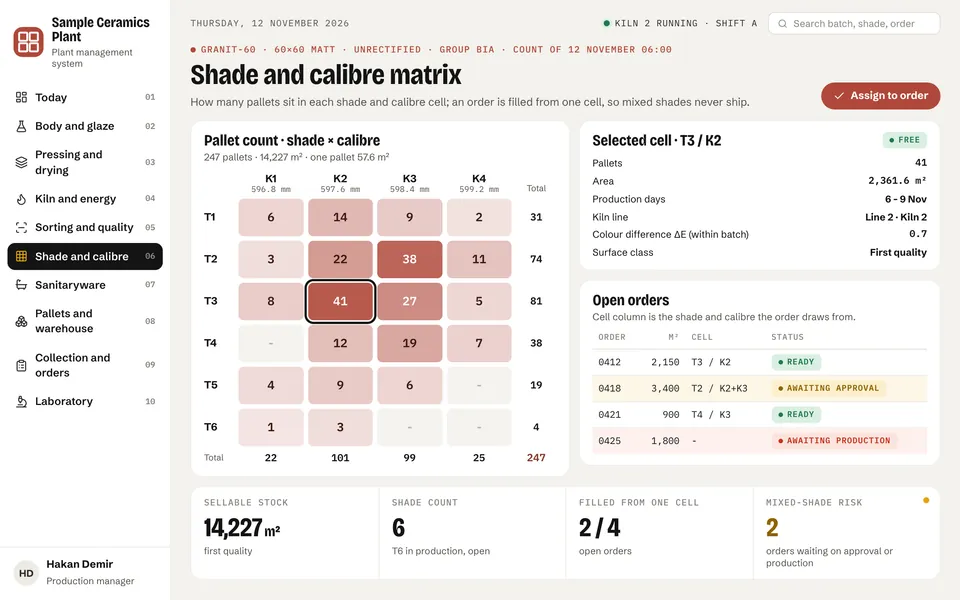
Glass and ceramics software shade and calibre matrix: pallet counts in six shade and four calibre cells, a selected-cell card and the cell assignment of open orders
Demo on request We walk you through the shade and calibre matrix, kiln curve, body recipe, sorting and order screens with sample data in a call.
Standards framework ready EN 14411 water absorption groups, CE and declaration-of-performance records and the Turkish emission-monitoring calendar come as rules in the system.
Machines left alone Presses, kilns, sorting lines and vision systems keep running on their own software; we read the data and tie it to the record. What can be read depends on the device and version, settled in discovery.
Scope set in discovery We start from pallet and shade records and grow module by module; not every plant needs every module.

This page is a branch of Building Materials Manufacturing software; the wider picture and the other branches are there.

Does this sound familiar?

In ceramics, profit does not vanish at the kiln exit but in how shade and calibre spread across pallets.

The picture below matches the process described in sector sources for tile and sanitaryware plants. If even one of these sounds like your plant, this page was written for you.

  • Pallets of different shades and calibres of the same product stand side by side in the warehouse, and whether one shade has enough quantity for an order is counted by hand at that moment.
  • Even a manufacturer's handbook calls mixing tiles of different shades in the same area an installation error; if mixed shades ship, the difference shows up at the customer's site.
  • When one kiln zone drifts a few degrees from the target profile, fired colour and size shift, but that information stays on the kiln screen and does not travel to the sorting line or the pallet record.
  • A new kaolin or clay lot changes the shade tendency; the lab result is in a notebook, the body recipe in another file, and the shade difference arrives as a surprise at sorting.
  • The sorting machine or quality inspector separates first, second and third quality, but which shift, kiln and body batch a downgrade belongs to gets lost in the monthly report.
  • In sanitaryware, where loss occurs across casting, drying, glazing and firing is not followed stage by stage, and the cast count of a mould lives in the mould-maker's memory.
  • The gas meter, daily output and kiln data sit in different places; the annual emission monitoring table and the energy consumption notification are assembled by hand every year.
  • The declaration of performance and CE information are not tied to the product collection and the shipment; the export file is assembled while hunting for documents.
  • Free stock, quantity reserved to orders and quantity in production for a collection sit in different tables, and what sales promised can exceed what the plant actually has.
  • In the accounting program, tile is one stock item and a pallet is one quantity; the value and age of stock by shade, calibre and quality class is never calculated.
The software landscape today

Which software do ceramic plants use today, and where does it get stuck?

We could not find an end-to-end business system for ceramic or glass processing plants in Turkey whose screens and scope are openly presented. Plants typically run four separate layers side by side, and the gap between them is closed with Excel and notebooks.

LayerSoftware in use todayThe gap it leaves
General ERP and accounting (horizontal backbone) Logo (Tiger, Netsis), Mikro, ETA, Canias, Uyumsoft, DİA Solid for accounts, stock, invoicing and e-delivery notes, and should stay. Logo's sectors page has a glass, cement and soil products vertical; but pallet stock by shade, calibre and quality class sits outside the standard item in these programs.
Line and machine automation Machine makers' software: SACMI (its page presents the smart-factory software HERE+ and powder plant automation), System Ceramics (sorting line, calibre classification and surface inspection systems) Strong in running the press, dryer, kiln, sorting line and vision systems. Their own pages do not list commercial processes such as orders, stock sold by shade, shipping and invoicing.
Sector-specific ERP apps (abroad) Naviceram (Aitana, a tile app on Microsoft Dynamics 365 Business Central) Tracks quality, shade, calibre and format from purchase to sale and sets prices by shade and calibre. On the Microsoft marketplace page the supported country is the United States only and languages are English and Spanish; Turkish regulation and local accounting need a local layer.
Warehouse and intralogistics software General warehouse management (WMS) software, machine makers' automated storage and vehicle systems Moves and places the pallet; the business rule that matches shade, calibre and quality information to an order is mostly built by hand for each plant.
Glass processing side Glass processing machine makers (e.g. Glaston: tempering, laminating and insulating glass lines) The machine side is strong; we could not verify on their own pages a Turkey-specific product that brings order sizes, cutting optimisation, breakage and waste records, invoices and delivery notes into one chain. This area is discussed separately in discovery.
Excel, paper and public documents Pallet ledger, shade list, kiln report, emission monitoring tables, GİB e-document systems, the Ministry's energy notification Flexible but tied to one person; keeps no version or history. Public systems are mandatory and fixed; plant software's job is to prepare the right data for them from the record.

Product names are compiled from vendors' public pages (September 2026); PAN is not affiliated with them. The "gap" column summarises situations we commonly meet in discovery and is not a statement about any specific product.

Our approach

Plant software that closes the gap between line automation and accounting.

We do not bring a second accounting program or a new line automation to your plant. We build the chain of records from body to pallet and from pallet to shipment, and make it talk to your existing systems. The system does the arithmetic; the foreman and management make the decision.

Body, glaze and raw-material lots

Body and glaze recipe, actual weighing, density, sieve residue and powder moisture are tied to the batch record. When a new kaolin or clay lot arrives, its effect on fired colour is noted in advance, so a shade difference is no surprise at sorting.

Kiln profile and zone deviation

The target profile and the measured temperature sit on one screen, zone by zone. When a zone leaves its target you see which pallets are affected; the deviation reaches the sorting line as a warning before it nears the shade limit.

Shade, calibre and quality-class record

Every pallet leaving the sorting line enters the record with shade, calibre, quality class, batch and kiln. Downgrade reasons match shift, line and body batch; the cause of waste does not vanish in the monthly report.

Energy, gas and emission record

The gas meter, kiln and dryer output, daily production and the emission monitoring plan are kept in one record. A ready table comes out for the annual monitoring report and the energy consumption notification.

Pallet stock and filling an order from a single cell

Stock shows as shade and calibre cells. An order is filled from one cell; if it falls short, an adjacent calibre needs approval and mixed shades are never shipped. Free, reserved and in-production quantity by collection sit together.

Shipping, documents and hand-off to accounting

The truck load is checked against its weight limit; the declaration of performance, delivery note and packing list are recorded in one chain. Delivery note and invoice data pass to your accounting program, so nothing is typed twice.

Modules we can build

Modules we can build for a ceramic plant

Every plant differs in line, product group and ERP set-up. We start with the modules below that fit your needs, then expand.

BODY

Body, glaze and raw-material lots

Recipe and actual weighing, raw-material lot, density, sieve residue, powder moisture, silo stock and glaze record. The shade effect of a raw-material change is noted.

PRESS

Pressing and drying

Press line, product size, mould and dryer outlet moisture, green tile waste record. The identity of the batch going from press to kiln is preserved.

KILN

Kiln profile and zone monitoring

Profile definition, zone target and measurement, deviation alerts, time in kiln, burner and gas use. Pallets affected by a deviation are listed.

SORTING

Sorting, quality class and waste reason

First, second and third quality split, breakage and scrap, downgrade reason, split by line and shift. The decision of the machine or inspector is tied to the record.

SHADE

Shade and calibre matrix

Shade and calibre cells by product, pallet count and area, colour difference within a batch, free or reserved status. Which cell an order will be filled from is visible.

SANITARY

Sanitaryware line

Quantity and loss across casting, drying, glazing, firing and sorting, mould type and cast count, mould-limit alerts, first-quality rate by product family.

PALLET

Pallet, warehouse and order matching

Pallet label, location, stock by collection, free and reserved quantity, assigning an order from a single cell, adjacent-calibre approval, orders waiting on production.

SHIPPING

Shipping and documents

Truck load and weight limit, loading dock, declaration of performance and CE information, delivery note, packing list, document chain for the export file.

What it looks like on screen

What glass and ceramics software looks like on screen

These screens come from the demo design we prepared for plants making ceramic tiles and sanitaryware. The figures are sample data; the system is set up around your own line, kiln profiles and existing ERP.

Shade and calibre matrix. Different shades and calibres of the same product sit on separate pallets. The matrix shows the pallet count in every shade and calibre cell; an order is filled from one cell, an adjacent calibre needs approval when it falls short, and mixed shades are never shipped.
Kiln curve and energy. The target firing profile and the measured temperature sit on one chart, zone by zone. When a zone drifts, you see which pallets are affected and whether they near the shade limit; gas use and the emission record are fed from the same screen.
Body and glaze recipe. The body recipe and the actual weighing sit side by side; density, sieve residue and powder moisture are tied to the batch record. When a raw-material lot changes, its effect on fired colour is noted up front, so a shade difference is no surprise on the sorting line.
Sorting line and sanitaryware. On tiles, the first, second and third quality split and the reason for each downgrade show during the shift. On sanitaryware, the loss across casting, drying, glazing, firing and sorting is followed as a chain; a warning comes when mould life nears its limit.
Collection, order and shipment. Stock, reserved and free quantity by collection show at a glance. For a shipment the pallets come from one shade and calibre cell, the truck load is checked against its weight limit, and the declaration of performance and dispatch note are recorded in the same chain.

Company names, people and figures on these screens are sample data. The system is built around your own processes, document names and rules. We walk you through the demo in a call: request a demo

Integration with your existing ERP

Accounting, line automation and the sorting line stay; a bridge is built between them

Plant software is not an ERP or line automation; it sits beside them. Accounting and e-document work stays in your current program, and the press, kiln and sorting line keep running on their own software. We tie the data that can be read from these systems to the record. Which data can be taken from which device depends on the model and output format and is settled in discovery; for information we cannot reach, a manual entry screen is designed.

Our integration approach →
  • Account, stock, delivery note and invoice transfer with Logo, Mikro, Netsis, ETA, Canias or whatever you use; double entry disappears.
  • Reading data from the kiln control system, temperature and gas meters, the sorting line and vision systems; settled in discovery by device model and data output.
  • Compatibility with pallet labels and barcode printers; your current label format and batch number structure are kept.
  • E-delivery note and e-invoice work stays with your current integrator; plant software only prepares the right data.
  • Working with the foreign trade layer for export documents and with outputs that fit buyers' data requests.
Outcomes

What changes once the record chain is in place?

  • When picking pallets for an order, the quantity available in one shade shows instantly; shipping mixed shades is blocked as a rule.
  • A kiln deviation warns before it turns into shade and calibre; the sorting line is ready for it.
  • Downgrade and waste reasons match shift, line, kiln and body batch; problems are sought at the source.
  • The effect of a new raw-material lot on fired colour is noted up front, so a shade difference is no surprise.
  • Free stock, reserved and in-production quantity by collection in one table; promises to sales match the plant's reality.
  • Stage loss and mould life in sanitaryware become visible; moulds are changed by number, not by guess.
  • Gas, production and emission data in one record; the annual monitoring report and energy notification come from a ready table.
  • The declaration of performance, delivery note and packing list come from the shipment record; no hunting for documents in the export file.
  • The age and value of stock by shade and calibre is calculated; slow-moving cells are spotted early.
  • Knowledge tied to one person's Excel file and memory moves into the company's record.
Process

A realistic five-stage path that begins with discovery.

  1. 01

    First call and demo

    1 week

    We listen to your product groups (tile, sanitaryware or glass processing), number of lines, kiln set-up, sorting system and the accounting program you use. We walk through the demo together and talk about which screen matches what in your plant.

  2. 02

    Discovery at the plant

    1-2 weeks

    We follow the flow on site from body preparation to the shipping gate. We collect your pallet label, shade and calibre codes, kiln profiles, sorting forms and shipping documents and take your field names as they are.

  3. 03

    Scope and written proposal

    1 week

    In a written proposal we settle which module to start with, which devices to read data from, which information is entered by hand and the integration points. Price and timeline are set at this stage.

  4. 04

    First phase and pilot line

    Depends on scope

    We usually start with pallet, shade and calibre records and sorting results; we run a pilot on one line and correct it with feedback from the foreman and warehouse staff. The old routine runs in parallel.

  5. 05

    Expansion and hand-over

    Ongoing

    Kiln monitoring, body, energy and shipping modules are added as needed. The data and code are yours; you choose the server; training and hand-over are done together.

Why Pan Innovation House?

Why PAN Innovation House?

You see the screens first

A demo, not a promise: on request we walk you through the shade and calibre matrix, kiln curve, body recipe, sorting and order screens in a call. Your own system is built from this core with your rules.

We work in the plant's own terms

Shade, calibre, rectified, pressing powder, body, glaze, zone, green tile, first quality, plaster mould and white drying appear on screen under the names you use; staff learn no new language.

We leave what stays alone

Accounting, ERP, e-documents, line automation and vision systems stay. We build the plant layer beside them; there is nothing you are forced to replace.

Data and code are yours

Plant data stays on your server or the cloud you choose, and the source code is handed over; you depend on no one.

We start with discovery

We do not quote without seeing the plant. We listen to your line and product set-up on site and settle the scope in a written proposal.

A London office for export visibility

Our headquarters are in Gaziantep and our office is in London. For export documents, buyers' data requests and overseas customer correspondence, language and time zone are no problem.

Frequently asked questions

Glass and Ceramics Manufacturing software: common questions

What are shade and calibre and why are they tracked separately?

Shade is the colour tone of the fired tile; calibre is the size class of tiles that are not rectified. Even for the same product, different batches and kiln conditions give different shades and calibres. A manufacturer's handbook defines mixing tiles of different shades in the same area as an installation error. That is why shade and calibre are kept on separate pallets and an order is filled from a single cell. On rectified products the size is single, so the box may carry no calibre code.

What do EN 14411 and the water absorption groups mean?

EN 14411 sets out the definitions, classification, characteristics, evaluation of conformity and marking of ceramic tiles. Tiles are grouped by forming method (extruded or dry-pressed) and water absorption: for Group I water absorption is 3 percent or less (0.5 percent or less is BIa, 0.5 to 3 is BIb); IIa is 3 to 6 percent, IIb 6 to 10 percent and III above 10 percent. The system holds this group on the product card and uses it on labels and documents.

Must ceramic tiles and sanitaryware be CE marked?

The European Commission's list of harmonised standards under the Construction Products Regulation (305/2011) includes EN 14411 for ceramic tiles, EN 997 for WC pans and EN 14688 for wash basins; these products are placed on the market with a declaration of performance and CE marking. In Turkey the Construction Products Regulation follows the same framework. Which product is certified under which edition and system depends on the current edition of the standard and the product group, and is settled in discovery; the system ties the declaration of performance to the product and shipment record.

Are ceramic and glass products covered by CBAM?

The consolidated text of Annex I to the EU carbon border regulation (Regulation 2023/956) dated 20 October 2025 lists cement, electricity, fertilisers, iron and steel, aluminium and hydrogen. Ceramic (chapter 69) and glass (chapter 70) products are not on that list. So ceramic tile, sanitaryware and glass are not under CBAM today. The text mentions giving priority to adding downstream products in the future, but that is not a provision in force; later changes should be followed in the official source.

Does emission monitoring in Turkey cover ceramic and glass plants?

Annex 1 of the Turkish Emissions Trading System Regulation published in the Official Gazette of 27 August 2026 lists glass production with a daily melting capacity of 20 tonnes or more and ceramic production by firing, tiles and porcelain included, with a daily production capacity of 75 tonnes or more. For these activities greenhouse gas emissions are monitored, reported and verified, and the report is submitted by 30 April each year. Entry into the allowance system depends on the category, and the system starts with a pilot period. Whether your plant is covered depends on its capacity and emissions.

Does the energy manager obligation concern ceramic plants?

Under the regulation on increasing efficiency in the use of energy resources and energy, an industrial establishment with total annual energy consumption of 1,000 TOE or more appoints a person holding an energy manager certificate and notifies energy consumption data to the Ministry by the end of March each year. Gas used by kilns and dryers counts towards the total. The system prepares meter data for the notification table.

Will software run the kiln curve?

No. The kiln control system keeps running the firing. Our layer compares measured temperature and gas with the target profile, links a deviation to the pallets that lived through it and raises a warning. The person who sets and changes the profile is always the kiln foreman and the process engineer; every change is stored with who made it, when and why.

Do you compete with machine software such as SACMI or System Ceramics?

No. These companies are strong in machine and line control for presses, kilns, sorting lines and vision systems; their own pages do not describe orders, stock sold by shade, shipping and invoicing. We do not replace line software; we tie the data we can read from it to the pallet, order, energy and document record.

What does software solve in sanitaryware production?

In sanitaryware a product passes through casting, drying, glazing, firing and sorting, and loss can occur at each stage. A plaster mould gives a limited number of casts, a polymer mould lasts longer. The software ties stage loss by quantity, mould type and cast count to the record, warns as a mould nears its limit and shows the first-quality rate by product family. Target values and decisions are yours.

Do you also build systems for glass processing (flat glass cutting, tempering, insulating glass)?

In glass processing plants, order sizes, the cutting plan, breakage and waste, tempering and insulating glass line sequence, delivery notes and invoices should come together in one chain. In this area we could not find a ready-made plant software specific to Turkey and verified on the vendor's own page; machine makers run the machine side. In discovery we design the order, cutting and shipping layer around your firm. We do not yet have screens for glass as detailed as for ceramics; they are shaped together as needed.

Do we have to replace our accounting program?

No. Logo, Mikro, Netsis or whatever you use stays. The plant layer takes account, stock, delivery note and invoice information from it or passes it there. Which fields transfer with which version is settled in discovery.

What do we need to start, and how are time and cost set?

First a call where we walk through the screens together; then we do discovery at the plant and settle the scope in a written proposal. Time and cost depend on the number of lines, devices to connect, module scope and the integration structure of your current systems. At this stage we do not promise a fixed timeline or price.

Where does our data live?

The data is yours. You choose the server: your own or the cloud you prefer. The source code is handed over; backup and access rules are designed together.

Next step

Let us walk through the demo, then visit your plant

A plant's system cannot be written remotely. Let us first walk through the screens together; then we see your line, kiln and warehouse on site and propose the first phase in writing. Your accounting program and your line automation both stay where they are.

Related services

Related areas worth considering

Pan Innovation House

Call us

By phone

+90 543 930 12 72

Our phone line is open every day.

WhatsApp on your phone

Scan with your phone camera. The chat opens with your message ready.

Prefer that we call you? Leave your details