Pan Innovation House Pan Innovation House
INDUSTRY SOFTWARE · MARBLE AND NATURAL STONE

From the block at the quarry to the pallet in the container, marble and natural stone software that keeps the stone's books

Pan Enterprise Solutions, the software arm of Pan Innovation House · based in Gaziantep, Türkiye, with a London office

Every block that leaves the quarry gets a number. We chain the block yard, the gang-saw cutting plan, slab yield, the epoxy and polishing line, grading, sized orders, container loading, and the quarry's dispatch slips and licence calendar under that one block number. Logo, Mikro, Netsis or whatever accounting program you use stays where it is; we do not touch your saws or polishing line, we build the operating layer beside them. We walk through the screens together in a meeting when you ask.

Asking about price? We listen to the scope in a short call and share the budget frame and timeline in writing. The first 30-minute call is free; the scope of an on-site discovery, and its fee if any, is agreed in writing during that call.

We work on site for plants in and around Gaziantep; elsewhere in Türkiye and abroad, discovery starts by video call and a visit is planned if needed. Our London office is at Unit 6 Cranford Way, Hornsey, London N8 9DG.

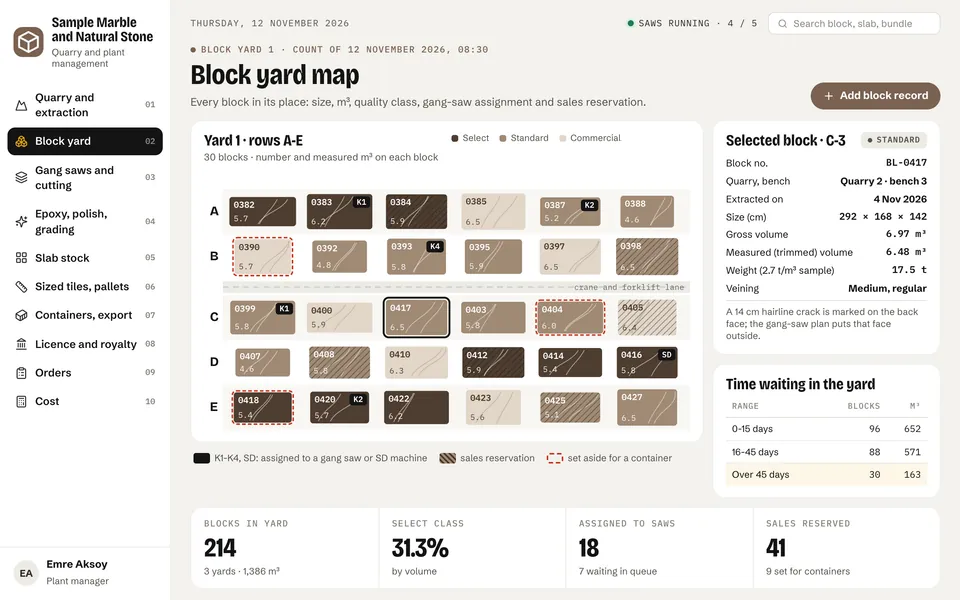
Marble and natural stone software block yard map: blocks in rows A-E by quality colour, saw tags, reservation patterns and a selected-block detail card
Demo on request We walk through the block yard, saw yield, polishing line, container and quarry screens with sample data in a meeting.
Mining rules built in Dispatch slips, state royalty, the April report and licence renewal dates arrive as rules and a calendar.
Without touching your ERP Accounting, e-invoice and e-waybill stay in your current program; the hand-off is settled in discovery, version by version.
Scope set in discovery A plant without a quarry can start as well as a firm with both; the system grows module by module.

This page is a branch of Building Materials Manufacturing software; the wider picture and the other branches are there.

Does this sound familiar?

In marble, profit is lost inside the block, not in the selling price.

In marble and natural stone the money starts at the quarry, grows or melts at the gang saw, and turns into paperwork at the container. If even one of the points below sounds familiar, this page was written for you.

  • A block's quarry, veining, crack note and size stay in a yard notebook or in paint on the block itself; sales and the saw operator describe the same block differently.
  • Finding a block in the yard means walking the yard; how many days it has waited, which saw it is assigned to and which customer it is reserved for sit in separate records.
  • Each block's cutting plan is drawn to the customer's sizes and its yield is only learned after cutting, when broken slabs are counted. In one academic study of a real five-block cutting plan, waste ranged from 8.8% to 19.6% from block to block.
  • Blade or wire changes, remaining cutting time and machine order depend on the foreman's guess; which block is on which machine and how long it has left is argued about in meetings.
  • How many hours a slab waits in curing after epoxy and mesh, when it enters the polishing queue and which class it is graded into does not flow back to the block; no one knows which block dragged yield down.
  • Vein and tone match between slabs from one block can be lost at the point of sale; the customer meets slabs that do not match and complains.
  • The container loading plan is made by hand; pallet and crate weights, remaining space and the weight margin per container are recalculated when the packing list is typed.
  • Packing list, export invoice, origin document and export declaration for one order sit with three or four people in different files; the missing document is noticed as the container heads to port.
  • Mined material must travel with a dispatch slip, and the licence calendar is full of dates to expect. When the slip is not tied to the block, the April report to the output record, and the June royalty to the quarry-gate price, the calendar lives in one person's memory.
  • In the accounting program the block is one stock item and slab and sized product are others; the quarry cost of a block, cutting waste and polishing cost per order are unclear even at month end.
The software landscape today

Which software do marble and natural stone firms use today, and where does it fall short?

In this research we did not find the product page of a ready-made Turkey-specific marble management system that runs from quarry to container. Firms usually run several layers side by side, and the gaps are closed with Excel, notebooks and the foreman's memory.

LayerSoftware in use todayThe gap it leaves
General ERP and accounting (horizontal backbone) Logo (Tiger, GO, Netsis), Mikro, ETA, Uyumsoft Solid for accounts, stock, invoices and e-waybill, and should stay. Logo's sectors page lists no mining or natural stone sector; blocks, slabs and sized product are usually held as general stock items, while the cutting plan and yield sit outside these programs.
Natural stone slab inventory (foreign-origin) DDL (Stone Inventory Management, Digital Cutting), Slabsmith, Moraware Inventory Strong on per-slab photos, size, status, reservation, remnants and layout. Their pages target countertop and stone fabricators and showrooms; quarry dispatch slips, block cutting plans at the gang saw and Turkish regulation are not listed.
Machine automation and monitoring The vendors' own software for cutting machines and lines Strong at following how a gang saw or saw-disc machine runs; building the commercial record, block cost, customer reservation and dispatch papers is not their job.
Excel and paper notebooks Block book, yard sketch, cutting plan sheet, container loading sheet Flexible and fast, but tied to one person and keeping no versions or approvals. The same block can show different sizes in different files.
Public systems and documents Mining dispatch slips, operating activity report and royalty declaration (General Directorate of Mining and Petroleum Affairs), GİB e-document systems, Ministry of Trade export applications Mandatory and fixed. The software's job is to prepare the right data for them: dispatched blocks consistent with the quarry record, and output consistent with the report and royalty calculation.

Product names are compiled from vendors' public pages (September 2026); PAN is not affiliated with them. The "gap" column summarises situations we commonly meet in discovery and is not a statement about any specific product.

Our approach

An operating layer that closes the gap between quarry, saw and accounting.

We are not bringing your firm a second accounting program or a new machine package. We build the record chain that runs from the block number to the container, and connect it to your existing systems. The system does the arithmetic; the foreman and management decide.

Block record and yard map

Every block leaving the quarry gets a number, quarry and bench, extraction date, length, width, height, measured m³, weight, quality class, veining and crack note. On the yard map each block shows in place, with quality colour, saw assignment, sales reservation and container hold on top. Time waiting in the yard is calculated from the record.

Cutting plan and slab yield

Before a block enters a gang saw or saw-disc machine, the cutting plan exists: rind, slab count, saw kerf and the broken-slab share together. Yield from block to sellable slab surface is followed in one flow; the result after cutting is written back to the plan, so the forecast for the next block is fed by records.

Epoxy, polishing, grading and quality

A slab is followed by block number through epoxy and mesh, curing, polishing and grading. How many m² wait at each stage, how many hours have passed in curing, and how the batch split into select, standard and commercial classes show at the head of the line. The grading result flows back to the block, so which block gave how much select material becomes data for future buying and selling.

Sized orders, pallets and containers

Sized order lines are placed onto pallets and crates, and those onto the container floor plan. Weight per container is tracked against your own limit and the packing list prints from the same record. Export invoice, origin document, export declaration and bill of lading appear on the order screen as documents still waiting.

Dispatch slip, licence and state royalty

Every block leaving the quarry is tied to a dispatch slip; a block without one stops at the exit gate as an alert. Monthly output, royalty accrual at the quarry-gate price, the operating activity report, the June payment and the licence renewal date show on a calendar in advance. We prepare the data; declarations and payments stay in your official systems and with your authorised people.

Cost and traceability

Quarry cost of a block, gang-saw and polishing cost, waste and packing are collected per order. For a complaint or customer question the chain of order, container, bundle, slab, block, quarry and dispatch slip opens in minutes; slabs from the same block are found together.

Modules we can build

Modules we can build for marble and natural stone

You do not need all of them at once. Most firms start with block records and the yard map, or with slab stock, and grow into cutting plans and containers. When you ask, we walk through most of these modules in a demo.

QUARRY

Quarry and block extraction

Block extraction by quarry, bench and shift, block size and m³, quality and veining notes, waste rock and rubble quantity, quarry yield and equipment records such as diamond wire.

BLOCK

Block yard and reservations

Yard map, row and position, waiting time, gang-saw assignment order, sales reservation, blocks held for containers and transfers between yards.

SAW

Cutting plan and yield

Cutting plan per gang saw and saw-disc machine, slab thickness and count, saw kerf, broken slabs, time left, machine status and the gap between planned and actual yield.

POLISH

Epoxy, mesh, polishing and grading

Waiting m² by stage, curing-time counter, polishing queue, thickness after polishing, grading result, quality class and waste.

SLAB

Slab stock and matching

Slab stock by block, bundle and pallet records, slab size and surface, a same-block slab group for vein and tone match, reservations and customer approval.

SIZED

Sized cutting and pallets

Cutting lists from order lines, size and quantity, packing, pallet or crate, m² and weight, cutting waste and pieces returned to stock.

LICENCE

Dispatch slip, licence and state royalty

Dispatch slip matched to block, monthly output, royalty accrual at the quarry-gate price, operating activity report and renewal calendar, licence details.

COST

Block and order cost

Block cost with quarry, gang saw, polishing, packing and freight items, slab and m² cost, margin by order and customer.

ERP

ERP and accounting hand-off

Passing accounts, stock, waybill and invoice data to your current program; block and slab records matching accounting stock without double entry.

What it looks like on screen

What marble and natural stone software looks like on screen

These screens come from the demo design we prepared for firms with quarries and processing plants. The figures are sample data; the system is set up around your own quarry, gang saws, polishing line and existing ERP.

Block yard map. Every block shows in its place: number, measured m³, quality-class colour, which saw it is assigned to, and its sales or container reservation. There is no walking the yard to find a block; the quarry exit date and waiting time sit in the same record.
Gang saw and block-to-slab yield. The cutting plan exists before the block enters the saw: rind, slab count, saw kerf and the broken-slab share together. Yield from block to sellable slab surface is one flow, with progress and time left per machine beside it.
Epoxy, mesh, polishing and grading. After cutting, slabs are followed by block number through epoxy and mesh, curing, polishing and grading. How many m² wait at each stage, how many hours they have cured, and which class they were graded into shows at the head of the line.
Sized tiles, pallets and container plan. Sized-order lines are placed onto pallets and crates, and those onto the container floor plan. Weight per container is tracked against the plant limit, and the status of packing list, export invoice and origin document stays on the same screen.
Quarry output, licence and state royalty. Every block leaving the quarry is tied to a dispatch slip; a block without one shows as a red alert at the exit gate. Monthly output, royalty accrual at the quarry-gate price and the licence calendar share one screen, so annual report, payment and renewal dates show in advance.

Company names, people and figures on these screens are sample data. The system is built around your own processes, document names and rules. We walk you through the demo in a call: request a demo

Integration with your existing ERP

Your accounting program and your cutting line both stay where they are.

Most marble firms already have two solid things: an accounting and e-document program on one side, and gang saws, polishing and cutting machines on the other. What is missing is the workflow in between: block records, cutting plans, slab inventory, grading, containers and dispatch papers. We write that layer and set up data exchange with both sides. Accounting and official documents stay in your current program; machine data is read when it can be read, not typed in.

Our integration approach →
  • Account, stock, waybill and invoice transfer with Logo, Mikro, Netsis, ETA or the program you use; block, slab and sized-product records matching accounting stock.
  • Reading run time, progress and stoppages from gang saws, saw-disc machines and the polishing line where they exist; machine control is not touched. Readability depends on the machine model and is settled in discovery.
  • Linking weighbridge and dispatch slip data to the block record; the official record of the dispatch slip and its relation to e-waybill are determined by your authorised people and your accountant, and we prepare the data.
  • Preparing packing list, invoice and origin document data for the export file; fit with the fields used by your customs broker or foreign trade program is discussed in discovery.
  • A phone-readable daily summary for management: blocks extracted, slabs cut, slabs waiting in curing, bundles ready, containers loaded and licence dates coming up.
Outcomes

What changes at the quarry and plant once this layer is in?

  • Each block is followed by number from quarry to container; sales, cutting and dispatch talk about the same block with the same size.
  • No walking the yard to look for a block; blocks that have waited too long or have clashing reservations show in advance.
  • The cutting plan exists before cutting; rind, saw kerf and broken-slab share become records, not guesses, and planned and actual yield stand side by side.
  • Order, time left and service state of gang saws and saw-disc machines on one screen; blade or wire changes are written into the cutting plan.
  • Epoxy curing waits and the polishing queue are visible from the record; the grading result flows back to the block and it is known how much select came from which block.
  • Slabs from the same block are found together; a customer who wants vein and tone match can be offered a grouped set.
  • The container loading plan is built with pallet and crate weights; the packing list prints from the same record, and surprises on loading day shrink.
  • The dispatch slip of a block leaving the quarry is matched in the record; the April report, the June royalty and licence renewal show on the calendar in advance.
  • Block and order cost is calculated without waiting for month end; it is clear which block, customer and product earns.
Process

A realistic five-stage path that begins with discovery.

  1. 01

    First meeting and demo

    1 week

    We listen to your quarry and plant, your machines, product groups, export share and the accounting program you use. We walk through the demo together and talk about which screen matches what you have.

  2. 02

    Discovery at quarry and plant

    1-2 weeks

    We follow the flow from block exit to container on site. We collect your block book, yard sketch, cutting plan sheet, grading criteria, packing and loading routine, and your dispatch slip and report calendar, and take your field names as they are.

  3. 03

    Scope, priority and budget

    1 week

    We present in writing the module order that starts where it hurts most, the integration routes, the timeline and the budget. The first phase is often block records and the yard map, or slab stock.

  4. 04

    Pilot and set-up

    4-8 weeks

    We build the first module with your real block data and try it on one quarry or one yard. Cutting plan and polishing line modules are added depending on how readable your machines are. Users work in their own terms.

  5. 05

    Go-live and growth

    Ongoing

    We train the team, watch the first months closely and fix what falters. Later modules are added in turn; the data and the code are yours, and you choose the server.

Why Pan Innovation House?

A team that speaks the language of stone and builds the record chain on site.

You see the screens first

Not promises but a show: we walk through the block yard, cutting yield, polishing line, container and quarry screens in a meeting when you ask. Your system is built from this core with your rules.

We work in the field's own terms

Block, gang saw, saw disc, rind, saw kerf, slab, epoxy, mesh, polishing, grading, sized tile and dispatch slip appear on screen under the names you use; staff do not learn a new language.

Mining rules go in as rules

The dispatch slip requirement, royalty rate, April report, June payment and licence renewal period enter the system as rule tables and a calendar; when the rules change the table is updated, the software is not rewritten.

We do not touch your accounting or your machines

Logo, Mikro, Netsis or ETA stays where it is; we do not interfere with control of your gang saws and polishing line. We build the missing record chain and exchange data with both sides.

Data and code are yours, you choose the server

The data and code of the software belong to the customer. You may keep the server in your own office, in the cloud or in-country; details are settled in discovery.

Gaziantep headquarters, London office

The team is in Gaziantep and the office in London. For firms that export, the document and language side is thought through from two countries; the first meeting is remote and discovery is on site.

Frequently asked questions

Marble and Natural Stone software: common questions

Is a marble quarry group II or group IV?

Under Article 2 of the Mining Law, stones produced as blocks such as marble, travertine, granite, andesite and basalt, and natural stones used for decoration, are in group II, sub-paragraph (b). Group IV covers industrial raw materials and metals. The software applies the law's dispatch slip, royalty and licence provisions as rules for II(b).

Is a dispatch slip mandatory when a block leaves the quarry?

Under Article 12 of the law, mined material must be dispatched with a dispatch slip. The slip is a declaration-type document carrying the information of a transport waybill. If dispatch without a slip is found, the material is confiscated and an administrative fine of five times the quarry-gate sale value is imposed, ten times on repetition. The software shows a block without a slip as an alert at the exit gate; the official record of the slip stays in your systems and with your authorised people.

What is the state royalty and when is it paid?

Under Article 14 of the law, for group II(b) natural stone the state royalty is 4.5% of the market sale price formed at the quarry. The whole royalty is paid by the last day of June each year; the President may raise or lower the rates by up to 25%. For the current rate and the announced quarry-gate price, check the notices of the competent general directorate. The software keeps the rate and price as tables and computes accrual from output.

When is the operating activity report due?

Under Article 29 of the law, the licence holder submits the previous year's operating activity report by the end of April each year; the report carries annual output, sales value and quantity, stock and royalty information. If it is not submitted, an administrative fine applies and production is halted until it is. The software extracts the output and sales data the report needs from the records.

When should a licence renewal be filed?

Under Article 24 of the law, a renewal request is filed with the operating project at the latest twelve months before the licence expiry date; whoever fails the obligation receives an administrative fine, and if it is not done by six months before expiry the licence is cancelled at the end of its term. The software shows this date on the licence card and calendar.

What is block yield in practice?

There is no single figure. In one academic study of a real five-block factory application, the cutting plan gave a total waste of 15.73%, varying between 8.77% and 19.57% from block to block. The system accumulates the data of your own blocks.

How does the difference between a gang saw and a saw-disc machine affect the software?

Both machines cut blocks into slabs; the cutting plan, slab thickness, saw kerf and slab count vary by machine. The software does not control the machine; it records the cutting plan and the actual result per machine. Whether your machine's progress and time data can be read depends on model and output and is settled in discovery.

Does the software provide vein and tone matching between slabs?

The software records a slab with its own block and bundle and groups slabs from the same block, so a customer who wants vein and tone match can be offered slabs from the same block. The decision to select a match by eye stays with you; photo or scan data is added to the record if you have it.

Does the software set the container weight limit?

No. You define the weight limit per container; it varies with vehicle, port and carrier conditions. The software adds up pallet and crate weights, shows remaining space and weight margin, and prints the packing list from the same record.

How do CE marking and standards enter the software for natural stone?

For natural stone, blocks, rough slabs, cladding slabs, modular tiles and flooring stone have separate European standards, and which product needs CE marking and a declaration of performance varies by product and standard. The software adds standard information, test result and declaration document fields to product records; which document is needed for which product is settled in discovery together with your product list.

Are export documents prepared inside the software?

We prepare the data needed for the packing list, invoice and origin document; official-system transactions and declarations stay with your customs broker or your own program. For the details of the foreign trade file, see our foreign trade software page.

Is it suitable for a firm with only a factory and no quarry?

Yes. Factories that buy blocks from outside keep block records as purchases and do not install the quarry and licence modules; they start with cutting plan, slab, polishing, sized-tile and container modules. Quarry modules are added only for firms that have a quarry.

How can I see the demo?

The demo is gone through on request, in a meeting, with sample data. The screens show the core of a system that would be built around your quarry, machines and accounting setup; the figures are examples.

Next step

Let's walk through the demo together, then visit your quarry and plant

A quarry's and plant's system cannot be written remotely. First let's walk through the screens together; then we will see your block yard, gang saws and polishing line on site and propose a first phase in writing.

Related services

Related areas worth considering

Pan Innovation House

Call us

By phone

+90 543 930 12 72

Our phone line is open every day.

WhatsApp on your phone

Scan with your phone camera. The chat opens with your message ready.

Prefer that we call you? Leave your details