Pan Innovation House Pan Innovation House
INDUSTRY SOFTWARE · AUTO SERVICE AND REPAIR

Auto service software that keeps the workshop’s books from check-in to the lift board, from adjuster approval to payment

Pan Enterprise Solutions, the software arm of Pan Innovation House · based in Gaziantep, Türkiye, with a London office

For multi-branch service businesses, body and paint shops and tyre workshops, we bring vehicle check-in, the damage sketch, job cards and technician planning, parts requests and supply, own-damage and liability insurance claims, customer approval and service reminders into one chain of records. Logo, Mikro, ETA or whatever accounting system you use stays in place; the service system is built alongside it. For a single-site mechanic, body shop or tyre shop we also offer a separate ready-made system (in Turkish) with job tracking, bookings, a till and a credit book.

Asking about price? We listen to the scope in a short call and share the budget frame and timeline in writing. The first 30-minute call is free; the scope of an on-site discovery, and its fee if any, is agreed in writing during that call.

We work on site for plants in and around Gaziantep; elsewhere in Türkiye and abroad, discovery starts by video call and a visit is planned if needed. Our London office is at Unit 6 Cranford Way, Hornsey, London N8 9DG.

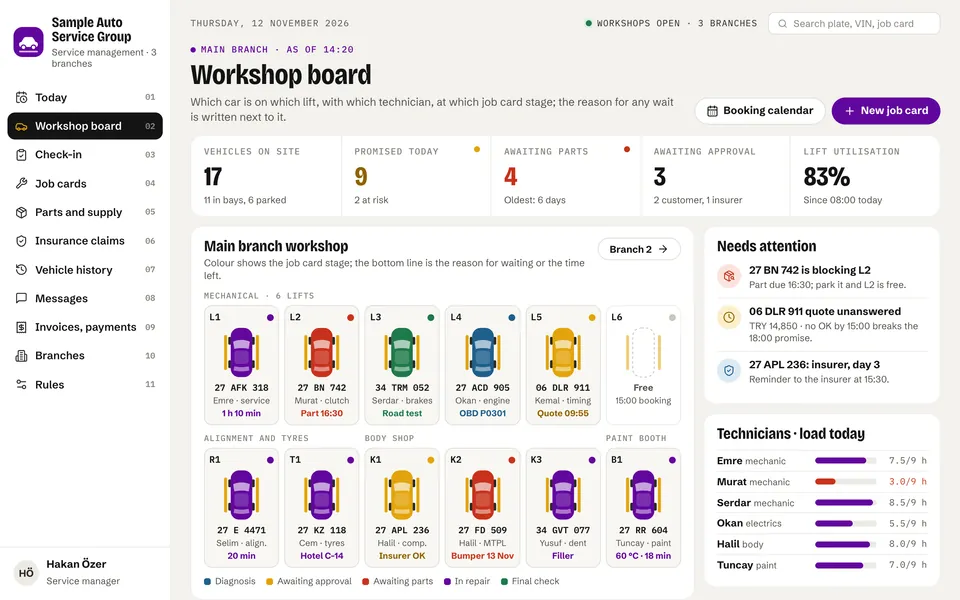
Auto service software workshop board: cars on six lifts, alignment, tyre, three body shop bays and the paint booth, job card stages, items needing attention and technician load
Every lift in view Which car is on which lift, with which technician, at which stage; if a car waiting for parts or approval is blocking a lift, the board says so at once.
Check-in starts the record Damage sketch, photos, mileage, fuel and the complaint go onto the drop-off receipt; it is sent to the customer’s phone and their confirmation is logged.
Claims in one chain Notification, adjuster, survey, repair approval, invoice and payment in one file; objection and payment deadlines count down on the claim.
Demo on request We walk through the workshop board, check-in, parts, insurance and vehicle history screens with sample data in a meeting.
Does this sound familiar?

Workshop profit is not lost on the job card; it leaks away on blocked lifts, verbal approvals and insurance money nobody chases.

According to the Turkish Ministry of Trade’s 2023 occupational guide, more than 55,000 registered tradespeople work in motor vehicle maintenance and repair. A growing workshop’s problem is not skill; it is keeping track of dozens of jobs at once. If one of the points below sounds familiar, this page is for you.

  • Which car is on which lift lives on a whiteboard or in the service manager’s head; a car waiting for parts blocks a lift for hours while the next booking waits.
  • Existing scratches and dents are not marked at check-in, or the photos stay on a staff member’s phone; at handover the argument starts about whether the damage happened in the workshop.
  • Extra work is approved over the phone; when the invoice arrives the customer says they never agreed, and the job card does not show who approved what and when.
  • Nobody knows whether the part the technician asked for is in stock, at another branch or due from a supplier; the delay is told to the customer at collection time.
  • Original and equivalent parts sit on the same line; which car got which, and whether the customer agreed, only comes out when someone digs through the file.
  • On insurance claims the adjuster approves less than the workshop claimed; where the gap comes from, the objection deadline and the money insurers still owe sit in a spreadsheet.
  • A customer has a service at one branch and tyres at another; the car’s history is split, and a repeat of the same fault or the warranty on a replaced part is missed.
  • Service reminders either never go out or everyone gets the same campaign message; nobody knows who agreed to notices and who agreed to marketing.
  • Which shelf a stored tyre set sits on, its tread depth and how many cars need changing at the start of the season are kept in a notebook.
  • The accounting system keeps invoices and accounts right, but the workshop, parts, insurance and customer approval flow lives outside it, on a few people’s phones.
The software landscape today

What software do auto workshops use today, and where does it get stuck?

Many products in Türkiye are sold as service programs, tyre software, parts catalogues and diagnostic tools; most cover job cards, stock and invoicing well. Workshops often run several side by side, with the rules between them in spreadsheets and WhatsApp. The product names below were checked on the vendors’ own pages.

LayerSoftware in use todayThe gap it leaves
General ERP and accounting (horizontal backbone) Logo, Mikro, ETA, DİA Solid for accounts, stock, invoicing and e-documents, and should stay. Lift and technician planning, insurance claims and customer approval run outside these systems in most workshops.
Auto service programs Vega Oto Servis, NoktaBarkod Oto Servis Programı, Bilsoft Bulut Teknik Servis Programı, DİA Teknik Servis Programı, Oto Servis Yazılımı Pro Vehicle records by plate and VIN, job cards, stock and invoicing. Vega’s page lists adjuster handling and own-damage excess, NoktaBarkod lists an inspection slip and profit per job card, DİA lists engine and chassis warranty tracking. Branch-by-branch lift planning and insurance deadlines can be adapted only as far as each product’s set-up allows.
Tyres and tyre hotel Lastsis Job cards, tyre hotel operations, barcoded stock and SMS for tyre sales and service businesses. Joining a tyre branch with the other branches in one vehicle history remains a separate job.
Parts catalogue and diagnostics TecAlliance TecDoc Catalogue, Bosch ESI[tronic] Tools the trade uses for part fitment and fault diagnosis. Workshop software should not replace them; its job is to tie the part number and fault code they produce to the job card and the parts request.
Insurance and public systems SBM smart adjuster assignment and claim lookup, Mobile Accident Report (Sigortam360), insurers’ network repair processes, GİB e-Invoice and e-Archive Mandatory and fixed. The adjuster’s report is written in the Insurance Information and Monitoring Centre’s report system; workshop software tracks the claim’s stage, the workshop’s claim, the adjuster’s approval and the deadlines.
Spreadsheets, WhatsApp, whiteboards and notebooks Lift whiteboard, parts notebook, insurance tracking file, approval messages, tyre hotel notebook Flexible but tied to people; no approvals and no history. When the service manager is on leave, the workshop’s memory goes too.

Product names are compiled from vendors' public pages (September 2026); PAN is not affiliated with them. The "gap" column summarises situations we commonly meet in discovery and is not a statement about any specific product.

Our approach

A service layer that runs from where the accounting system stops to the workshop floor.

We do not bring you a second accounting system. We build the chain of records from check-in to handover and reminders, and connect it to your accounting system and e-document provider. The system does the arithmetic; the service manager makes the quotes, approvals and priorities.

Vehicle check-in and drop-off receipt

The check-in form opens with plate and VIN and records mileage, fuel, loose items and the customer’s complaint; existing damage is marked on the sketch together with the customer, and every photo is tied to its mark. The drop-off receipt goes out by SMS or email and the customer’s confirmation is logged.

Lift, technician and job card board

Lifts, alignment, body shop bays and the paint booth on one plan, with each job card’s stage, technician and reason for waiting. If a car waiting for parts or approval is blocking a lift, or an unanswered quote is about to break a promised time, an alert appears.

Quote and line-by-line approval

After diagnosis, labour and parts lines become a quote; the customer approves each line on their phone or postpones it to the next service. Unapproved work never reaches the job card, and free-of-charge cases such as the same fault recurring within a year are flagged on the line.

Parts requests, stock and supply

A technician’s parts request is checked against the branch’s own store, then other branches, and only then goes to a supplier with the promised time on record. Original and equivalent parts are kept apart, and late orders and each supplier’s delivery record are visible.

Own-damage and liability claims

Notification, adjuster, survey, repair approval, repair, invoice and payment are tracked in one file, with the workshop’s claim next to the amount the adjuster approved. Objection, notice and payment deadlines count down on the file, and money owed by insurers is aged.

Vehicle history, reminders and accounting export

Visits to any branch come together on one vehicle record; service reminders are worked out from the car’s own mileage and go out according to the customer’s consent. Invoices, payments and parts movements are passed to your accounting system.

Modules we can build

Modules we can build for an auto service business

You do not need all of them at once. Most workshops start with check-in, the job card board and parts, then grow into insurance claims, the tyre hotel and reminders. On request we walk through most of these modules in a demo.

CHECK-IN

Vehicle check-in and damage sketch

Plate and VIN, mileage, fuel, loose items, damage sketch with photos tied to each mark, customer complaint, drop-off receipt by SMS with confirmation.

WORKSHOP

Lift, technician and job card board

Bay and lift plan, technician assignment and daily load, job card stages, reason for waiting, promised time and risk alerts.

APPROVAL

Quotes and customer approval

Line-by-line quotes, approval or postponement by phone, approval of extra work, time and person of approval, postponed work carried to the next service.

INSURANCE

Own-damage and liability claims

Notification, adjuster, survey, repair approval, claimed versus approved, objection and payment deadlines, excess, receivables from insurers.

BODY SHOP

Body and paint planning

Body shop bays, paint preparation and booth queue, bake time, labour and materials per panel.

TYRES

Tyre hotel and seasonal bookings

Shelf address, tread depth and condition of each stored set, seasonal change bookings, days end-of-life tyres have been held on site.

ERP

Accounting and e-document integration

Exchange of accounts, stock, invoices and payments with Logo, Mikro, ETA, DİA and other systems; e-Invoice and e-Archive through your existing provider.

What it looks like on screen

What auto service software looks like on screen

The screens below come from a sample setup we built for a three-branch auto service business. Plates, names and amounts are fictional; the system is set up around your own lifts, branches and insurance workflow.

Workshop board. Lifts, alignment, body shop bays and the paint booth on one plan: the car, technician and job card stage in every bay. If a car waiting for parts is blocking a lift, or an unanswered quote is about to break a promise, the screen says so right away.
Vehicle check-in. At drop-off, existing damage is marked on the sketch together with the customer and every photo is tied to its mark; mileage, fuel and loose items are recorded. The drop-off receipt goes to the customer’s phone, and extra work joins the job card only line by line with their approval.
Parts and supply. A technician’s parts request is checked against the branch’s own stock, then other branches, and only then goes to a supplier with the promised time on record. Original and equivalent parts are shown apart; on an insurance job no order goes out before the owner’s consent.
Insurance claims. Own-damage and liability claims follow one chain from notification to payment: adjuster, survey, repair approval, repair, invoice. What the workshop claimed and what the adjuster approved sit side by side, and objection and payment deadlines count down on every file.
Vehicle history. Every visit to any branch on one vehicle record, with the one-year same-fault and six-month parts warranty dates in plain sight. Service reminders are worked out from the car’s own mileage, and messages follow the customer’s consent.

Company names, people and figures on these screens are sample data. The system is built around your own processes, document names and rules. We walk you through the demo in a call: request a demo

Integration with your existing ERP

Your accounting system, e-document provider and diagnostic tester stay in place.

Most workshops already have an accounting system, a diagnostic tester and a parts catalogue. What is missing is the workshop flow between them: check-in, lifts, approvals, parts, insurance and history. We write that layer and connect it to your systems; the integration route depends on each product’s version and licence.

Our integration approach →
  • Accounts, stock, invoices and payments exchanged with Logo, Mikro, ETA, DİA or the system you use; no more double entry.
  • e-Invoice and e-Archive through your existing provider; the invoice raised to an insurer is matched to its claim number.
  • If you already use a service or tyre program, job cards and stock can be read from it; you can move over without ripping it out.
  • SMS and WhatsApp messages go from your business account; the drop-off receipt, approval link and reminder come from the same record.
  • The diagnostic tester’s report and the part number found in the catalogue are attached to the job card; the exact method depends on the device model and is settled during discovery.
Outcomes

What changes in the workshop once this layer is live?

  • Every lift and technician on one board; a car waiting for parts or approval no longer blocks a lift for nothing.
  • Check-in damage is on record with photos and the customer’s confirmation; handover disputes are settled by looking at the record.
  • Extra work is approved line by line; unapproved work never reaches the invoice.
  • Where a part is and when it arrives is known; delays reach the customer in time.
  • Original and equivalent parts are shown apart; where the owner’s consent is required, the consent is kept on file.
  • On insurance claims the gap between claimed and approved and the objection deadline are visible; receivables do not go unchased.
  • Vehicle history across branches on one record; same-fault and parts warranty dates are not missed.
  • Service reminders follow each car’s own use; campaign messages never go to anyone without consent.
  • The shelf and tread depth of every stored tyre set are known; seasonal bookings are planned ahead.
  • Accounting and e-documents stay as they are; nothing is typed twice.
Process

A realistic five-stage path that begins with discovery.

  1. 01

    First meeting and demo

    1 week

    We listen to how many branches, lifts and technicians you have, your body, paint and tyre departments, the insurers you work with and the accounting and service programs you use. We walk through the demo together and discuss which screen matches what in your workshop.

  2. 02

    Discovery in the workshop

    1-2 weeks

    We spend a day in your workshop watching check-in, the lift queue, parts requests and handover. We collect sample job cards, quotes and claim files, and keep your own names for stages and fields.

  3. 03

    Scope, priorities and budget

    1 week

    We present in writing the module order, starting where it hurts most, together with integration routes, timeline and budget. The first phase is usually check-in, the job card board and parts.

  4. 04

    Development and pilot

    6-10 weeks

    We deliver modules one by one and test them with real cars at one branch. Service advisers, technicians, the parts desk and accounts use the screens at every delivery, and corrections come from the workshop floor.

  5. 05

    Go-live and support

    Ongoing

    After training, data migration and go-live, maintenance and support continue. When a new branch, a new insurer agreement or a new department opens, the system grows with you.

Why Pan Innovation House?

A team that speaks the workshop’s language and builds the flow on the shop floor.

You see the screens first

A demonstration, not a promise: on request we walk through the workshop board, check-in, parts, insurance and vehicle history screens in a meeting. Your system is built from this core with your own rules.

We work in the trade’s terms

Job card, lift, technician, quote, extra work, adjuster, excess, equivalent part and tyre hotel appear on screen under the names your team already uses; nobody has to learn a new vocabulary.

We turn regulations into rules

The drop-off receipt, same-fault and parts warranty periods, adjuster objection windows, insurer payment and notice deadlines and messaging consent are entered as rule tables; when the law changes, the table is updated rather than the software rewritten.

Accounting and testers stay in place

We do not rip out systems that work; we close the gap between them, so switching risk stays low and benefits come early.

Based in Gaziantep, we come to you

Headquartered in Gaziantep with an office in London, we travel to workshops across Türkiye for discovery and run the pilot on site.

Your data, your code

You choose the server; your data and the code written for you are yours. Even if the maintenance contract ends, the system keeps running.

Frequently asked questions

Auto Service and Repair Workshops software: common questions

What is auto service software?

It is business software that keeps an auto workshop’s check-in, job cards, technician and lift planning, parts, insurance claims, handover and reminders in one record. The accounting system keeps invoices and accounts; workshop software follows the car from the moment it arrives to handover, and an insurance claim from notification to payment.

We have a single workshop; is this too much for us?

For a single-site mechanic, body shop or tyre shop, our ready-made system (in Turkish) is usually enough: job tracking, bookings, a till and a credit book come ready, and customers see their job’s stage on their phone. It does not issue e-invoices, and its credit book is shared across branches. If you need branch-by-branch workshops, insurance claims, parts supply or an accounting export, the system on this page is built module by module.

We are a franchised dealer workshop; is this page for us?

Franchised workshops and car dealers have their own page: Dealer Management System (DMS). This page is for independent workshops, multi-branch chains, and body, paint, tyre and auto electrical shops.

What must we record when a vehicle is checked in?

Türkiye’s After-Sales Services Regulation also covers independent workshops. Under Article 11, the drop-off receipt shows who handed the vehicle over and who received it, the customer’s complaint and requests, the vehicle’s type, make and model, and the date; a service slip is issued at handover. Both may be sent by SMS or email with the customer’s confirmation, in which case no signature is needed. Article 16 requires records to be kept for three years.

What if the same fault comes back after an out-of-warranty repair?

Under Article 10 of the same regulation, if the same fault recurs within a year of an out-of-warranty repair, the customer cannot be charged; misuse is excluded. A part replaced outside warranty carries at least six months’ warranty. The system keeps these dates on the vehicle record and flags free cover on the quote line.

What is the difference between original and equivalent parts?

The Turkish Competition Authority’s Communiqué No. 2017/3 defines an original part as one made to the vehicle maker’s specifications and production standards, and an equivalent-quality part as one compared with the original and certified by an accredited body. Agreements that stop authorised workshops selling parts to independent workshops lose the block exemption. The guidelines add that a vehicle supplier may require its authorised workshops to tell customers in advance when equivalent parts are used and to show the brand on the invoice.

As an independent workshop, can we access vehicle and diagnostic information?

Article 61 of Türkiye’s type-approval regulation (aligned with EU 2018/858) requires manufacturers to give independent repairers unrestricted, standardised and non-discriminatory access to OBD, repair and maintenance information and diagnostic tools, for a reasonable fee under Article 63. Workshop software does not access this itself; it ties your tester’s report and fault codes to the job card.

How is a loss adjuster assigned on a motor liability claim?

Under the Insurance Adjusters Assignment Regulation in force since 1 April 2026, the insurer passes the claim to the Insurance Information and Monitoring Centre by the next working day. On compulsory motor liability claims the adjuster is assigned in sequence through the Adjuster Assignment and Tracking System and is mandatory above one tenth of the minimum property cover; sequential assignment also applies to heavy damage and total loss under own-damage cover. A report can be challenged within three working days, and the arbitrator adjuster decides. Sequential assignment started in pilot provinces.

What happens when a customer brings a liability claim to a workshop outside the insurer’s network?

Under Section B.2.2 of the compulsory motor liability general conditions, the claimant may choose any repair centre. The insurer may pay its network rate for parts, supply and labour, but only if it tells the claimant within two working days of notification. Once documents are complete, compensation is due within eight working days. The system counts down both deadlines and shows the gap in advance.

Can we fit equivalent parts on a liability insurance job?

Under the amendment in force since 1 July 2026, a damaged original part that cannot be repaired is replaced with an original part; a reusable or equivalent part is used only with the claimant’s consent or where no original is available, and the insurer bears the burden of proof. The change applies to policies issued after it took effect. On these files the system holds the parts order until consent is on record.

Does the system pull adjuster reports and damage records by itself?

No. Under the regulation on the Insurance Information and Monitoring Centre, every notified claim goes into the Centre’s database, and adjuster reports cannot be given to third parties without the authority’s permission. The system files the report and amount that reach you and tracks the deadlines.

What records do we need for used oil and old tyres?

Under the Waste Oils Management Regulation, a business that changes engine oil keeps a temporary storage area, holds a certificate from the provincial directorate and reports oil changes online. The End-of-Life Tyres Regulation bans open-air storage at tyre shops, limits it to sixty days and requires free hand-over to an authorised carrier. The system totals oil litres and removed tyres from job cards.

Do we need consent to send service reminders?

Under Article 6 of Türkiye’s regulation on commercial electronic messages, messages about the use and maintenance of a service the customer received need no separate consent, provided they promote nothing. Campaign messages need prior consent and registration in the national message management system (İYS) under Article 5. The system keeps service notices and campaigns as separate channels.

How long does set-up take, and how is the budget set?

After discovery we give a written timeline and budget per module. The first phase usually reaches the shop floor within a few weeks; the full scope with the pilot takes two to three months. The budget depends on modules, branches and integrations.

Can we see a demo, and where will our data live?

On request we walk through the workshop board, check-in, parts, insurance and vehicle history screens with sample data in a meeting; we do not publish the demo openly. The system runs on the server you choose, and your data and the code written for you are yours.

Next step

Let’s walk through the demo, then visit your workshop

A workshop’s flow cannot be designed from a distance. Let’s go through the screens first; then we will see your check-in, lift queue and claim files on site and propose the first phase in writing.

Related services

Related areas worth considering

Pan Innovation House

Call us

By phone

+90 543 930 12 72

Our phone line is open every day.

WhatsApp on your phone

Scan with your phone camera. The chat opens with your message ready.

Prefer that we call you? Leave your details